
Peptide Stacking for Longevity and Total Health Optimization: Part 11 of 11
If you have followed this peptide stack series from the beginning, you have seen a clear pattern. Every guide started the same way: by identifying the patient’s real bottleneck, not by listing popular peptides. In Part 1, the bottleneck was fatigue and low energy production. In Part 2, it was tissue healing and staying active. Part 3 addressed the systems that decline with age. Part 4 focused on lean mass and physical resilience. Part 5 covered body recomposition. Part 6 dove into metabolic health. Part 7 explored cognitive performance. Part 8 examined the gut immune axis. Part 9 covered sleep, recovery, and stress resilience. And Part 10 addressed hormonal health and vitality.
Now, in this final guide, we pull everything together. The question is no longer “Which peptide is best for X?” It is “How do I prioritize and combine these strategies for lifelong health?”
Longevity is not about one miracle therapy. It is about maintaining resilience across multiple systems simultaneously. A patient can have perfect gut health but poor sleep, and the gut will eventually suffer. Another can have optimal hormones but chronic inflammation, and the hormones will be suppressed. True longevity requires a stack of stacks—not in the sense of taking every peptide at once, but in the sense of having a personalized, multi year plan that addresses each bottleneck as it emerges.
This guide is for Connecticut patients who want to think beyond the next six months. It is for those who see peptide therapy not as a quick fix but as a strategic tool for extending healthspan, preserving function, and preventing the slow decline that robs quality of life.
The Unified Theory of Peptide Stacking
Every guide in this series shared the same logical structure: anchor, support, foundation. The anchor addresses the dominant bottleneck. Support layers fix secondary obstacles. Foundation peptides (like BPC 157 or GHK Cu) improve the overall environment so the anchor and support can work.
When we step back, we see that all eleven guides fit into a unified framework of human health. That framework has five irreducible pillars:
- Energy & Mitochondrial Function– Without cellular energy, nothing else works (Part 1, Part 6).
- Structural Integrity– Tissues, gut barrier, blood brain barrier, and connective tissue must be intact (Part 2, Part 8).
- Recovery & Repair Systems– Sleep, GH pulsatility, and inflammation resolution (Part 9, Part 4).
- Communication Networks– Hormonal axes (HPG, HPT, HPA) and neurotransmitters (Part 10, Part 7).
- Protection & Resilience– Immune modulation, antioxidant capacity, and neuroprotection (Part 3, Part 7, Part 8).
A longevity focused peptide stack does not try to hit all five pillars at once. Instead, it identifies which pillar is most compromised and anchors there. Over time, as that pillar stabilizes, the next bottleneck becomes visible, and the stack evolves.
This is why the best peptide therapy is never static. A patient may start with a gut immune stack (Part 8), then add sleep support (Part 9), then later shift to a hormonal stack (Part 10) as the earlier issues resolve. The stack changes because the patient changes.
From Acute Repair to Longevity Maintenance
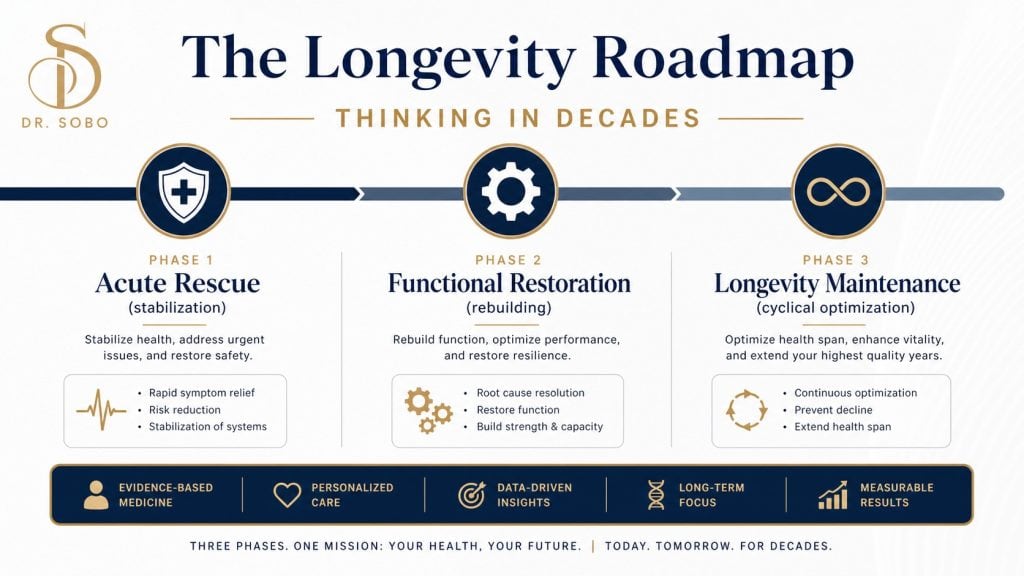
One of the most common mistakes patients make is treating peptide therapy as a one time protocol. In reality, there are three distinct phases of use.
Phase 1: Acute Rescue (Weeks 1–8)
This phase is about stopping active damage. For a patient with severe leaky gut, ongoing injury, or burnout, the goal is symptom relief and stabilization. BPC 157, TB 500, DSIP, or Selank are typical anchors. The stack is simple and focused. Patients often notice dramatic improvements quickly because they are moving from a very low baseline.
Phase 2: Functional Restoration (Months 3–6)
Once the acute crisis is managed, the focus shifts to rebuilding the underlying systems. This is where GH supporting stacks (CJC 1295/Ipamorelin), hormonal signaling peptides (Kisspeptin, Gonadorelin), and mitochondrial support (MOTS c) come into play. Results are slower but more durable. This phase often requires 3–6 months of consistent therapy.
Phase 3: Longevity Maintenance (Ongoing, Cyclical)
After functional restoration, the goal is to maintain high function and prevent age related decline. This is not about daily peptides forever. It is about cyclical use—for example, a 4 week Epitalon course twice a year, or a 12 week GH stack every 18 months. Maintenance protocols are lower dose, shorter duration, and tailored to the patient’s current weakest system.
Many Connecticut patients make the mistake of stopping completely after Phase 2. They feel great, assume they are “cured,” and then slowly drift back toward dysfunction over 12–24 months. A smarter approach is to schedule annual peptide check ins—reassess labs, symptoms, and bottlenecks, then run a short maintenance cycle if needed.
The Prioritization Matrix: Which Stack Comes First?
Patients often ask: “If I have gut issues, fatigue, and low libido, where do I start?” The answer depends on which problem is driving the others.
Rule 1: Always address sleep and stress first if they are broken.
Poor sleep and high cortisol will sabotage any other therapy. If a patient has fragmented sleep or an overactive HPA axis, start with Part 9 (DSIP, Selank). Trying to fix gut or hormones on top of untreated sleep disturbance is like building a house on a cracked foundation.
Rule 2: Resolve inflammation and barrier issues before hormonal stacks.
Chronic inflammation (leaky gut, poor diet, unresolved injury) suppresses the HPG axis. BPC 157, TB 500, and gut healing protocols (Part 8) should come before Kisspeptin or Gonadorelin. Otherwise, the hormonal peptides will have a blunted effect.
Rule 3: Fatigue can be a bottleneck or a symptom.
If fatigue is the primary complaint, check whether it is central fatigue (low mitochondrial output, Part 1) or peripheral fatigue (poor recovery, part of Part 9). MOTS c and GH stacks help central fatigue. DSIP and Selank help fatigue driven by poor sleep and stress.
Rule 4: Body composition and metabolic health often improve as other systems are fixed.
Many patients want a weight loss stack (Part 5, Part 6) but actually need better sleep or lower inflammation first. When sleep normalizes and cortisol drops, central fat often begins to reduce without any direct fat loss therapy. Prioritize the upstream drivers.
A simple decision tree:
- Sleep < 6 hours or fragmented?→ Start with Part 9.
- Chronic digestive symptoms or food sensitivities?→ Start with Part 8.
- Normal sleep and gut, but low energy?→ Check hormones (Part 10) and mitochondria (Part 1).
- Normal sleep, gut, energy, but poor body composition?→ Consider Part 5 or Part 6.
- All of the above are good, but cognitive decline?→ Part 7.
This prioritization is exactly what we do in clinical practice at Dr. Sobo’s clinic in Connecticut. No two patients start at the same place.
Putting It All Together: Sample Longevity Maps
To make this concrete, here are three hypothetical patient archetypes and how their peptide stacks might evolve over 12–18 months.
Archetype A: The Burnout Executive
- Initial presentation: Severe fatigue, brain fog, insomnia, low libido, anxiety, bloating. Has tried everything.
- Bottleneck analysis: Sleep and HPA axis are the primary drivers. Gut is secondary. Hormones are suppressed by high cortisol.
- Month 1–2: DSIP (sleep anchor) + Selank (HPA modulation). No other peptides. Focus on sleep hygiene and stress reduction.
- Month 3–4: Add BPC 157 for gut healing (bloating and food sensitivities). Reassess sleep—usually much improved.
- Month 5–8: Add CJC1295/Ipamorelin for GH support (energy, recovery, body composition). Libido often returns spontaneously.
- Month 9–12: Taper DSIP and Selank to asneeded. Consider a short cycle of Kisspeptin if libido remains flat.
- Maintenance: Annual Epitalon cycle (circadian reset) + as needed BPC 157 for gut flares.
Archetype B: The Post Injury Athlete
- Initial presentation: Chronic tendon pain, poor healing, interrupted training, lost muscle mass. Sleep is okay but recovery is incomplete.
- Bottleneck analysis: Structural repair (Part 2) is primary. GH axis is underperforming due to age and overtraining.
- Month 1–3: Wolverine stack (BPC 157 + TB 500) for tissue repair. Add CJC 1295/Ipamorelin for GH support.
- Month 4–6: Transition to body recomposition stack (Part 5) with tesamorelin if central fat is present, or continue GH support.
- Month 7–12: Shift to maintenance: cyclical BPC 157 before heavy training blocks + MOTS c for endurance.
- Long term: Annual GH stack booster (8–12 weeks). Use BPC 157 as needed for any flare ups.
Archetype C: The Aging Healthy Patient (55+, wants to stay ahead)
- Initial presentation: Mild decline in energy, muscle tone, memory, and libido. No major disease. Wants prevention.
- Bottleneck analysis: Age related decline across multiple systems, but no single crisis.
- Approach: Cyclical, low dose maintenance rather than continuous stacking.
- Cycle 1 (3 months): Epitalon (pineal/circadian) + GHK Cu (cellular repair) + low dose Semax (cognitive).
- Break 3 months: Nothing but lifestyle.
- Cycle 2 (3 months): CJC 1295/Ipamorelin (GH support) + MOTS c (mitochondrial).
- Break 3 months.
- Cycle 3 (3 months): Kisspeptin (libido) + Selank (stress resilience) + BPC 157 (gut barrier maintenance).
- Annual labs: Track IGF 1, testosterone, cortisol, inflammatory markers. Adjust next year’s cycles based on results.
These maps are examples only. Actual protocols require medical supervision and regular monitoring.
The Role of Lifestyle: Peptides Enhance, Not Replace
No peptide stack can overcome a poor diet, chronic sleep deprivation, unmanaged stress, or lack of movement. This is mentioned in every guide, but it bears repeating in the final installment.
Peptides work best when they are layered on top of a solid foundation:
- Nutrition: Sufficient protein, fiber, healthy fats, and micronutrients. For gut health, avoid processed foods and common triggers.
- Sleep: 7–9 hours with consistent timing. No amount of DSIP can fix a patient who stays up until 2 AM on screens.
- Stress management: Daily practices (breathwork, walking, therapy, social connection) that lower baseline cortisol.
- Movement: Resistance training for muscle preservation, zone 2 cardio for mitochondrial health, and mobility work for injury prevention.
When these are in place, peptides can produce remarkable results. When they are absent, peptides often feel like “nothing is working.”
Safety and Monitoring Across LongTerm Use
Longevity stacking requires periodic reassessment. Here is what we monitor at Dr. Sobo’s practice for patients on extended or cyclical protocols:
- IGF 1 levels(every 3–6 months) when using GH supporting peptides to avoid supraphysiologic elevation.
- Comprehensive metabolic panel, CBC, lipids(every 6–12 months).
- Inflammatory markers( hs CRP, ferritin, ESR) to track systemic inflammation.
- Sex hormones, LH, FSH(every 6 months) for patients using Kisspeptin or Gonadorelin.
- Cortisol rhythm(salivary or blood) for those on long term HPA modulation.
- Symptom tracking(sleep quality, energy, libido, digestion, mental clarity) via a simple log.
Never “set and forget” a peptide protocol. The body changes, and the stack must change with it.
Lorem ipsum dolor sit amet, consectetur adipiscing elit. Ut elit tellus, luctus nec ullamcorper mattis, pulvinar dapibus leo.
Why Connecticut Patients Should Think in Decades, Not Weeks
Most peptide marketing focuses on rapid transformations: “Lose 20 pounds in 8 weeks.” “Fix your gut in a month.” That approach sells products, but it does not build lasting health.
The patients who succeed long term are those who think in decades. They understand that:
- Gut healing may take 6 months, not 30 days.
- Hormonal restoration can take a year of cycling therapies.
- Cognitive optimization is a lifelong practice.
- Recovery and sleep need ongoing attention, not a one time fix.
Connecticut is home to many high functioning, busy professionals—executives, parents, athletes, and retirees who want to stay active and sharp. For them, peptide stacking is not about escaping illness. It is about building a reserve of resilience that pays dividends for years.
This series has provided the map. Now the work begins: identifying your personal bottlenecks, prioritizing wisely, and committing to a long term strategy that evolves as you do.
Final Takeaway
Peptide stacking for longevity and total health optimization is not about taking every peptide at once. It is about building a personalized, phased, and cyclical plan that addresses your weakest systems first, then maintains your strongest systems over time.
The eleven guides in this series cover every major domain: fatigue, injury, anti aging, strength, body recomposition, metabolic health, cognition, gut immune, sleep stress, and hormones. In this final guide, we have integrated them into a unified framework.
Start where you are most broken. Fix that. Then move to the next bottleneck. Use the prioritization rules. Monitor your labs and symptoms. Cycle your therapies. And always remember that lifestyle is the foundation—peptides are the accelerator.
For Connecticut patients ready to move beyond symptom suppression and into true optimization, peptide stacking offers a powerful, evidence informed path. The journey is not always quick, but it is durable. And that is the very definition of lasting health.
FAQ
What is a longevity peptide stack?
A longevity peptide stack is not a fixed combination of peptides. It is a personalized, multi phase strategy that addresses the patient’s current weakest physiological systems (sleep, gut, hormones, mitochondria, etc.) and evolves over time. Longevity stacking prioritizes healthspan, resilience, and prevention of age related decline, not just short term symptom relief. Typical cycles might include Epitalon for circadian function, GHK Cu for cellular repair, CJC 1295/Ipamorelin for GH support, and MOTS c for mitochondrial health, but the exact stack depends on individual bottlenecks.
How do I know which peptide stack to start with?
Use the prioritization rules in this guide: (1) Fix sleep and stress first (Part 9) if they are broken. (2) Address inflammation and gut barrier issues (Part 8) before hormonal stacks. (3) Distinguish between central fatigue (mitochondrial, Part 1) and peripheral fatigue (recovery, Part 9). (4) Body composition often improves after upstream drivers (sleep, stress, gut) are fixed. A thorough clinical evaluation and lab work are essential to avoid guessing.
Can I combine peptides from multiple guides at the same time?
Yes, but only if each peptide serves a distinct role and does not overlap unnecessarily. For example, a patient with poor sleep (DSIP, Part 9), gut inflammation (BPC 157, Part 8), and low recovery (CJC 1295/Ipamorelin, Part 9/10) might use all three simultaneously. However, adding three peptides that all target GH or all target inflammation is wasteful and may increase side effects. Start with one anchor, then add support layers only if a different bottleneck remains.
How long should I stay on a peptide stack?
It depends on the phase. Acute rescue stacks (e.g., BPC 157 for an injury) often run 4–8 weeks. Functional restoration stacks (e.g., CJC 1295/Ipamorelin for GH support) typically run 3–6 months. Longevity maintenance is cyclical: for example, 4 weeks of Epitalon twice a year, or 12 weeks of a GH stack every 18 months. Continuous daily use of most peptides is not recommended due to potential desensitization or safety concerns. Always follow a clinician supervised protocol.
Do I need to cycle off peptides?
Yes for most peptides. Continuous stimulation of the GH axis (e.g., daily CJC 1295 for a year) can lead to reduced sensitivity or elevated IGF 1 outside the normal range. Cycling—using a peptide for a defined period, then taking a break—preserves efficacy and safety. Exceptions exist for some repair peptides (BPC 157) that can be used as needed for flare ups. Your provider should give you a specific on/off schedule.
Can I use peptides if I am already on prescription hormones (testosterone, thyroid, etc.)?
Yes, often with benefit. For example, adding a GH supporting stack to testosterone replacement therapy (TRT) may improve body composition and recovery beyond TRT alone. However, the peptide protocol may need dose adjustments. Never start or stop peptides without informing the provider who manages your hormone replacement. Some peptides, like Gonadorelin, are used specifically to restart natural production after discontinuing exogenous testosterone.
Are there any longterm risks of peptide stacking?
When used under medical supervision with appropriate monitoring, the risks of most common peptides (BPC 157, TB 500, GH secretagogues, Epitalon, Selank, etc.) are low. Potential risks include injection site reactions, fatigue, headache, and for GH secretagogues, elevated IGF 1 (monitor). Long term continuous use (years) without cycling is not recommended. The most significant risk is not medical but strategic: using the wrong stack for your actual bottleneck, which wastes time and money. This is why personalized assessment is critical.
How do I find a qualified peptide practitioner in Connecticut?
Look for a functional medicine physician, naturopathic doctor, or anti aging specialist with specific training in peptide therapy. They should perform a comprehensive intake, order relevant labs, explain the rationale for each peptide, provide a clear cycling plan, and schedule follow up monitoring. Avoid clinics that sell pre made “stacks” without an individual evaluation. Dr. Sobo’s practice in Connecticut offers this level of personalized care.
What labs should I get before starting a longevity peptide program?
Minimum: CBC, CMP, lipid panel, hs CRP, ferritin, fasting insulin or glucose, HbA1c, vitamin D, TSH/free T3/free T4. For hormonal concerns: total and free testosterone, estradiol (sensitive), LH, FSH, SHBG, DHEA S, cortisol (AM and possibly evening). For gut issues: zonulin, calprotectin, and comprehensive stool analysis. For cognitive concerns: consider a neuroinflammatory panel. Your practitioner will tailor the lab order based on your symptoms.
Can I do peptide therapy if I have an autoimmune disease?
Yes, but with caution. Peptides like Thymosin Alpha 1 (immune modulator) and BPC 157 (anti inflammatory) are often used for autoimmune conditions. However, some peptides that strongly stimulate the immune system could theoretically trigger flares. A thorough evaluation and slow, low dose introduction under close supervision is essential. Never self prescribe peptides with an autoimmune diagnosis.
Why is Part 11 different from the others?
Parts 1–10 each focus on a single domain (fatigue, injury, metabolism, etc.). Part 11 integrates all of them into a unified longevity framework. It provides the rules for prioritizing which domain to treat first, how to cycle therapies over months and years, and how to shift from acute repair to maintenance. This final guide is the “operating manual” that tells you how to use all the other guides together.
Do I really need all eleven guides to start peptide therapy?
No. Most patients only need one or two of the earlier guides based on their primary complaint. Part 11 is for those who want to think long term—whether you are just starting or have been using peptides for a while and want to optimize your approach. Read the guide that matches your biggest bottleneck first. Then use Part 11 to plan your next steps.
Sources And Related Reading
Dr. Sobo Peptide Stacking Series
- Peptide Stacking for Fatigue in Connecticut | Dr. Sobo Guide #1
- Injury Healing Peptide Stacking in Connecticut | Dr. Sobo Guide #2
- Anti-Aging Peptide Stack Guide Part 3 of 11
- Strength and Muscle Peptide Stacking Guide Part 4 of 11 | Dr. Sobo
- Body Recomposition Peptide Stack Guide Part 5 of 11 | Dr. Sobo Connecticut
- Peptide Stacking for Metabolic Health in CT | Dr. Sobo Guide Part 6 of 11
- Peptide Stacking for Cognitive Performance & Brain Health | Dr. Sobo Guide Part 7 of 11
- Peptide Stacking for Gut Health & Immune Support | Dr. Sobo Guide Part 8 of 11
- Peptide Stacking for Sleep, Recovery & Stress | Dr. Sobo Guide Part 9 of 11
- Peptide Stacking for Hormonal Health and Vitality | Dr. Sobo Guide Part 10 of 11
Related Dr. Sobo Peptide Therapy Pages
- Peptide Stacking Therapy | Regenerative Medicine in Connecticut
- Peptides | Dr. Sobo | Connecticut
- CJC-1295 / Ipamorelin Stack in Stamford, CT
- Ipamorelin Peptide Therapy for Recovery, Fat Loss and Healthy Aging
- Epitalon Peptide Therapy in Connecticut | Dr. Sobo
- BPC-157 Peptide Therapy | Regenerative Medicine | Dr. Sobo
- Wolverine Peptide Stack | BPC-157 + TB-500 | Dr. Sobo
- KPV Peptide Therapy for Gut Health | Dr. Sobo
- PT-141 Peptide Therapy in Stamford, CT | Dr. Sobo
Medical and Scientific References
- Growth Hormone Secretagogues as Potential Therapeutic Agents to Restore Growth Hormone Secretion in Older Subjects to Those Observed in Young Adults
- Growth Hormone Secretagogues: Prospects and Potential Pitfalls
- Use of Growth Hormone and Growth Hormone Secretagogues in Aging: Help or Harm
- The GH-IGF-1 Axis in Circadian Rhythm
- Pineal Peptides Restore the Age-Related Disturbances in Hormonal Functions of the Pineal Gland and the Pancreas
- Morphofunctional and Signaling Molecules Overlap of the Pineal Gland and Thymus: Role and Significance in Aging
- The GH/IGF-1 Axis in Ageing and Longevity
