
By Dr. Henry Sobo, MD – Peptide Stacking Connecticut
#1 Overcoming Fatigue Stacking Guide
Peptide stacking for fatigue is one of the most common reasons people begin exploring peptide therapy, but it is also one of the most misunderstood. Many people assume low energy is one problem with one solution. In reality, fatigue usually has a pattern.
Some people feel exhausted because they are not getting restorative sleep. Others feel drained because metabolic dysfunction, excess body weight, inflammation, poor recovery, or age-related mitochondrial decline is limiting how efficiently the body produces and uses energy. Some patients do not describe themselves as tired at all. They say they feel weak, flat, unmotivated, or unable to recover physically the way they used to.
That distinction matters.
A smart peptide stack for fatigue is not built by choosing whichever peptide sounds strongest in isolation. It is built by matching the stack to the likely driver of the fatigue. That is why peptide stacking therapy can be so useful when it is personalized properly. The goal is to use the right combination for the right patient, for the right reason.
For Connecticut patients researching fatigue, this is the most important point to understand:
The best peptide stack is not the one with the most ingredients. It is the one that best matches why you are fatigued.
What fatigue really means in peptide planning
Before discussing stacks, it helps to define the problem correctly. “Fatigue” is often used as a blanket term, but clinically it can refer to several different experiences:
- feeling sleepy or non-restored after sleep
- feeling mentally drained or foggy
- feeling physically depleted with poor endurance
- feeling weak rather than merely tired
- feeling slowed down by excess body weight or metabolic dysfunction
- feeling older than your age in terms of recovery and stamina
That is why a good fatigue-stacking strategy starts with a simple question:
What kind of fatigue are you trying to solve?
If the answer is poor sleep, a sleep-focused approach may matter most. If the answer is low metabolic energy, mitochondrial support may be more relevant. If the answer is excess body weight with low stamina, body-composition treatment may be the key lever. If the answer is poor recovery and age-related decline, a different stack may be more appropriate.
The main fatigue patterns that influence stack selection
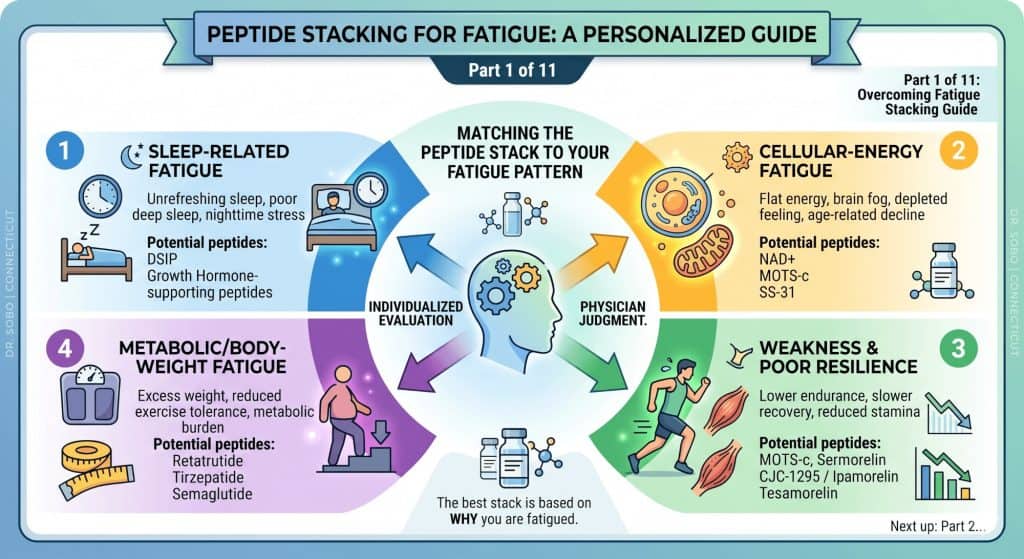
Sleep-related fatigue
If someone does not sleep well, treating “energy” without addressing sleep is often incomplete. If fatigue is associated with poor sleep, a sleep-focused approach may make more sense than jumping straight to a general energy-support strategy.
This is where DSIP and certain growth-hormone-supporting peptides may become part of the discussion. Sleep quality matters because deep sleep is one of the body’s most restorative states, and growth hormone release is closely tied to slow-wave sleep.
When fatigue is strongly linked to non-restorative sleep, difficulty achieving deep sleep, or stress-disrupted nights, the stack often needs a sleep-restoration angle first. In that setting, DSIP and growth-hormone-supporting peptides may be more relevant than simply choosing a broad “energy” peptide.
Signs the fatigue may be sleep-driven
- waking up unrefreshed even after enough time in bed
- feeling tired but not physically restored
- noticing worse energy after poor sleep
- stress-related sleep disruption
- poor sleep quality followed by low daytime resilience
Mitochondrial or cellular-energy fatigue
Some fatigue is less about falling asleep and more about how well the body produces and manages energy. This is where NAD+, MOTS-c, and SS-31 become especially relevant in the fatigue conversation.
NAD+ is often viewed as foundational support for mitochondrial energy metabolism and cellular resilience. MOTS-c is frequently discussed in relation to metabolic adaptation, exercise signaling, and age-related mitochondrial decline. SS-31 is often included in conversations about mitochondrial efficiency, endurance, and aging muscle.
When patients say they are not especially sleepy but feel depleted, flat, mentally dull, or physically underpowered, a mitochondrial-support framework may be more useful than a sleep-only approach.
Signs this pattern may fit
- low energy without obvious sleepiness
- brain fog or reduced mental sharpness
- the feeling of being underpowered rather than just tired
- low stamina with age
- reduced daily resilience or capacity
Weakness, poor endurance, and slow recovery
Weakness is not the same thing as tiredness.
Some patients are not describing sleepiness at all. They are describing poor physical resilience, reduced endurance, slower recovery, lower exercise tolerance, or the feeling that they simply do not bounce back the way they used to. That is where MOTS-c and growth-hormone-supporting peptides such as Sermorelin, CJC-1295 / Ipamorelin, or Tesamorelin may make more sense in the stack discussion.
A person who feels weak may need a different treatment emphasis than a person whose main problem is non-restorative sleep or metabolic burden.
Signs this pattern may fit
- lower exercise tolerance
- slower recovery after activity
- reduced physical stamina
- loss of resilience with age
- feeling weak rather than sleepy
Metabolic and body-composition fatigue
Excess body weight can drain energy in ways many people underestimate. It increases the energy cost of movement, often worsens inflammation, can interfere with sleep quality, and may reduce exercise tolerance. In some patients, body-composition burden is one of the main reasons fatigue persists.
That is why Retatrutide, Tirzepatide, and Semaglutide may belong in the fatigue conversation when metabolic burden is clearly part of the problem.
This is not about cosmetic weight loss. It is about reducing one of the physiologic reasons the patient feels chronically tired.
Signs this pattern may fit
- lower stamina with excess body weight
- more fatigue during basic movement or exercise
- metabolic dysfunction linked to low energy
- poor endurance that improves when body composition improves
feeling physically slowed by body-fat burden
How the main peptides fit into an overcoming-fatigue stack
NAD+: foundational support for cellular energy
NAD+ is one of the most versatile therapies in the fatigue conversation because it sits close to the center of energy metabolism. It is often viewed as a foundational option when a patient’s complaint is broad, whole-body depletion rather than one narrow symptom.
It may be especially relevant for people dealing with:
- generalized low energy
- mental fatigue
- reduced clarity or concentration
- age-related decline in stamina
- the need for broad mitochondrial support
One of the reasons NAD+ is often discussed in stacking is that it can pair conceptually with multiple fatigue frameworks rather than only one.
MOTS-c: the metabolic resilience and “exercise mimic” peptide
MOTS-c is especially interesting because it sits at the intersection of mitochondria, exercise signaling, metabolism, and healthy aging. It is often discussed when the complaint sounds more like weakness, poor resilience, lower endurance, or age-related decline in physical energy.
It may fit best for patients dealing with:
- lower exercise tolerance
- weakness rather than simple tiredness
- reduced physical stamina
- metabolic dysfunction
- age-related decline in muscle energy
NAD+ and MOTS-c are often discussed together because both fit within the broader mitochondrial and metabolic-health conversation. NAD+ is commonly framed as foundational support for cellular energy pathways, while MOTS-c is more often discussed in relation to metabolic adaptation, exercise signaling, and resilience.
DSIP: when restorative sleep may be the real energy solution
DSIP belongs in this guide because many fatigue cases are partly sleep cases in disguise. If someone is not getting restorative sleep, trying to improve daytime energy without improving nighttime recovery may only go so far.
It may fit best when fatigue presents with:
- poor sleep quality
- unrefreshing sleep
- stress-related sleep problems
- recovery that feels worse after disrupted sleep
- a sense that you are never fully rested

HAVE QUESTIONS ABOUT Peptide stacking for fatigue?
If you are researching peptides, and reside in Connecticut, Greenwich, or Norwalk area, contact us today for a Personalized Consultation. We focus on combining safe, effective medication with a realistic lifestyle plan.
For broader options, see our Conditions Treated page.
Growth hormone support peptides: recovery, restoration, and sleep-linked resilience
This category includes Sermorelin, CJC-1295 / Ipamorelin, and Tesamorelin.
These are especially relevant in fatigue conversations where the issue is not just low energy, but poor recovery, reduced restorative sleep, lower physical resilience, and body-composition changes. Patients who say they feel run down, less recovered, or less physically robust than before may fit this framework better than a simple “energy booster” approach.
They may fit best for people dealing with:
- poor recovery
- reduced restorative sleep
- lower resilience after exercise or stress
- age-related decline in recovery
- body-composition concerns linked to fatigue
SS-31: targeted mitochondrial support
SS-31 is often discussed in relation to mitochondrial support, muscle energy, fatigue resistance, and age-related decline in physical function.
This makes it especially relevant when the fatigue picture includes:
- aging-related low endurance
- poor fatigue resistance
- muscle-energy decline
- slow physical recovery
- a sense that the body is less efficient than it used to be
Weight-focused peptides: Retatrutide, Tirzepatide, and Semaglutide
These therapies belong in the discussion when fatigue is being worsened by metabolic burden and excess body weight.
They may fit best when:
- excess body weight clearly reduces stamina
- mobility is more difficult than it should be
- exercise tolerance is lower
- body-composition burden is interfering with energy and recovery
- metabolic dysfunction appears to be part of the fatigue picture
For readers also interested in the body-composition side of the discussion, see Does Retatrutide Preserve Muscle?.
Comparison Table: Matching Fatigue Type to Stack Emphasis
Fatigue Pattern | Common Clues | Typical Stack Emphasis |
Sleep-related fatigue | Unrefreshing sleep, poor deep sleep, nighttime stress, feeling tired but wired | DSIP, GH-supporting peptides |
Cellular-energy fatigue | Flat energy, brain fog, depleted feeling, age-related decline | |
Weakness and poor resilience | Lower endurance, slower recovery, reduced stamina | |
Metabolic/body-weight fatigue | Excess weight, reduced exercise tolerance, low mobility, metabolic burden |
Comparison Table: NAD+ vs MOTS-c vs SS-31 for Fatigue Conversations
Therapy | Best Conceptual Fit | When It May Be Most Relevant |
Broad cellular-energy support | General low energy, mental fatigue, age-related depletion | |
Metabolic resilience and endurance support | Weakness, lower stamina, exercise intolerance, age-related metabolic decline | |
Mitochondrial targeting and fatigue resistance | Aging muscle, reduced endurance, slow physical recovery |
Comparison Table: DSIP vs GH-Supporting Peptides for Recovery-Focused Fatigue
Option | Primary Discussion Angle | Best Fit |
Sleep quality and restorative sleep support | Patients whose fatigue starts with poor sleep | |
Recovery, resilience, sleep-linked GH support | Patients whose fatigue includes poor recovery, lower physical resilience, or age-related decline |
Why physician judgment matters in fatigue stacking
The most important message in this entire guide is that peptide stacking for fatigue should be individualized.
Fatigue is not a diagnosis. It is a symptom. That means good treatment planning should account for:
- sleep quality
- body composition
- exercise tolerance
- recovery capacity
- weakness versus tiredness
- age-related decline
- metabolic health
- the difference between mental fatigue and physical depletion
This is where Dr. Sobo’s approach matters. The goal is not to pick the trendiest stack. The goal is to identify the dominant driver of fatigue and build the treatment plan around that pattern.
Why Connecticut patients need a personalized peptide stacking evaluation
Connecticut patients researching peptides for fatigue are often overwhelmed by online advice that makes every stack sound universal. It is not.
The best fatigue stack for a patient who sleeps poorly may be completely different from the best stack for someone whose low energy is tied to metabolic dysfunction, weight burden, slower recovery, or age-related mitochondrial decline.
That is why the consultation matters more than the hype.
A personalized evaluation helps determine whether the conversation should center more on:
- DSIP and sleep restoration
- NAD+ and broad cellular energy
- MOTS-c and endurance or metabolic resilience
- SS-31 and targeted mitochondrial support
- GH-supporting peptides such as Sermorelin, CJC-1295 / Ipamorelin, or Tesamorelin
- weight-focused therapies such as Retatrutide, Tirzepatide, or Semaglutide
Who may be a good candidate for a fatigue-focused peptide stack?
A fatigue-oriented stack may be worth discussing if you:
- feel consistently low in energy despite trying to improve sleep and routine
- feel weak, flat, or under-recovered
- notice age-related decline in stamina or resilience
- feel that excess body weight is making energy worse
- want a more personalized plan than generic online peptide advice
When a broader medical evaluation still matters
Fatigue is common, but it is not always simple. Low energy can also overlap with thyroid issues, anemia, untreated sleep apnea, medication side effects, mood-related symptoms, cardiometabolic issues, and other medical conditions.
That is one more reason physician-guided care matters. Peptide stacking should be part of a thoughtful, individualized strategy, not a substitute for appropriate medical assessment.
Final Takeaway
The best peptide stack for fatigue is not based on what is trending online. It is based on why you are fatigued.
If poor sleep is the problem, the stack should reflect that. If the main issue is low cellular energy or mitochondrial decline, the stack should reflect that. If weakness, slow recovery, or poor endurance is the real complaint, the stack should reflect that too. And if body-composition burden is draining your energy, a metabolic approach may need to be part of the plan.
That is what makes peptide stacking therapy so useful when it is personalized properly.
If you are exploring fatigue-related peptide options in Connecticut, Dr. Sobo’s approach is built around clinical judgment, symptom-pattern matching, and selecting the right stack for the right reason.
Frequently Asked Questions (FAQs)
What is the best peptide stack for fatigue?
There is no one best stack for everyone because fatigue can come from different causes. Some people need a sleep-focused approach, while others may need support centered on cellular energy, recovery, metabolic health, or body composition. The best plan depends on why the fatigue is happening.
Which peptides are commonly discussed for fatigue?
Common fatigue-related discussions may include NAD+, MOTS-c, DSIP, SS-31, GH-supporting peptides such as Sermorelin, CJC-1295 / Ipamorelin, and Tesamorelin, and in some cases weight-focused therapies like Retatrutide, Tirzepatide, or Semaglutide.
Is fatigue always related to sleep?
No. Sleep is one common driver, but fatigue can also be related to metabolic dysfunction, poor recovery, mitochondrial inefficiency, body-composition burden, or age-related decline in resilience and stamina.
Can NAD+ and MOTS-c be used in the same fatigue conversation?
When does DSIP make the most sense for fatigue?
DSIP makes the most sense in the conversation when fatigue appears strongly tied to poor restorative sleep, feeling unrefreshed after sleep, or stress-related nighttime disruption.
What is the difference between tiredness and weakness?
Tiredness often refers to low energy or sleepiness. Weakness usually points more toward lower physical resilience, reduced muscle energy, slower recovery, or worse endurance. That difference can affect which peptide categories are more relevant.
Why would weight-loss peptides be discussed in a fatigue blog?
Because excess body weight can worsen low energy by reducing exercise tolerance, increasing strain on the body, affecting mobility, and contributing to metabolic dysfunction. In some patients, improving body composition can meaningfully improve energy.
Why is personalized peptide stacking better than copying a stack online?
Because two people with “fatigue” can have completely different biologic drivers. One may need better sleep support. Another may need mitochondrial support. Another may need help with recovery or body-composition burden. A personalized approach is more likely to match the treatment to the real problem.
More Helpful Articles
REDEFINE 4 Results: CagriSema vs. Tirzepatide, Weight Loss, and FDA Status
Phase 3 head-to-head results and an anticipated late-2026 FDA decision create strong news and comparison intent. This article was evidence-checked on September 6, 2026. Regulatory status, labels, and trial publications

GLP-1 Medications and Vision Changes: NAION, Retinopathy, and Warning Signs
Regulatory safety updates and new observational research are driving urgent patient questions about vision loss. This article was evidence-checked on September 6, 2026. Regulatory status, labels, and trial publications can
GLP-1 Microdosing: Evidence, Risks, and What “Low Dose” Really Means
Evidence review date: September 6, 2026. GLP-1 microdosing has attracted substantial consumer and telehealth interest, but direct clinical-trial evidence remains limited. Medication approvals, prescribing information, safety communications, and clinical evidence
Sources
- Peptide Stacking Therapy in Connecticut
- How Peptide Stacking Therapy Is Personalized: A Connecticut Patient’s Guide
- NAD+ Peptide Therapy
- MOTS-c Peptide Therapy
- DSIP Peptide Therapy
- Sermorelin Peptide Therapy
- CJC-1295 / Ipamorelin
- Tesamorelin Peptide Therapy
- SS-31 Peptide Therapy Connecticut
- Retatrutide in Connecticut
- Tirzepatide Peptide Therapy
- Semaglutide Peptide Therapy
- Does Retatrutide Preserve Muscle?
