
By Dr. Henry Sobo, MD – Peptide Stacking Connecticut
#3 Anti-Aging Peptide Stack Guide
Aging does not affect every patient in the same way, so anti-aging treatment should never be approached as if it solves one single problem.
For some people, aging shows up as reduced strength, slower recovery, less stamina, and changes in body composition. For others, it appears as poorer sleep, less restorative nights, more stress sensitivity, and reduced resilience. Some patients are primarily concerned about visible aging, such as thinner skin, lower elasticity, slower healing, and changes in hair and nails. Others are more focused on fatigue, brain fog, lower daily drive, and the sense that their body is no longer producing or using energy as efficiently as it once did.
That is why peptide stacking therapy can be such a useful framework when it is personalized correctly.
A personalized anti-aging peptide stack is not about taking every peptide associated with longevity at once. It is about identifying the main pattern of age-related decline and choosing therapies that fit that pattern. A patient struggling with poor sleep may need a very different plan than someone focused on skin quality. A patient dealing with declining vitality and strength may need a different core strategy than someone whose main complaint is fatigue and brain fog. A patient whose aging concerns are being amplified by excess body weight may need body-composition support built into the plan as well.
For Connecticut patients exploring peptide-based anti-aging care, this is the key idea:
The best anti-aging stack is not the one with the longest ingredient list. It is the one that best matches how aging is affecting your function, energy, recovery, appearance, and resilience.
What Is an Anti-Aging Peptide Stack?
An anti-aging peptide stack is a personalized combination of peptide therapies or peptide-adjacent therapies selected to address one or more aging-related concerns instead of using a generic longevity approach.
Depending on the patient, the stack may be built around:
- energy and mitochondrial support
- strength, recovery, and body composition
- sleep quality and circadian rhythm
- skin, hair, and nail quality
- collagen support and tissue remodeling
- metabolic health and weight reduction
- broader longevity-oriented goals
This matters because anti-aging is not only about appearance. It is also about how well the body recovers, how efficiently it produces energy, how deeply the patient sleeps, how well muscle and connective tissue are maintained, and how much metabolic burden is accelerating visible or functional decline.
Why There Is No Single Best Anti-Aging Peptide Stack
There is no universal best anti-aging peptide stack because there is no universal aging pattern.
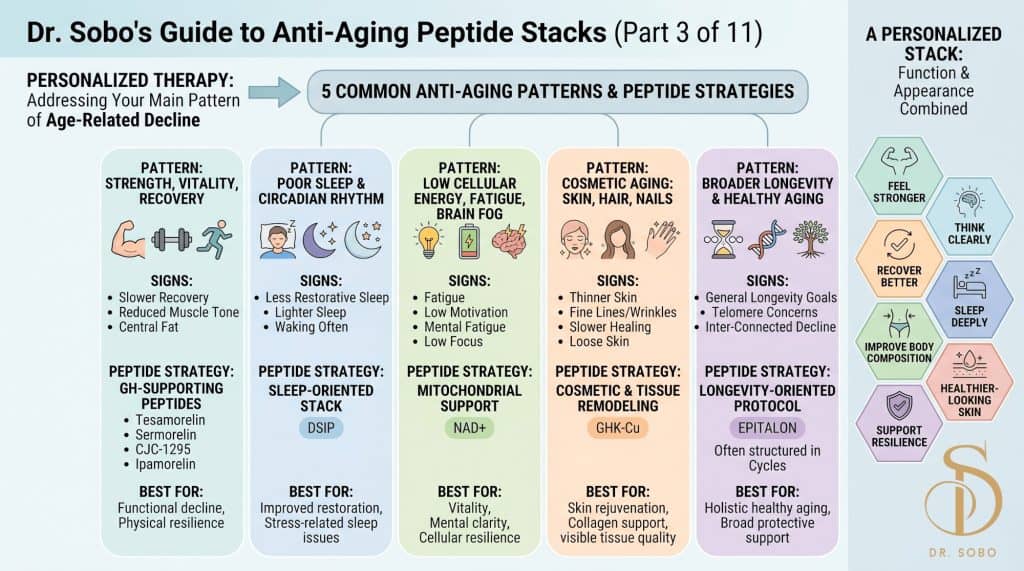
Someone with declining vitality and slower recovery may be better matched to GH-supporting peptides. Someone with poor sleep and disrupted circadian rhythm may need DSIP as part of the conversation. Someone with low energy, lower resilience, and brain fog may be better matched to NAD+. Someone focused on skin quality, collagen support, and visible rejuvenation may want GHK-Cu included. Someone interested in broader longevity concepts may ask about Epitalon, which is often discussed as a cyclical protocol rather than a continuous daily therapy. Research on Epitalon is promising, but still limited in large modern human trials. (pmc.ncbi.nlm.nih.gov)
Why Anti-Aging Should Never Be Treated Like One Generic Goal
The phrase “anti-aging” is useful for search intent, but it covers many different real-world concerns.
One person’s anti-aging concern is:
- less muscle tone
- slower recovery
- more central fat gain
- lower endurance
- feeling physically older
Another person’s concern is:
- worse sleep
- later-life insomnia
- more stress sensitivity
- lower restoration
- feeling tired but not refreshed
Another patient is focused primarily on:
- fine lines and wrinkles
- thinner skin
- slower wound healing
- visible changes in hair and nails
- a more cosmetic aging pattern
Another is more concerned with:
- fatigue
- brain fog
- lower mental stamina
- less motivation
- reduced vitality
That is why a strong anti-aging plan begins with a better question:
What part of aging are you trying to improve first?
That answer helps determine whether the conversation should focus more on GH-supporting peptides, sleep support, mitochondrial support, tissue-quality peptides, metabolic support, or a broader longevity-oriented protocol.
The Main Anti-Aging Patterns That Shape Peptide Stack Selection
Loss of Strength, Vitality, and Recovery
One of the most common age-related complaints is not cosmetic at all. It is the feeling that strength, resilience, exercise tolerance, and recovery capacity have gradually declined.
This is where GH-supporting peptides often become part of the conversation.
That category may include:
These therapies are relevant in anti-aging discussions because GH-related physiology is associated with recovery, body composition, connective tissue, and physical resilience. Human studies have shown that increased GH availability can stimulate collagen synthesis in tendon and skeletal muscle connective tissue, which helps explain why GH-supporting therapies are often discussed for recovery, tissue quality, and aging-related vitality. (pmc.ncbi.nlm.nih.gov)
Tesamorelin is especially relevant when body composition is part of the concern, since it is commonly discussed around visceral fat and metabolic health. More broadly, GH-supporting therapies are often part of stacks designed to support strength, recovery, and feeling physically more capable with age.
When GH-supporting peptides may make the most sense
GH-supporting peptides may be especially relevant when aging is showing up as reduced vitality, slower recovery, lower strength, changes in body composition, and reduced physical resilience. They are often used less as “youth molecules” and more as supportive tools for maintaining recovery, function, and tissue quality as patients age. (pmc.ncbi.nlm.nih.gov)
Signs this may be the right category
- slower recovery after training
- reduced muscle tone
- feeling less physically robust
- more central or visceral fat
- concern about connective-tissue aging
- wanting an anti-aging strategy that feels more functional than cosmetic
Poor Sleep, Weaker Circadian Rhythm, and Lower Restoration
For many patients, aging becomes obvious first in sleep quality.
They do not sleep as deeply. They wake more easily. Their nights feel lighter and less restorative. Their circadian rhythm feels less stable. Over time, that affects energy, recovery, mood, and cognitive performance.
This is where DSIP becomes part of the anti-aging discussion.
DSIP has long been studied as a sleep-related peptide. Early reviews described it as a nonapeptide linked to delta sleep and broader neuroendocrine effects, though the evidence base is older and mixed by modern standards. That means it should be discussed carefully. It still fits into an anti-aging framework when poor sleep and poor restoration are major parts of the decline pattern. (pubmed.ncbi.nlm.nih.gov)
Sleep matters in anti-aging because it influences hormone regulation, nervous-system recovery, memory consolidation, stress resilience, and next-day energy. If a patient’s aging pattern includes poor sleep, an anti-aging plan that ignores sleep may miss one of the biggest drivers of decline.
Why sleep matters in an anti-aging stack
Sleep is one of the body’s main recovery systems. Poor sleep affects stress regulation, hormone balance, recovery quality, cognitive performance, and daily resilience. If aging is showing up partly as worse sleep, then a useful anti-aging stack may need to address sleep quality and circadian rhythm instead of focusing only on visible aging or low energy. (pubmed.ncbi.nlm.nih.gov)
Signs this may be the right category
- less restorative sleep
- waking up more often
- later-life insomnia patterns
- feeling unrefreshed in the morning
- more stress-related sleep disruption
- wanting anti-aging support that improves how you feel, not just how you look
Low Cellular Energy, Fatigue, and Brain Fog
Many people do not describe aging as “I look older.” They describe it as “I feel older.”
This may show up as:
- lower energy
- less stamina
- mental fatigue
- lower focus
- less daily drive
- slower recovery from stress
- the sense that the body’s energy systems are no longer working efficiently
This is where NAD+ becomes especially important.
NAD+ is central to energy metabolism, mitochondrial function, redox biology, and DNA-repair-related cellular processes. Reviews consistently describe declining NAD+ biology as relevant to aging, mitochondrial dysfunction, and chronic metabolic decline. That makes NAD+ one of the strongest choices when anti-aging is being experienced as fatigue, lower vitality, or reduced cellular resilience. (pmc.ncbi.nlm.nih.gov)
Because the brain is highly energy-dependent, NAD+ is also often discussed in conversations about mental clarity, brain fog, and cognitive stamina. That does not make it a guaranteed cognitive treatment, but it helps explain why it is such a common part of vitality-focused anti-aging discussions. (pmc.ncbi.nlm.nih.gov)
Why NAD+ is part of many anti-aging stacks
NAD+ is part of many anti-aging discussions because it supports mitochondrial function, energy metabolism, redox balance, and cellular resilience. Since NAD+ levels are associated with aging-related decline in mitochondrial health and metabolic function, supporting NAD+-related biology is often discussed as a way to address fatigue, mental clarity, and day-to-day vitality. (pmc.ncbi.nlm.nih.gov)
Signs this may be the right category
- low energy with age
- brain fog
- mental fatigue
- low stamina
- reduced metabolic resilience
- wanting an anti-aging plan focused more on function than appearance
Cosmetic Aging: Skin, Hair, Nails, and Tissue Quality
Not every anti-aging goal is systemic. Many patients want visible improvement in tissue quality.
That may include:
- thinner skin
- reduced elasticity
- slower wound healing
- rougher skin texture
- concern about scar quality
- changes in hair or nails
This is where GHK-Cu becomes one of the most relevant peptides in the anti-aging category.
GHK-Cu is a naturally occurring copper-binding tripeptide that declines with age and has been studied for wound healing, fibroblast activity, collagen and elastin support, skin regeneration, and tissue remodeling. Reviews describe regenerative and protective actions in skin, along with gene-expression effects relevant to tissue repair and remodeling. (pmc.ncbi.nlm.nih.gov)
This makes GHK-Cu especially useful when the anti-aging goal is more cosmetic or tissue-quality-focused rather than centered on energy, sleep, or body composition.
Why GHK-Cu is widely used for aesthetic anti-aging goals
GHK-Cu is often used in anti-aging discussions for skin rejuvenation, collagen support, fibroblast stimulation, tissue remodeling, and visible improvements in skin quality. It is especially relevant when the patient’s goals are more cosmetic, such as improving skin firmness, elasticity, healing quality, or overall tissue appearance. (pmc.ncbi.nlm.nih.gov)
Signs this may be the right category
- loose or thinner skin
- fine lines and wrinkles
- slower skin healing
- more visible cosmetic aging
- interest in skin, hair, and nail support
- desire for stronger collagen support
Broader Longevity Support and Telomere-Oriented Protocols
This is where Epitalon stands apart from the rest.
Epitalon is a synthetic tetrapeptide derived from work on pineal peptides and has been studied in relation to telomerase, telomere biology, circadian regulation, oxidative stress, and broader longevity-related mechanisms. A recent review describes it as highly bioactive and promising, while also making clear that evidence is still developing and not anchored in large modern mainstream clinical trials. (pmc.ncbi.nlm.nih.gov)
A classic cell study found that Epitalon induced telomerase activity and telomere elongation in human cells, which is one reason it remains widely discussed in longevity circles. That finding is important, but it should be interpreted conservatively. Cell-level and early translational findings are not the same thing as definitive long-term clinical outcomes in humans. (pubmed.ncbi.nlm.nih.gov)
What makes Epitalon different from the other peptides in this guide is that it is usually discussed as a broader longevity-oriented intervention rather than one aimed only at skin, recovery, or energy. It is also often discussed as a cyclical therapy rather than an ongoing daily treatment.
Why Epitalon is considered a longevity-focused peptide
Epitalon is considered an anti-aging peptide because it has been studied for effects on telomerase activity, telomere maintenance, circadian rhythm, oxidative-stress biology, and longevity-related mechanisms. Its biggest appeal in longevity medicine comes from telomere-related research, but the clinical evidence remains promising rather than definitive. (pmc.ncbi.nlm.nih.gov)
Why Epitalon is different
Most anti-aging peptides are discussed around one practical result:
- better skin
- more energy
- better sleep
- better recovery
- improved body composition
Epitalon is different because it is discussed as a broader healthy-aging and longevity protocol. That is why it may stack well conceptually with more functional or cosmetic therapies, while still usually being treated as a timed cycle rather than a year-round daily peptide.
How the Main Anti-Aging Peptides Fit Into a Stack
Best discussed for:
- broader longevity goals
- telomere-oriented anti-aging conversations
- circadian-rhythm support discussions
- antioxidant and resilience themes
- structured anti-aging cycles
Best discussed for:
- skin rejuvenation
- collagen and elastin support
- wound-healing quality
- hair and nail appearance
- cosmetic anti-aging goals
GH-Supporting Peptides: Tesamorelin, Sermorelin, CJC-1295, Ipamorelin
Best discussed for:
- declining vitality
- slower recovery
- changes in body composition
- lower resilience
- connective-tissue support
Best discussed for:
- fatigue
- low vitality
- mitochondrial support
- brain fog
- reduced cellular resilience
Best discussed for:
- poor restorative sleep
- circadian-rhythm decline
- stress-related sleep problems
- recovery-oriented anti-aging plans
Weight-Focused Therapies: Semaglutide and Tirzepatide
Weight-focused therapies belong in some anti-aging discussions because body composition affects mobility, metabolic health, energy, inflammation, and the overall experience of aging. When excess body weight is worsening fatigue, limiting movement, and accelerating metabolic decline, a weight-focused therapy may fit well alongside energy-, skin-, or recovery-focused peptides.

HAVE QUESTIONS ABOUT Anti-Aging Peptide Stack?
If you are researching peptides, and reside in Connecticut, Greenwich, or Norwalk area, contact us today for a Personalized Consultation. We focus on combining safe, effective medication with a realistic lifestyle plan.
For broader options, see our Conditions Treated page.
Why weight-loss therapies may belong in an anti-aging stack
Weight-focused therapies may belong in an anti-aging stack when excess body weight is contributing to fatigue, lower mobility, inflammation, metabolic dysfunction, or the broader feeling of accelerated aging. Improving body composition can complement therapies aimed at energy, skin, sleep, and recovery.
Comparison Table: Best Anti-Aging Peptide Category by Goal
Primary Goal | Most Relevant Category | Common Options |
Longevity-oriented support | Telomere and circadian protocol | |
Skin, hair, nails, and tissue quality | Cosmetic and tissue remodeling | |
Strength, vitality, and recovery | GH-supporting anti-aging stack | |
Energy and mental clarity | Mitochondrial and cellular-energy support | |
Sleep and circadian function | Sleep-oriented stack | |
Metabolic aging and body-composition burden | Weight-focused support |
Comparison Table: Epitalon vs NAD+ vs GHK-Cu
Therapy | Main Anti-Aging Angle | Best Fit |
Longevity, telomere, circadian discussion | Broader anti-aging and protocol-based longevity interest | |
Cellular energy and mitochondrial support | Fatigue, vitality, mental clarity, resilience | |
Skin and tissue rejuvenation | Cosmetic aging, collagen, skin quality |
Comparison Table: DSIP vs GH-Supporting Peptides
Therapy Type | Main Aging Pattern | Best Use Case |
Sleep and circadian decline | Poor restorative sleep, stress-related sleep issues | |
GH-supporting peptides | Loss of strength, vitality, recovery, body composition | Patients who feel physically older, weaker, or slower to recover |
Why Judgment Matters in Anti-Aging Stacking
One of the biggest mistakes in anti-aging peptide conversations is assuming every promising peptide should be stacked together.
That is not the goal.
The goal is to identify which aging pattern matters most right now.
For example:
- If the main complaint is poor sleep, a sleep-oriented stack may matter more than a cosmetic one.
- If the main complaint is fatigue and low vitality, NAD+ may be more relevant than a skin peptide.
- If the main complaint is visible aging, GHK-Cu may deserve more attention.
- If the main complaint is loss of strength and vitality, GH-supporting peptides may be the better core strategy.
- If the patient wants a broader anti-aging protocol, Epitalon may be layered in thoughtfully as part of a structured cycle.
That is why personalized evaluation matters more than copying a longevity stack from the internet.
Why Connecticut Patients Should Think About Anti-Aging in Terms of Function and Appearance Together
For Connecticut patients searching anti-aging peptides, best peptide stack for longevity, Epitalon in Connecticut, NAD+ for aging, or GHK-Cu for skin rejuvenation, the most useful anti-aging strategy is often the one that combines function goals with appearance goals.
Patients rarely want only one thing. They often want to:
- feel stronger
- recover better
- sleep more deeply
- think more clearly
- improve body composition
- maintain healthier-looking skin
- support resilience as they age
That is why a personalized anti-aging stack can be so compelling. It lets the treatment plan reflect the actual way aging is affecting the patient, rather than forcing every person into the same generic wellness template.
Final Takeaway
The best anti-aging peptide stack is not the one with the longest list of ingredients. It is the one that matches the way aging is actually showing up in your life.
If aging feels like lower strength and vitality, GH-supporting peptides may be the best core discussion. If it feels like poor sleep and reduced restoration, DSIP may deserve more attention. If the main problem is fatigue, brain fog, and reduced energy, NAD+ may be one of the strongest options to explore. If the main goals are cosmetic, GHK-Cu may be a strong fit. And if the goal is a broader longevity-oriented protocol, Epitalon may be worth discussing as part of a structured cycle.
That is what makes peptide stacking therapy so useful in anti-aging care: the stack can be tailored to the biology of decline instead of applying one generic solution to everyone.
Frequently Asked Questions (FAQs)
What is the best peptide stack for anti-aging?
There is no universal best anti-aging stack. The right approach depends on whether the main issue is declining vitality, poor sleep, lower energy, visible skin aging, metabolic decline, or broader healthy-aging goals.
Why is Epitalon considered an anti-aging peptide?
Epitalon is considered an anti-aging peptide because it has been studied for telomerase activity, telomere maintenance, circadian function, oxidative-stress biology, and longevity-related mechanisms. The science is promising, but human clinical evidence remains limited compared with more established therapies. (pmc.ncbi.nlm.nih.gov)
Does Epitalon actually lengthen telomeres?
A classic cell study found that Epitalon induced telomerase activity and telomere elongation in human cells. That supports the biologic rationale behind its longevity reputation, but it does not mean long-term human clinical outcomes are fully established. (pubmed.ncbi.nlm.nih.gov)
Why is Epitalon often discussed as a cycle instead of a daily therapy?
In peptide medicine, Epitalon is often discussed as a cyclical therapy rather than a continuous daily treatment. This reflects how it is commonly used in longevity-oriented practice discussions, even though formal mainstream standardized dosing guidance remains limited.
What does GHK-Cu do for anti-aging?
GHK-Cu is commonly discussed for skin rejuvenation, collagen support, fibroblast activity, tissue remodeling, wound healing, and visible improvements in skin quality. It is especially relevant when the patient’s goals are more cosmetic. (pmc.ncbi.nlm.nih.gov)
Can GHK-Cu help with hair and nails?
It is often discussed that way in regenerative and aesthetic medicine because of its broader tissue-support profile, although the strongest peer-reviewed discussion centers on skin regeneration, healing, collagen, and remodeling. (pmc.ncbi.nlm.nih.gov)
Why is NAD+ part of anti-aging care?
NAD+ is central to anti-aging discussions because it participates in mitochondrial function, energy metabolism, redox biology, and cellular resilience. Declining NAD+ biology is widely discussed as part of aging-related mitochondrial and metabolic decline. (pmc.ncbi.nlm.nih.gov)
Can NAD+ help with mental clarity?
NAD+ is often discussed in connection with brain energy metabolism because neurons are highly dependent on mitochondrial function and ATP production. That helps explain why it is frequently included in conversations about mental clarity, brain fog, and cognitive stamina. (pmc.ncbi.nlm.nih.gov)
Why are GH-supporting peptides included in anti-aging stacks?
They are often included because aging commonly involves loss of strength, slower recovery, body-composition changes, and reduced vitality. GH-related physiology is also linked to connective-tissue support and collagen synthesis. (pmc.ncbi.nlm.nih.gov)
Is DSIP mainly for sleep?
Yes. DSIP is mainly discussed in relation to sleep, especially slow-wave sleep, stress-related sleep patterns, and circadian-rhythm support. It becomes especially relevant when poor sleep is part of the aging pattern. (pubmed.ncbi.nlm.nih.gov)
Why would a weight-loss therapy be part of an anti-aging stack?
Because body-composition burden affects energy, mobility, inflammation, metabolic health, and the overall experience of aging. If excess weight is accelerating fatigue or decline, a weight-focused therapy may complement other anti-aging peptides.
Should all anti-aging peptides be stacked together at once?
No. The goal is not to take every promising peptide together. The goal is to choose the peptides that best match the patient’s main priorities, symptoms, and stage of aging.
Who may be a good candidate for an anti-aging peptide stack?
Patients who are noticing age-related decline in energy, sleep quality, recovery, body composition, vitality, or visible skin quality may be good candidates for an individualized discussion about peptide therapy.
Why is physician guidance important for anti-aging peptides?
Because different anti-aging complaints point toward different treatment priorities. A personalized plan is usually more useful than copying a generic longevity stack online.
More Helpful Articles
REDEFINE 4 Results: CagriSema vs. Tirzepatide, Weight Loss, and FDA Status
Phase 3 head-to-head results and an anticipated late-2026 FDA decision create strong news and comparison intent. This article was evidence-checked on September 6, 2026. Regulatory status, labels, and trial publications
GLP-1 Medications and Vision Changes: NAION, Retinopathy, and Warning Signs
Regulatory safety updates and new observational research are driving urgent patient questions about vision loss. This article was evidence-checked on September 6, 2026. Regulatory status, labels, and trial publications can
GLP-1 Microdosing: Evidence, Risks, and What “Low Dose” Really Means
Evidence review date: September 6, 2026. GLP-1 microdosing has attracted substantial consumer and telehealth interest, but direct clinical-trial evidence remains limited. Medication approvals, prescribing information, safety communications, and clinical evidence
Sources
- Peptide Stacking Therapy in Connecticut
- How Peptide Stacking Therapy Is Personalized: A Connecticut Patient’s Guide
- Epitalon Peptide Therapy
- GHK-Cu Peptide Therapy
- Tesamorelin Peptide Therapy
- Sermorelin Peptide Therapy
- CJC-1295 Peptide Therapy
- Ipamorelin Peptide Therapy
- NAD+ Peptide Therapy
- NAD Peptide Treatment Explained: From Mitochondrial Function to Mental Clarity
- DSIP Peptide Therapy
- Semaglutide Peptide Therapy
- Tirzepatide Peptide Therapy
- Overview of Epitalon—Highly Bioactive Pineal Tetrapeptide with Promising Properties (pmc.ncbi.nlm.nih.gov)
- Epithalon Peptide Induces Telomerase Activity and Telomere Elongation in Human Cells (pubmed.ncbi.nlm.nih.gov)
- Regenerative and Protective Actions of the GHK-Cu Peptide in the Light of the New Gene Data (pmc.ncbi.nlm.nih.gov)
- Growth Hormone Stimulates the Collagen Synthesis in Human Tendon and Skeletal Muscle (pmc.ncbi.nlm.nih.gov)
- The Role of NAD+ Metabolism and Its Modulation of Mitochondria in Aging and Disease (pmc.ncbi.nlm.nih.gov)
- Delta-Sleep-Inducing Peptide (DSIP): A Review (pubmed.ncbi.nlm.nih.gov)
