
By Dr. Henry Sobo, MD – Peptide Stacking Connecticut
#4 Strength and Muscle Stacking Guide
Building strength and maintaining muscle mass is one of the clearest examples of why peptide stacking therapy should be personalized instead of generic.
Some patients want to improve muscle tone, recover better, and feel stronger in the gym. Others are less focused on performance and more concerned with preserving lean mass as they age, improving body composition, and avoiding the slow decline in strength that often comes with reduced growth-hormone signaling, higher body fat, slower recovery, and more time spent dealing with nagging injuries. Some people are not looking to “bulk up” at all. They want to stay functional, protect muscle during weight loss, recover from training more efficiently, and avoid the cycle of overuse pain that limits consistency.
That is why a smart muscle-focused stack is not built by combining random popular peptides. It is built by understanding which category should serve as the anchor and which categories should serve as support.
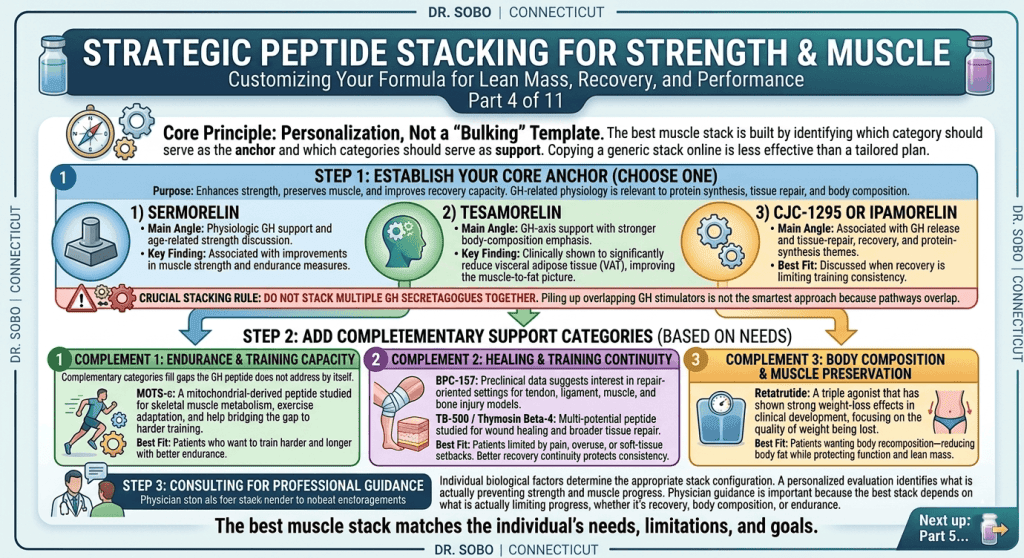
For this topic, the anchor is usually one growth-hormone-supporting peptide rather than several at once. That is an important point. These therapies work through overlapping GH and IGF-related pathways, so the goal is not to layer multiple GH secretagogues on top of each other. The goal is to choose one and then pair it with a complementary category such as endurance and metabolic support, recovery-focused support, or body-composition support. That stacking logic is central to this guide.
For Connecticut patients researching peptides for strength, lean mass, and body composition, this is the key principle:
The best muscle stack is not the one with the most overlap. It is the one that combines one core anabolic-recovery direction with the right complementary support for endurance, healing, and body composition.
What is a strength and muscle peptide stack?
A strength and muscle peptide stack is a personalized combination of peptide therapies or peptide-adjacent therapies chosen to support one or more of the following goals:
- maintaining or improving lean mass
- improving recovery from training
- supporting protein synthesis and tissue repair
- improving body composition
- preserving muscle during fat loss
- improving training consistency by reducing injury-related setbacks
- supporting endurance and metabolic efficiency
This matters because building or maintaining muscle is not only about one pathway. Strength, recovery, body composition, connective-tissue health, metabolic flexibility, sleep quality, and injury resilience all influence how much progress a person can actually make.
A patient may want more muscle, but if recovery is poor, body fat is high, endurance is low, or chronic tendon pain keeps interrupting training, then the stack needs to solve more than one problem.
Why there is no single best peptide stack for muscle growth and strength
There is no universal best muscle stack because patients are usually trying to solve different versions of the same goal.
One person wants:
- better muscle tone
- improved recovery
- more anabolic support
- less decline with age
Another wants:
- better endurance
- improved metabolic efficiency
- better training output
- more resistance to fatigue
Another wants:
- faster recovery from tendon or joint irritation
- fewer setbacks from overuse injuries
- more consistency in training
Another is primarily focused on:
- losing body fat
- protecting lean mass
- improving body composition without sacrificing function
That is why a muscle-focused stack usually works best when it is organized like this:
- Choose one GH-supporting peptide as the base
- Add a complementary category if needed:
- MOTS-c for endurance and metabolic support
- BPC-157 or TB-500 / Thymosin Beta-4 for healing and recovery support
- Retatrutide when body-composition burden and fat loss are part of the muscle-preservation goal
That is the strategic logic behind a smarter strength stack.
Why GH-supporting peptides are usually the foundation of a strength stack
When the main goal is enhancing strength, preserving muscle, or improving recovery capacity, GH-supporting peptides usually make the most sense as the foundation.
That category may include:
These therapies are often discussed because the GH to IGF-1 axis is relevant to protein synthesis, connective-tissue physiology, recovery, and body composition. Human clinical research has shown that GH availability can stimulate collagen synthesis in tendon and skeletal muscle connective tissue, and published work on sermorelin in older adults reported increases in physiologic GH output with improvements in strength and functional measures in a small cohort.
This does not mean every GH-supporting peptide does the exact same thing clinically in every patient. It does mean they belong in the center of the conversation when the goal is preserving or improving muscle-related function.
Why you should not stack multiple GH secretagogues together
This is one of the most important rules in this guide.
GH secretagogues and GH-releasing peptides are often discussed together online, but stacking several of them at once is usually not the smartest approach when their primary pathways overlap. A better strategy is to choose one GH-supporting option and then pair it with a different peptide category that fills a gap the GH peptide does not address by itself.
For example:
- A GH-supporting peptide can anchor the stack for muscle, recovery, and body composition
- MOTS-c can complement it by supporting endurance and metabolic efficiency
- BPC-157 or TB-500 / Thymosin Beta-4 can complement it by helping the patient stay consistent through recovery support
- Retatrutide can complement it when fat loss and lean-mass preservation are part of the real goal
That is a more rational stacking model than piling overlapping GH stimulators into the same plan.
Sermorelin for strength and age-related muscle support
Sermorelin is often discussed in age-related strength and vitality conversations because it supports the body’s own GH signaling rather than acting like exogenous growth hormone. In a small study of healthy older men, nightly sermorelin increased mean overnight GH output while staying within physiologic norms and was associated with improvements in muscle strength and endurance measures. That does not make it a guaranteed muscle-building therapy, but it helps explain why sermorelin remains relevant in performance-aging and muscle-maintenance discussions.
For the right patient, sermorelin may be especially relevant when the goal is:
- preserving strength with age
- supporting recovery
- improving exercise capacity
- avoiding the sense of age-related physical decline
Tesamorelin for body composition and muscle-supporting goals
Tesamorelin is often one of the most compelling GH-related options when body composition is central to the goal. Clinical trials found that tesamorelin significantly reduced visceral adipose tissue, with pooled phase 3 data showing about a 15% reduction at 26 weeks in the studied population. Additional human studies have also reported reductions in hepatic fat.
Why does that matter in a muscle guide? Because better body composition can make strength goals easier to reach. Lower visceral fat can improve movement, recovery, metabolic health, and the visual payoff of maintaining lean mass. This is especially relevant for patients who say they want more muscle, but whose real obstacle is that body-fat burden is masking progress and reducing performance capacity.
Tesamorelin also belongs in the conversation because GH-axis support can influence recovery, tissue repair, and the ability to train more effectively over time. Published reviews and human trials support its relevance to GH-driven body-composition changes, though claims about broad performance enhancement should remain measured and individualized.
CJC-1295 and Ipamorelin for recovery-oriented muscle support
CJC-1295 and Ipamorelin are often discussed in performance and body-composition settings because they are associated with GH release and the downstream tissue-repair, recovery, and protein-synthesis themes that patients care about.
In end-user terms, this is why they matter:
- they are often discussed when recovery is limiting training consistency
- they can fit muscle-preservation conversations
- they may be part of stacks centered on better body composition and training tolerance
- they are usually more useful when chosen as the one GH-supporting anchor rather than combined with multiple overlapping GH peptides
MOTS-c for endurance, training output, and muscle homeostasis
A strength stack does not always fail because the patient lacks anabolic signaling. Sometimes it fails because the patient cannot train hard enough, recover metabolically, or sustain consistent output.
That is where MOTS-c becomes especially useful in the conversation.
MOTS-c is a mitochondrial-derived peptide studied for its effects on skeletal muscle metabolism, exercise adaptation, and age-related physical decline. A 2021 Nature Communications paper described MOTS-c as an exercise-induced mitochondrial-encoded regulator of age-dependent physical decline and muscle homeostasis, with animal data showing improved physical performance and metabolic adaptation.
That makes MOTS-c conceptually different from a GH-supporting peptide.
A GH peptide is usually the better core choice when the target is muscle maintenance, recovery, and body composition.
MOTS-c is usually the better complement when the patient also wants:
- better endurance
- improved metabolic efficiency
- stronger training tolerance
- support for exercise adaptation
- help bridging the gap between wanting to train harder and actually being able to
This is why it makes sense as a stack partner rather than a replacement for a GH-supporting peptide in many muscle-focused plans.
Recovery and healing peptides: why they matter for strength even if they do not directly build muscle
Many patients do not fail to gain strength because they lack effort. They fail because they keep getting interrupted.
Recurring tendon pain, joint irritation, muscle strains, overuse problems, and slower healing can wreck consistency. That is why recovery-focused peptides matter even in a strength guide.
The main recovery category here includes:
These peptides are not usually discussed as direct muscle-building agents. They are discussed because they may help patients stay in the game.

HAVE QUESTIONS ABOUT Strength and Muscle Stacking?
If you are researching peptides, and reside in Connecticut, Greenwich, or Norwalk area, contact us today for a Personalized Consultation. We focus on combining safe, effective medication with a realistic lifestyle plan.
For broader options, see our Conditions Treated page.
BPC-157 for training continuity and soft-tissue support
Research on BPC-157 is still dominated by preclinical data, but systematic reviews describe interest in musculoskeletal healing, including tendon, ligament, muscle, and bone injury models. The current literature suggests promise in repair-oriented settings, but also makes clear that high-quality human clinical safety and efficacy data remain limited.
Why does that matter for a muscle stack?
Because patients who are constantly limited by tendon soreness, joint irritation, or soft-tissue setbacks often cannot train consistently enough to build or preserve muscle the way they want.
TB-500 for broader repair signaling
TB-500 / Thymosin Beta-4 is often discussed in broader tissue-repair and recovery contexts because thymosin beta-4 has been studied for wound healing, cell migration, angiogenesis, inflammation modulation, and tissue remodeling. Reviews describe it as a multifunctional peptide with broad repair-related actions.
For strength-focused patients, the takeaway is simple:
If overuse pain or slow healing keeps interrupting training, then a recovery peptide may have real value not because it directly adds muscle, but because it can help protect the consistency required to maintain or gain strength.
The Wolverine stack and why it belongs in a muscle guide
The Wolverine peptide stack — the combination of BPC-157 and TB-500 / Thymosin Beta-4 — belongs in this guide for one reason: consistency builds strength.
A patient who is always dealing with tendon irritation, muscle strains, nagging inflammation, or poor recovery can rarely train long enough or hard enough to get the full benefit of a muscle-building strategy.
That is why the Wolverine stack can fit logically alongside a GH-supporting peptide: the GH peptide anchors the muscle and recovery strategy, while the Wolverine stack supports the soft-tissue side of training continuity.
Retatrutide and muscle preservation during fat loss
A muscle guide should also address an increasingly important real-world problem: patients want to lose fat without sacrificing lean mass.
That is where Retatrutide belongs in the conversation.
Retatrutide is a triple agonist that has shown strong weight-loss effects in clinical development, and body-composition conversations around retatrutide have increasingly focused on the quality of the weight being lost, not just the scale change. In practical terms, that matters for muscle-focused patients who want to reduce body fat while protecting function and lean tissue. The evidence base is still developing, but this is exactly why retatrutide can fit a muscle guide: it may complement a strength stack when the patient’s real goal is better body composition with muscle preservation, not simply larger muscles.
This is especially relevant for patients who say:
- “I want to get leaner without looking smaller”
- “I want to lose fat but keep strength”
- “I want body recomposition, not just weight loss”
How the best strength and muscle stacks are usually organized
A smarter stacking model looks like this:
Stack Type 1: Strength, recovery, and age-related muscle support
- One GH-supporting peptide such as Sermorelin or Tesamorelin
- Add recovery support if soft-tissue problems limit consistency
Stack Type 2: Strength plus endurance and training capacity
- One GH-supporting peptide
- MOTS-c for endurance and metabolic support
Stack Type 3: Strength plus healing and training continuity
- One GH-supporting peptide
- BPC-157 and/or TB-500 / Thymosin Beta-4 for soft-tissue recovery support
Stack Type 4: Body recomposition with lean-mass protection
- One GH-supporting peptide
- Retatrutide when body-fat reduction is part of the goal
That structure makes more sense than stacking several peptides that all do versions of the same thing.
Comparison Table: Choosing the right muscle-stack role for each peptide category
Category | Best Role in the Stack | Best Fit |
GH-supporting peptides | Core anchor | Strength, recovery, lean mass, body composition |
Performance and metabolic complement | Endurance, training output, muscle homeostasis | |
Recovery complement | Soft-tissue healing, tendon and joint support | |
Broader repair complement | Tissue remodeling, recovery continuity | |
Body-composition complement | Fat loss with lean-mass protection focus |
Comparison Table: Sermorelin vs Tesamorelin for muscle-related goals
Therapy | Main Discussion Angle | Best Fit |
Physiologic GH support and age-related strength discussion | Older adults, vitality, strength, endurance | |
GH-axis support with stronger body-composition emphasis | Visceral fat, leaner physique, muscle-supporting recomposition |
Comparison Table: MOTS-c vs recovery peptides in a strength stack
Option | Main Benefit to the Muscle Goal | Best Use Case |
Better endurance and metabolic training capacity | Patients who want to train harder and longer | |
Better recovery continuity | Patients limited by pain, overuse, or soft-tissue setbacks |
Why personalized evaluation matters for muscle-focused peptide stacking
A patient may say they want more strength, but the underlying problem may actually be one of the following:
- poor GH-related recovery
- body-fat burden limiting performance
- low endurance and metabolic inefficiency
- repeated injuries limiting training consistency
- age-related decline in recovery and lean-mass maintenance
That is why the consultation matters.
The right stack is not chosen by starting with what is popular online. It is chosen by identifying what is actually preventing strength and muscle progress.
Why Connecticut patients should think about strength and muscle goals in a broader way
For Connecticut patients searching peptides for muscle growth, best peptide stack for strength, Sermorelin for muscle, Tesamorelin body composition, or MOTS-c for endurance, the best plan is often broader than “more muscle.”
Most patients also want:
- better body composition
- fewer interruptions from injury
- better training tolerance
- stronger recovery
- healthier aging
- preserved function during fat loss
That is why a personalized stack is often more effective than a single-goal approach. It reflects the reality that strength, muscle, endurance, injury resilience, and body composition all influence each other.
Final takeaway
The best strength and muscle peptide stack is usually built around one GH-supporting peptide, not several. That peptide acts as the anchor for recovery, lean-mass support, and body-composition improvement. From there, the smartest addition depends on what else is limiting progress.
If endurance and metabolic capacity are the main issue, MOTS-c may be the right complement. If recurring injuries and soft-tissue recovery are the real bottleneck, BPC-157 or TB-500 / Thymosin Beta-4 may matter more. If body-fat reduction and lean-mass preservation are the bigger goal, Retatrutide may belong in the discussion.
That is what makes peptide stacking therapy so useful for strength and muscle goals: the stack can be built around what is actually limiting performance, recovery, and body composition rather than forcing every patient into the same template.
Frequently Asked Questions (FAQs)
What is the best peptide stack for strength and muscle?
There is no single best stack for everyone. Most strong muscle-focused plans are built around one GH-supporting peptide, then paired with a complementary category such as MOTS-c for endurance, BPC-157 or TB-500 / Thymosin Beta-4 for recovery, or Retatrutide when fat loss and lean-mass preservation are part of the goal.
Should you stack multiple GH secretagogues together?
Usually that is not the smartest approach because their pathways overlap. In many cases, the better strategy is to choose one GH-supporting peptide and then pair it with a different category that adds something new to the plan, such as endurance support, healing support, or body-composition support.
Why is Sermorelin used for strength and muscle support?
Sermorelin is discussed for muscle-related goals because it supports physiologic GH release. In a small study of older men, sermorelin increased overnight GH output and was associated with improvements in strength and endurance measures.
Why is Tesamorelin important in a muscle guide?
Tesamorelin is important because muscle goals are often really body-composition goals. Clinical data show tesamorelin reduces visceral adipose tissue, which can help support a leaner physique and a more favorable muscle-to-fat picture.
What does MOTS-c add to a strength stack?
MOTS-c is usually discussed as a complement for endurance, metabolic flexibility, and exercise adaptation rather than as the main anabolic anchor. It may help support training capacity and muscle homeostasis.
Can recovery peptides help you build or preserve muscle?
Indirectly, yes. BPC-157 and TB-500 / Thymosin Beta-4 are more about healing and training continuity than direct muscle gain. They matter because patients who recover better often train more consistently.
What is the Wolverine stack?
The Wolverine stack is the nickname for stacking BPC-157 with TB-500 / Thymosin Beta-4. It is commonly discussed for injury recovery, soft-tissue healing, and training continuity.
Why would Retatrutide be part of a muscle stack?
Because many patients want body recomposition, not just bigger muscles. Retatrutide may fit when the goal is reducing body fat while protecting function and lean mass.
Is this type of stack only for athletes?
No. Many patients interested in these stacks are not competitive athletes. They may be trying to maintain muscle with age, recover better, improve body composition, preserve strength during fat loss, or stay more active and functional.
Why is physician guidance important for muscle-stacking peptides?
Because the best stack depends on what is actually limiting progress. One patient needs more recovery support. Another needs better body composition. Another needs better endurance. Another needs help preserving muscle with age. A personalized plan is more useful than copying a generic “muscle stack” online.
More Helpful Articles
REDEFINE 4 Results: CagriSema vs. Tirzepatide, Weight Loss, and FDA Status
Phase 3 head-to-head results and an anticipated late-2026 FDA decision create strong news and comparison intent. This article was evidence-checked on September 6, 2026. Regulatory status, labels, and trial publications
GLP-1 Medications and Vision Changes: NAION, Retinopathy, and Warning Signs
Regulatory safety updates and new observational research are driving urgent patient questions about vision loss. This article was evidence-checked on September 6, 2026. Regulatory status, labels, and trial publications can
GLP-1 Microdosing: Evidence, Risks, and What “Low Dose” Really Means
Evidence review date: September 6, 2026. GLP-1 microdosing has attracted substantial consumer and telehealth interest, but direct clinical-trial evidence remains limited. Medication approvals, prescribing information, safety communications, and clinical evidence
Sources
- Peptide Stacking Therapy in Connecticut
- How Peptide Stacking Therapy Is Personalized: A Connecticut Patient’s Guide
- Sermorelin
- CJC-1295
- Ipamorelin
- Tesamorelin
- MOTS-c
- BPC-157
- TB-500 / Thymosin Beta-4
- Wolverine Peptide Stack in Stamford, CT
- The Wolverine Peptide Stack – Faster Recovery, Less Pain, Better Healing
- Does Retatrutide Preserve Muscle?
- GLP-3 Retatrutide Triple Receptor Drug
- Retatrutide vs Tirzepatide
- Sermorelin: A Better Approach to Management of Adult-Onset Growth Hormone Deficiency?
- MOTS-c Is an Exercise-Induced Mitochondrial-Encoded Regulator of Age-Dependent Physical Decline and Muscle Homeostasis
- Progress on the Function and Application of Thymosin β4
- Emerging Use of BPC-157 in Orthopaedic Sports Medicine: A Systematic Review
- Tesamorelin Phase 3 Trial Summary and VAT Reduction Data
