
FOOT AND ANKLE PAIN Treatment in Connecticut

When Foot or Ankle Pain Sidelines Your Life
Foot and ankle pain is one of the most common reasons patients come into my Stamford clinic seeking relief. Whether it’s stubborn heel pain from plantar fasciitis, chronic ankle sprains causing instability, aching joints from arthritis, or sharp nerve pain from Morton’s neuroma—these issues can stop you from walking, exercising, or even standing comfortably.
My goal is always to address the underlying tendon or joint damage. Too often, conventional treatments just mask symptoms. That’s where regenerative medicine like PRP and stem cell therapy often make the difference.
“Many patients tell me the pain disappears and function returns after a few PRP injections. That’s real healing, not just relief.” – Dr. Henry Sobo, MD
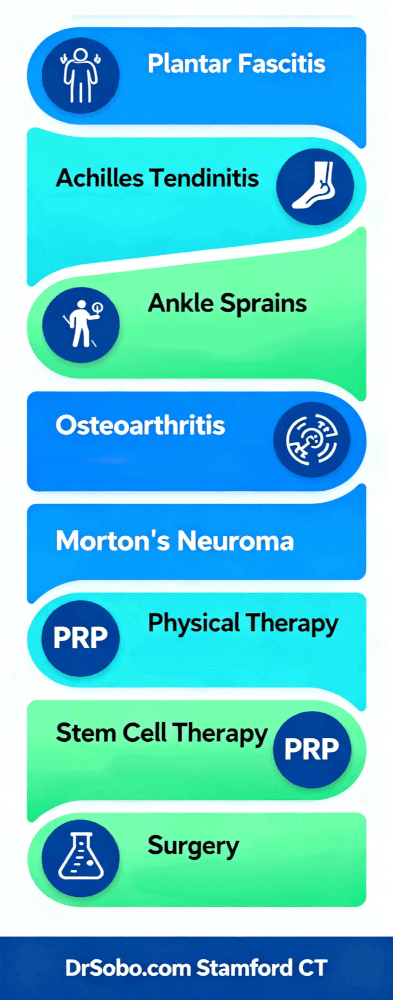
Common Foot and Ankle Conditions I Treat
Osteoarthritis of the Foot and Ankle
Cartilage wears down causing joint pain, stiffness, and swelling—especially in the ankle and midfoot. Conservative care helps early, but regeneratives may delay or avoid surgery.
Chronic Ankle Sprains & Instability
Repeated ankle sprains weaken ligaments and tendons, causing instability and chronic pain. PRP supports ligament healing, improving balance and function.
Achilles Tendinopathy
Overuse leads to tendon degeneration and pain at the back of the heel. Treatments encouraging tendon repair, like PRP or stem cells, often outperform steroids.
Plantar Fasciitis & Heel Pain
Inflammation and microtears in the plantar fascia cause classic morning heel pain. Emerging evidence shows PRP reduces pain and improves function better than corticosteroids.
Morton’s Neuroma and Bunions
Nerve irritation (Morton’s neuroma) or bony deformity (bunions) causes sharp pain and burning sensations. Conservative care works initially; advanced regenerative options can help nerve inflammation and tissue healing.
How Regenerative Medicine Addresses the Root Causes of Foot & Ankle Pain
Many patients come to me after months or years of recurrent foot and ankle pain, frustrated because traditional treatments only mask symptoms. The reason often lies in unaddressed tissue degeneration and systemic factors impairing healing.
In my practice, I explain that regenerative medicine doesn’t just quiet pain—it promotes actual tissue repair. Whether it’s a partially torn tendon, cartilage wear in a joint, or plantar fascia microtears, PRP and stem cells provide biological signals that jump-start your body’s natural recovery processes.
But healing also depends on other factors:
Inflammation: Chronic low-grade inflammation can delay repair. We assess markers like hsCRP and manage inflammation through diet, supplements, or medication.
Metabolic health: Insulin resistance, obesity, and hormone imbalances hinder healing. Functional medicine protocols help modulate these systems for better outcomes.
Nutrition: Collagen synthesis requires an adequate supply of vitamin C, amino acids, and minerals like magnesium and zinc.
Biomechanics: Proper foot alignment, footwear, and orthotic support reduce abnormal strain and promote lasting recovery. We work closely with physical therapists and podiatrists for comprehensive care.
“Regenerative injections give your tendons and joints the tools to heal—but optimizing your whole-body health creates an environment where recovery thrives.” – Dr. Henry Sobo, MD
Specialized Conditions and Targeted Treatments
Plantar Fasciitis
Heel pain caused by stress and microtears in the plantar fascia. Beyond rest and orthotics, PRP accelerates tendon remodeling, and stem cells may be considered for long-standing cases.
Chronic Ankle Instability
Repeated sprains damage ligaments that don’t heal well on their own. PRP injections strengthen ligament fibers, often combined with balance therapy to restore function.
Bunion Pain and Deformity
While surgery is often needed for structural correction, regenerative therapies can reduce pain and inflammation pre- and post-op, helping speed recovery.
Morton’s Neuroma
This nerve irritation can cause burning and numbness. While injections and surgery are common, regenerative injections may reduce perineural inflammation and promote nerve health.
Treatment Options: What Works and When
| Treatment | Conditions Best Treated | Effectiveness (12 weeks) | Downtime | Notes |
|---|---|---|---|---|
| Rest & Orthotics | Plantar fasciitis, ankle arthritis | 50-60% | None | Often first step |
| NSAIDs & Steroids | Inflammation flare-ups | Moderate (short term) | None/1 day | Risk of tendon weakening |
| Physical Therapy | Instability, tendinopathy | 70-80% | None | Eccentric exercises vital |
| PRP Injections | Tendon injuries, arthritis | 75-85% | 3-5 days soreness | Stimulates tissue repair |
| Stem Cell Therapy | Severe tears, chronic cases | 70-80% | 10-14 days | Higher cost, investigational |
| Surgery | Advanced arthritis, deformities | 85-95% | 6-12 weeks | Last resort option |
“PRP is often the tipping point for patients stuck in the pain cycle for months. Stem cells come into play in tougher, chronic tears or failed PRP cases.” – Dr. Henry Sobo, MD
My Foot and Ankle Pain Treatment Protocol
I use a structured three-phase approach integrating regenerative therapies with rehab:
Phase 1 (Weeks 1-4):
Diagnostic ultrasound for precise injury mapping
Activity modification + orthotics/bracing
Initiate physical therapy focusing on stretching and strengthening
Phase 2 (Weeks 5-8):
Ultrasound-guided PRP or stem cell injection to target pathology
Protect repair with gradual loading activities
Nutritional support: collagen, vitamin C, omega-3 fatty acids
Phase 3 (Weeks 9-16):
Progressive functional rehab toward sport/work-specific demands
Possible PRP booster if pain or function plateaus
Maintenance of orthotics and lifestyle adjustments
Stem Cell Therapy for Foot and Ankle Pain: Advanced Regenerative Option
For Severe or Persistent Cases Not Responding to PRP
When ultrasound-guided PRP provides limited improvement or imaging reveals significant tendon or joint damage in the foot or ankle, stem cell therapy offers a powerful option to stimulate deeper tissue regeneration.
My Stem Cell Patient Profile
Persistent foot or ankle pain despite 6+ months of conservative and PRP treatment
MRI or ultrasound confirmed tendon tears, ligament damage, or advanced joint degeneration
Significant functional limitation or pain interfering with daily activities
Age under 65 and overall good metabolic health
Commitment to a patience‑driven 3-6 month recovery protocol
Bone Marrow Aspirate Concentrate (BMAC) Procedure
Outpatient harvesting of bone marrow from the hip under local anesthesia
Processing and concentrating stem cells to 5-10 times baseline levels
Ultrasound-guided injection precisely targeting damaged foot or ankle tissue
Post-procedure care involves 10-14 days of protected use, followed by gradual return to activity
Treatment cost: $4,500-$7,500 (typically self-pay)
Recovery time: Approximately 10-14 days of downtime, longer than PRP’s 3–5 days
Clinical Outcomes
70-80% of patients with severe or chronic foot and ankle tissue injuries achieve significant pain reduction and functional improvement
Tendon and ligament remodeling peaks between 3 to 6 months after treatment
Approximately 65% of these patients avoid surgical intervention after successful stem cell therapy
Grip and load bearing strength improves substantially within 6 months after treatment
Comparison: Stem Cells vs PRP for Foot and Ankle Pain
| Metric | PRP | Stem Cell Therapy |
|---|---|---|
| Best For | Partial tears, mild to moderate tendinopathy | Complete tears, chronic degeneration, PRP failures |
| Success Rate | 75-85% | 70-80% in severe cases |
| Durability | 2+ years | 3+ years |
| Cost | $800-1,200 | $4,500-7,500 |
| Downtime | 3-5 days | 10-14 days |
Clinical Experience at Our Stamford Clinic
A 50-year-old avid walker with chronic plantar fasciitis and partial tendon tears experienced only mild relief with two PRP injections but reached 80% improvement after stem cell therapy combined with physical therapy and nutritional optimization.
For more information, see our full Stem Cell Therapy program.
Schedule Your Evaluation in Stamford, CT
Foot and ankle pain should not control your life. With precise diagnosis and personalized regenerative treatments, regain mobility and comfort.
Contact us today to schedule your consultation and learn about our PRP Treatments, Stem Cell Therapy, and Functional Medicine services.
References
Individual results vary. Composite clinical patterns. Medical evaluation required.
Frequently Asked Questions
Is PRP effective for plantar fasciitis?
Yes. PRP reduces pain and improves function better than steroid injections and with longer-lasting results.
How many PRP injections will I need?
Most patients need 1–3 injections spaced 4–6 weeks apart. Improvement is usually noticed after the first injection.
When is stem cell therapy recommended?
Stem cells are reserved for severe or persistent cases unresponsive to PRP or conservative care, usually with significant tendon tears or joint damage.
Will insurance cover regenerative treatments?
Coverage varies; many regenerative therapies are self-pay currently. Pricing and financing options are provided by our office.
How soon can I return to normal activities?
Light activity usually resumes immediately. Full recovery varies but often occurs 4–16 weeks depending on injury and treatment.
Real Patients, Real Stories
I suffered from heel pain for several months. My prior doctor had given me a couple of cortisone injections which did not give me relief . After a PRP treatment my pain started improving in less than 2 weeks. Doctor Sobo gave me a second PRP treatment 4 weeks later and within 2 months from the start my pain was gone. I can now walk as much as I like and I have not had any more problems with my foot.