
Ipamorelin Peptide Therapy
Ipamorelin Peptide Therapy for Recovery, Sleep, Body Composition, and Healthy Aging
Ipamorelin peptide therapy is used in hormone-optimization and regenerative-medicine settings to stimulate the body’s own growth hormone release rather than replacing growth hormone directly. For the right patient, this may support better recovery, deeper sleep, improved body composition, and healthier aging when used as part of a medically supervised treatment plan.
At Dr. Sobo’s peptide therapy program, treatment is approached through a broader clinical lens: goals, symptoms, metabolic health, body composition, and safety all matter. This is not a one-size-fits-all protocol. It is a personalized strategy built around appropriate candidate selection, dosing, monitoring, and realistic expectations.
What Is Ipamorelin?
Ipamorelin is a synthetic pentapeptide and a selective growth hormone secretagogue. In plain English: it is designed to activate the growth hormone secretagogue receptor, also called the ghrelin receptor, which helps trigger pulsatile release of growth hormone from the pituitary. It is not the same thing as synthetic human growth hormone (HGH), and it does not work by binding to IGF-1 receptors. That old internet claim is biochemical spaghetti; the cleaner mechanism is ghrelin-receptor stimulation leading to growth hormone release.
Because growth hormone signaling influences recovery, sleep architecture, body composition, collagen turnover, and the downstream IGF-1 pathway, Ipamorelin is often discussed in the context of wellness optimization, injury recovery, performance support, and healthy aging. Still, it is important to be precise: Ipamorelin is not an FDA-approved finished drug product for these uses, and treatment decisions should be made within proper medical oversight.
How Does Ipamorelin Work?
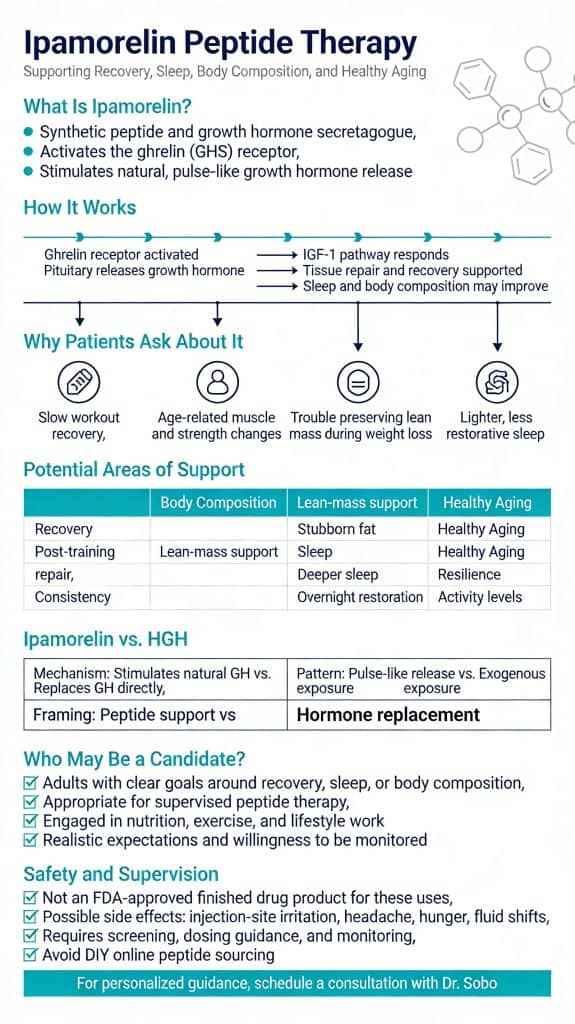
Ipamorelin works by mimicking signaling at the ghrelin receptor to stimulate natural, pulse-like growth hormone release. That pulse pattern matters. The body does not normally drip growth hormone like a leaky faucet; it releases it in bursts, especially around sleep and recovery. Ipamorelin is attractive in clinical discussion because it aims to support that more physiological pattern instead of directly replacing hormone.
The simplified pathway
- Ipamorelin activates the ghrelin / GHS receptor
- The hypothalamus and pituitary respond
- Growth hormone is released in pulses
- The liver and peripheral tissues respond with downstream IGF-1 activity
- That signaling may influence recovery, body composition, tissue repair, and sleep-related restoration
One reason Ipamorelin gets attention is selectivity. Earlier growth hormone-releasing peptides were known for broader hormonal spillover. Ipamorelin has been described in the literature as more selective for GH release, with less stimulation of ACTH, cortisol, prolactin, LH, FSH, or TSH than some older compounds. That does not make it magic. It makes it more interesting. The endocrine system still deserves respect and supervision.
Why Patients Are Interested in Ipamorelin
Many adults become interested in Ipamorelin because growth hormone secretion changes with age, body composition, sleep quality, and metabolic status. Growth hormone secretion declines with aging, a phenomenon often discussed as part of the “somatopause.” At the same time, patients may notice slower workout recovery, reduced lean mass, more central fat gain, lower resilience, and lighter sleep. That does not mean everyone needs peptide therapy. It does explain why people go hunting for answers in this category.
Some patients seek help with:
- Slow recovery from training or orthopedic stress
- Age-related changes in muscle tone and body composition
- Trouble maintaining lean mass during fat-loss programs
- Poor sleep quality and overnight recovery
- Broad “I do not bounce back like I used to” complaints
A proper evaluation matters because similar symptoms can also show up with poor sleep hygiene, thyroid issues, stress overload, low testosterone, overtraining, poor protein intake, insulin resistance, or plain old life hitting like a truck.
Potential Benefits of Ipamorelin Peptide Therapy
1) Recovery and Exercise Support
Ipamorelin is commonly discussed for recovery because growth hormone signaling plays a role in tissue repair, protein turnover, and post-exercise adaptation. Patients who are active, training regularly, or trying to maintain performance as they age often ask whether improved GH signaling may help them recover more efficiently between sessions. Clinical results vary, but this is one of the most common reasons people explore treatment.
Potential recovery-related goals may include:
- Better recovery from resistance training
- Improved training consistency
- Support for connective tissue turnover
- Better overnight restoration after strenuous activity
This is also why Ipamorelin is often mentioned alongside regenerative approaches such as BPC-157 peptide therapy or broader wellness and musculoskeletal support protocols.
2) Body Composition Support
Ipamorelin may help support body-composition goals by influencing growth hormone and downstream IGF-1 signaling, which are involved in lipolysis, lean-mass preservation, and metabolic regulation. It is not a shortcut around nutrition and exercise. Anyone selling it that way is peddling peptide fairy dust. But it may fit into a structured program for patients trying to improve body composition under clinical guidance.
Patients often explore it when they want to:
- Reduce stubborn body fat
- Preserve or support lean mass
- Avoid the “smaller but softer” look during weight loss
- Improve results from training and nutrition
This is particularly relevant in patients using medical weight-loss therapies such as Semaglutide, Tirzepatide, or Retatrutide in Connecticut, where preserving lean mass and supporting recovery may become part of the bigger treatment conversation.
3) Sleep and Overnight Restoration
One of the earliest benefits some patients report with growth-hormone-secretagogue therapy is improved sleep quality, especially deeper and more restorative sleep. That is biologically plausible because normal GH secretion is tightly linked to sleep, especially slow-wave sleep. Better sleep can, in turn, improve recovery, energy, training tolerance, and even appetite regulation.
Patients often describe:
- Deeper sleep
- Feeling more restored on waking
- Better overnight recovery
- Improved exercise readiness the next day
Not every patient notices a dramatic change, but sleep is a major reason Ipamorelin remains such a recurring topic in peptide discussions.
4) Healthy Aging and Tissue Support
As growth hormone signaling changes with age, some adults explore Ipamorelin as part of a healthy-aging strategy focused on resilience rather than hype. This usually centers on maintaining muscle, supporting recovery, preserving activity levels, and complementing broader wellness interventions such as exercise, nutrition, sleep optimization, and metabolic care. Growth hormone biology is relevant to body composition, bone metabolism, and connective tissue, but anti-aging claims should stay grounded and not drift into carnival-barker territory.
Potential goals may include:
- Maintaining lean mass with age
- Supporting physical resilience
- Improving recovery capacity
- Complementing an active longevity plan
Ipamorelin vs HGH: What Is the Difference?
Ipamorelin and HGH are not the same. Ipamorelin stimulates the body’s own growth hormone release; HGH therapy delivers exogenous hormone directly. That difference affects physiology, monitoring, treatment strategy, and often cost.
Feature | Ipamorelin | Synthetic HGH |
Mechanism | Stimulates natural GH release | Replaces GH directly |
Release Pattern | Pulse-like / physiological intent | Exogenous hormone exposure |
Feedback Loop | More aligned with native signaling | May bypass normal regulation |
Typical Discussion | Recovery, body composition, sleep support | Confirmed GH deficiency and other specific uses |
Treatment Framing | Peptide / secretagogue approach | Hormone replacement approach |
For many patients, the appeal of Ipamorelin is that it aims to encourage the body’s signaling rather than override it. For others, a formal endocrine workup may point in a different direction entirely.
Ipamorelin vs Other Peptides
Ipamorelin is best understood as one tool in a larger peptide category, not a universal solution. Different peptides are used for different goals.
Peptide | Primary Discussion Area | Typical Role |
Ipamorelin | GH release support | Recovery, sleep, body composition |
CJC-1295 | GHRH-pathway support | Often paired with Ipamorelin |
Tesamorelin | GHRH analog | Visceral-fat discussion in specific settings |
BPC-157 | Tissue support | Recovery / injury-related interest |
GLP-1 agents | Metabolic support | Appetite, weight, glucose-related goals |
The point is not to collect peptides like trading cards. The point is to match mechanism to patient goal.
Common Stacking Discussion: Ipamorelin With Other Therapies
Ipamorelin is often discussed in “stacking” protocols because clinicians may combine different mechanisms to target recovery, body composition, or metabolic outcomes more comprehensively. That does not mean stacking is automatically better. It means the logic should be individualized.
Combination | Why It Is Discussed | Potential Goal |
Ipamorelin + CJC-1295 | Complementary GH signaling pathways | Recovery, sleep, lean-mass support |
Ipamorelin + GLP-1 therapy | Weight loss plus muscle-preservation discussion | Body composition during fat loss |
Ipamorelin + recovery-focused protocols | Multi-pathway support | Training recovery and resilience |
On this site, the most relevant related pages include Semaglutide, Tirzepatide, and Retatrutide in Connecticut. These internal links matter not just for SEO, but for helping patients understand the bigger metabolic picture.
Can Ipamorelin Help During GLP-1 Weight-Loss Treatment?
This is one of the more interesting clinical discussion points. As patients lose weight on GLP-1–based therapies, the focus is not only on pounds lost but also on what kind of tissue is being lost. In some cases, preserving lean mass, supporting training recovery, and maintaining physical function become high-priority goals.
That is why Ipamorelin may enter the conversation for select patients using Semaglutide, Tirzepatide, or Retatrutide. The goal is not simply “add more stuff.” The goal is to support a more favorable body-composition outcome when weight loss is already underway.
Separate from body composition, preclinical research has also explored Ipamorelin’s ghrelin-receptor effects on gastric motility and postoperative ileus in rodent models. That is not the same as proving a standard treatment role in humans using GLP-1 medications, but it is a biologically relevant research signal.
What Research Says About Digestive Motility
Ipamorelin has been studied in animal models for gastric dysmotility and postoperative ileus because ghrelin signaling can influence gastrointestinal motility. In a rodent model, investigators reported that Ipamorelin accelerated gastric emptying and improved gastric contractility through ghrelin-receptor-mediated mechanisms involving cholinergic excitatory pathways. Interesting? Yes. Permission to overstate it in humans? Absolutely not. Science is not a permission slip for hype.
For a service page, the honest clinical takeaway is this:
- There is mechanistic and preclinical interest
- More human research is needed
- It may be relevant in broader metabolic or GI discussions
- It should not be marketed as a proven cure for gastroparesis or GLP-1 side effects
That distinction protects both trust and compliance.
Who May Be a Candidate for Ipamorelin Therapy?
Candidates for Ipamorelin are typically adults with clear goals around recovery, sleep, healthy aging, or body composition who are appropriate for medically supervised peptide therapy. Good candidacy is not based on curiosity alone. It is based on history, symptoms, current medications, metabolic status, risk factors, and treatment goals.
You may be a better candidate if you are:
- Experiencing slower exercise recovery
- Trying to preserve lean mass during a medical weight-loss program
- Concerned about age-related declines in resilience
- Looking for a more physiologic GH-support discussion than direct HGH replacement
- Willing to follow a supervised protocol and monitoring plan
You may need extra caution or may not be a candidate if you have:
- Active malignancy concerns
- Significant uncontrolled endocrine issues
- Pregnancy
- Major untreated sleep or metabolic disorders
- An unrealistic “Hollywood-in-3-weeks” expectation set
Safety, Side Effects, and Why Supervision Matters
Ipamorelin is generally described as well tolerated in the literature, but “generally well tolerated” is not the same thing as “casually DIY this from the internet.” Possible side effects discussed in clinical use include injection-site irritation, headache, increased hunger, fluid retention, and dose-related discomfort. Because this therapy interfaces with endocrine signaling, supervision matters.
Reasons for medical supervision is important:
- Proper candidate screening
- Safer dosing and titration
- Monitoring response and side effects
- Avoiding inappropriate stacking
- Distinguishing peptide expectations from hormone-replacement indications
This is especially relevant in a peptide category where online advice can mutate into folklore faster than mold on forgotten bread.
Is Ipamorelin FDA Approved?
No — Ipamorelin is not currently an FDA-approved finished drug product for routine clinical use in the way many patients assume. FDA materials discuss Ipamorelin-related bulk drug substances in the context of compounding review and safety-risk discussions, which is very different from saying it is an FDA-approved branded medication for anti-aging, recovery, or fat loss.
That does not automatically end the clinical conversation. It does mean the page should be accurate about regulatory status. Precision builds trust. Sloppy phrasing builds headaches.
How Is Ipamorelin Typically Administered?
Ipamorelin is commonly discussed as a subcutaneous injection protocol, often used in recurring weekly schedules determined by the treating clinician. Exact dosing, frequency, and cycle length vary based on goals, tolerance, concurrent therapies, and medical judgment. Because its half-life is relatively short, it is often described in pulse-style administration strategies rather than “set it and forget it” long-acting use.
A typical patient workflow may include:
- Consultation and symptom review
- Medical history and candidacy assessment
- Goal setting: recovery, body composition, sleep, healthy aging
- Personalized protocol creation
- Follow-up monitoring and adjustment
What Results Can Patients Expect?
Results from Ipamorelin, when they occur, are usually gradual rather than dramatic. Patients who respond often report the earliest changes in sleep quality and recovery, followed later by body-composition changes when therapy is paired with exercise and nutrition. That timeline is one reason service pages should avoid miracle language. Real progress is usually incremental, not cinematic.
A reasonable expectation framework:
- Weeks 1–4: Some patients notice deeper sleep or better recovery
- Months 1–3: Improvements may emerge in training tolerance, body composition, or resilience
- Months 3+: Changes are more meaningful when combined with structured nutrition and resistance training
Why Patients in Connecticut Search for Ipamorelin
Local search intent matters here. People are not only searching “What is Ipamorelin?” They are searching for things like:
- Ipamorelin peptide therapy in Connecticut
- peptide clinic near me
- growth hormone peptide therapy Connecticut
- anti-aging peptide therapy near me
- peptides for recovery and weight loss Connecticut
That is why this page is built for both education and action. Patients in Connecticut want more than generic peptide chatter. They want to know whether there is a physician-guided option that takes symptoms, safety, body composition, and realistic outcomes seriously.
At Dr. Sobo’s practice, peptide therapy discussions can be integrated with broader metabolic and wellness strategies, including Semaglutide, Tirzepatide, and Retatrutide in Connecticut, depending on the patient’s goals and medical profile.
Dr. Sobo’s Approach to Ipamorelin Therapy
Dr. Sobo’s approach is not built around trend-chasing; it is built around patient selection, mechanism-based planning, and medically supervised optimization. That matters in a peptide space full of recycled claims and copycat pages. A higher-quality program should evaluate whether the patient’s real need is recovery support, body-composition strategy, metabolic intervention, hormone optimization, sleep improvement, or a different path altogether.
That means the clinical conversation should include:
- Current symptoms and functional goals
- Training status and recovery capacity
- Weight-loss strategy and lean-mass preservation
- Sleep quality and daily energy
- Broader metabolic context
- Safety, appropriateness, and monitoring
That is how you build trust and outcomes — with clinical reasoning, not peptide cosplay.
Frequently Asked Questions
What does Ipamorelin do?
Ipamorelin stimulates the body’s natural release of growth hormone by activating the growth hormone secretagogue receptor, also known as the ghrelin receptor. That signaling may support recovery, sleep quality, body composition, and healthy aging goals when used in a medically supervised setting.
Is Ipamorelin the same as HGH?
No. Ipamorelin is a growth hormone secretagogue, meaning it encourages the body to release its own growth hormone. HGH therapy provides exogenous hormone directly. Those are related pathways but not the same treatment strategy.
What is the Wolverine peptide stack?
The Wolverine peptide stack refers to combining BPC-157 and TB-500 to support accelerated tissue healing and injury recovery.
Is Ipamorelin FDA approved?
No. Ipamorelin is not currently an FDA-approved finished drug product for the common wellness, anti-aging, or recovery, often discussed online. FDA materials instead reference Ipamorelin-related bulk drug substances in compounding and safety-review contexts.
How does Ipamorelin increase growth hormone?
Ipamorelin activates the ghrelin / growth hormone secretagogue receptor, which signals the pituitary to release growth hormone in pulses. This can influence downstream IGF-1 activity and related recovery and metabolic processes.
Can Ipamorelin help with fat loss?
It may support body-composition goals by influencing lipolysis and lean-mass preservation, especially when paired with structured nutrition, exercise, and medical supervision. It is better understood as a support tool than a standalone fat-loss solution.
Can Ipamorelin help preserve muscle during weight loss?
That is one reason it is discussed alongside GLP-1 therapies. In select patients, the goal may be to support recovery, training tolerance, and lean-mass preservation while weight loss is underway. This should be individualized rather than assumed.
Can Ipamorelin improve sleep?
Some patients report deeper, more restorative sleep, and that is biologically plausible because growth hormone secretion is closely linked to sleep architecture. Sleep response varies, but it is one of the more commonly discussed early benefits.
How long does it take to notice results from Ipamorelin?
When patients respond, early changes may show up first in sleep or recovery over several weeks. Body-composition changes usually take longer and are far more dependent on training, nutrition, and consistency.
Is Ipamorelin better than HGH?
Not universally. It is different. Ipamorelin may appeal to patients looking for a more physiological, secretagogue-based approach, while HGH therapy belongs in a different clinical conversation with its own indications and monitoring requirements.
Who is a good candidate for Ipamorelin therapy?
Adults seeking support for recovery, sleep, body composition, or healthy aging may be candidates if they are clinically appropriate for peptide therapy and willing to follow a supervised treatment plan. Candidacy depends on health history, goals, medications, and risk factors.
How to Get Started with Ipamorelin Peptide Therapy with Dr. Sobo?
Schedule a consultation at Dr. Sobo’s Stamford, CT office: discuss symptoms, recovery, sleep, body composition, and healthy aging.
Sources
- Growth Hormone-Releasing Peptides: Clinical and Basic Aspects
- Growth Hormone-Releasing Peptides (Oxford Academic)
- Efficacy of Ipamorelin on Gastric Dysmotility in a Rodent Model of Postoperative Ileus
- FDA Briefing Document Referencing Ipamorelin-Related Bulk Drug Substances
- FDA: Certain Bulk Drug Substances That May Present Significant Safety Risks
- Growth Hormone and Aging
- Hormones and Aging: An Endocrine Society Scientific Statement