
If you have been following this peptide stack series, you already know that effective therapy is never about choosing the most popular combination. It is about identifying the patient’s specific physiological bottleneck. In Part 6: Peptide Stacking for Metabolic Health in Connecticut, the focus was on insulin resistance, central fat, and energy stability. In Part 7: Peptide Stacking for Cognitive Performance, we discussed brain resilience, focus, and neuroprotection. In Part 8: Peptide Stacking for Gut Health and Immune Support, the topic was the gut immune axis. And in Part 9: Peptide Stacking for Sleep, Recovery, and Stress Resilience, we addressed the foundational triad of rest, repair, and nervous system balance.
In this guide, we turn to a topic that touches nearly every other system in the body: hormonal health and vitality. Hormones are not isolated messengers. They regulate metabolism, mood, libido, muscle mass, sleep quality, immune function, and cognitive performance. When one hormone is out of balance, the entire network shifts. Patients often describe the experience as a slow, frustrating decline: lower energy, reduced drive, poor recovery, weight gain that resists effort, and a general sense of “not feeling like themselves.”
Many patients assume this is simply aging. But aging does not have to mean hormonal collapse. In many cases, the signaling systems that control hormone production become less efficient, not the glands themselves. That is where peptide therapy offers a unique advantage. Rather than simply replacing hormones from the outside, certain peptides help restore the brain’s ability to signal the endocrine system—supporting the body’s own hormone production in a more physiologic, pulsatile, and self regulated manner.
For Connecticut patients looking to regain vitality, libido, energy, and a sense of wellbeing, peptide stacking for hormonal health is often the missing piece that makes all other interventions finally work.
Why Hormonal Health Is More Than Testosterone or Estrogen
Most patients think of hormones in isolation. Men worry about testosterone. Women worry about estrogen and progesterone. But hormonal health is a network phenomenon. The hypothalamus and pituitary gland act as the master conductors, releasing signals (releasing hormones and tropic hormones) that tell the thyroid, adrenals, ovaries, and testes what to do.
When this network functions well:
- Energy is stable throughout the day.
- Libido is appropriate and responsive.
- Sleep is restorative.
- Body composition responds to effort.
- Mood is resilient, not brittle.
- Recovery from stress and exercise is complete.
When the network functions poorly, patients may experience low libido, fatigue, brain fog, poor exercise tolerance, central weight gain, reduced muscle tone, poor sleep, and emotional flatness. Standard hormone replacement (testosterone, estrogen, thyroid hormone) can be life changing for some, but it does not address the underlying signaling failure. It replaces the output without necessarily restoring the rhythm or sensitivity of the system.
Peptides that work on the hypothalamic pituitary axis (HPA, HPT, HPG axes) offer a different approach. They help restore communication between the brain and the endocrine glands, supporting the body’s natural hormone production in a way that preserves feedback loops and circadian rhythms.
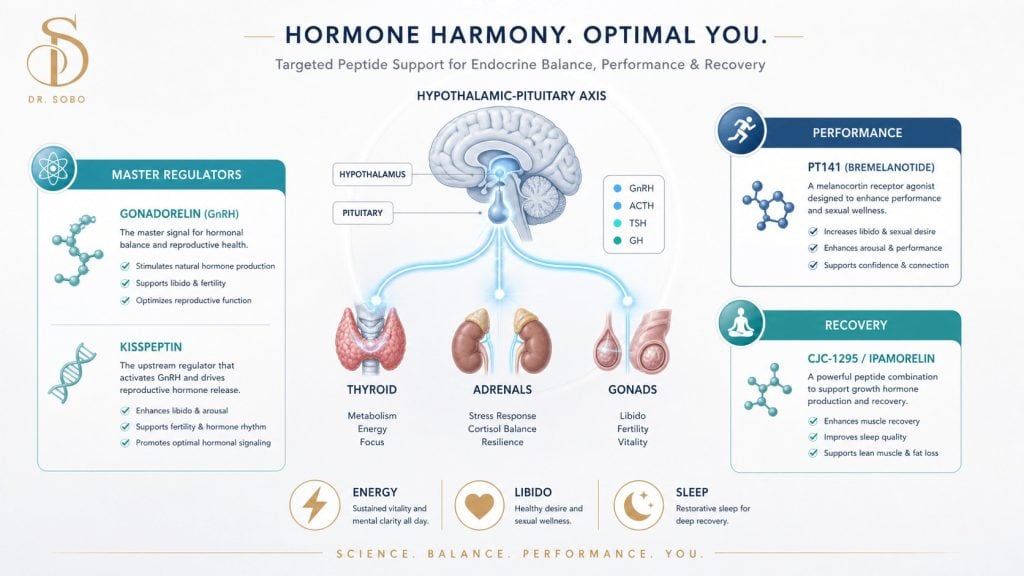
The Master Regulators: Peptides That Restore HypothalamicPituitary Signaling
Growth hormone (GH) and sex hormones do not function independently. They influence and regulate one another through a tightly connected endocrine network. Low GH levels are frequently associated with symptoms such as fatigue, reduced libido, poor recovery, loss of lean muscle mass, and unfavorable body composition—many of the same symptoms commonly seen with low testosterone or estrogen deficiency.
At the same time, improving GH signaling may enhance the responsiveness and sensitivity of the gonadal axis, helping the body regulate hormone production more efficiently.
CJC-1295 / Ipamorelin Stack
The combination of CJC-1295 and Ipamorelin, previously discussed in Part 9: Peptide Stacking for Sleep, Recovery, and Stress Resilience, is equally valuable in hormonal optimization protocols.
This stack works by increasing the body’s natural pulsatile release of growth hormone rather than supplying synthetic GH externally. By supporting physiologic GH secretion patterns, the CJC-1295/Ipamorelin combination may help improve:
- Sleep quality
- Recovery capacity
- Lean muscle preservation
- Fat metabolism
- Energy stability
- Mood and resilience
Because sleep and recovery are foundational for endocrine health, many patients notice improvements in libido, motivation, and vitality within weeks of beginning therapy—even without directly manipulating testosterone or estrogen levels.
For patients struggling with fatigue, poor recovery, or age-related hormonal decline, this stack often serves as a foundational layer within a broader peptide therapy strategy.
Tesamorelin
Tesamorelin is a growth hormone-releasing hormone (GHRH) analog originally studied for reducing visceral fat in patients with HIV-associated lipodystrophy. However, its role in hormonal health extends well beyond that specific use case.
Visceral fat is not simply stored energy—it functions as an active endocrine organ. Excess abdominal fat produces inflammatory cytokines and metabolic signals that can suppress both the growth hormone axis and the gonadal axis. This contributes to lower testosterone levels, insulin resistance, chronic inflammation, and reduced vitality.
By helping reduce visceral adiposity, Tesamorelin may indirectly improve:
- Testosterone production
- Insulin sensitivity
- Metabolic flexibility
- Energy levels
- Hormonal balance
- Body composition
For patients carrying significant abdominal fat alongside symptoms of low energy, low libido, or metabolic dysfunction, Tesamorelin can act as a powerful anchor therapy that addresses both hormonal optimization and body composition simultaneously.
This is particularly relevant for patients already addressing metabolic health, since insulin resistance and visceral fat accumulation are closely tied to hormonal decline and impaired endocrine signaling.
Rather than viewing GH support as separate from hormonal optimization, advanced peptide protocols recognize that recovery, metabolism, sleep quality, and reproductive hormones are all interconnected parts of the same physiologic system.
GHSupporting Peptides and Hormonal CrossTalk
Growth hormone (GH) and sex hormones do not operate in silos. They influence each other. Low GH is associated with reduced libido, poor body composition, and fatigue—symptoms that overlap with low testosterone or low estrogen. Conversely, optimizing GH can improve the sensitivity of the gonadal axis.
CJC 1295 / Ipamorelin Stack
This combination, discussed in Part 9: Peptide Stacking for Sleep, Recovery, and Stress Resilience, is equally relevant here. By increasing pulsatile GH release, the CJC 1295/Ipamorelin stack improves sleep quality, recovery, and lean mass—all of which support healthy hormone production. Patients often report improved libido, better mood, and more stable energy within weeks of starting this stack, even without directly manipulating sex hormones.
Tesamorelin
Tesamorelin is a GHRH analog that has been studied primarily for reducing visceral fat in HIV associated lipodystrophy. But its relevance to hormonal health is broader. Visceral fat is an endocrine organ itself, producing inflammatory cytokines that suppress both the gonadal and GH axes. By reducing central adiposity, Tesamorelin indirectly improves testosterone levels, insulin sensitivity, and overall hormonal balance. For patients with significant abdominal fat and low vitality, Tesamorelin can serve as an anchor for both body composition and hormonal restoration.
Peptides for Thyroid and Adrenal Support
Growth hormone (GH) and sex hormones do not function independently. They influence and regulate one another through a tightly connected endocrine network. Low GH levels are frequently associated with symptoms such as fatigue, reduced libido, poor recovery, loss of lean muscle mass, and unfavorable body composition—many of the same symptoms commonly seen with low testosterone or estrogen deficiency.
At the same time, improving GH signaling may enhance the responsiveness and sensitivity of the gonadal axis, helping the body regulate hormone production more efficiently.
CJC-1295 / Ipamorelin Stack
The combination of CJC-1295 and Ipamorelin, previously discussed in Part 9: Peptide Stacking for Sleep, Recovery, and Stress Resilience, is equally valuable in hormonal optimization protocols.
This stack works by increasing the body’s natural pulsatile release of growth hormone rather than supplying synthetic GH externally. By supporting physiologic GH secretion patterns, the CJC-1295/Ipamorelin combination may help improve:
- Sleep quality
- Recovery capacity
- Lean muscle preservation
- Fat metabolism
- Energy stability
- Mood and resilience
Because sleep and recovery are foundational for endocrine health, many patients notice improvements in libido, motivation, and vitality within weeks of beginning therapy—even without directly manipulating testosterone or estrogen levels.
For patients struggling with fatigue, poor recovery, or age-related hormonal decline, this stack often serves as a foundational layer within a broader peptide therapy strategy.
Tesamorelin
Tesamorelin is a growth hormone-releasing hormone (GHRH) analog originally studied for reducing visceral fat in patients with HIV-associated lipodystrophy. However, its role in hormonal health extends well beyond that specific use case.
Visceral fat is not simply stored energy—it functions as an active endocrine organ. Excess abdominal fat produces inflammatory cytokines and metabolic signals that can suppress both the growth hormone axis and the gonadal axis. This contributes to lower testosterone levels, insulin resistance, chronic inflammation, and reduced vitality.
By helping reduce visceral adiposity, Tesamorelin may indirectly improve:
- Testosterone production
- Insulin sensitivity
- Metabolic flexibility
- Energy levels
- Hormonal balance
- Body composition
For patients carrying significant abdominal fat alongside symptoms of low energy, low libido, or metabolic dysfunction, Tesamorelin can act as a powerful anchor therapy that addresses both hormonal optimization and body composition simultaneously.
This is particularly relevant for patients already addressing metabolic health, since insulin resistance and visceral fat accumulation are closely tied to hormonal decline and impaired endocrine signaling.
Rather than viewing GH support as separate from hormonal optimization, advanced peptide protocols recognize that recovery, metabolism, sleep quality, and reproductive hormones are all interconnected parts of the same physiologic system.
Differentiating Primary vs. Secondary Hormonal Dysfunction
Not all hormonal issues respond to the same approach. Understanding the level of the breakdown is essential.
Primary dysfunction means the gland itself (testes, ovaries, thyroid) is failing. The brain is sending plenty of signal, but the gland cannot respond. In this case, peptide signaling (Gonadorelin, Kisspeptin) is unlikely to work well. These patients often require hormone replacement.
Secondary dysfunction means the brain is not sending enough signal. LH/FSH are low or inappropriately normal despite low sex hormones. This is exactly where peptides like Gonadorelin and Kisspeptin shine. They can often restore natural production without exogenous hormones.
Tertiary dysfunction involves the hypothalamus failing to release GnRH. This is often stress induced, inflammation driven, or age related. Peptides that support hypothalamic health (e.g., Epitalon, DSIP, Selank) may be needed before GnRH analogs can work effectively.
This is why a thorough lab assessment—including total and free testosterone, estradiol, LH, FSH, SHBG, cortisol, DHEAS, and thyroid panel—is essential before building a hormonal stack. Guessing leads to wasted time and money.
Building Your Hormonal Health and Vitality Peptide Stack
As with every guide in this series, the best stack is organized by the patient’s dominant bottleneck.
Type 1: Low Libido and Sexual Dysfunction – CNS Driven
- Anchor: PT 141 (on demand) or Kisspeptin (cyclic)
- Support: CJC 1295/Ipamorelin for energy and recovery
- Best for: Patients with normal or mildly low sex hormones but significant loss of desire or arousal. Often stress or dopamine related.
Type 2: Secondary Hypogonadism (Low LH/FSH)
- Anchor: Gonadorelin (pulsatile protocol) or Kisspeptin
- Support: Tesamorelin if central fat is present; CJC1295/Ipamorelin for GH support
- Best for: Men with low testosterone and low or inappropriately normal LH. Also for post menopausal women with low libido and low LH.
Type 3: Post Testosterone Therapy Restart
- Anchor: Gonadorelin (to restore pituitary signaling) + hCG (optional for testicular function)
- Support: Selank + DSIP to manage the stress of withdrawal
- Best for: Patients who have been on exogenous testosterone and want to attempt natural production restoration.
Type 4: Age Related Vitality Decline (Mixed Hormonal Bottlenecks)
- Anchor: CJC1295/Ipamorelin (GH support improves everything downstream)
- Support: Tesamorelin (visceral fat) + Kisspeptin (libido)
- Best for: Patients over 45 with declining energy, body composition changes, and mild reductions in sex hormones but no clear primary hypogonadism.
Type 5: Stress Induced Hormonal Failure (High Cortisol, Low Libido, Fatigue)
- Anchor: Selank + DSIP (reset HPA axis and sleep)
- Support: BPC157 (reduce systemic inflammation) + Gonadorelin only after HPA calibration
- Best for: Burnout patients with normal labs on paper but profound loss of vitality. Treat stress first, then hormones.
Why Hormonal Peptide Stacking Is Not a Quick Fix
Patients often expect immediate results from hormonal peptides. Some—like PT141—can work in an hour. But true restoration of the hypothalamic pituitary gonadal axis takes time. Pulsatile Gonadorelin protocols typically require 6–12 weeks of consistent use before LH and testosterone rise meaningfully. Kisspeptin may produce subjective libido improvements within weeks, but lab changes take longer.
GH supporting stacks (CJC1295/Ipamorelin) usually take 3–6 months to produce sustained changes in body composition, sleep, and energy. And the HPA axis reset (Selank, DSIP) may require 8–12 weeks to fully normalize cortisol rhythms.
This timeline is actually encouraging. It means the body is learning to regulate itself again, not just being propped up by external hormones. The results are more durable and carry fewer long term risks.
The Interconnection with Other Guides in This Series
Hormonal health is not a standalone topic. It appears throughout this series because it underpins everything:
- A fatigue patient (Part 1) may have low cortisol or low thyroid.
- An injury patient (Part 2) heals poorly when growth hormone or sex hormones are low.
- An anti aging patient (Part 3) is really trying to preserve hormonal signaling.
- A strength patient (Part 4) cannot build muscle without adequate androgens and GH.
- A body recompositionpatient (Part 5) struggles when cortisol drives central fat.
- A metabolic healthpatient (Part 6) has insulin resistance linked to low testosterone.
- A cognitive performancepatient (Part 7) needs sex hormones for dopamine and focus.
- A gut immune patient (Part 8) suffers systemic inflammation that suppresses the HPG axis.
- A sleep/recoverypatient (Part 9) cannot normalize hormones without deep sleep.
This is why a comprehensive evaluation—looking at fatigue, recovery, body composition, cognition, gut health, sleep, and stress—almost always leads back to hormonal health. And why peptide stacking, done correctly, addresses the root cause rather than just the symptom.
Final Takeaway
Hormonal health is the silent foundation of vitality, libido, energy, and resilience. When the hypothalamic pituitary signaling systems become inefficient, patients suffer from a slow, frustrating decline that is often misattributed to aging alone. Peptide therapy offers a unique way to restore these signaling pathways—not by replacing hormones from the outside, but by helping the brain and endocrine glands communicate as they did when the patient was younger.
By using gonadorelin, kisspeptin, or PT141 for the reproductive axis, GHsupporting stacks (CJC1295/Ipamorelin, Tesamorelin) for metabolic and tissue support, and stress modulating peptides (Selank, DSIP) for HPA axis balance, Connecticut patients can often regain natural hormone production without lifelong replacement therapy.
The best hormonal stack is never chosen from a list of popular names. It is built after a thorough lab assessment and clinical evaluation to identify whether the bottleneck is at the hypothalamus, pituitary, gonad, or adrenal gland. Then the stack is anchored to that specific level of dysfunction, with support layers added only when they solve a different problem.
For many patients, restoring hormonal health is the key that unlocks meaningful progress in every other area of their lives—energy, mood, libido, body composition, and long term resilience.
FAQ
What is a peptide stack for hormonal health and vitality?
A peptide stack for hormonal health is a personalized combination of peptides designed to support the hypothalamic pituitary axes (reproductive, thyroid, adrenal, and growth hormone). Unlike direct hormone replacement, these peptides work by restoring the body’s own signaling pathways, helping the brain and endocrine glands communicate more effectively. This approach preserves natural feedback loops and circadian rhythms, leading to more durable improvements in libido, energy, body composition, and overall vitality.
Which peptide is best for low libido?
PT141 (Bremelanotide) is the most direct peptide for sexual desire and arousal. It acts on melanocortin receptors in the brain and is FDA approved for hypoactive sexual desire disorder (HSDD) in premenopausal women. In men, it is used off label for erectile dysfunction and low libido. PT141 is typically used on demand, with effects lasting 6–12 hours. For longer term libido restoration, Kisspeptin or Gonadorelin may be preferred because they increase natural LH and testosterone production.
Can peptides increase testosterone naturally?
Yes, but only in cases of secondary hypogonadism (where the brain is not sending enough LH/FSH signal). Gonadorelin (GnRH) and Kisspeptin both stimulate the pituitary to release LH, which then signals the testes to produce testosterone. These peptides do not work in primary hypogonadism (testicular failure). A baseline lab panel measuring total testosterone, free testosterone, LH, and FSH is essential before starting.
What is the difference between Gonadorelin and Kisspeptin?
Gonadorelin is synthetic GnRH—it directly stimulates the pituitary to release LH and FSH. Kisspeptin acts upstream of GnRH, stimulating the hypothalamus to release GnRH. Kisspeptin is often considered more physiologic because it preserves the natural feedback loops that control GnRH pulsatility. In clinical practice, Gonadorelin is more commonly used in restart protocols after exogenous testosterone, while Kisspeptin is sometimes preferred for patients with mild low libido and normal LH.
Does PT141 work for women?
Yes. PT141 (Bremelanotide) is FDA approved specifically for premenopausal women with acquired, generalized hypoactive sexual desire disorder (HSDD). It has been shown to increase the number of satisfying sexual events and reduce distress related to low desire. It is administered as a subcutaneous injection about 45 minutes before anticipated sexual activity. Side effects include nausea (which often diminishes with use) and transient flushing.
Can peptides help with perimenopause or menopause symptoms?
Indirectly, yes. Peptides like Kisspeptin and Gonadorelin can stimulate residual ovarian function in early perimenopause, potentially improving libido and mood. However, in late perimenopause or post menopause, the ovaries may no longer respond to LH/FSH. In those cases, GH supporting stacks (CJC1295/Ipamorelin) can improve energy, body composition, and sleep quality, which often reduces the burden of menopausal symptoms. For severe vasomotor symptoms (hot flashes), hormone replacement therapy remains the standard of care.
Is the CJC1295 / Ipamorelin stack useful for hormonal health?
Absolutely. Growth hormone and sex hormones are synergistic. Low GH is associated with low libido, poor recovery, and central fat accumulation—all of which worsen sex hormone profiles. By improving GH pulsatility, the CJC1295/Ipamorelin stack enhances sleep quality, lean mass, and metabolic health, creating a favorable environment for the gonadal axis to function. Many patients report improved libido and energy within weeks of starting this stack, even before direct sex hormone modulation.
Does Tesamorelin affect hormones other than growth hormone?
Tesamorelin is a GHRH analog that primarily increases GH, but its effects on visceral fat reduction have secondary hormonal benefits. Visceral fat produces inflammatory cytokines that suppress both the HPG axis (lowering testosterone) and the GH axis. By reducing central adiposity, Tesamorelin can indirectly raise testosterone and improve insulin sensitivity. It is particularly useful for patients with significant abdominal obesity and low vitality.
How long does it take for hormonal peptide stacks to work?
It depends on the peptide and the patient’s baseline. PT141 works within an hour (on demand). Kisspeptin may produce subjective improvements in libido within 2–4 weeks. Gonadorelin pulsatile protocols usually require 6–12 weeks to raise LH and testosterone significantly. GH stacks (CJC1295/Ipamorelin) take 3–6 months for sustained changes in body composition and energy. Stress modulating peptides (Selank, DSIP) often produce noticeable improvements in sleep and anxiety within days to weeks, but full HPA reset can take 8–12 weeks.
Are these peptides safe for longterm use?
Most hormonal signaling peptides are used in cycles (e.g., 3–6 months followed by a break) to prevent desensitization. Gonadorelin and Kisspeptin are generally well tolerated when used under medical supervision. PT141 is not intended for daily use; it is an on demand therapy. GH supporting stacks (CJC1295/Ipamorelin) can be used for longer periods (6–12 months) with monitoring of IGF1 levels to avoid supraphysiologic GH. Safety and monitoring should always be managed by a qualified practitioner.
Do I need lab testing before starting a hormonal peptide stack?
Yes—this is non negotiable. A proper hormonal stack requires a baseline assessment of total testosterone, free testosterone, estradiol (sensitive), LH, FSH, SHBG, DHEAS, cortisol (AM and possibly evening), TSH, free T3, free T4, and a complete metabolic panel. Without this data, you cannot distinguish primary from secondary dysfunction, and you may waste time on the wrong anchor peptide. Many patients have tried “testosterone boosters” for years without success because they never measured LH.
Why is stress management included in a hormonal health stack?
Because chronic stress elevates cortisol, and cortisol directly suppresses GnRH release from the hypothalamus. High cortisol at night also disrupts deep sleep, which is when LH and GH pulses normally occur. Addressing stress (via Selank, DSIP, and lifestyle changes) is often a prerequisite for any gonadal or GH peptide to work. Trying to raise testosterone while cortisol remains high is like trying to fill a bucket with a hole in the bottom.
Sources
- Peptide Stacking for Fatigue in Connecticut | Dr. Sobo Guide #1
- Injury Healing Peptide Stacking in Connecticut | Dr. Sobo Guide #2
- Anti-Aging Peptide Stack Guide Part 3 of 11
- Strength and Muscle Peptide Stacking Guide Part 4 of 11 | Dr. Sobo
- Body Recomposition Peptide Stack Guide Part 5 of 11 | Dr. Sobo Connecticut
- Peptide Stacking for Metabolic Health in CT | Dr. Sobo Guide Part 6 of 11
- Peptide Stacking for Cognitive Performance & Brain Health | Dr. Sobo Guide Part 7 of 11
- Peptide Stacking for Gut Health & Immune Support | Dr. Sobo Guide Part 8 of 11
- Peptide Stacking for Sleep, Recovery & Stress | Dr. Sobo Guide Part 9 of 11
- Peptide Stacking | Dr. Sobo
- Peptides | Dr. Sobo | Connecticut
- CJC 1295 / Ipamorelin stack Stamford CT
- Kisspeptin, a potential therapeutic target for female reproductive dysfunction
- Bremelanotide (PT 141) for hypoactive sexual desire disorder
- Gonadorelin versus hCG for testosterone restoration after anabolic steroid use
- Tesamorelin reduces visceral fat and improves metabolic profile
