
By Dr. Henry Sobo, MD – Peptide Stacking Connecticut
#2 Injury Healing and Repair Stacking Guide
Injury healing is one of the clearest reasons patients become interested in peptide stacking therapy. When someone is dealing with a tendon strain, ligament injury, muscle tear, post-surgical recovery, chronic overuse pain, or slow tissue healing, the goal is not just to “feel better.” The goal is to help the body repair damaged tissue as efficiently and intelligently as possible.
That is where stacking becomes important.
Healing is not one single event. It is a coordinated biologic process that includes inflammation control, blood-vessel formation, fibroblast activity, collagen production, tissue remodeling, and gradual recovery of function. Different peptides may support different parts of that process, which is why a personalized stack can make more sense than relying on a single agent. Your brief frames this injury-repair topic around BPC-157, TB-500 / Thymosin Beta-4, growth-hormone-supporting peptides such as CJC-1295, Sermorelin, Ipamorelin, and Tesamorelin, along with GHK-Cu.
For Connecticut patients researching healing peptides, that is the central idea:
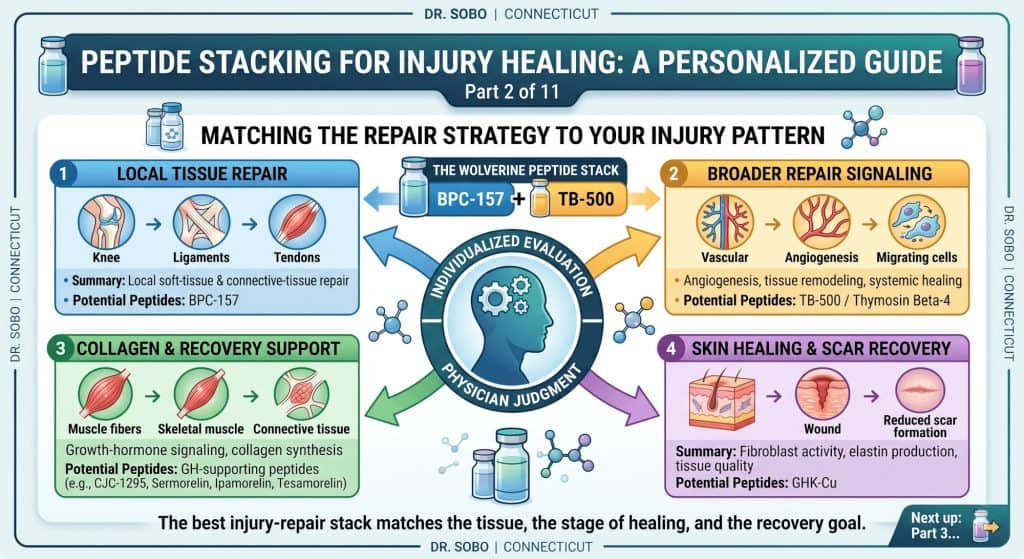
The best injury-repair stack is not the most hyped one. It is the one that matches the tissue, the stage of healing, and the recovery goal.
What is peptide stacking for injury healing?
Peptide stacking for injury healing means combining therapies that may support different aspects of tissue repair instead of treating every injury as if it needs the same kind of help. Depending on the injury, the stack may be built to support:
- local tissue repair
- angiogenesis and blood flow
- collagen production and remodeling
- fibroblast activity
- tendon and ligament healing
- muscle recovery
- anti-catabolic support during inactivity
- wound healing and scar-conscious recovery
- post-procedure recovery support
That is why injury healing is such a natural fit for peptide stacking therapy. Tissue repair is multi-step biology, not a one-step event.
What is the best peptide stack for injury healing?
There is no single best injury-healing stack for every patient. The most appropriate combination depends on whether the main goal is tendon repair, ligament recovery, muscle healing, skin or wound support, post-surgical recovery, or broader connective-tissue remodeling. In many healing conversations, BPC-157 and TB-500 / Thymosin Beta-4 are central, while GH-supporting peptides and GHK-Cu may be layered in depending on the patient’s needs.
Why injury recovery should never be treated like one generic problem
A tendon injury is not the same as a muscle tear. A ligament sprain is not the same as post-surgical healing. A wound-healing problem is not the same as a chronic overuse issue. A patient who is worried about scar quality may need a different strategy than one who is worried about muscle loss during downtime.
That is why generic advice often falls short.
A better question is not just, “What peptide heals injuries?”
A better question is:
What kind of repair support does this injury need most right now?
Some injuries need more help with angiogenesis and blood flow. Some need more collagen support. Some need broader tissue-remodeling support. Some need help preserving recovery capacity during inactivity. Some need better skin and connective-tissue quality during healing.
That is exactly why physician-guided stacking matters.
The four main repair patterns that shape peptide stack selection
- Local tissue repair and soft-tissue recovery
This is the category where BPC-157 usually becomes a central part of the conversation. It’s one of the best-known and longest-used peptides in regenerative medicine and highlights its use in muscles, joints, tendons, ligaments, and gastrointestinal healing.
The evidence base for BPC-157 remains much stronger in preclinical literature than in large human trials, but review articles describe it as being studied across tendon, ligament, muscle, bone, GI, and wound-healing models. A recent systematic review in orthopaedic sports medicine also concluded that most of the evidence remains preclinical and that human safety data are still limited.
Here are several mechanisms that make BPC-157 attractive in healing discussions:
- angiogenesis support
- VEGF-related activity
- improved blood flow to damaged tissues
- collagen and fibroblast support
- nitric oxide pathway involvement
- faster functional recovery after tissue damage
Those themes are reflected in mechanistic literature that links BPC-157 to angiogenic signaling and tissue-healing pathways.
What does BPC-157 do for injury healing?
BPC-157 is commonly discussed for injury healing because research literature describes it in connection with angiogenesis, fibroblast activity, nitric-oxide-related signaling, and healing support in tendon, ligament, muscle, bone, and GI tissue models. Its reputation in regenerative medicine is strong, but the highest-quality human clinical data are still limited, so claims should stay measured.
When BPC-157 fits best
- tendon and ligament strains
- muscle injuries
- soft-tissue healing discussions
- overuse injuries
- GI-healing discussions
- cases where localized repair support is a priority
- Broader repair signaling, angiogenesis, and tissue remodeling
This is where TB-500 / Thymosin Beta-4 becomes especially important. Your brief describes it as a thymus-derived peptide with a role in tissue repair, angiogenesis, inflammation control, apoptosis regulation, and cell proliferation across different sites in the body.
That framing is consistent with review literature on thymosin beta-4. Recent reviews describe Tβ4 as a multifunctional peptide involved in cell migration, angiogenesis, inflammation modulation, oxidative-stress responses, apoptosis-related signaling, and tissue repair across dermal, ocular, and other injury models.
This is one reason TB-500 is often thought of as the more system-wide partner in an injury-repair stack.
What does TB-500 do in an injury-repair stack?
TB-500, the synthetic-use name commonly associated with thymosin beta-4, is often discussed as a broader recovery-support peptide because Tβ4 has been studied for cell migration, angiogenesis, inflammation modulation, apoptosis regulation, and wound-healing support. It is commonly paired with more localized repair strategies when the goal is broader tissue-recovery signaling.
When TB-500 fits best
- broader soft-tissue recovery discussions
- systemic repair support
- healing plans involving angiogenesis and tissue remodeling
- recovery support around PRP or regenerative care
- overuse injuries with lingering tissue stress
- Recovery support through growth-hormone signaling
Your brief specifically recommends stacking injury-repair peptides with GH secretagogues such as CJC-1295, Sermorelin, Ipamorelin, and Tesamorelin.
This makes sense biologically because GH-related pathways are relevant to connective-tissue physiology. Human research has shown that increased GH availability can stimulate collagen synthesis in tendon and skeletal muscle connective tissue. Reviews on growth hormone secretagogues also discuss their roles in endogenous GH release and tissue-recovery-related physiology.
That does not mean GH-supporting peptides are a universal answer for every injury. It means they may become more relevant when the healing goal includes connective-tissue recovery, collagen support, or maintaining muscle during downtime.
Can growth-hormone peptides help with healing?
Growth-hormone-supporting peptides are often included in injury-recovery conversations because GH is linked to collagen synthesis and connective-tissue physiology. Human studies show increased GH availability can stimulate matrix collagen synthesis in skeletal muscle and tendon, which helps explain why these therapies are discussed for recovery, remodeling, and tissue support.
When GH-supporting peptides fit best
- tendon and ligament recovery discussions
- post-surgical recovery planning
- muscle preservation during inactivity
- connective-tissue remodeling support
- patients concerned about slower recovery with age
- anti-catabolic support during periods of reduced training or immobilization
- Skin healing, collagen remodeling, and scar-conscious recovery
This is where GHK-Cu becomes especially useful in the discussion. Your brief emphasizes fibroblast stimulation, collagen and elastin production, angiogenesis, skin healing, tissue quality, and reduced scar formation.
Those themes are well supported by review literature. GHK-Cu has been described as a naturally occurring copper-binding peptide associated with wound healing, fibroblast activity, collagen remodeling, glycosaminoglycan activity, angiogenesis-related effects, and skin regeneration. Reviews also discuss its effects on multiple cellular pathways involved in tissue repair.
What is GHK-Cu used for in healing discussions?
GHK-Cu is commonly discussed for wound healing, skin repair, fibroblast activation, collagen remodeling, elastin support, and connective-tissue quality. It is especially relevant when the goal is not just basic healing, but better tissue quality, skin recovery, or scar-conscious repair.
When GHK-Cu fits best
- skin wounds and cuts
- scar-related healing support
- connective-tissue remodeling discussions
- collagen and elastin support
- skin-quality improvement after injury or procedures
- certain tendon, ligament, and soft-tissue discussions where tissue quality matters

HAVE QUESTIONS ABOUT Peptide stacking for Injury Healing and Repair?
If you are researching peptides, and reside in Connecticut, Greenwich, or Norwalk area, contact us today for a Personalized Consultation. We focus on combining safe, effective medication with a realistic lifestyle plan.
For broader options, see our Conditions Treated page.
Why BPC-157 and TB-500 are so often discussed together
One of the strongest points in your source brief is that BPC-157 and TB-500 are frequently used together, and that this pairing has become widely known through the “Wolverine” nickname.
That pairing became popular for a simple reason: each peptide is commonly described as supporting a different side of the repair equation.
- BPC-157 is often discussed as a more localized tissue-repair option
- TB-500 / Thymosin Beta-4 is often discussed as a broader tissue-remodeling and migration-support option
That is not a guarantee that every injury needs both. It does explain why the stack has become one of the best-known combinations in regenerative and sports-recovery discussions.
Why are BPC-157 and TB-500 often stacked together?
They are often stacked because they are thought to support complementary parts of healing. BPC-157 is commonly associated with localized soft-tissue and connective-tissue repair, while TB-500 is commonly associated with broader repair signaling, cell migration, and angiogenesis. That makes the combination intuitive in injury-recovery discussions.
The Wolverine stack and why patients keep searching for it
Your brief references The Wolverine Peptide Stack – Faster Recovery, Less Pain, Better Healing, and that is strategically important because many patients already know the nickname.
The reason the “Wolverine” name stuck is simple: it offers a memorable label for the BPC-157 plus TB-500 combination. From a content strategy perspective, this matters because users search those terms directly. From a patient-education perspective, the more important message is that the nickname should never replace clinical judgment. The name is memorable. The evaluation is what matters.
What is the Wolverine peptide stack?
The Wolverine stack is the nickname commonly used for stacking BPC-157 with TB-500 / Thymosin Beta-4 for injury recovery and healing support. The idea is that BPC-157 may support local tissue repair while TB-500 may support broader repair signaling and remodeling.
How the main peptides fit into an injury-healing stack
Best discussed for:
- tendon and ligament support
- muscle recovery
- localized repair support
- overuse injuries
- GI-healing discussions
Best discussed for:
- broader tissue recovery
- systemic healing support
- angiogenesis and migration-related healing discussions
- soft-tissue remodeling
- regenerative support strategies
CJC-1295, Sermorelin, Ipamorelin, and Tesamorelin
Best discussed for:
- connective-tissue support
- collagen-related recovery
- anti-catabolic support during inactivity
- post-surgical recovery discussions
- recovery capacity during long healing windows
Best discussed for:
- skin healing
- tissue-quality improvement
- scar-conscious recovery
- collagen remodeling
- fibroblast activity and connective-tissue quality
Comparison Table: Best peptide category by injury-healing goal
Healing Goal | Most Relevant Discussion Category | Common Examples |
Local soft-tissue repair | Tissue-focused repair support | |
Broader recovery and remodeling | Systemic repair signaling | |
Collagen support and anti-catabolic recovery | GH-related recovery support | |
Skin repair and scar-conscious healing | Collagen remodeling and fibroblast support |
Comparison Table: BPC-157 vs TB-500
Therapy | Main Discussion Angle | Best Fit |
Localized connective-tissue and soft-tissue repair | Tendons, ligaments, muscle recovery | |
Broader tissue remodeling and migration support | More systemic recovery discussions | |
Stacked together | Complementary repair strategy | When both local and broader repair support are desired |
Comparison Table: GHK-Cu vs GH secretagogues
Option | Main Healing Focus | Best Use Case |
Collagen remodeling, wound healing, skin quality | Skin healing, scar support, tissue-quality goals | |
GH-supporting peptides | Recovery capacity, collagen synthesis, anti-catabolic support | Broader recovery, connective-tissue support, inactivity periods |
Why physician-guided healing plans matter
Injury-healing stacks should not be built around hype alone. A useful plan should consider:
- what tissue is injured
- how severe the injury is
- whether healing is acute, delayed, or chronic
- whether the patient is post-surgical or post-procedure
- whether pain, function, remodeling, or scar quality matters most
- whether the patient is immobilized or less active than usual
- whether tendon, ligament, muscle, skin, or GI recovery is the dominant issue
That is where Dr. Sobo’s role becomes important. The value is not just knowing the names of the peptides. The value is matching the repair strategy to the injury pattern.
Connecticut patients should think about function, not just faster healing
For Connecticut patients searching peptides for injury healing, BPC-157 for tendon repair, TB-500 for recovery, or best peptide stack for ligament healing, the real question is not just how quickly healing can happen. The better question is how well the tissue heals and whether the stack supports the kind of recovery that matters most for long-term function.
A tendon that heals poorly is still a problem. A wound that closes without quality remodeling may still leave issues. A patient who loses too much strength during downtime may have a longer road back even after the tissue itself improves.
That is why personalized stacking matters.
Final takeaway
The best peptide stack for injury healing is not based on internet popularity. It is based on the biology of repair.
If the main need is local soft-tissue healing, BPC-157 may be central to the discussion. If broader tissue-remodeling support is needed, TB-500 / Thymosin Beta-4 may make sense. If connective-tissue recovery and preserving recovery capacity matter, GH-supporting peptides may belong in the plan. If skin healing, collagen quality, and scar-conscious repair are part of the goal, GHK-Cu may deserve a larger role.
That is what makes peptide stacking therapy so useful in injury recovery: the stack can be matched to the tissue, the stage, and the healing objective.
Frequently Asked Questions (FAQs)
What is the best peptide stack for injury healing?
There is no universal best stack. The most appropriate plan depends on whether the injury involves tendon, ligament, muscle, skin, wound healing, post-surgical recovery, or broader connective-tissue remodeling.
Why are BPC-157 and TB-500 often used together?
They are commonly discussed together because BPC-157 is often framed as more localized tissue support, while TB-500 is often framed as broader recovery and remodeling support.
Is BPC-157 mainly used for tendons and ligaments?
That is one of the most common ways it is discussed, though research has also explored its role in muscle, bone, GI, and other tissue models. Much of the evidence remains preclinical.
What makes TB-500 different from BPC-157?
TB-500 is more often discussed in relation to cell migration, angiogenesis, and broader tissue-repair signaling, while BPC-157 is more often discussed for localized tissue-repair support.
Can growth-hormone peptides support injury recovery?
They are often discussed in healing plans because GH-related pathways are linked to connective-tissue physiology and collagen synthesis. Human studies support that GH can stimulate collagen synthesis in tendon and skeletal muscle connective tissue.
Why would GHK-Cu be used in a healing stack?
GHK-Cu is often discussed when wound healing, skin repair, fibroblast activity, collagen remodeling, and tissue quality are important goals.
Can peptide stacking help after surgery?
It is often discussed in post-surgical recovery conversations, especially when the goals include connective-tissue support, collagen remodeling, recovery capacity, and limiting loss of muscle or function during downtime.
Can peptides be used with PRP or regenerative procedures?
Your source notes specifically discuss BPC-157 and TB-500 alongside PRP and stem-cell-related regenerative care. That is a common topic in peptide-repair discussions.
What is the Wolverine peptide stack?
It is the nickname for stacking BPC-157 with TB-500 / Thymosin Beta-4 for injury-recovery support.
Is injury healing the same as pain relief?
No. Pain relief and healing overlap, but they are not the same. A useful recovery plan should focus on tissue repair, remodeling quality, return of function, and the broader healing environment.
Why is connective-tissue support so important in injury recovery?
Because tendons, ligaments, fascia, skin, and the extracellular matrix all depend heavily on collagen quality, fibroblast activity, remodeling, and blood supply during recovery.
Why does physician guidance matter with healing peptides?
Because tendons, ligaments, fascia, skin, and the extracellular matrix all depend heavily on collagen quality, fibroblast activity, remodeling, and blood supply during recovery.
More Helpful Articles
REDEFINE 4 Results: CagriSema vs. Tirzepatide, Weight Loss, and FDA Status
Phase 3 head-to-head results and an anticipated late-2026 FDA decision create strong news and comparison intent. This article was evidence-checked on September 6, 2026. Regulatory status, labels, and trial publications
GLP-1 Medications and Vision Changes: NAION, Retinopathy, and Warning Signs
Regulatory safety updates and new observational research are driving urgent patient questions about vision loss. This article was evidence-checked on September 6, 2026. Regulatory status, labels, and trial publications can
GLP-1 Microdosing: Evidence, Risks, and What “Low Dose” Really Means
Evidence review date: September 6, 2026. GLP-1 microdosing has attracted substantial consumer and telehealth interest, but direct clinical-trial evidence remains limited. Medication approvals, prescribing information, safety communications, and clinical evidence
Sources
- Peptide Stacking Therapy in Connecticut
- How Peptide Stacking Therapy Is Personalized: A Connecticut Patient’s Guide
- BPC-157 Peptide Therapy
- TB-500 / Thymosin Beta-4
- Wolverine Peptide Stack – Faster Recovery, Less Pain, Better Healing
- CJC-1295 Peptide Therapy
- Sermorelin Peptide Therapy
- Ipamorelin Peptide Therapy
- Tesamorelin Peptide Therapy
- GHK-Cu Peptide Therapy
- Emerging Use of BPC-157 in Orthopaedic Sports Medicine: A Systematic Review
- Tendon, Ligament, and Muscle Injury Therapy Perspectives with Growth Factors and Stable Gastric Pentadecapeptide BPC 157—A Review
- Progress on the Function and Application of Thymosin β4
- The Regenerative Peptide Thymosin β4 Accelerates the Rate of Dermal Healing
- Growth Hormone Stimulates the Collagen Synthesis in Human Tendon and Skeletal Muscle
- Tendon and Skeletal Muscle Matrix Gene Expression and Functional Responses to Immobilisation and Rehabilitation: Effect of Growth Hormone Administration
- Regenerative and Protective Actions of the GHK-Cu Peptide in the Light of the New Gene Data
- GHK Peptide as a Natural Modulator of Multiple Cellular Pathways in Skin Regeneration
