
By Dr. Henry Sobo, MD – Peptide Stacking Connecticut
Part 6 Peptide Stacking for Metabolic Health in Connecticut
If you have been following this peptide stack series, you have already seen how stacking changes based on the patient’s true bottleneck. In Part 1: Peptide Stacking for Fatigue in Connecticut, the core issue was energy production and recovery. In Part 2: Injury Healing Peptide Stacking in Connecticut, the real obstacle was tissue repair and staying active long enough to heal well. In Part 3: Anti-Aging Peptide Stack Guide, the discussion centered on resilience, recovery, body composition, and the systems that often decline with age. By the time patients reach this topic, the question usually becomes more specific: what if the real issue is metabolic health?
That question matters because “metabolic health” is often used as a catch-all phrase when the real problem is more complex. A patient may say they want to lose weight, but the deeper issue may be insulin resistance, central fat, poor appetite signaling, low exercise tolerance, fatigue after meals, or a body that seems to resist change despite real effort. Another patient may think they need a stronger fat-loss plan when the actual problem is that their metabolic flexibility is poor, their sleep is fragmented, their recovery is weak, and they cannot sustain the kind of training that would protect lean mass during fat loss. Peptide stacking becomes useful only when those differences are identified and treated strategically.
This is why metabolic health deserves its own guide in the series. The best peptide stack for metabolic health is rarely just a “weight-loss stack.” It is often a structured plan built around the dominant metabolic obstacle, then supported with therapies that improve recovery, preserve function, and help the patient create a healthier body composition over time. The goal is not simply a lower number on the scale. It is a body that handles energy, food, recovery, and activity more effectively than before.
What metabolic health really means
Metabolic health is about how well the body produces, stores, and uses energy. In practical terms, it affects blood sugar handling, appetite regulation, fat storage, recovery, energy stability, and the ability to maintain a healthier body composition over time. Patients often notice poor metabolic health before they know what to call it. They describe it as stubborn weight gain, abdominal fat that does not respond, strong cravings, energy crashes after eating, lower stamina, poor recovery, or a body that seems to get “stuck” in fat-storage mode.
This is part of why so many peptide discussions start with body composition and then end up circling back to metabolism. Weight change is often the visible symptom. Metabolic dysfunction is often the real driver. A patient may be training consistently and eating better than before, yet still feel like progress is slow, fragile, or incomplete. When that happens, the question is not just “How do I lose weight?” It becomes “What is blocking my body from using energy and adapting normally?”
From a stacking perspective, that is a major distinction. If the true metabolic issue is central fat and appetite dysregulation, one type of anchor may make the most sense. If the patient’s real issue is weak recovery, low exercise tolerance, and poor GH-related support, a different anchor may fit better. If the patient’s real issue is fatigue and low metabolic output, mitochondrial support may matter more than simply adding another appetite-focused therapy. This is why metabolic stacking is so often misunderstood. Patients hear “metabolic health” and assume there is one best answer. There is not.
Why metabolic health and weight loss are not the same thing
Weight loss and metabolic health overlap, but they are not identical. A patient can lose weight in a way that makes metabolic health worse if too much lean tissue is lost, recovery becomes poor, and the body becomes more stressed rather than more resilient. On the other hand, a patient can improve metabolic health even before dramatic scale changes happen if appetite stabilizes, energy becomes more consistent, visceral fat begins to improve, and the body responds more normally to food and activity.
This is why a good metabolic plan usually aims beyond short-term weight reduction. A healthier metabolism supports better long-term fat loss, better muscle preservation, better training tolerance, and a lower chance of quickly regaining what was lost. For many patients, the biggest win is not just seeing the scale move. It is feeling like the body has stopped fighting every healthy change.
That is also why peptide stacking needs to be more thoughtful in this area. A therapy that suppresses appetite may help, but if the patient loses lean tissue, cannot recover, and becomes weaker over time, the metabolic result may be less impressive than it first appears. The best metabolic stack supports the quality of the outcome, not just the speed.
The real bottlenecks in metabolic health
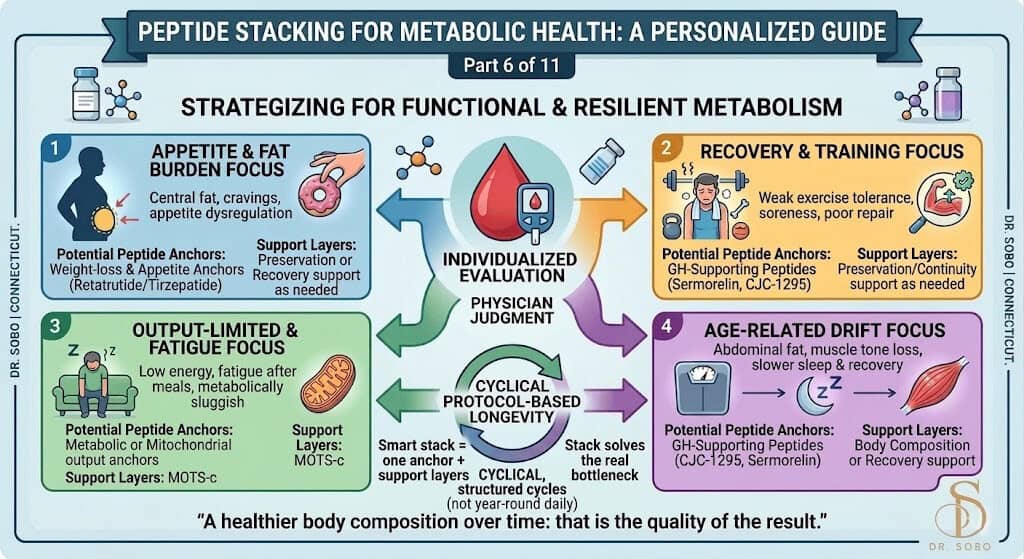
Patients often come in saying they have a metabolism problem, but those problems usually fall into a few recognizable categories. The first is appetite and body-fat burden. The patient feels hungry too often, struggles with cravings, gains weight centrally, and finds it difficult to maintain a steady calorie deficit without feeling depleted. In that case, the stack may need a stronger appetite and body-composition anchor.
The second bottleneck is poor metabolic flexibility. This patient may not necessarily be eating dramatically more than everyone else, but they feel energy crashes, sluggishness after meals, low stamina, and difficulty switching between fuel sources. They may feel like even modest activity takes too much effort. In that case, metabolic support and mitochondrial support become much more relevant.
The third bottleneck is poor recovery and weak training response. This patient wants better body composition and better metabolic health, but every attempt at exercise leaves them drained, inflamed, or under-recovered. They may not need a stronger weight-loss push as much as they need a better repair-and-adapt environment.
The fourth bottleneck is age-related body composition drift. This patient may notice more fat, less muscle tone, poorer sleep, slower recovery, and a body that no longer responds to the same habits that worked years ago. In that case, GH-related support may belong near the center of the conversation.
This is exactly why a metabolic peptide stack should never be chosen from a list of trendy names. It should be organized around the dominant reason the metabolism is underperforming.
The anchor-first strategy for metabolic stacking
A smart metabolic health stack usually starts with one anchor. The anchor is the therapy category that addresses the patient’s biggest metabolic obstacle. This could be a body-fat and appetite anchor, a GH-support anchor, or a metabolic-output anchor. The rest of the stack should only be added if it solves a different and clearly defined problem.
For example, a patient with significant central fat and appetite dysregulation may need a body-composition-first anchor. A patient with declining body composition, weaker recovery, and age-related loss of training response may need GH-axis support as the center of the plan. A patient who knows what to do but cannot produce enough sustained physical output may need metabolic and mitochondrial support to make the rest of the plan actually work.
This anchor-first model matters because overlap is one of the most common stacking mistakes. When patients combine therapies that all aim at roughly the same problem while ignoring the real bottleneck, the result is often more expensive and less effective. The stack works best when each layer has a distinct role.
Weight-loss and appetite-focused anchors
When the dominant metabolic problem is appetite dysregulation, central fat, or body-fat burden that is preventing meaningful progress, a weight-loss-oriented anchor often makes the most sense. This is where the discussion naturally overlaps with Peptide Therapy Weight Loss in Connecticut. The patient may not just want to weigh less. They may want less central fat, fewer cravings, better control over food noise, and a body that stops drifting back toward excess fat storage.
This kind of anchor is especially helpful when the patient’s body composition goal has repeatedly failed because hunger, overeating, or poor appetite signaling keeps undoing the plan. In those cases, better appetite control can create the foundation that allows other changes to finally work. It can become easier to train consistently, easier to improve food quality, and easier to preserve lean mass because the patient is no longer fighting the same level of metabolic resistance.
This does not mean a weight-loss anchor is enough by itself. Some patients still need recovery support, GH-related support, or healing support to make the result healthier and more sustainable. But when body-fat burden is the main obstacle, ignoring it usually makes the whole stack weaker.
GH-supporting peptides and metabolic health
GH-supporting peptides often matter in metabolic stacking because metabolism is not only about appetite. It is also about body composition, tissue quality, recovery, sleep, and the body’s ability to adapt to effort. This is one reason CJC-1295 for Men and related GH-supportive discussions appear so often in patients who are concerned about body composition and energy at the same time.
For patients with age-related decline in recovery, weaker exercise response, lower muscle tone, and a general sense that their body no longer responds well to healthy habits, GH-supporting peptides may help create a more favorable metabolic environment. This is particularly useful when the patient’s “metabolic problem” is actually a combination of central fat, lean-mass loss, weak recovery, and lower vitality.
This is also why a purely appetite-focused stack can sometimes miss the bigger picture. If the patient loses weight but becomes weaker, less active, and less metabolically resilient, the result may not actually be better. GH-related support can be important when preserving function and tissue quality is central to the goal.
CJC-1295 and the metabolic-recovery connection
CJC-1295 belongs in metabolic health discussions because patients often underestimate how much recovery affects metabolism. A body that is always under-recovered tends to move less, train less effectively, and preserve lean mass less efficiently. Over time, that influences body composition and metabolic output.
This matters because metabolic health is not just chemistry. It is also behavior made easier or harder by physiology. A patient who recovers better may be more active, less inflamed, and more likely to preserve lean tissue during body-fat reduction. That can change the entire metabolic outcome. In that sense, CJC-1295 may not be a direct “fat-loss therapy,” but it can still be an important metabolic stack component when poor recovery is quietly driving the whole problem.
Sermorelin and age-related metabolic drift
Sermorelin often fits the metabolic-health conversation when the patient is dealing with age-related decline in vitality, recovery, muscle tone, and body composition. These patients frequently describe the same pattern: more abdominal fat, less muscle quality, weaker workouts, poorer recovery, worse sleep, and a body that just feels older than expected.
In that situation, the problem is not simply calories. The problem is that the internal environment has shifted in a direction that makes fat gain easier and healthy adaptation harder. Sermorelin may fit a plan like this because the patient often needs more than appetite control. They need a body that is more capable of using the basics well again.
Mitochondrial and endurance support for metabolic output
Not every metabolic patient needs stronger appetite support. Some already eat fairly well and still feel sluggish, easily fatigued, and unable to sustain exercise. Their body-composition challenge is often tied to weak metabolic output rather than only excess input. This is where the logic from Part 1: Peptide Stacking for Fatigue in Connecticut becomes relevant again.
When fatigue and low exercise tolerance are major obstacles, mitochondrial and endurance-supportive therapies may matter more. These patients often know what they should be doing, but their body does not provide enough stable energy to do it consistently. In those cases, the stack may need to support metabolic flexibility and activity tolerance rather than only suppressing appetite.
This is a key metabolic-health insight. A better metabolism is not only one that stores less fat. It is also one that can produce enough usable energy to support movement, recovery, and adaptation. If the patient cannot generate enough consistent output, body composition usually suffers.

HAVE QUESTIONS ABOUT Peptide Stacking for Metabolic Health ?
If you are researching peptides, and reside in Connecticut, Greenwich, or Norwalk area, contact us today for a Personalized Consultation. We focus on combining safe, effective medication with a realistic lifestyle plan.
For broader options, see our Conditions Treated page.
Recovery peptides and metabolic consistency
Recovery-focused therapies may also belong in a metabolic stack when recurring soreness, overuse pain, or soft-tissue setbacks keep breaking the patient’s momentum. This may sound more like an injury issue than a metabolic one, but the two are often connected. A patient who cannot stay active because of recurring pain may slowly lose conditioning, lose lean tissue, and drift toward worse body composition and poorer metabolic health.
This is why BPC-157 peptide therapy and the Wolverine peptide stack can still matter in a metabolic-health plan. They are not appetite therapies. They are continuity therapies. They help protect the consistency needed to improve body composition and metabolic resilience over time.
For some patients, that is the hidden issue. Their metabolic health does not improve because every healthy push gets interrupted by pain, soreness, or poor healing. If that is true, fixing the recovery bottleneck may produce a more meaningful metabolic result than adding yet another weight-loss layer.
A smarter way to organize a metabolic health stack
A smart metabolic health stack is usually organized by dominant problem.
Type 1: Appetite and body-fat burden first
The anchor is a body-composition or appetite-focused therapy. Recovery or GH support is added only if the patient needs help preserving lean mass, training better, or improving tissue quality while body fat comes down.
Type 2: Recovery and body-composition drift first
The anchor is GH-related support such as a therapy in the CJC-1295 or Sermorelin category. Appetite support may be added later if central fat remains a major issue.
Type 3: Low output and fatigue first
The anchor emphasizes mitochondrial or endurance support. The goal is to improve energy production and exercise tolerance so the patient can finally benefit from the rest of the plan.
Type 4: Interrupted consistency first
The anchor may still be a body-composition or GH-support strategy, but recovery support such as BPC-157 peptide therapy or the Wolverine peptide stack is added because recurring setbacks are the real reason progress keeps collapsing.
This kind of structure is far more useful than asking for one best metabolic stack. The best stack depends on what the metabolism is actually struggling with.
Why metabolic health is so important for body recomposition
Metabolic health and body recomposition are tightly connected. A patient who improves appetite signaling, central fat burden, energy stability, and recovery capacity usually has a much better chance of changing body composition in a meaningful and lasting way. This is why Part 6 naturally follows the body recomposition discussion from the previous article in the series.
The reverse is also true. If a patient tries to improve body composition without improving metabolic health, progress may stay fragile. They may lose some weight but regain it. They may look smaller without preserving muscle. They may feel weaker instead of stronger. Better metabolic health creates a better foundation for preserving lean tissue while reducing fat mass.
Why Connecticut patients should think bigger than “fat loss”
Patients searching for metabolic peptide therapy in Connecticut are often really looking for something broader than fat loss. They want steadier energy, fewer cravings, less central fat, better workouts, better recovery, and a body that responds more normally to effort. They may also want healthier aging, better function, and a metabolic plan that does not make them feel depleted.
That is why a personalized stack matters so much. A patient who only gets appetite support may still feel weak and under-recovered. A patient who only gets GH support may still struggle with cravings and central fat. A patient who only gets healing support may still have poor metabolic flexibility. The best plan usually reflects the body’s real hierarchy of needs.
Final takeaway
The best peptide stack for metabolic health is not just a “weight-loss stack.” It is a personalized strategy built around the main reason the patient’s metabolism is underperforming. For some, that is appetite dysregulation and central fat. For others, it is age-related body-composition drift. For others, it is poor recovery, low exercise tolerance, or recurring setbacks that destroy consistency.
That is why the anchor matters so much. A body-composition anchor may make sense when appetite and fat burden are dominant. GH-supportive therapies may matter more when tissue quality, recovery, and age-related drift are central. Mitochondrial and endurance support may be critical when fatigue and low output are blocking progress. Healing support may belong in the plan when pain and poor recovery keep interrupting the behaviors that metabolic health depends on.
The smartest metabolic stack is the one that solves the real bottleneck first, then adds only the support that truly improves the quality of the result.
Frequently Asked Questions (FAQs)
What is a peptide stack for metabolic health?
A peptide stack for metabolic health is a personalized combination of peptide therapies chosen to help improve body composition, appetite regulation, recovery, energy stability, and the body’s ability to handle food and activity more effectively over time.
Is metabolic health the same as weight loss?
No. Weight loss is only one possible outcome. Metabolic health also includes energy stability, blood sugar handling, appetite control, recovery, activity tolerance, and the ability to maintain healthier body composition in a sustainable way.
What if my biggest issue is central fat?
If central fat and appetite dysregulation are the main problems, a body-composition or appetite-focused anchor may make the most sense. In some patients, that has to come first before other therapies can really work.
Why would GH-supporting peptides matter for metabolism?
Because metabolic health is influenced by recovery, body composition, lean-mass preservation, tissue quality, and the body’s ability to adapt to effort. GH-supportive therapies may help create a more favorable environment for those changes.
How does CJC-1295 fit into a metabolic stack?
CJC-1295 may fit when poor recovery, weaker training response, and body-composition drift are major parts of the metabolic problem rather than appetite alone.
Can fatigue be part of a metabolism problem?
Yes. Some patients have poor metabolic output rather than just excess intake. If they cannot generate stable energy or sustain exercise, that can block meaningful progress.
Why would recovery peptides matter for metabolic health?
Recovery peptides may matter because recurring pain, tendon irritation, and soft-tissue setbacks can reduce activity, lower consistency, and worsen body composition over time.
How is this different from a body recomposition stack?
A body recomposition stack focuses on changing the fat-to-lean-mass ratio. A metabolic health stack is broader and also looks at appetite, energy handling, recovery, and metabolic function as drivers of body-composition change.
Do all patients need more than one peptide?
No. Some patients do best with a single clear anchor. Stacking only makes sense when an added therapy solves a different bottleneck instead of overlapping the same role.
Why is personalization so important?
Because the phrase “my metabolism is slow” can describe very different problems. One patient needs appetite control, another needs recovery, another needs better exercise tolerance, and another needs healing support. The best stack depends on the real cause of stalled progress.
More Helpful Articles

REDEFINE 4 Results: CagriSema vs. Tirzepatide, Weight Loss, and FDA Status
Phase 3 head-to-head results and an anticipated late-2026 FDA decision create strong news and comparison intent. This article was evidence-checked on September 6, 2026. Regulatory status, labels, and trial publications

GLP-1 Medications and Vision Changes: NAION, Retinopathy, and Warning Signs
Regulatory safety updates and new observational research are driving urgent patient questions about vision loss. This article was evidence-checked on September 6, 2026. Regulatory status, labels, and trial publications can

GLP-1 Microdosing: Evidence, Risks, and What “Low Dose” Really Means
Evidence review date: September 6, 2026. GLP-1 microdosing has attracted substantial consumer and telehealth interest, but direct clinical-trial evidence remains limited. Medication approvals, prescribing information, safety communications, and clinical evidence
Sources
- Peptide Stacking for Fatigue in Connecticut | Dr. Sobo Guide #1
- Injury Healing Peptide Stacking in Connecticut | Dr. Sobo Guide #2
- Anti-Aging Peptide Stack Guide Part 3 of 11
- Peptide Therapy in Connecticut | Anti-Aging & Regeneration Guide
- Peptide Therapy Weight Loss in Connecticut
- Peptides | Dr. Sobo | Connecticut
- CJC-1295 for Men: Growth Hormone Support & Body Composition
- BPC-157 Peptide Therapy
- Wolverine Peptide Stack: BPC-157 + TB-500 for Faster Recovery
