
Peptide Therapy Comparison
BPC-157, KPV, TB-500, MOTS-c, Semax, and Epitalon are often grouped together under the broad label of peptide therapy, but they are not interchangeable. Each has a different amino-acid sequence, proposed biological role, research history, evidence base, and set of unanswered safety questions. A peptide associated with tissue-repair research is not automatically appropriate for metabolic, neurologic, gastrointestinal, or sleep-related goals.
Interest in these six peptides increased after the FDA’s Pharmacy Compounding Advisory Committee considered specified free-base and acetate forms at its July 23–24, 2026 meeting. The committee issued favorable recommendations for inclusion on the Section 503A Bulks List. Those votes were an important regulatory development, but they did not make the substances FDA-approved drugs, prove that they are safe or effective for a particular condition, or establish standardized treatment protocols.
This peptide therapy comparison explains how the six peptides differ, what the available research can and cannot establish, and why a physician-guided evaluation matters. Patients who want a broader introduction can also review Dr. Sobo’s peptide therapy in Connecticut overview.
What Patients Should Know at a Glance
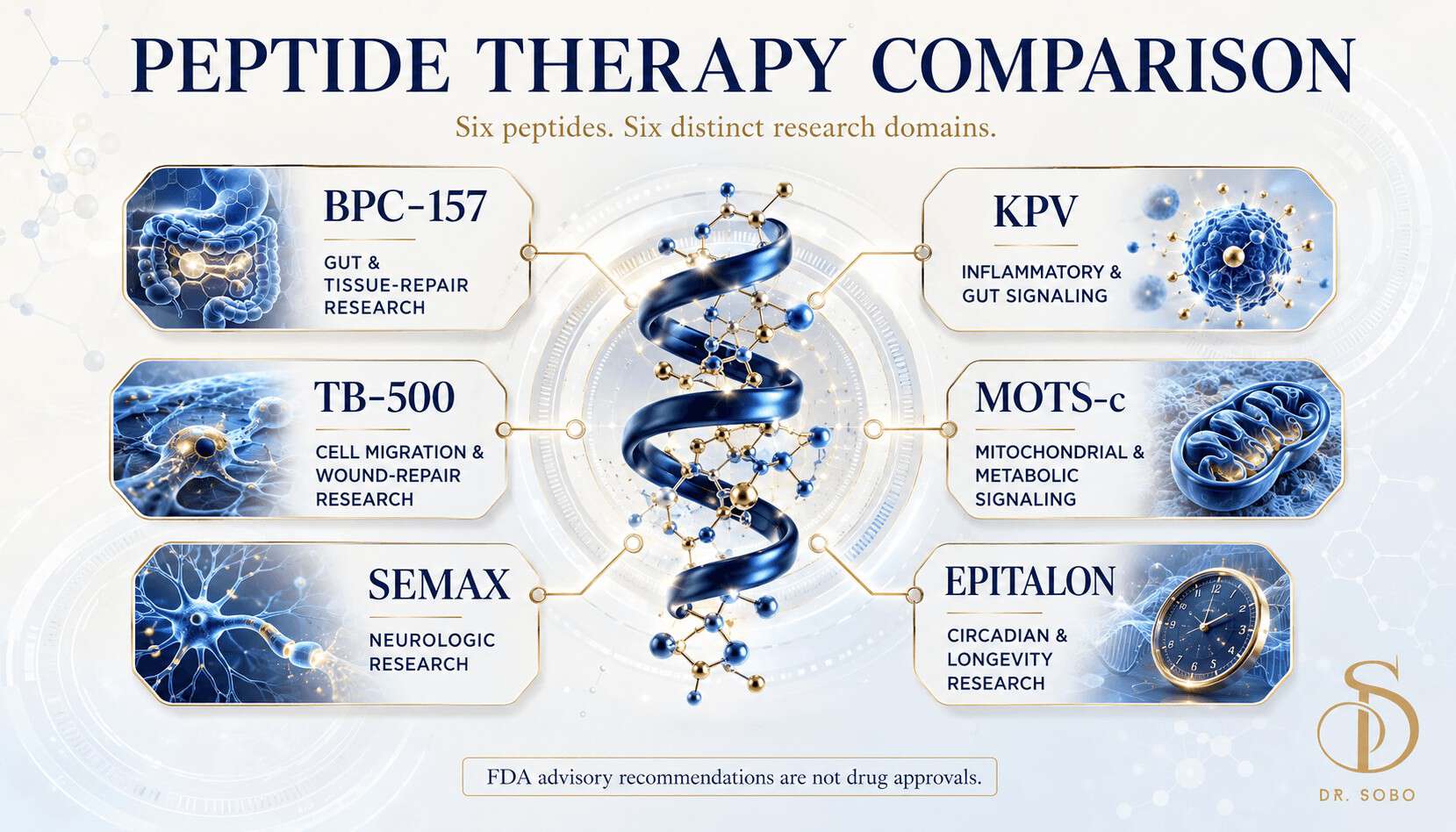
BPC-157 and TB-500 are most often discussed in tissue-repair and recovery research. KPV is associated with inflammatory signaling, skin and intestinal research. MOTS-c is studied as a mitochondrial-derived signaling peptide related to metabolism and cellular stress. Semax has been investigated in neurologic research, primarily outside the United States. Epitalon appears in circadian, melatonin, cellular-aging, and longevity research.
None of these six substances is an FDA-approved drug. As of August 11, 2026, the advisory committee’s favorable votes have not become a final FDA rule adding the substances to 21 CFR 216.23. Evidence quality varies substantially, and several of the peptides lack adequate controlled human trials.
Evidence status: Regulatory and research information on this page was reviewed through August 11, 2026. Peptide regulation and clinical evidence can change. Patients should confirm current availability, legal status, and medical appropriateness with a qualified healthcare professional.
How Do the Six Peptides Differ?
The clearest way to compare these peptides is by research domain rather than by marketing claims. BPC-157 and TB-500 are commonly placed in the recovery category, but they are chemically distinct and do not have equivalent human evidence. KPV is a three-amino-acid fragment associated with alpha-melanocyte-stimulating hormone biology. MOTS-c is encoded within mitochondrial DNA and is studied as a metabolic signaling molecule. Semax is a synthetic peptide related to a fragment of adrenocorticotropic hormone, while Epitalon is a four-amino-acid synthetic peptide associated with pineal and circadian research.
| Peptide | Primary research domain | Why patients ask about it | Human evidence snapshot | U.S. FDA status |
|---|---|---|---|---|
| BPC-157 | Gastrointestinal and tissue-repair pathways | Gut health, tendons, ligaments, joints, and recovery | Very limited; small uncontrolled or pilot studies cannot establish effectiveness or long-term safety | Not an FDA-approved drug; favorable nonbinding 2026 committee recommendation, with final action pending |
| KPV | Inflammatory, epithelial, skin, and intestinal signaling | Gut inflammation, immune balance, and wound-related research | Predominantly laboratory and animal research; FDA found no clinical studies or human exposure data in its review | Not an FDA-approved drug; favorable nonbinding 2026 committee recommendation, with final action pending |
| TB-500 | Cell migration and wound-repair biology | Soft-tissue recovery and broader repair support | Predominantly preclinical for TB-500 itself; research on native thymosin beta-4 should not automatically be attributed to TB-500 products | Not an FDA-approved drug; favorable nonbinding 2026 committee recommendation, with final action pending |
| MOTS-c | Mitochondrial signaling, metabolism, and cellular stress adaptation | Energy, metabolic health, exercise capacity, body composition, and healthy aging | Mechanistic, observational, laboratory, and animal evidence; FDA found no studies administering MOTS-c to humans | Not an FDA-approved drug; favorable nonbinding 2026 committee recommendation, with final action pending |
| Semax | Neurologic and neurotrophic pathways | Cognition, focus, neurologic recovery, migraine, and brain-health research | Some human studies, mainly intranasal and outside the United States; form, study quality, and generalizability limit conclusions | Not an FDA-approved drug; favorable nonbinding 2026 committee recommendation, with final action pending |
| Epitalon | Pineal, circadian, melatonin, cellular-aging, and telomere research | Sleep, circadian rhythm, longevity, and healthy aging | Limited and heterogeneous; much of the evidence is preclinical or cannot establish clinical anti-aging benefits | Not an FDA-approved drug; favorable nonbinding 2026 committee recommendation, with final action pending |
The table is a research comparison, not a treatment-selection chart. A patient’s symptoms may have causes that require diagnosis or established treatment. The presence of an interesting mechanism does not show that administering a peptide will produce a meaningful clinical outcome.
What Is BPC-157?
BPC-157 is a synthetic 15-amino-acid peptide associated with a sequence described in gastric research. It is discussed in studies involving gastrointestinal protection, inflammatory signaling, blood-vessel formation, collagen organization, and tissue repair. These mechanisms explain why patients frequently ask about BPC-157 for digestive concerns and musculoskeletal recovery.
The evidence requires careful interpretation. Animal studies have produced findings involving tendons, ligaments, muscles, bone, and gastrointestinal injury models, but results in animals do not establish that BPC-157 treats these conditions in people. Recent reviews have identified only a very small number of uncontrolled human studies. One safety pilot involved two healthy adults, which is far too small to define uncommon adverse effects, effectiveness, ideal dosing, or long-term outcomes.
FDA’s 2026 briefing review focused on BPC-157-related substances in the context of ulcerative colitis. The agency identified major limitations involving characterization, effectiveness, and safety. The advisory committee later voted favorably on the listing question, but that committee decision did not turn preclinical findings into proven human benefits.
Patients can learn more from the practice’s detailed BPC-157 peptide therapy page and its separate comparison of BPC-157 and TB-500.
What Is KPV?
KPV is a three-amino-acid peptide fragment—lysine, proline, and valine—associated with the C-terminal sequence of alpha-melanocyte-stimulating hormone. Laboratory and animal research has examined KPV in inflammatory signaling, epithelial biology, skin models, intestinal transport, and experimental colitis. This is why KPV is commonly discussed in relation to gut health, inflammatory conditions, and wound healing.
KPV should not be described as a proven treatment for inflammatory bowel disease, “leaky gut,” skin disease, or immune dysfunction. In its 2026 evaluation, FDA reported that it did not identify clinical studies, human pharmacokinetic studies, human safety studies, or human exposure data for KPV through any route. That means the clinical dose-response relationship, absorption, metabolism, potential interactions, immunogenicity, and long-term safety remain inadequately defined.
KPV and BPC-157 may appear in the same gut-health conversation, but they are different molecules with different proposed pathways. KPV is more closely associated with inflammatory and epithelial signaling research, while BPC-157 is commonly discussed in gastrointestinal-protective and repair models. Neither should replace diagnostic evaluation or established treatment for persistent digestive symptoms.
For a focused explanation, see Dr. Sobo’s KPV peptide therapy page and the guide to KPV peptide benefits and evidence limits.
What Is TB-500?
TB-500 is commonly discussed as a synthetic peptide related to thymosin beta-4 biology. Thymosin beta-4 is a naturally occurring 43-amino-acid peptide involved in actin regulation, cell migration, angiogenesis, inflammation, and wound-repair processes. A critical evidence distinction is that findings from studies of native thymosin beta-4 cannot automatically be assigned to every substance or product marketed as TB-500.
FDA’s 2026 review evaluated TB-500 free base and TB-500 acetate for wound healing. The agency reported that it did not identify clinical studies using TB-500 in humans, human pharmacokinetic or pharmacodynamic studies, or adequate human safety data. Therefore, claims that TB-500 reliably accelerates recovery, repairs tendons, or improves surgical outcomes in people exceed what controlled clinical evidence can currently establish.
BPC-157 and TB-500 are often compared because both appear in recovery discussions. BPC-157 is frequently framed as more localized or gastrointestinally relevant, while TB-500 is framed as broader cell-migration and wound-repair support. That distinction is primarily mechanistic and practice-oriented; no robust head-to-head human trial proves that one is superior or that combining them improves outcomes.
Patients researching recovery can review the practice’s TB-500 and thymosin beta-4 page. A medical evaluation should also determine whether imaging, physical therapy, orthopedic care, activity modification, or another established treatment is needed.
What Is MOTS-c?
MOTS-c is a 16-amino-acid mitochondrial-derived peptide encoded within mitochondrial DNA. Research has explored how it may participate in metabolic signaling, cellular stress responses, insulin sensitivity, energy regulation, skeletal-muscle adaptation, and communication between mitochondria and the cell nucleus. These research themes have led to interest in MOTS-c for metabolic health, exercise capacity, fatigue, body composition, and healthy aging.
Mechanistic interest is not the same as clinical proof. Human studies have examined naturally occurring MOTS-c levels, genetic variants, and associations with health or exercise, but that is different from administering MOTS-c as a treatment. FDA’s 2026 assessment stated that it did not identify clinical studies or human exposure data involving administered MOTS-c. Potential benefits, optimal candidates, dosing, route-specific risks, interactions, and long-term safety are therefore uncertain.
MOTS-c also should not be described as an alternative equivalent to FDA-approved obesity medications or osteoporosis treatments. The regulatory committee evaluated MOTS-c-related substances in connection with obesity and osteoporosis, but a favorable listing recommendation did not approve MOTS-c for either condition. Patients with metabolic disease or low bone density need evidence-based assessment and should not postpone established care.
Dr. Sobo’s MOTS-c peptide therapy page offers additional context on mitochondrial and metabolic goals.
What Is Semax?
Semax is a synthetic seven-amino-acid peptide related to an adrenocorticotropic hormone fragment but designed without the parent hormone’s full endocrine activity. Research has examined neurotrophic signaling, oxidative stress, inflammation, cerebral blood flow, and functional brain connectivity. Semax has a history of study and use outside the United States, particularly through intranasal administration.
Semax has more human literature than KPV, TB-500, or administered MOTS-c, but the evidence is still difficult to translate into broad U.S. clinical claims. Studies vary in design, indication, quality, language, product characterization, and reporting. FDA noted that publications often did not specify whether the Semax used was the free base or acetate form. The agency also found insufficient evidence for the uses it evaluated—cerebral ischemia, migraine, and trigeminal neuralgia—and highlighted unresolved safety questions.
A small functional-connectivity study in healthy participants can help researchers understand possible brain effects, but it cannot prove that Semax improves memory, focus, mood, dementia, stroke recovery, or another clinical outcome. Patients with new neurologic symptoms, severe headache, facial pain, cognitive change, weakness, speech difficulty, or possible stroke symptoms need prompt conventional medical evaluation.
For more detail, visit Dr. Sobo’s Semax peptide page and the current Semax FDA status review.
What Is Epitalon?
Epitalon, also spelled Epithalon, is a synthetic tetrapeptide with the amino-acid sequence alanine-glutamic acid-aspartic acid-glycine. It is associated with research on pineal signaling, melatonin production, circadian rhythms, oxidative stress, telomerase activity, cellular aging, and longevity. These research areas have made Epitalon a frequent topic in sleep and healthy-aging discussions.
The longevity narrative is much stronger than the clinical evidence. Cell-culture findings involving telomerase or telomere length do not prove that Epitalon extends human life, prevents age-related disease, or produces a clinically meaningful anti-aging effect. Animal longevity experiments likewise cannot establish outcomes in people. FDA’s 2026 review found limited evidence relevant to insomnia and did not identify human clinical studies adequately assessing the safety of Epitalon-related bulk drug substances.
Epitalon should not be presented as a substitute for evaluation of chronic insomnia, sleep apnea, depression, medication effects, endocrine problems, or other causes of poor sleep. A patient’s sleep concerns may require a sleep study, behavioral treatment, medication review, circadian interventions, or treatment of another health condition.
Patients interested in the research can read Dr. Sobo’s Epitalon peptide therapy page and the updated explanation of Epitalon’s FDA status in 2026.
Which Peptides Are Most Often Compared for Specific Goals?
Recovery and tissue repair: BPC-157 vs. TB-500
BPC-157 and TB-500 are the most frequently compared recovery peptides. BPC-157 has a larger body of preclinical research involving gastrointestinal and musculoskeletal tissues, plus a very small amount of uncontrolled human evidence. TB-500 is discussed through cell-migration and thymosin beta-4-related repair pathways, but FDA did not find clinical studies administering TB-500 to humans. No high-quality head-to-head human study establishes which is better, and no controlled evidence proves that a combined “stack” is superior to either peptide alone.
Gut and inflammatory signaling: KPV vs. BPC-157
KPV and BPC-157 both appear in gut-health research, but for different reasons. KPV is associated with inflammatory and epithelial signaling in laboratory and animal models. BPC-157 is associated with gastrointestinal protection and repair pathways, also largely in preclinical models. Neither has the controlled human evidence required to claim that it treats inflammatory bowel disease, irritable bowel syndrome, celiac disease, or another gastrointestinal diagnosis.
Metabolic and cellular energy goals: MOTS-c
MOTS-c occupies a different category because it is a mitochondrial-derived signaling peptide. Its relevance is strongest in early metabolism, cellular-stress, muscle, and exercise research. It is not a GLP-1 medication, not an FDA-approved weight-loss treatment, and not established therapy for osteoporosis. Patients interested in body composition or energy need an evaluation that considers nutrition, sleep, exercise, medications, endocrine function, metabolic markers, and established treatment options.
Brain health and cognition: Semax
Among the six, Semax has the most direct neurologic research history. That does not make it a proven cognitive enhancer or approved neurologic treatment in the United States. Human studies exist, but their design and applicability vary, and FDA identified substantial evidence and safety limitations. Neurologic symptoms should be diagnosed before any discussion of adjunctive or investigational options.
Sleep, circadian rhythm, and healthy aging: Epitalon
Epitalon is the peptide most directly associated with pineal, melatonin, circadian, and longevity research. Human clinical support remains limited, and anti-aging conclusions often rely on cells, animals, or heterogeneous older studies. Sleep problems and age-related concerns require separate evaluation because they may reflect treatable medical, behavioral, respiratory, hormonal, or medication-related causes.
What Did the July 2026 FDA Advisory Committee Actually Decide?
On July 23–24, 2026, the Pharmacy Compounding Advisory Committee considered whether specified free-base and acetate forms of BPC-157, KPV, TB-500, MOTS-c, Semax, and Epitalon should be recommended for inclusion on the 503A Bulks List. The committee issued favorable recommendations for all six. It did not recommend Emideltide, also known as DSIP.
The votes were close rather than unanimous, reflecting disagreement about chemical characterization, product quality, evidence of effectiveness, human safety data, immunogenicity, impurities, and the availability of approved treatments. FDA’s own briefing documents had concluded that the evaluation criteria weighed against listing each of the six substances. The independent advisory committee reached favorable recommendations after considering FDA’s analysis, presentations, public comments, and discussion. FDA will make the final regulatory determination.
As of August 11, 2026, the current version of 21 CFR 216.23 does not list these six peptides. The committee votes therefore did not:
- Approve any of the peptides as a drug;
- Approve a compounded preparation made with any of them;
- Establish safety or effectiveness for any indication;
- Authorize every pharmacy to compound them immediately;
- Validate dosing schedules, routes of administration, or peptide stacks;
- Make online research products appropriate for human use; or
- Replace the need for a patient-specific prescription and medical supervision.
For a full explanation, read the site’s coverage of the FDA peptide compounding vote and the guide to the FDA 503A Bulks List.
Does a Favorable Compounding Recommendation Prove a Peptide Works?
No. The 503A Bulks List process and the FDA drug-approval process answer different questions. A drug approval normally requires a sponsor to submit data supporting the product’s identity, manufacturing quality, safety, effectiveness, dosing, labeling, and risk information for a specific use. The Bulks List process evaluates whether a bulk drug substance may be used in traditional compounding under specified statutory conditions.
Even substances already listed in 21 CFR 216.23 are not thereby recognized as safe or effective drugs. Federal regulation expressly states that list inclusion does not demonstrate the safety or efficacy of a compounded drug and does not make the product FDA-approved or FDA-endorsed. This distinction protects patients from reading a regulatory access decision as proof of clinical benefit.
Can BPC-157, KPV, TB-500, MOTS-c, Semax, and Epitalon Be Combined?
Multiple peptides are sometimes discussed together because they target different research pathways, but there is little controlled human evidence evaluating combinations among these six. Combining substances increases the number of variables involved: it becomes harder to determine which component produced an effect, which caused a side effect, whether interactions occurred, and how each should be adjusted.
A responsible peptide-stacking discussion begins with one defined clinical goal and a medical assessment. It should not begin with a prebuilt combination found online. The physician must consider whether the goal has been correctly identified, whether an established treatment should come first, whether baseline testing is appropriate, and whether the expected value justifies the uncertainty. Generic dosing protocols are not a substitute for individualized care.
How Does Dr. Sobo Evaluate a Patient for Peptide Therapy?
Dr. Henry C. Sobo, M.D., evaluates peptide therapy within a broader integrative medical plan at Optimal Health Medical in Stamford, Connecticut. Selection is based on the patient rather than on the popularity of a peptide. The process may include:
- Clarifying the primary goal: recovery, digestive health, metabolic function, energy, cognition, sleep, healthy aging, or another concern;
- Reviewing the diagnosis: determining whether symptoms have been adequately evaluated and whether imaging, specialist care, or established treatment is needed;
- Assessing medical history: including chronic conditions, allergies, prior procedures, surgeries, and treatment response;
- Reviewing medications and supplements: identifying possible interactions, overlapping effects, and reasons to avoid or delay a therapy;
- Using laboratory data when appropriate: selecting tests based on the patient’s goals and health status rather than ordering a generic panel;
- Explaining evidence quality: separating established human data from early human, animal, laboratory, and mechanistic research;
- Discussing alternatives: comparing peptide therapy with physical therapy, nutrition, sleep treatment, approved medications, regenerative procedures, or specialist care;
- Creating a monitored plan: setting realistic goals, follow-up timing, outcome measures, and criteria for changing or stopping treatment; and
- Coordinating the full health strategy: integrating treatment with exercise, resistance training, nutrition, recovery, stress management, and other medically appropriate care.
Patients should receive a patient-specific prescription through a legitimate, appropriately licensed pharmacy when compounded therapy is clinically appropriate. That is fundamentally different from buying an unlabeled vial, a product marked “research use only,” or an injectable sold without a medical evaluation and prescription.
Patients comparing program costs can also review what affects the cost of peptide therapy, including consultation, monitoring, pharmacy, follow-up, and the complexity of the treatment plan.
Peptide Therapy in Stamford and Connecticut
Optimal Health Medical serves patients seeking physician-guided peptide therapy in Stamford and throughout Fairfield County, including Greenwich, Darien, New Canaan, Norwalk, Westport, Fairfield, and surrounding Connecticut communities. Virtual consultations may also be available when medically and legally appropriate.
A consultation is an opportunity to move beyond a list of popular peptide names and determine what the patient’s symptoms, goals, diagnosis, evidence, and health history actually support. To discuss peptide therapy with Dr. Sobo, request a consultation or call 203-348-8805.
Frequently Asked Questions
What are BPC-157, KPV, TB-500, MOTS-c, Semax, and Epitalon?
They are six chemically distinct peptides studied in different biological domains. BPC-157 and TB-500 are associated with tissue-repair research; KPV with inflammatory and epithelial signaling; MOTS-c with mitochondrial and metabolic signaling; Semax with neurologic pathways; and Epitalon with pineal, circadian, and cellular-aging research. Grouping them as “peptides” does not mean they have the same effects, evidence, safety profile, or medical uses.
Which peptide has the strongest human evidence?
None of the six has the type of robust U.S. clinical evidence expected for an FDA-approved drug. Semax has a larger human literature than KPV, TB-500, or administered MOTS-c, but many studies were conducted outside the United States and have limitations involving design, reporting, formulation, and generalizability. BPC-157 has only very small uncontrolled human studies. Evidence strength also depends on the specific condition and outcome being considered.
How are BPC-157 and TB-500 different?
BPC-157 is a 15-amino-acid synthetic peptide commonly studied in gastrointestinal and tissue-repair models. TB-500 is discussed in relation to thymosin beta-4 biology, including actin regulation, cell migration, and wound repair. Both are promoted for recovery, but no high-quality head-to-head human trial shows that one is superior. Evidence involving native thymosin beta-4 should not automatically be attributed to TB-500 products.
Is KPV the same type of peptide as BPC-157?
No. KPV is a three-amino-acid fragment associated with alpha-melanocyte-stimulating hormone biology and inflammatory signaling. BPC-157 is a 15-amino-acid peptide associated with gastrointestinal-protective and tissue-repair research. Both appear in gut-health discussions, but their proposed pathways and evidence bases differ. FDA reported no human exposure data for KPV, while BPC-157 has only a very small amount of uncontrolled human evidence.
What is MOTS-c being studied for?
MOTS-c is studied as a mitochondrial-derived signaling peptide related to metabolism, cellular stress responses, insulin sensitivity, muscle function, exercise adaptation, and aging biology. Human observational research on natural MOTS-c levels is not the same as a clinical trial administering the peptide. FDA’s 2026 review found no clinical studies or human exposure data for administered MOTS-c, so treatment benefits and long-term safety remain uncertain.
What is the difference between Semax and Epitalon?
Semax is mainly associated with neurologic and neurotrophic research, including studies involving cerebral ischemia, migraine, pain, cognition, and brain connectivity. Epitalon is associated with pineal function, melatonin, circadian rhythm, telomerase, cellular aging, and longevity research. Neither is FDA-approved in the United States. Human evidence for both has substantial limitations and does not support broad claims that Semax enhances cognition or Epitalon extends human lifespan.
Did the FDA approve these six peptides in July 2026?
No. The Pharmacy Compounding Advisory Committee recommended specified forms of BPC-157, KPV, TB-500, MOTS-c, Semax, and Epitalon for possible inclusion on the 503A Bulks List. Advisory recommendations are nonbinding. The votes did not approve the peptides as drugs, approve compounded preparations, establish safety or effectiveness, or authorize unrestricted use. As of August 11, 2026, final FDA action remains pending.
What is the FDA 503A Bulks List?
The 503A Bulks List identifies certain bulk drug substances that may be used in traditional pharmacy compounding when statutory and regulatory conditions are met and when the substance lacks an applicable USP/NF monograph and is not a component of an FDA-approved drug. Inclusion does not make a compounded preparation FDA-approved, FDA-endorsed, or proven safe and effective for a particular condition.
Does a favorable advisory vote mean these peptides are safe?
No. The vote addressed a compounding-list recommendation, not a finding that a substance has been proven safe. FDA’s briefing documents identified missing human data, product-characterization concerns, peptide impurities, aggregation, immunogenicity, and other uncertainties that varied by substance. Close committee votes also demonstrate that expert opinions differed. Safety must be evaluated in relation to the exact substance, preparation, route, dose, patient, medical history, and duration.
Can multiple peptides be used together?
Peptides may be discussed in combinations when their research pathways appear complementary, but controlled human evidence for most stacks is absent. Combining substances can make benefits, adverse effects, and interactions harder to interpret. A physician should first define the treatment goal, evaluate established options, review medications and health risks, and decide whether adding more than one investigational or compounded therapy is medically reasonable.
How does a physician decide which peptide may be appropriate?
The decision should begin with diagnosis, symptoms, goals, medical history, medications, examination findings, and relevant laboratory or imaging data. A physician should also explain the quality of evidence, uncertainty, alternatives, monitoring requirements, and reasons to stop. The “best peptide” is not determined by a universal chart; it depends on whether a therapy is medically appropriate and whether its potential value justifies its limitations for that patient.
Where can Connecticut patients discuss physician-guided peptide therapy?
Patients in Stamford, Greenwich, Darien, New Canaan, Norwalk, Westport, Fairfield, and surrounding Connecticut communities can request a consultation with Dr. Henry C. Sobo, M.D., at Optimal Health Medical. The consultation can include medical-history review, medication and supplement review, goal clarification, evidence discussion, relevant testing, treatment alternatives, and a monitored plan when peptide therapy is considered appropriate.
Sources
- FDA: July 23–24, 2026 Pharmacy Compounding Advisory Committee Meeting
- FDA Briefing Document: BPC-157-Related Bulk Drug Substances
- FDA Briefing Document: KPV-Related Bulk Drug Substances
- FDA Briefing Document: TB-500-Related Bulk Drug Substances
- FDA Briefing Document: MOTS-c-Related Bulk Drug Substances
- FDA Briefing Document: Semax-Related Bulk Drug Substances
- FDA Briefing Document: Epitalon-Related Bulk Drug Substances
- FDA: Bulk Drug Substances Used in Compounding Under Section 503A
- Electronic Code of Federal Regulations: 21 CFR § 216.23
- BPC-157 as an Investigational Peptide Therapeutic: A Critical Appraisal of Its Biopharmaceutical Profile and Translational Potential
- Functional Connectomic Approach to Studying Selank and Semax Effects in Healthy Participants
- Synthetic Tetrapeptide Epitalon and Neuroendocrine Regulation in Senescent Monkeys

Medically reviewed by
Medical disclaimer: This article is for educational purposes and does not provide personal medical advice. Peptide therapies discussed here may be investigational, compounded, or unsupported by adequate clinical evidence for particular uses. Do not start, stop, or combine treatments without evaluation by a qualified healthcare professional.