
By Dr. Henry Sobo, MD – Medical Weight Loss, Functional & Hormone Therapy, Connecticut
Ipamorelin Peptide Therapy: Benefits for Recovery, Fat Loss, and Healthy Aging
Peptide therapies are becoming increasingly discussed in regenerative and metabolic medicine, particularly among patients interested in recovery, performance, and healthy aging. One of the most widely researched peptides in this category is Ipamorelin.
Ipamorelin is a synthetic growth hormone secretagogue that stimulates the body’s natural production of growth hormone. Rather than replacing hormones with synthetic growth hormone injections, Ipamorelin works by activating the ghrelin receptor in the hypothalamus and pituitary gland. This process triggers the release of growth hormone in pulses similar to the body’s natural endocrine rhythm.
Because growth hormone influences metabolism, tissue repair, sleep cycles, and muscle development, therapies that support natural growth hormone production have become an area of interest in both regenerative medicine and metabolic health programs.
Patients exploring Ipamorelin often want to understand whether stimulating natural hormone signaling may support improvements in recovery, body composition, sleep quality, and overall wellness.
What Is Ipamorelin?
Patients researching treatment options often begin by learning more about Ipamorelin peptide therapy and how this peptide may support recovery, metabolic health, and healthy aging by stimulating natural growth hormone production.
Growth hormone plays a critical role in several biological processes including:
- muscle protein synthesis
- fat metabolism
- collagen production
- bone health
- cellular repair
Unlike synthetic human growth hormone injections, Ipamorelin does not replace growth hormone. Instead, it stimulates the body’s natural hormone production.
This difference is important because the body normally releases growth hormone in short pulses, particularly during deep sleep and recovery periods. Ipamorelin attempts to support this natural signaling pattern rather than override it.
Because of its selectivity, research suggests that Ipamorelin stimulates growth hormone release without significantly affecting hormones such as cortisol, prolactin, or thyroid-stimulating hormone. This selectivity is one reason it has received attention in clinical research involving growth hormone secretagogues.
Patients interested in treatment options often begin by learning more about Ipamorelin peptide therapy and how it may fit into broader wellness or recovery programs.
How Ipamorelin Works in the Body
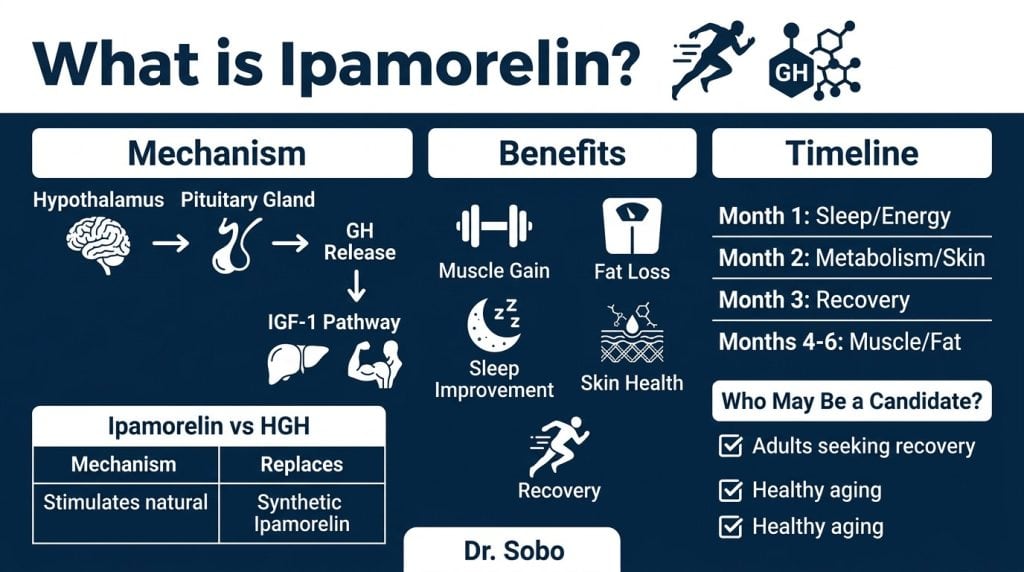
Ipamorelin mimics the activity of ghrelin, a hormone that helps regulate appetite and growth hormone secretion. When the ghrelin receptor is activated, the hypothalamus signals the pituitary gland to release growth hormone.
The process works through several steps.
First, Ipamorelin binds to the growth hormone secretagogue receptor.
Second, the hypothalamus sends signals to the pituitary gland.
Third, the pituitary releases growth hormone into circulation.
Fourth, growth hormone stimulates the production of insulin-like growth factor-1 (IGF-1).
IGF-1 is the hormone responsible for many of the downstream effects associated with growth hormone signaling, including tissue repair, muscle growth, and metabolic regulation.
This pathway explains why growth hormone secretagogues are often discussed in the context of recovery, metabolic health, and longevity research.
Why Growth Hormone Declines With Age
Natural growth hormone production gradually decreases with age. By the time many adults reach middle age, growth hormone levels may be significantly lower than during adolescence or early adulthood.
This decline can influence several aspects of physical health including:
- muscle mass
- metabolic rate
- sleep quality
- fat distribution
- connective tissue health
Lower growth hormone levels may contribute to increased visceral fat, slower recovery from exercise, reduced energy levels, and changes in body composition.
For this reason, therapies designed to support natural growth hormone signaling have been explored within anti-aging and metabolic medicine.
Potential Benefits of Ipamorelin Peptide Therapy
Recovery and Muscle Repair
Growth hormone plays a central role in tissue regeneration and protein synthesis. Because of this, therapies that stimulate growth hormone production may support faster recovery from physical stress.
Many patients exploring peptide therapy are interested in improving recovery after exercise or injury. Growth hormone and IGF-1 signaling influence muscle repair, collagen production, and connective tissue health.
Improved recovery capacity may allow individuals to maintain consistent training routines, which is an important factor in long-term fitness and metabolic health.
Improved Body Composition
Growth hormone influences lipolysis, the process by which the body breaks down stored fat for energy. It also plays a role in preserving lean muscle mass.
For individuals attempting to improve body composition, therapies that support growth hormone signaling may complement structured exercise and nutrition programs.
Some metabolic programs combine recovery peptides with medical weight-management therapies such as Semaglutide, Tirzepatide, and Retatrutide. These treatments target appetite regulation and metabolic health, while peptides like Ipamorelin may support recovery and lean muscle preservation during weight-loss programs.
Sleep Quality and Overnight Recovery
Growth hormone release occurs primarily during deep sleep cycles. Because of this connection, improvements in growth hormone signaling may influence sleep quality.
Many patients exploring peptide therapy report improvements in sleep depth and overall restfulness. Better sleep may also contribute to improved recovery, hormone balance, and metabolic health.
Skin Health and Collagen Production
Growth hormone signaling also influences collagen synthesis. Collagen is an important structural protein in skin, tendons, ligaments, and connective tissue.
Over time, collagen production declines with age. Because growth hormone stimulates collagen synthesis, therapies that support this pathway may contribute to improvements in skin elasticity and tissue repair.
Who May Be a Candidate for Ipamorelin Therapy
Not every patient is a candidate for peptide therapy, and treatment decisions should always be made under medical supervision.
Individuals who may explore Ipamorelin therapy often include adults interested in:
- improving recovery from exercise
- supporting lean muscle mass
- improving sleep quality
- maintaining metabolic health
- supporting healthy aging
A physician evaluation is necessary to determine whether peptide therapy is appropriate based on medical history, current medications, and treatment goals.
What to Expect From Treatment
Peptide therapy protocols vary depending on the patient and the treatment program.
Ipamorelin is typically administered through subcutaneous injections. Because the peptide has a relatively short half-life, it is commonly used in protocols designed to mimic natural hormone pulses.
Patients often begin noticing early improvements in sleep quality and recovery within the first month. Body composition changes may take longer and often become noticeable after three to six months.
Lifestyle factors such as exercise, nutrition, and sleep habits play an important role in determining overall outcomes.
Ipamorelin vs HGH Therapy
Feature | Ipamorelin | HGH Therapy |
Mechanism | Stimulates natural GH release | Replaces GH directly |
Hormone Feedback | Maintains natural feedback loops | May suppress natural GH |
Administration | Peptide therapy | Hormone replacement therapy |
Clinical Discussion | Recovery, wellness support | Hormone deficiency treatment |
Ipamorelin vs Other Peptides
Peptide | Primary Use | Typical Benefit |
Ipamorelin | Growth hormone stimulation | Recovery and sleep support |
CJC-1295 | GH-releasing hormone analog | Often stacked with Ipamorelin |
BPC-157 | Tissue repair peptide | Injury recovery |
Tesamorelin | GH signaling | Visceral fat reduction |
Timeline of Potential Benefits
Timeframe | Possible Changes |
Month 1 | Improved sleep and energy |
Month 2 | Improved metabolism and skin health |
Month 3 | Improved recovery and joint comfort |
Months 4-6 | Lean muscle development and fat metabolism |
Individual results vary depending on health status, lifestyle habits, and treatment consistency.

HAVE QUESTIONS ABOUT Ipamorelin Peptide Therapy ?
If you have questions about the Ipamorelin CJC-1295 stack or BPC-157 and reside in Connecticut, Greenwich, or Norwalk area, contact us today for a Personalized Consultation. We focus on combining safe, effective medication with a realistic lifestyle plan.
For broader options, see our Conditions Treated page.
Frequently Asked Questions
What does Ipamorelin do?
Ipamorelin stimulates the natural release of growth hormone by activating ghrelin receptors in the hypothalamus and pituitary gland. This signaling pathway influences muscle repair, fat metabolism, sleep cycles, and collagen production.
Is Ipamorelin the same as HGH?
No. Ipamorelin stimulates the body’s natural growth hormone production, while HGH therapy replaces growth hormone with synthetic hormone injections.
How long does Ipamorelin take to work?
Some patients notice improvements in sleep and recovery within several weeks. Body composition changes typically develop gradually over three to six months.
Can Ipamorelin help with fat loss?
Growth hormone influences lipolysis, which is the metabolic process that breaks down stored fat. Ipamorelin may support fat metabolism when combined with proper nutrition and exercise.
Can Ipamorelin build muscle?
Growth hormone and IGF-1 signaling influence muscle repair and protein synthesis. Ipamorelin may support lean muscle development when paired with resistance training.
Is Ipamorelin safe?
Ipamorelin is generally well tolerated under medical supervision. Possible side effects may include injection site irritation, mild headaches, or temporary water retention.
Does Ipamorelin improve sleep?
Growth hormone release is closely linked to deep sleep cycles. Many patients report improved sleep quality and deeper rest when using peptide therapy.
Can Ipamorelin be stacked with other peptides?
Yes. Ipamorelin is commonly combined with peptides such as CJC-1295 to enhance growth hormone signaling.
Can Ipamorelin help preserve muscle during weight loss?
Some physicians explore combining recovery peptides with metabolic therapies to help preserve lean muscle mass during weight loss programs.
Who should avoid Ipamorelin therapy?
Individuals with certain medical conditions, including uncontrolled endocrine disorders or active cancer, may not be candidates for peptide therapy. A medical evaluation is required before treatment.
More Helpful Articles
PRP for Rotator Cuff Tendinopathy: What the 2025 AAOS Guideline and 2026 Evidence Say
A new systematic review and updated orthopedic guidance create timely, local treatment-intent content. This article was evidence-checked on September 6, 2026. Regulatory status, labels, and trial publications can change; verify
Forzinity FDA Approval Explained: Elamipretide, Barth Syndrome, and SS-31 Claims
Forzinity FDA approval has created understandable questions about elamipretide, Barth syndrome and products marketed as “SS-31.” The central distinction is straightforward: the FDA approved a specific elamipretide product for a
REDEFINE 4 Results: CagriSema vs. Tirzepatide, Weight Loss, and FDA Status
Phase 3 head-to-head results and an anticipated late-2026 FDA decision create strong news and comparison intent. This article was evidence-checked on September 6, 2026. Regulatory status, labels, and trial publications
Helpful links:
- BPC‑157 gastrointestinal and musculoskeletal healing benefits
- Thymosin Beta‑4 (TB‑500) for systemic tissue repair
- comprehensive peptide therapy in Connecticut
Sources
Growth Hormone Releasing Peptides Research
https://pubmed.ncbi.nlm.nih.gov/9849822/
Growth Hormone Secretagogues Study
https://www.sciencedirect.com/science/article/abs/pii/S1096637499999987
Ipamorelin Research Overview
https://en.wikipedia.org/wiki/Ipamorelin
Ghrelin and Gastrointestinal Motility Research
https://pmc.ncbi.nlm.nih.gov/articles/PMC4863553/
