
PATIENT GUIDE | PEPTIDE REGULATION
Semax FDA Status 2026: What the Advisory Committee Vote Does—and Does Not—Mean
A patient-focused guide to the July 2026 vote, Semax’s current U.S. regulatory position, the evidence FDA reviewed, and what must happen next.
The Semax FDA status 2026 update is important, but the headline requires careful interpretation. A federal advisory committee supported a potential compounding pathway for Semax-related bulk drug substances. It did not approve Semax as a drug, validate every claimed benefit, authorize unrestricted sales, or make products from online peptide laboratories appropriate for patients.
The distinction is especially important because the favorable advisory result differed from the FDA staff review. FDA reviewers concluded that the available characterization, effectiveness, and safety information weighed against placing Semax free base and Semax acetate on the 503A Bulks List. The committee nevertheless recommended inclusion. FDA leadership must now consider both the staff analysis and the committee’s advice before taking any final action.
This article explains what happened, what did not happen, what evidence the FDA evaluated, and how patients should interpret Semax claims while the regulatory process remains unfinished.
Quick Answer: Is Semax FDA-Approved in 2026?
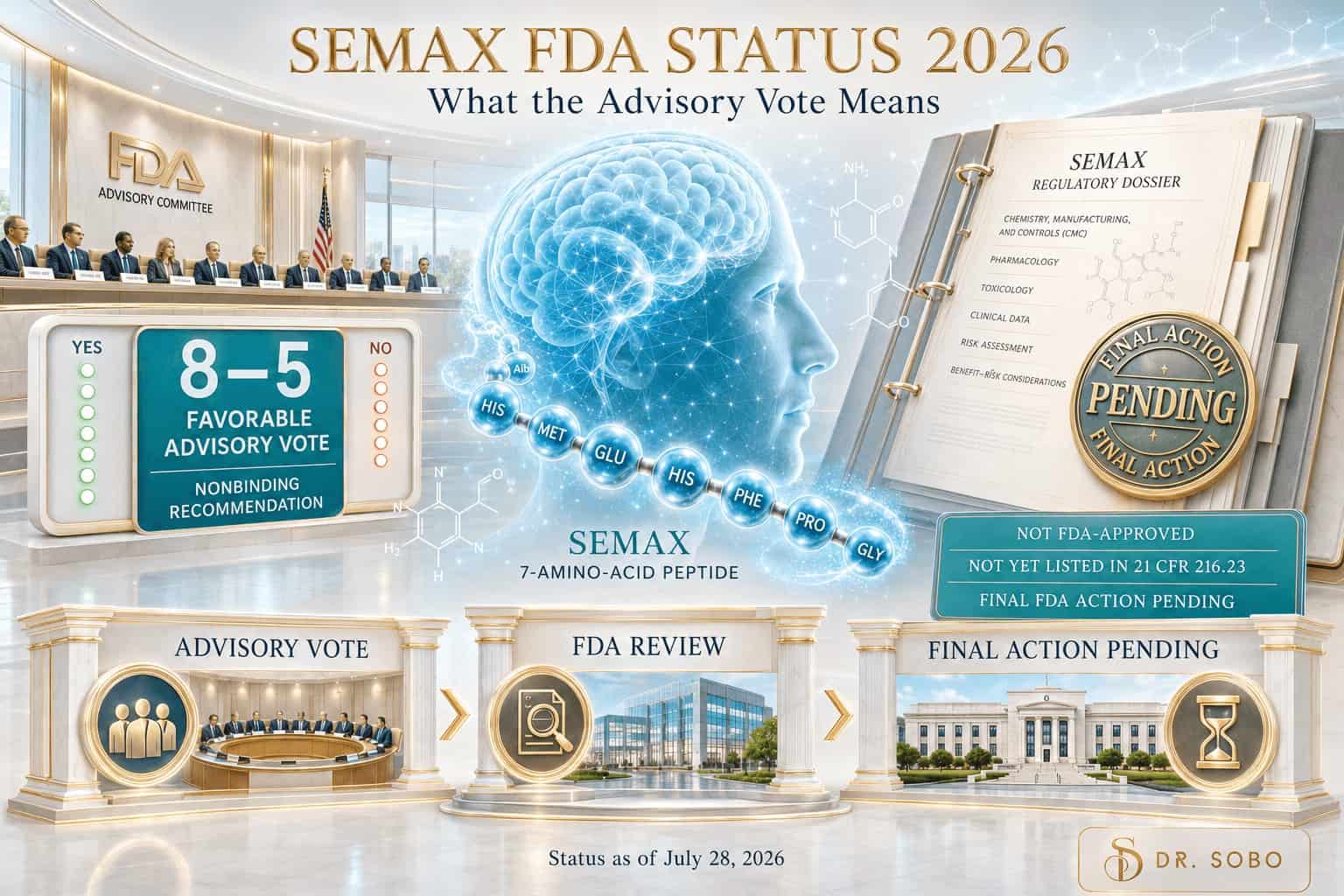
No. Semax is not an FDA-approved drug in the United States. The July 24, 2026 vote was a recommendation from the FDA’s Pharmacy Compounding Advisory Committee concerning whether specified Semax-related bulk drug substances should be included on the 503A Bulks List. An advisory vote is not drug approval, final FDA authorization, proof of safety or effectiveness, or a personal treatment recommendation.
Even if the FDA ultimately places Semax free base or Semax acetate on the formal 503A Bulks List, a compounded Semax preparation would remain an unapproved drug. List inclusion would address one condition for traditional patient-specific compounding from a bulk drug substance. It would not establish an approved indication, standardized product, approved label, dosing schedule, route, or manufacturer.
Semax FDA Status 2026 at a Glance
| Question | Status as of July 28, 2026 | What it means |
|---|---|---|
| Is Semax FDA-approved? | No | No Semax product has completed FDA premarket approval for a U.S. indication. |
| Did the advisory committee support listing? | A post-meeting report recorded an 8–5 favorable vote | FDA’s official voting questions addressed Semax free base and Semax acetate separately; the recommendation remains nonbinding. |
| Did FDA staff support listing? | No | FDA’s written review concluded the available evidence weighed against listing Semax free base and Semax acetate. |
| Has FDA issued a final decision? | No | The advisory recommendation remains nonbinding and the agency’s final action is pending. |
| Is Semax in 21 CFR 216.23? | No | Semax is not on the current formal 503A Bulks List. |
| Is Semax registered outside the U.S.? | Yes, in Russia | Foreign registration does not create FDA approval or establish a U.S. approved use. |
What Exactly Did the FDA Advisory Committee Vote On?
The committee considered Semax free base and Semax acetate for potential inclusion on the FDA 503A Bulks List. These are distinct bulk drug substances, even though they share the same active moiety. FDA’s review emphasized that free bases, salts, formulations, and finished products should not be treated as interchangeable simply because they are marketed under the familiar name “Semax.”
FDA evaluated the substances in connection with cerebral ischemia, migraine, and trigeminal neuralgia. The agency also noted that a 503A listing decision is not necessarily limited to one clinical use. That makes the quality of the substance characterization and the breadth of potential exposure important parts of the review.
A post-meeting regulatory report recorded an 8–5 favorable advisory vote for Semax-related bulk drug substances. FDA’s official voting questions addressed Semax free base and Semax acetate separately. The reported tally is meaningful because it gives FDA independent expert advice after public testimony and discussion, but it does not bind the agency. The official FDA meeting record explains that advisory committee recommendations are nonbinding and that the agency makes the final decision after considering the available record.
For the full seven-peptide results, see FDA Peptide Compounding Vote 2026: What the Recommendation Means for Patients. That campaign article covers all six favorable recommendations and the unfavorable emideltide vote; this guide focuses only on Semax.
What the Semax Vote Does—and Does Not—Mean
| The vote does mean | The vote does not mean |
|---|---|
| An FDA advisory committee recommended Semax-related bulk substances for possible 503A listing. | Semax became FDA-approved, proven safe, or proven effective. |
| FDA must consider the committee’s advice as it completes its review. | FDA is legally required to follow the 8–5 recommendation. |
| The federal compounding debate moved to the next regulatory stage. | Every pharmacy may immediately compound or dispense Semax. |
| The committee considered Semax free base and Semax acetate. | Every salt, blend, concentration, route, device, or product called Semax was endorsed. |
| The evaluated uses included cerebral ischemia, migraine, and trigeminal neuralgia. | Semax was approved to treat stroke, migraine, facial pain, ADHD, memory loss, depression, or other conditions. |
| The vote may influence future FDA policy. | Products sold by online laboratories became prescription medications or passed FDA quality review. |
Why Did FDA Staff Recommend Against Listing Semax?
FDA staff evaluated Semax using the criteria applied to nominated bulk drug substances: physical and chemical characterization, historical use in compounding, available evidence of effectiveness or lack of effectiveness, and safety concerns. The agency’s written conclusion was that the balance of those factors weighed against placing either Semax free base or Semax acetate on the list.
1. Substance Identity and Characterization Concerns
FDA reported inconsistent naming and uncertainty in the withdrawn nomination packages about whether the nominated material was Semax free base or Semax acetate. The agency also said critical information was missing or inadequate for attributes such as impurities, aggregates, microbial bioburden, and bacterial endotoxins. These issues matter because different active ingredients can have different physical, chemical, pharmacokinetic, and safety characteristics.
FDA also raised product-specific questions about proposed intranasal sprays, including the container, closure, and pump. A bulk ingredient review cannot assume that every delivery device produces a reliable dose or preserves quality. For proposed injectable use, endotoxin, sterility, particulates, aggregation, and impurity control become especially important.
2. Limited Effectiveness Evidence for the Evaluated Uses
FDA concluded that the available evidence was insufficient to support Semax free base or Semax acetate for cerebral ischemia, migraine, or trigeminal neuralgia. The agency identified only two references relevant to those evaluated uses and described limitations that included small samples, incomplete reporting, absent control groups, unclear clinical endpoints, and lack of information about which Semax form was studied.
For migraine, FDA discussed a 1996 open-label study involving 12 adults who received one intranasal dose. Four participants reported cessation of headache pain, while the remaining participants had incomplete relief. FDA noted the absence of blinding, a control group, adequate baseline characterization, standardized reporting, and enough design detail to establish effectiveness. The agency found no additional Semax references for migraine.
3. Safety and Pharmacokinetic Uncertainty
FDA reported that it could not find human pharmacokinetic studies for Semax free base or Semax acetate by any route. It also found no safety literature for the proposed subcutaneous route; the human literature it evaluated involved intranasal use. Most references did not discuss adverse events in enough detail to define a safety profile.
The review raised potential concerns involving bleeding risk, immunogenicity, aggregation, and peptide-related impurities. FDA also found one consumer FAERS report involving ocular pain and eye burning after use of Semax nasal drops purchased online. A single spontaneous report cannot establish causation or incidence, but it also cannot be used to claim that the product class is safe. Underreporting is particularly relevant because traditional 503A compounders generally do not have the same adverse-event reporting obligations as 503B outsourcing facilities.
What Evidence Did FDA Review for Semax?
| Evaluated use | Evidence summarized by FDA | FDA’s conclusion |
|---|---|---|
| Cerebral ischemia | A meeting abstract with limited information about clinically meaningful endpoints; professional guidelines did not discuss Semax. | Insufficient evidence of effectiveness; approved treatment and prevention options exist. |
| Migraine | One small, uncontrolled, open-label study with 12 adults and unclear outcome measures. | Insufficient evidence; most participants did not have complete pain resolution and standard migraine evidence was lacking. |
| Trigeminal neuralgia | A small uncontrolled study that included 25 adults across trigeminal-neuralgia-related groups, with limited design and reporting detail. | Insufficient evidence; professional guidelines did not discuss Semax and approved therapies exist. |
| Cognition, ADHD, depression, Parkinson’s disease, Alzheimer’s disease, and other promoted uses | Not the uses FDA formally evaluated for the 503A balancing decision, although some were noted in U.S. marketing. | The favorable vote cannot be treated as validation of these claims. |
What Is Semax, and Why Is It Discussed as a Nootropic Peptide?
Semax is a synthetic seven-amino-acid peptide derived from a fragment of adrenocorticotropic hormone, often described as ACTH(4–10) with a stabilizing Pro-Gly-Pro sequence. It is commonly discussed in relation to neuroprotection, neurotrophic signaling, attention, memory, mood, and stress response. Much of the mechanistic literature involves laboratory or animal models, including research on brain-derived neurotrophic factor and other signaling pathways.
These proposed mechanisms are biologically interesting but should not be converted into guaranteed patient outcomes. A change in a biomarker, gene-expression pattern, imaging measure, or animal behavior does not prove that Semax improves cognition, prevents neurodegeneration, treats depression, or accelerates stroke recovery in U.S. patients. Those clinical questions require adequately designed human trials using a clearly characterized product.
For general background on the peptide rather than its current regulatory status, review Dr. Sobo’s Semax peptide overview. The service page and this article serve different search intents: the page explains the peptide, while this article explains the 2026 FDA process and evidence limitations.
Does Semax’s Russian Registration Change Its U.S. FDA Status?
No. FDA’s briefing document states that Semax is a registered drug in Russia and is available there as 0.1% and 1% nasal drops. That history is relevant to international use and the evidence record, but it does not create FDA approval in the United States. National regulators can use different legal standards, evidence requirements, product specifications, indications, and labeling systems.
Patients should also avoid assuming that a U.S. compounded preparation is identical to a Russian registered product. The active ingredient form, excipients, concentration, manufacturing controls, container, pump, storage requirements, and intended use may differ. Foreign registration cannot be transferred to an unidentified U.S. product sold under the same name.
Is Semax Legal in the United States After the Vote?
A simple yes-or-no answer is misleading. Semax is not FDA-approved, and the advisory vote did not automatically place it on the formal 503A Bulks List or authorize unrestricted compounding and sale. The legal analysis can depend on the exact substance, the compounding pathway, current FDA enforcement policy, prescription status, pharmacy and state requirements, sourcing, formulation, and the intended use of the finished product.
The safest patient-facing conclusion is that the committee vote changed the policy debate, not that Semax was broadly “legalized.” Pharmacies and prescribers must evaluate the law and FDA policy in effect when a prescription is considered. Patients should not rely on a seller’s blog, social-media post, or advisory-vote headline as proof that a product can be lawfully dispensed.
Can a 503A Pharmacy Compound Semax Immediately Because of the Vote?
Not because of the vote alone. Section 503A contains multiple conditions, and the Bulks List is only one possible route for a bulk substance. As of July 28, 2026, Semax does not appear in the formal list at 21 CFR 216.23. The FDA may also use interim enforcement policies while evaluating nominated substances, but an interim policy is not the same as formal list inclusion or product approval.
Any pharmacy considering Semax would need to assess the exact federal and state framework, the patient-specific prescription, the precise Semax form, the source and certificate of analysis, formulation and testing requirements, labeling, storage, and whether the proposed preparation meets applicable professional standards. Patients should ask the prescriber and dispensing pharmacy to explain the current pathway rather than accepting a generic statement that “the FDA approved peptides.”
What Happens Next After the 8–5 Semax Vote?
The advisory committee has completed its recommendation, but FDA still controls the final agency action and timing is uncertain. FDA can accept, modify, or reject the committee’s recommendation. Formally adding Semax free base, Semax acetate, or both substances to 21 CFR 216.23 would require the applicable federal rulemaking process. FDA could separately issue or revise guidance or an interim enforcement policy while that process is pending, but such a policy would not constitute formal list inclusion or FDA approval.
- FDA reviews the committee discussion, vote, public comments, briefing materials, and the agency’s own scientific analysis.
- FDA determines whether the record supports adding Semax free base, Semax acetate, both substances, or neither substance to the relevant 503A pathway.
- If FDA proceeds with the formal list, the agency follows the applicable regulatory process and consults the United States Pharmacopeia as required.
- The official regulation, guidance, or enforcement policy must be updated before pharmacies and prescribers can evaluate the practical effect.
- Product-specific and patient-specific requirements remain even after any favorable federal action.
Patients and publishers should date every status statement and link to the official FDA record. Regulatory language such as “pending,” “recommended,” and “not FDA-approved” should remain visible until the agency completes the process.
Why the Difference Between the Committee and FDA Staff Matters
The Semax decision is not a simple story of the FDA declaring a peptide safe. FDA staff and the advisory committee reached different recommendations after considering the same broad regulatory question. Staff emphasized characterization gaps, limited clinical evidence, uncertain human pharmacokinetics, route-specific safety gaps, immunogenicity and aggregation concerns, and the availability of approved therapies.
Committee members who supported inclusion were recommending potential access through traditional compounding, not granting new-drug approval. A person can support a regulated compounding pathway while still acknowledging that the clinical evidence is incomplete. Likewise, opposing list inclusion does not necessarily mean that every possible future use is disproven. The disagreement shows why the vote should be described precisely rather than marketed as a scientific verdict.
What Should Patients Know About Semax Nasal Sprays and Injections?
Route matters. The human literature FDA reviewed involved intranasal Semax, while the nominations also proposed subcutaneous injection. FDA reported no human safety literature for the subcutaneous route. Evidence from a nasal product cannot automatically establish the safety, dosing, absorption, or effectiveness of an injectable product.
Nasal delivery also introduces formulation and device questions. Concentration, droplet or spray volume, pump performance, container compatibility, sterility, preservatives, storage, and dosing consistency can affect what reaches the patient. A label that says only “Semax” does not answer these questions. Patients should never calculate a dose from online instructions or transfer a research product into a nasal or injectable form.
Compounded Semax vs. Online “Research Use Only” Products
A physician-prescribed medication prepared by an appropriately licensed pharmacy and an online research chemical are not equivalent. Legitimate pharmacy compounding is connected to a named patient, prescriber, dispensing pharmacy, formulation, label, instructions, storage requirements, and professional accountability. Compounded medications are still not FDA-approved, and quality and clinical uncertainty remain, but the medical and pharmacy framework provides safeguards that an anonymous online sale does not.
Online products labeled “research use only” or “not for human consumption” may have uncertain identity, salt form, purity, potency, sterility, endotoxin level, storage history, and dosing accuracy. FDA’s single FAERS case involved nasal drops purchased online, which reinforces why gray-market products should not be treated as medications. Patients should avoid online laboratories and direct-to-consumer sellers that do not meet pharmacy and medical-provider standards.
For a broader safety framework, read How to Evaluate Peptide Information Online. It explains how to separate clinical evidence, early research, testimonials, marketing claims, and product sales.
What Should a Patient Ask Before Discussing Semax?
The first question should be about the medical problem, not product availability. Stroke symptoms, recurrent migraine, trigeminal neuralgia, cognitive changes, depression, anxiety, or attention problems require appropriate evaluation and should not be self-treated with a peptide purchased online. Standard diagnostic and treatment pathways may be urgent or supported by stronger evidence.
- What diagnosis or defined clinical goal is being addressed?
- What FDA-approved or guideline-supported treatments are available, and why might they not meet the patient’s need?
- What exact Semax substance, concentration, formulation, route, device, and schedule are proposed?
- Is the rationale based on randomized human evidence, a small uncontrolled study, foreign use, animal research, or mechanism alone?
- What are the known, suspected, and unknown risks for this patient’s medications and medical history?
- Could bleeding risk, immune reactions, nasal irritation, product impurities, or route-specific risks be relevant?
- Which licensed pharmacy would prepare and dispense the medication, and how can its license be verified?
- What follow-up, outcome measures, stop rules, and adverse-event reporting plan will be used?
A qualified clinician should be willing to discuss uncertainty, alternatives, monitoring, and the limits of the evidence. Medical supervision cannot make an unapproved treatment equivalent to an FDA-approved drug, but it can reduce the risks created by self-diagnosis, unclear sourcing, improvised dosing, and missing follow-up.
Semax, Cognitive Performance, and Peptide Stacking
Semax is frequently discussed online as a nootropic or as part of a cognitive-performance peptide stack. The July 2026 vote did not evaluate or approve a Semax-and-Selank combination, cognitive enhancement in healthy adults, or any multi-peptide stack. Combining investigational substances can create additional uncertainty involving dose, interactions, adverse effects, attribution of benefit, and attribution of harm.
Patients researching this area can review Peptide Stacking for Cognitive Performance and Brain Health for broader clinical context. That discussion should be read alongside the current FDA status: a potential compounding pathway does not establish that a cognitive stack is proven, standardized, or appropriate for an individual patient.
What the Semax Vote Means for Patients in Connecticut
For patients in Stamford, Greenwich, Norwalk, Fairfield County, and elsewhere in Connecticut, the federal advisory vote is only one part of the decision. State pharmacy law, the dispensing pharmacy’s licensure, the prescriber’s judgment, the exact formulation, the patient’s medical history, and the availability of established treatments still matter.
Optimal Health Medical evaluates peptide questions within a broader medical plan rather than treating an advisory vote as a recommendation for everyone. Patients can review the Peptide Therapy in Connecticut guide and contact Optimal Health Medical at 203-348-8805 to discuss symptoms, goals, current medications, evidence, alternatives, sourcing, and monitoring with Dr. Henry C. Sobo, M.D.
The Bottom Line on Semax FDA Status in 2026
The July 24, 2026 meeting produced a meaningful regulatory development: a post-meeting regulatory report recorded an 8–5 favorable advisory vote for Semax-related bulk drug substances. FDA’s official questions considered Semax free base and Semax acetate separately. The result was not FDA approval, a final listing decision, or a conclusion that Semax is safe and effective for cerebral ischemia, migraine, trigeminal neuralgia, cognitive enhancement, or any other use.
The most accurate status as of July 28, 2026 is straightforward: Semax remains unapproved by the FDA; the committee recommendation is nonbinding; final FDA action is pending; Semax does not yet appear in 21 CFR 216.23; and important questions remain about characterization, effectiveness, safety, route, formulation, and product quality.
Patients should avoid online research sellers, seek appropriate evaluation for neurological symptoms, compare any proposed use with established treatments, verify pharmacy and prescription details, and rely on dated official FDA sources rather than promotional interpretations of the vote.
Frequently Asked Questions About Semax FDA Status 2026
Is Semax FDA-approved in 2026?
No. Semax is not an FDA-approved drug in the United States. On July 24, 2026, an FDA advisory committee voted 8–5 to recommend Semax-related bulk drug substances for potential inclusion on the 503A Bulks List. That recommendation concerns a possible compounding pathway. It is not new-drug approval, an approved indication, or proof that a finished Semax product is safe and effective.
What did the FDA advisory committee decide about Semax?
A post-meeting regulatory report recorded an 8–5 favorable advisory vote for Semax-related bulk drug substances. FDA’s official voting questions addressed Semax free base and Semax acetate separately. FDA evaluated the substances in relation to cerebral ischemia, migraine, and trigeminal neuralgia. The recommendation is nonbinding, and FDA had not issued a final determination as of July 28, 2026.
Did the Semax vote make it legal for every pharmacy to compound Semax?
No. The vote did not automatically add Semax to the formal list in 21 CFR 216.23 or create blanket permission for every pharmacy. A pharmacy must evaluate the exact federal and state rules, current FDA policy, the substance and formulation, sourcing, prescription requirements, and applicable quality standards. Patients should not interpret an advisory tally as immediate authorization.
Why did FDA staff recommend against adding Semax to the 503A Bulks List?
FDA staff cited concerns involving inconsistent substance naming, incomplete characterization, missing information about impurities and aggregates, limited evidence for the evaluated uses, uncertain human pharmacokinetics, no human safety literature for proposed subcutaneous use, and possible immunogenicity and bleeding risks. FDA concluded that the available information weighed against listing Semax free base and Semax acetate.
Does the 8–5 vote prove that Semax works for migraine?
No. FDA identified one small, uncontrolled, open-label migraine study involving 12 adults and found no additional Semax migraine references. The agency noted unclear outcome measures, no control group, no blinding, incomplete baseline details, and incomplete pain resolution for most participants. The committee vote addressed potential 503A listing, not FDA approval for migraine treatment.
Is Semax approved for stroke or cognitive enhancement?
Not by the FDA. FDA reviewed Semax in connection with cerebral ischemia but concluded that the available evidence was insufficient. Cognitive enhancement was not approved by the vote, and broad nootropic claims should not be inferred from animal studies, proposed mechanisms, small human studies, or foreign use. Stroke symptoms require emergency evaluation and should never be self-treated with Semax.
Is Semax approved in Russia?
FDA’s 2026 briefing document states that Semax is a registered drug in Russia and is available there as 0.1% and 1% nasal drops. Russian registration does not create FDA approval in the United States. It also does not prove that a U.S. compounded or online product has the same ingredient form, formulation, manufacturing controls, device, labeling, or approved uses.
Are Semax nasal sprays safer than Semax injections?
The available information does not support a simple safety ranking. FDA found human literature involving intranasal Semax but no human safety literature for the proposed subcutaneous route. Nasal products still raise questions about formulation, sterility, concentration, pump performance, dose consistency, irritation, storage, and product identity. Route-specific evidence should not be transferred from one formulation to another.
Can I buy Semax from an online peptide laboratory?
Patients should avoid online peptide laboratories and sellers that do not meet pharmacy and medical-provider standards. Products labeled “research use only” may have uncertain identity, potency, purity, sterility, endotoxin levels, storage, and dosing accuracy. A posted certificate does not replace a valid prescription, an appropriately licensed pharmacy, a medical evaluation, clear labeling, and accountable follow-up care.
What should patients watch for next in the Semax FDA process?
Watch for an official FDA final determination, an update to 21 CFR 216.23, new guidance or enforcement policy, and any substance-specific limitations. Verify whether the action covers Semax free base, Semax acetate, both substances, or neither. Continue to distinguish list eligibility from FDA approval, and check the date of every regulatory summary because the status may change.
Sources
- FDA: July 23–24, 2026 Pharmacy Compounding Advisory Committee Meeting — Official meeting record, agenda, evaluated uses, briefing materials, presentations, and archived broadcasts.
- FDA: Briefing Document for Semax-Related Bulk Drug Substances — Primary FDA review of Semax free base and Semax acetate, including characterization, evidence, safety, and staff recommendation.
- FDA: Questions for the July 23–24, 2026 PCAC Meeting — Official voting questions presented to the advisory committee.
- RAPS: FDA Advisory Committee Backs Two More Peptides, Rejects One for Compounding List — Post-meeting report documenting the 8–5 Semax vote and the other July 24 results.
- Electronic Code of Federal Regulations: 21 CFR 216.23 — Current formal 503A Bulks List; Semax was not listed as of July 28, 2026.
- FDA: Human Drug Compounding Laws — Explains sections 503A and 503B and confirms that compounded drugs are not FDA-approved.
- FDA: Interim Policy on Compounding Using Bulk Drug Substances Under Section 503A — Explains FDA’s interim Category 1 policy and the process for developing the formal list.

Medically reviewed by Dr. Henry C. Sobo, M.D.
Learn more about Dr. Sobo and his approach to functional medicine, peptide therapy, and individualized patient care at Optimal Health Medical.
Medical Disclaimer
This article is for general educational purposes and does not provide medical advice, diagnosis, or treatment. Regulatory status, evidence, availability, and pharmacy policies may change. Sudden severe pain—may require urgent or emergency medical care. Consult a qualified healthcare professional before making treatment decisions.