
A new systematic review and updated orthopedic guidance create timely, local treatment-intent content. This article was evidence-checked on September 6, 2026. Regulatory status, labels, and trial publications can change; verify time-sensitive facts immediately before publication.
PRP may improve pain or function for some patients with rotator cuff tendinopathy, but results depend on the diagnosis, tear status, injection target, PRP preparation, rehabilitation, and study quality. Those statements are not contradictory: evidence can suggest benefit while still being too heterogeneous to support the same recommendation for every patient.
Quick answer
Direct answer: PRP may improve pain or function for some patients with rotator cuff tendinopathy, but results depend on the diagnosis, tear status, injection target, PRP preparation, rehabilitation, and study quality.
A 2026 systematic review reported modest but potentially durable functional benefit over corticosteroid in randomized trials, while updated orthopedic guidance remains cautious about routine use in some rotator-cuff settings.
Evidence limit: Those statements are not contradictory: evidence can suggest benefit while still being too heterogeneous to support the same recommendation for every patient.
Clinical application: PRP should follow a diagnosis-specific evaluation rather than being offered for undifferentiated shoulder pain.
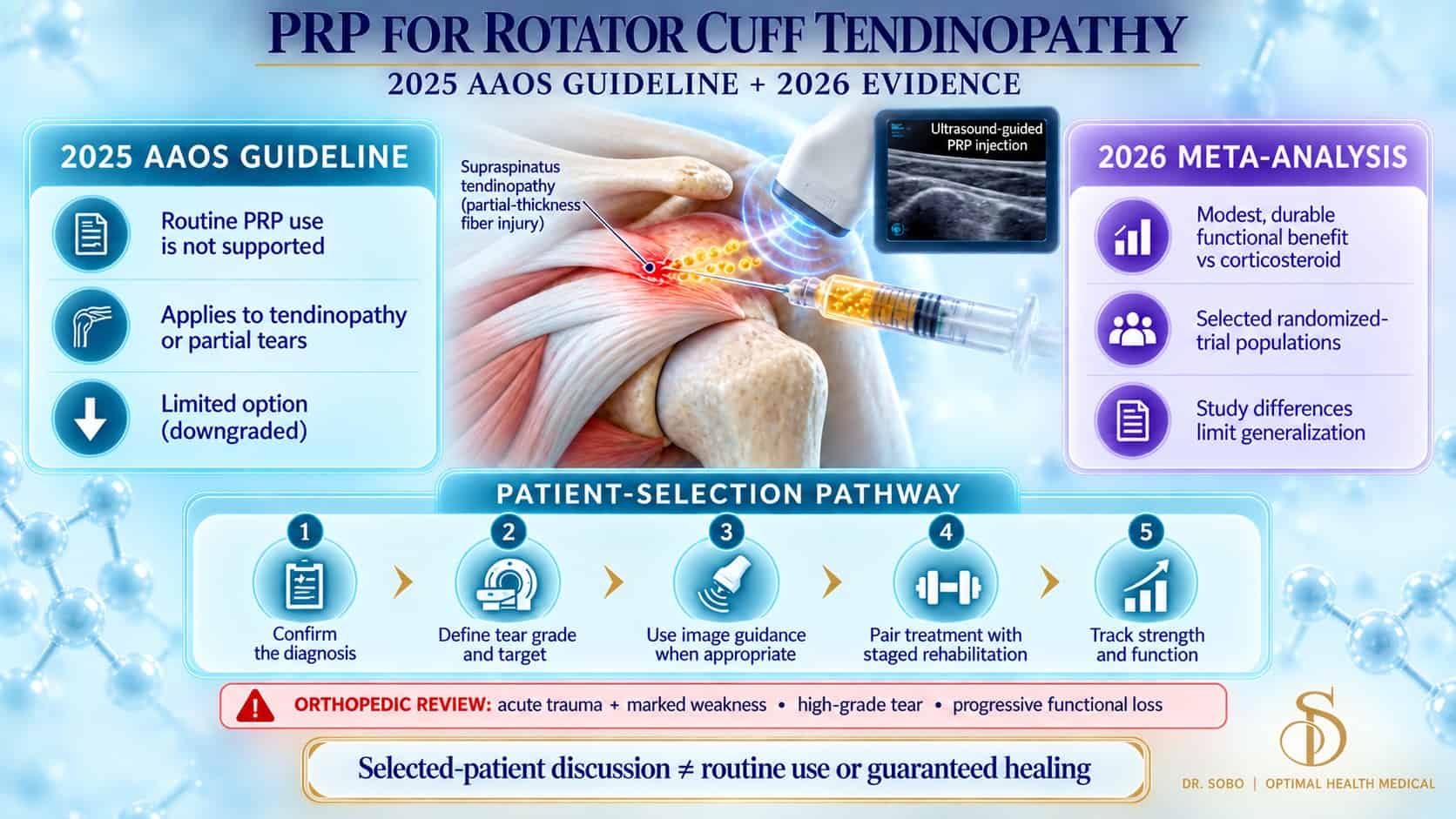
The 2026 Evidence Answer: Promising Findings, Restrained Recommendation
The most accurate conclusion is not simply “PRP works” or “PRP does not work.” A 2026 systematic review and meta-analysis of randomized trials reported modest but durable functional benefit for PRP compared with corticosteroid injection in rotator-cuff tendinopathy.[2] However, the 2025 AAOS guideline states that routine PRP use is not supported for rotator-cuff tendinopathy or partial tears. AAOS classified this as a limited option after downgrading through its evidence-to-decision framework.[1]
| Question | Best current answer | Evidence limitation | Clinical implication |
|---|---|---|---|
| Can PRP improve symptoms? | Some randomized evidence supports pain or functional improvement in selected tendinopathy/partial-tear populations | Preparations, targets and rehabilitation vary | Discuss probability and uncertainty, not guaranteed healing |
| Is PRP routinely recommended? | No; the 2025 AAOS guideline does not support routine use | Guideline option is limited/downgraded | Use diagnosis-specific shared decision-making |
| Is it better than corticosteroid? | Corticosteroid may provide earlier relief; some analyses favor PRP for later function | Timing and outcome instruments differ | Match treatment to goals, risks and time horizon |
| Does PRP heal a tear? | Structural tendon regeneration should not be promised | Symptoms, imaging and healing do not always move together | Track function and reconsider surgery when indicated |
Why Tendinopathy and Partial-Thickness Tears Must Be Separated
Rotator-cuff tendinopathy describes a painful tendon disorder without automatically establishing a discrete tear. A partial-thickness tear involves disruption of only part of the tendon thickness, while a full-thickness tear extends through the tendon. Trials sometimes combine these populations even though prognosis, mechanical demand, imaging findings, and the threshold for surgical referral may differ. A patient should therefore ask which diagnosis was actually studied before applying an average trial result.
Symptoms also do not map perfectly to imaging. Some structural abnormalities are present without pain, while severe symptoms can occur with limited structural change. The clinical decision should integrate trauma history, active weakness, motion, work or sport demands, examination, imaging when indicated, and response to progressive rehabilitation.
PRP Product and Injection Variables That Affect Interpretation
| Variable | Why it matters | What should be documented |
|---|---|---|
| Platelet concentration | PRP systems do not produce one uniform biologic product | Preparation system and measured or expected concentration when available |
| Leukocyte content | Leukocyte-rich and leukocyte-poor preparations may not be interchangeable | Product classification and rationale |
| Injection target | Subacromial bursa, tendon, and tear interface are different targets | Diagnosis, anatomic target, and guidance method |
| Number of injections | Trials use different schedules | Planned series, reassessment point, and stopping rule |
| Rehabilitation | Loading programs can influence function and recovery | Exercise phases, milestones, and next-day response |
What Ultrasound Guidance Can—and Cannot—Add
Ultrasound can identify relevant anatomy in real time and help the clinician place an injection at the intended structure. It can also document some tendon and bursal findings. Guidance improves confidence in location, but it does not make an uncertain diagnosis correct, standardize the PRP product, or guarantee a clinical response. The indication, preparation, target, rehabilitation plan, and outcome measures still need to be specified.
Because published studies vary across all of these elements, patients should be cautious when a clinic quotes one success rate without explaining whether the study population, tear type, product, procedure, and follow-up resemble the proposed plan. Evidence should support a shared decision, not a guarantee.
How to Judge Whether a Study Applies to a Particular Shoulder
Start with the enrollment criteria. A study of chronic, nontraumatic tendinopathy may not apply to a patient with sudden weakness after a fall. A trial that allows only low-grade partial tears may not answer questions about a high-grade tear or a retracted full-thickness tear. Duration of symptoms, prior physical therapy, age, diabetes, smoking, occupational load, and baseline function can also change the expected course.
Next, compare the intervention. The words “platelet-rich plasma” do not reveal platelet dose, leukocyte content, activation method, injection volume, number of injections, or target. When those details are missing or different from the proposed procedure, confidence in direct applicability should fall. The comparator matters too: saline, exercise, corticosteroid, dry needling, or no injection answer different clinical questions.
Finally, examine the outcome and time point. A statistically significant score change is not automatically a noticeable improvement. Patients usually care about sleep, reaching, dressing, lifting, work, and sport. Evidence is more useful when it reports clinically meaningful thresholds, adverse events, additional procedures, and durability—not only an average pain score at one visit.
Candidate and Non-Candidate Signals
| Finding | Why it changes the discussion | Likely next step |
|---|---|---|
| Persistent symptoms with a diagnosis that matches trial populations | Creates a more defensible basis for shared decision-making after appropriate rehabilitation | Review evidence, cost, uncertainty, target, and milestones |
| Acute trauma with marked weakness | Raises concern for a clinically important tear that should not be delayed by an elective injection | Prompt imaging or orthopedic assessment when indicated |
| Progressive stiffness with major passive-motion loss | May suggest adhesive capsulitis or another dominant diagnosis | Reassess the pain generator and treatment plan |
| Neck pain, numbness, or radiating symptoms | May indicate cervical or neurologic contribution | Neurologic and cervical evaluation as appropriate |
| No structured loading program | Makes it difficult to know whether foundational care has been tested | Establish a progressive rehabilitation plan |
Outcome Measures and Stopping Rules
Before the procedure, record a small set of outcomes that matter to the patient. Examples include nights awakened by pain, active elevation, strength testing, a validated shoulder score, tolerated lifting load, work-shift capacity, or ability to complete a sport-specific task. Repeating the same measures at planned intervals is more informative than asking only whether the shoulder feels better that day.
The plan should also define what happens if progress stalls. A lack of meaningful improvement may require reassessment of the diagnosis, imaging, rehabilitation dose, work exposure, sleep, metabolic factors, or referral. It should not automatically lead to repeated injections. Conversely, a temporary flare should be interpreted in the context of expected aftercare instructions and red-flag symptoms rather than treated as immediate proof of failure.
Safety Questions to Resolve Before Treatment
Patients should disclose anticoagulants, antiplatelet medicines, NSAIDs, supplements that affect bleeding, infection risk, immune conditions, pregnancy, allergies, and previous injection reactions. Medication changes must be coordinated with the prescribing clinician; patients should not stop cardiovascular or other necessary treatment to follow a generic internet protocol.
Urgent reassessment is appropriate for fever, spreading redness, drainage, rapidly escalating pain, new numbness or weakness, major swelling, or a pale, blue, or unusually cold limb. Those features are not expected routine soreness. Written instructions should identify whom to call after hours and where to seek urgent care.
What Patients Can Realistically Expect
PRP is usually evaluated over weeks to months, not by the first few days. A temporary increase in soreness can occur, but that early response does not prove success or failure. The useful question is whether function improves across a defined follow-up window while the patient completes an appropriate loading program. Improvement may be gradual and incomplete, and some patients will not achieve a meaningful response.
Claims about “healing” should be translated into measurable outcomes. Less night pain, better reach, higher tolerated resistance, improved work capacity, and recovery after exercise are more actionable than a promise that an image will normalize. Imaging can be helpful when the diagnosis changes or new weakness develops, but routine repeat imaging is not automatically the best measure of benefit.
Cost and opportunity cost also belong in informed consent because PRP is often not covered by insurance. Patients should understand the number of proposed procedures, rehabilitation commitment, alternatives, and the point at which the plan will change. A careful plan protects against both premature abandonment and indefinite treatment without objective progress.
Candidate Selection Begins With the Diagnosis
“Shoulder pain” is not a sufficient indication. Pain may arise from rotator-cuff tendinopathy, a partial or full-thickness tear, bursitis, adhesive capsulitis, glenohumeral arthritis, cervical radiculopathy or another condition. AAOS supports combining examination maneuvers and using ultrasound or MRI as adjuncts when a tear must be characterized.[1]
A more defensible PRP candidate has a diagnosis that fits the evidence, persistent functional limitations despite an appropriate rehabilitation trial, realistic expectations and no more urgent surgical indication. Acute traumatic weakness, a high-grade tear, substantial retraction, progressive loss of function or failure of well-designed conservative care may shift the conversation toward orthopedic evaluation.
Recovery Should Be Criterion-Based
| Phase | Primary goal | Examples of progression criteria | Reasons to pause |
|---|---|---|---|
| Protection | Manage expected post-procedure irritation | Comfortable daily movement and stable symptoms | Escalating pain, fever, drainage, new weakness or numbness |
| Restore motion | Prevent unnecessary stiffness | Improving active and passive motion without major next-day flare | Worsening night pain or progressive loss of motion |
| Build capacity | Progress cuff and scapular loading | Improving strength, control and recovery between sessions | Pain or weakness that accumulates across sessions |
| Return to demand | Prepare for work, lifting or sport | Task-specific strength and tolerance with acceptable 24-hour response | Compensation, instability or inability to meet functional benchmarks |
Published PRP protocols vary considerably in activity restrictions, rehabilitation timing and medication instructions.[6] Patients should not copy another clinic’s calendar or stop aspirin, anticoagulants or prescribed medication without coordinated guidance. Recovery should be adjusted to the treated structure, baseline function and symptom response.
How to Determine Whether PRP Helped
Pain scores fluctuate with sleep, workload, stress and recent activity, so success should be defined with more than one number. Useful measures include night-pain frequency, active range of motion, strength, tolerance for reaching or lifting, work capacity, exercise volume and the next-day response to loading. A validated shoulder questionnaire can provide another consistent measure when repeated at appropriate intervals.
Follow-up imaging is not automatically required and may not mirror symptoms. If function is not improving, the next step is reassessment of the diagnosis, treatment target and rehabilitation plan—not an automatic repeat injection. New weakness, trauma, progressive motion loss or neurologic symptoms may require additional imaging or specialist evaluation.
Rotator-Cuff Evaluation and PRP Planning in Stamford
At Optimal Health Medical, the first task is to identify the pain generator and determine whether the condition fits the evidence reviewed in this article. Examination, ultrasound or MRI findings, prior rehabilitation, work and sport demands, medication history and the presence of weakness or trauma can materially change the recommendation.
If PRP is considered, the plan should specify the treatment target, image guidance, expected flare, activity restrictions, rehabilitation milestones and the point at which lack of improvement triggers reassessment. Patients in Stamford and Fairfield County can request a shoulder evaluation.
Key Takeaways
- The 2025 AAOS guideline does not support routine PRP use for rotator-cuff tendinopathy or partial tears.
- A 2026 meta-analysis nevertheless reports possible modest, durable functional benefit over corticosteroid in selected trial populations.
- Those findings support individualized discussion—not a guarantee or routine-treatment claim.
- Accurate diagnosis and progressive rehabilitation are more important than the injection label alone.
- Acute weakness, high-grade tears or progressive functional loss may require orthopedic evaluation rather than delayed escalation.
Frequently Asked Questions
Does PRP work for rotator cuff tendinopathy?
The 2025 AAOS guideline does not support routine PRP use, although newer trial syntheses report possible modest benefit in selected patients. Results are not guaranteed, and diagnosis and rehabilitation matter.
Can PRP heal a torn rotator cuff?
PRP should not be promised to heal every tear. Tear size, retraction, muscle quality, trauma, weakness, and surgical indications require evaluation.
Does the evidence differ for tendinopathy and partial-thickness tears?
Yes. Studies may enroll tendinopathy, partial-thickness tears, or mixed groups. The diagnosis, tear grade, treatment target, PRP preparation, and rehabilitation protocol affect how directly a result applies.
Is ultrasound guidance used?
Ultrasound guidance is commonly used to visualize shoulder anatomy and guide placement, particularly when a specific tendon or structure is targeted.
How painful is shoulder PRP?
Patients may feel pressure during the injection and a temporary flare afterward. Experience varies by target and individual sensitivity.
How long is recovery?
Recovery is usually measured over weeks to months and depends on diagnosis, procedure, activity demands, and rehabilitation progression.
When can I exercise?
Exercise should return in stages, beginning with permitted motion and low-load work before heavier strengthening and overhead activity.
Can I take ibuprofen after PRP?
Protocols vary. Do not start or stop ibuprofen, aspirin, anticoagulants, or other medicines without guidance from the relevant clinician.
What if PRP does not help?
The clinician should reassess diagnosis, target, rehabilitation, adherence, and alternatives rather than automatically repeating the procedure.
Can BPC-157 or TB-500 be added?
Dr. Sobo may evaluate them as physician-supervised adjuncts for selected patients, but direct evidence for improving rotator-cuff PRP outcomes is limited and they are not FDA-approved for that purpose.
Sources
- AAOS 2025 Clinical Practice Guideline: Management of Rotator Cuff Injuries
- 2026 systematic review: PRP versus corticosteroid for rotator-cuff tendinopathy
- Randomized trial: PRP versus corticosteroid for tendinopathy/partial tears
- AAOS OrthoInfo: Platelet-Rich Plasma
- Ultrasound-guided PRP injections for tendinopathies
- Systematic review: Post-procedure protocols after PRP for tendinopathy
- AAOS OrthoInfo: Rotator cuff tears—surgical treatment options
- Dr. Sobo: PRP aftercare and recovery timeline
This article is educational and does not provide individualized medical advice. Diagnosis, candidacy, medication changes, procedures, and monitoring require evaluation by a qualified healthcare professional.

Medically reviewed by Dr. Henry C. Sobo, M.D.