
PRP vs Cortisone vs Surgery: Which Path Fits Your Goals?
By Dr. Henry Sobo, MD – Regenerative Medicine Specialist
The Shoulder Pain Dilemma: Quick Relief or Lasting Recovery?
As a physician specializing in regenerative medicine, I see patients every week struggling with the same question: should I choose PRP, cortisone injections, or surgery for my shoulder pain? Rotator cuff tears, biceps tendinitis, frozen shoulder, and arthritis create a painful crossroads where short-term relief competes with long-term joint health.
Each option has distinct timelines, risks, recovery demands, and outcomes. My goal in this post is to help you understand what each treatment delivers—and more importantly, what it doesn’t—so you can match the right path to your lifestyle, timeline, and recovery goals.
PRP (Platelet-Rich Plasma): Healing from Within
PRP uses your own concentrated platelets and growth factors, injected precisely into damaged shoulder tendons, ligaments, or joint spaces. Unlike medications, PRP stimulates your body’s natural repair mechanisms.
What PRP delivers:
Targets tendon repair and tissue regeneration, not just pain suppression
Evidence shows improved shoulder function at 3-6 months for rotator cuff tendinopathy
Minimal downtime—most patients return to desk work in 1-2 days
No risk of tendon weakening (unlike repeated cortisone)
Best for: Partial rotator cuff tears, chronic tendinitis, athletes wanting to avoid surgery, patients delaying joint replacement.
Recent meta-analyses confirm PRP outperforms cortisone for long-term shoulder function, though pain relief develops gradually over weeks
“Patients often ask me, ‘PRP, cortisone, or surgery—which is best for my shoulder?’ The real answer is personalized: cortisone for quick relief, PRP for healing without downtime, surgery for structural repair. I help each patient match treatment to their timeline, lifestyle, and long-term goals.”
– Dr. Henry Sobo, MD
Regenerative Medicine Specialist, Connecticut
Cortisone Injections: Fast Relief, Limited Duration
Corticosteroids provide powerful, rapid inflammation reduction. A single injection often delivers 70-80% pain relief within days for shoulder bursitis, acute tendinitis, or arthritis flares.
The reality of cortisone:
Excellent for short-term pain control (2-8 weeks typically)
Convenient office procedure, immediate return to activities
Multiple injections risk tendon weakening and tissue atrophy
Does not repair underlying structural damage
While cortisone buys time and comfort, it addresses symptoms rather than pathology. Studies show diminished effectiveness after 2-3 injections, with some patients experiencing rebound pain.
Surgery: Definitive Repair, Extended Recovery
Arthroscopic rotator cuff repair, biceps tenodesis, or labral reconstruction offers structural correction for significant tears and instability.
Surgical outcomes:
85-95% success for full-thickness rotator cuff tears in experienced hands
Permanent structural changes to damaged anatomy
4-6 months recovery before reliable sports return
5-10% re-tear rate depending on tear size and patient factors
Surgery shines for complete tears with weakness, younger active patients, or failed conservative care. However, recovery demands commitment to physical therapy and activity modification.
Sobo’s Insight:
“The beauty of PRP is it gives patients a real alternative—avoid surgery downtime while actually healing tendon damage that cortisone only masks. I’ve seen weekend warriors back to golf in weeks, not months, with stronger shoulders long-term.”
– Dr. Henry Sobo, MD
Regenerative Orthopedics Specialist
PRP vs Cortisone vs Surgery: Head-to-Head Comparison
| Treatment | Pain Relief Timeline | Duration of Benefit | Downtime | Tissue Healing | Best Patient Profile |
|---|---|---|---|---|---|
| PRP | 2-6 weeks | 6-24 months | 1-3 days | Stimulates repair | Partial tears, chronic pain, delay surgery |
| Cortisone | 2-7 days | 4-12 weeks | 0-1 day | No healing | Acute flares, bridge to other treatments |
| Surgery | Post-op pain 2-6 weeks | Permanent (if successful) | 4-6 months | Structural repair | Full tears, failed conservative care |
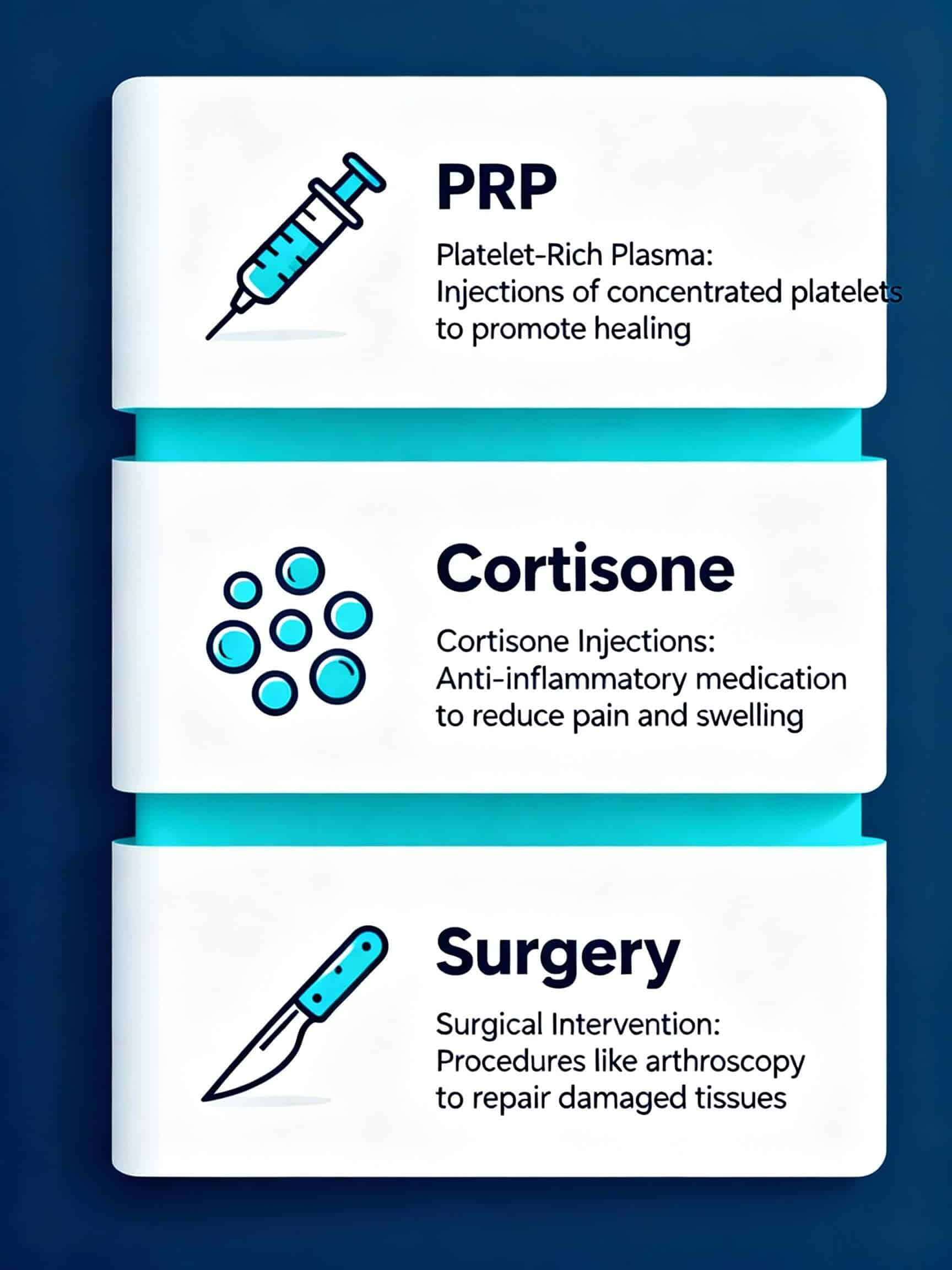
Which path fits your goals? decision framework
Choose PRP if you want:
Avoid surgery while addressing tendon pathology – Minimal work/sport disruption -Potential to strengthen damaged tissue – Drug-free healing approach
Choose Cortisone if you need:
Rapid pain relief for upcoming events/work – Temporary bridge while planning next steps – Single flare management
Choose Surgery if you have:
- Complete rotator cuff tear with weakness – Structural instability or locking – Failed all conservative treatments – Young age/active lifestyle demanding durability
What the Latest Research Shows (2024-2025)
PRP demonstrates superior 6-month functional outcomes vs. cortisone for rotator cuff tendinopathy
Single PRP injection matches surgery pain relief at 1-year for partial tears in some studies
Combination approaches (PRP + targeted PT) optimize outcomes across all tendon pathology stages
Cortisone retains role for acute inflammation but loses effectiveness with repetition
NIH Review: PRP for Rotator Cuff Injuries | PLOS One Meta-analysis
Integrated Approach: Often the Best Path
In my practice, I rarely recommend isolated treatments. The optimal path often combines:
Diagnostic clarity – MRI/ultrasound to identify pathology
Short-term pain control – cortisone or activity modification
Tissue healing – PRP for partial tears/tendinopathy
Structural rehab – surgery + post-op biologics when indicated
Long-term prevention – targeted physical therapy
Dr. Sobo’s Insight: “Here is the reality: Medication is a tool, not a lifestyle.”

Next Steps: Finding Your Best Path
Shoulder pain treatment decisions hinge on your diagnosis, timeline, and goals. The first step is always clarity:
Comprehensive exam and imaging review
Goal alignment (work, sports, pain tolerance)
Evidence-based recommendations
Transparent discussion of risks/benefits
Schedule Your Shoulder Evaluation
Key Takeaways
PRP = Tissue healing, moderate timeline, low risk
Cortisone = Rapid relief, temporary, risk with repetition
Surgery = Definitive repair, long recovery, high success for appropriate cases
Integrated approaches beat single-modality treatments
Individualized assessment trumps one-size-fits-all recommendations
Dr. Henry Sobo, MD practices regenerative orthopedics in Connecticut, specializing in ultrasound-guided PRP injections and non-surgical joint preservation. Learn more about PRP treatments or shoulder pain solutions.
References & Medical Sources
Individual results vary. All treatment decisions should involve comprehensive medical evaluation.

Ready to Start a Plan That Works?
If you’re exploring care in the Stamford, Greenwich, or Norwalk area, start with our PRP, cortisone injections.
We focus on combining safe, effective medication with a realistic lifestyle plan. For broader options, see our Holistic Medicine Programs.
PRP vs Cortisone vs Surgery: Frequently Asked Questions
What is the difference between PRP and cortisone for shoulder pain?
PRP uses your own blood platelets to stimulate healing and tissue repair, while cortisone is a steroid that reduces inflammation but doesn’t repair damage. PRP works gradually over weeks but provides longer-lasting benefits (6-24 months), while cortisone offers rapid relief (days) but typically lasts 4-12 weeks.
Is PRP better than cortisone for rotator cuff tears?
Recent studies show PRP provides better long-term shoulder function and pain relief compared to cortisone for partial rotator cuff tears and tendinopathy. Cortisone is superior for immediate relief, but PRP supports tendon healing without the risk of tissue weakening from repeated steroid injections.
When should I choose surgery over PRP for shoulder pain?
Surgery is typically recommended for full-thickness rotator cuff tears with significant weakness, structural instability, or when conservative treatments (including PRP) have failed. PRP works best for partial tears, chronic tendinitis, and patients wanting to delay or avoid surgery.
How long does PRP take to work compared to cortisone?
Cortisone provides noticeable pain relief within 2-7 days. PRP typically shows improvement starting at 2-6 weeks, with peak benefits at 3-6 months as tissue remodeling occurs. Patients often need 1-3 PRP sessions for optimal results.
Can I get PRP and cortisone injections together?
Yes, many protocols use cortisone first for rapid pain control, followed by PRP 4-6 weeks later to promote healing. This combination addresses both immediate symptoms and underlying tissue damage effectively.
Does insurance cover PRP vs cortisone vs surgery?
Cortisone injections and surgery are usually covered by insurance when medically indicated. PRP is often considered investigational and requires self-pay, though costs are comparable to 2-3 cortisone injections.
What are the risks of PRP vs cortisone for shoulder treatment?
PRP risks are minimal (brief soreness, rare infection) since it uses your own blood. Cortisone risks include tendon weakening with repeated use, temporary blood sugar spikes in diabetics, and rare tissue atrophy. Surgery carries standard operative risks plus 4-6 months recovery.
How successful is PRP vs surgery for shoulder tendinitis?
For chronic rotator cuff tendinopathy, PRP shows 70-85% improvement rates at 6-12 months. Arthroscopic surgery has 85-95% success for full tears but requires extensive rehab. PRP often serves as a successful alternative for partial tears and tendinosis.
Can athletes use PRP instead of surgery?
Yes, PRP allows faster return to sport (4-8 weeks) compared to surgery (4-6 months). Professional sports medicine increasingly uses PRP for partial tears and overuse injuries to avoid surgical downtime while promoting tendon healing.

Read more our posts...
REDEFINE 4 Results: CagriSema vs. Tirzepatide, Weight Loss, and FDA Status
Phase 3 head-to-head results and an anticipated late-2026 FDA decision create strong news and comparison intent. This article was evidence-checked on September 6, 2026. Regulatory status, labels, and trial publications

GLP-1 Medications and Vision Changes: NAION, Retinopathy, and Warning Signs
Regulatory safety updates and new observational research are driving urgent patient questions about vision loss. This article was evidence-checked on September 6, 2026. Regulatory status, labels, and trial publications can
GLP-1 Microdosing: Evidence, Risks, and What “Low Dose” Really Means
Evidence review date: September 6, 2026. GLP-1 microdosing has attracted substantial consumer and telehealth interest, but direct clinical-trial evidence remains limited. Medication approvals, prescribing information, safety communications, and clinical evidence