The Lancet is one of the most well-known and respected scientific/ medical journals in the world. They have previously published two reviews of the state of scientific knowledge regarding risk factors for dementia and what can be done to prevent the ever-increasing incidence of dementia as a worldwide health problem. The number of people with dementia worldwide in 2019 was estimated at 57 million and is projected to increase to 153 million by 2050.4
They outlined the known risk factors and spoke to what an individual can do to prevent the onset of dementia and presented the latest research and knowledge that can enable public health officials to cultivate public health policies to protect their populations.
The Lancet Commission on this matter conducted scientific reviews that were published first in 2017 and updated in 2020, which documented twelve risk factors for dementia. Now in the new comprehensive review published as their 2024 update, they have added 2 more risk factors for dementia that we should all be aware of. https://www.thelancet.com/journals/lancet/article/PIIS0140-6736(24)01296-0/fulltext
The 2024 update of the Lancet Commission on Dementia provides new hopeful evidence about dementia prevention, intervention, and care. As people live longer, the number of people who live with dementia continues to rise, emphasizing the need to identify and implement preventive approaches.
The 12 risk factors that were identified from the existing research literature in their 2020 report were as follows:
- hypertension
- physical inactivity
- diabetes
- excessive alcohol consumption
- smoking
- obesity
- depression
- hearing loss
- social isolation
- traumatic brain injury
- less education
- air pollution
The 2020 report said that reducing the risk factors across the board had the potential to prevent 40% of cases of dementia.2
Evidence is increasing and is now stronger than ever that managing and trying to eliminate these risk factors reduces the risk of developing dementia.
In the new 2024 report, they have presented compelling evidence to establish two more risk factors:
Untreated vision loss and High LDL cholesterol (the “bad” cholesterol), are also risk factors for dementia.
The Lancer Commission completing its scientific analysis made this bold statement:
“Modifying 14 risk factors might prevent or delay nearly half of dementia cases”
They say, “Be ambitious about prevention. Prevention involves both policy changes at national and international governmental levels and individually tailored interventions. Population-based policy should prioritize equity and ensure that groups at high risk are included. Actions to decrease dementia risk should begin early and continue throughout life. Risk is clustered in individuals; therefore, interventions should often be multicomponent.”
An individual’s risk is modifiable even for those at risk genetically- specifically individuals who carry the APOE gene known to be a risk factor. The multicomponent interventions recommended by the existing science, will still be helpful for those with a genetic propensity toward dementia. https://www.thelancet.com/commissions/dementia-prevention-intervention-care#:~:text=As%20life%20 expectancies%20 increase%2C%20the,are%20risk%20factors%20for%20dementia.
Specific actions to reduce dementia risk across the life course
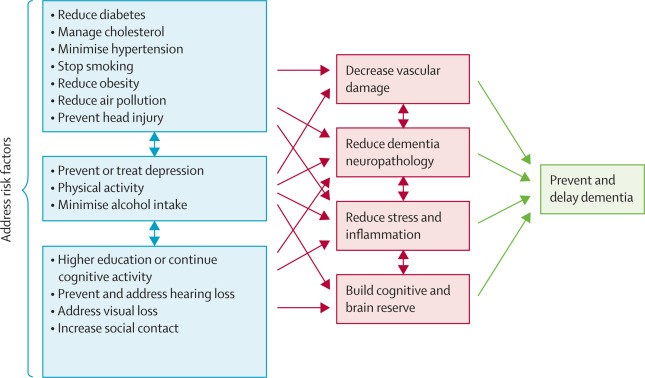
The Lancet commission made these specific recommendations to manage these 14 risk factors:
- Individuals should exercise because the research clearly shows that people who exercise and /or participate in sports are less likely to develop dementia.
- Public policies as it relates to our schools, can have a great impact by influencing the degree of physical activity that younger people engage in and can become accustomed to, early in their lives.
- Treat obesity as early in life as possible and maintain a healthy weight which will greatly diminish the incidence of diabetes, another independent risk factor.
- Reduce excessive alcohol consumption on an individual basis, as well as through promotion of increased public awareness of the levels and risks of excess drinking.
- Eliminate cigarette smoking as an individual action and make public health policies to diminish cigarette smoking via price controls, education, and preventing smoking in public places.
- Treat depression effectively.
- Decrease harmful noise exposure to reduce hearing loss, and make hearing aids accessible for people with hearing loss.
- Encourage stimulating mental activities in midlife, preventing cognitive decline.
- Encourage the use of helmets and head protection for those engaged in bicycle riding and contact sports.
- Prevent or reduce hypertension to maintain a systolic blood pressure of 130 mm Hg or less from age 40 years on.
- Test for and treat high LDL cholesterol (bad cholesterol).
- Screening and treatment for vision loss.
- Encourage supportive community environments to reduce social isolation by facilitating participation in social activities.
- Reduce exposure to air pollution.
Scientific evidence shows that reducing the risk of dementia increases the number of healthy years of life one has before the onset of many diseases as well as dementia, and this compresses the time one suffers from dementia at the end of life.
People with healthier lifestyles, who exercise and don’t smoke, and those who avoid drinking alcohol excessively have a lower risk of developing dementia, and they also have the onset of dementia delayed so that they live with better health for longer, and will have fewer years of living with dementia at the end of life.19
The present studies and presentation by the Lancet Commission provides a comprehensive dementia prevention program incorporating managing the 14 known risk factors. There is a great chance that incorporating these preventive measures could meet with success, as it is felt that approximately 50% of dementia could theoretically be prevented or eliminated by eliminating these 14 risk factors.
This preventative approach should start early in life- the earlier the better. And although addressing the risk factors at an earlier stage of life is best, it is never too late to reduce dementia risk. Even for those who are already elderly, attending to all of these preventive measures should result in a positive impact. Even for those who have already suffered the onset of dementia, these healthy lifestyle interventions may still be of value in slowing down the advancement of dementia for that individual.
Evidence for specific risk factors suggests that all children should be educated about these elements of a healthy lifestyle. And it is important to recognize that being cognitively, physically, and socially active in midlife and later in life is beneficial. The evidence that treating hearing loss decreases the risk of dementia is now even stronger than when the 2020 Commission report was published. The prescription for, and use of hearing aids is particularly effective in people with both hearing loss and other additional risk factors for dementia. New evidence also suggests that treating depression and smoking cessation can both reduce dementia risk. The report states that reducing air pollution is linked with improved cognition and a reduction in dementia risk. Public health policy makers should implement strategies to improve air pollution, particularly in areas with high air pollution.
Traumatic Brain Injury (TBI), at any age and from any source, is a risk factor for dementia. Contact sports pose that risk and protection from head injury, such as by the use of appropriate head protection equipment, is important. Also avoiding playing sports immediately after a traumatic brain injury should be stressed by all of those who are involved in managing youth sports in schools and elsewhere.
The Lancet Commission on dementia prevention, intervention, and care was reconvened to produce the 2024 report with the aim of influencing public policy, clinical medical practice, and plans for future research. Exciting progress is being made in the field of dementia prevention and all of society should participate in achieving the goal of reducing dementia, which is becoming more common as people are living longer. The authors of the report state, “We unanimously agreed on the best available evidence and its consistency. We identified advances that are likely to have the greatest effects and performed new work to allow us to calculate the effects of potentially modifiable risk factors for dementia. Here, we report our new analyses and consolidate current knowledge, summarizing the balance of evidence about prevention, intervention, and care.”
The Lancet Commission produced the following graphic which presents an overall view of the risk factors, and the resulting benefits of risk factor reduction.