KLOW is a name commonly used for a combination of BPC-157, TB-500, GHK-Cu, and KPV. It is often described as GLOW with KPV added. Research on KPV has examined inflammatory signaling in cells and animal models, which gives researchers a specific question to investigate: could this peptide have a role in a defined inflammatory condition? That research does not show that KPV treats inflammation in people or improves a four-peptide KLOW product.
As of November 25, 2026, KLOW has no standardized clinical formulation or evidence-based protocol. The four ingredients have different research histories and safety questions, and no direct clinical study of the named combination was identified. This article examines the evidence ingredient by ingredient, explains why adding KPV does not establish an additive benefit, and discusses established care and patient-safety considerations.
What Is the KLOW Peptide Stack?
“KLOW” is an informal name, not an FDA-approved drug name or standardized treatment. The label is commonly used for a combination of BPC-157, TB-500, GHK-Cu, and KPV. Products described by the same name may differ in ingredients, amounts, formulation, route, and quality controls. The name alone does not verify product identity.
| Ingredient | General description | Evidence question |
|---|---|---|
| BPC-157 | A synthetic 15-amino-acid peptide investigated primarily in preclinical tissue-protection and repair research. | Do small, route-specific human reports translate into reliable clinical benefit or a known safety profile? |
| TB-500 | A common name used for a short thymosin beta-4-related fragment; the name has not always been used consistently. | What evidence directly concerns the fragment rather than full-length thymosin beta-4? |
| GHK-Cu | A copper-binding form of the tripeptide glycyl-histidyl-lysine. | What does route-specific topical research establish, and what remains unknown for other formulations? |
| KPV | A three-amino-acid peptide corresponding to a portion of alpha-melanocyte-stimulating hormone. | Can findings in cells and animal models be translated into a treatment that helps people? |
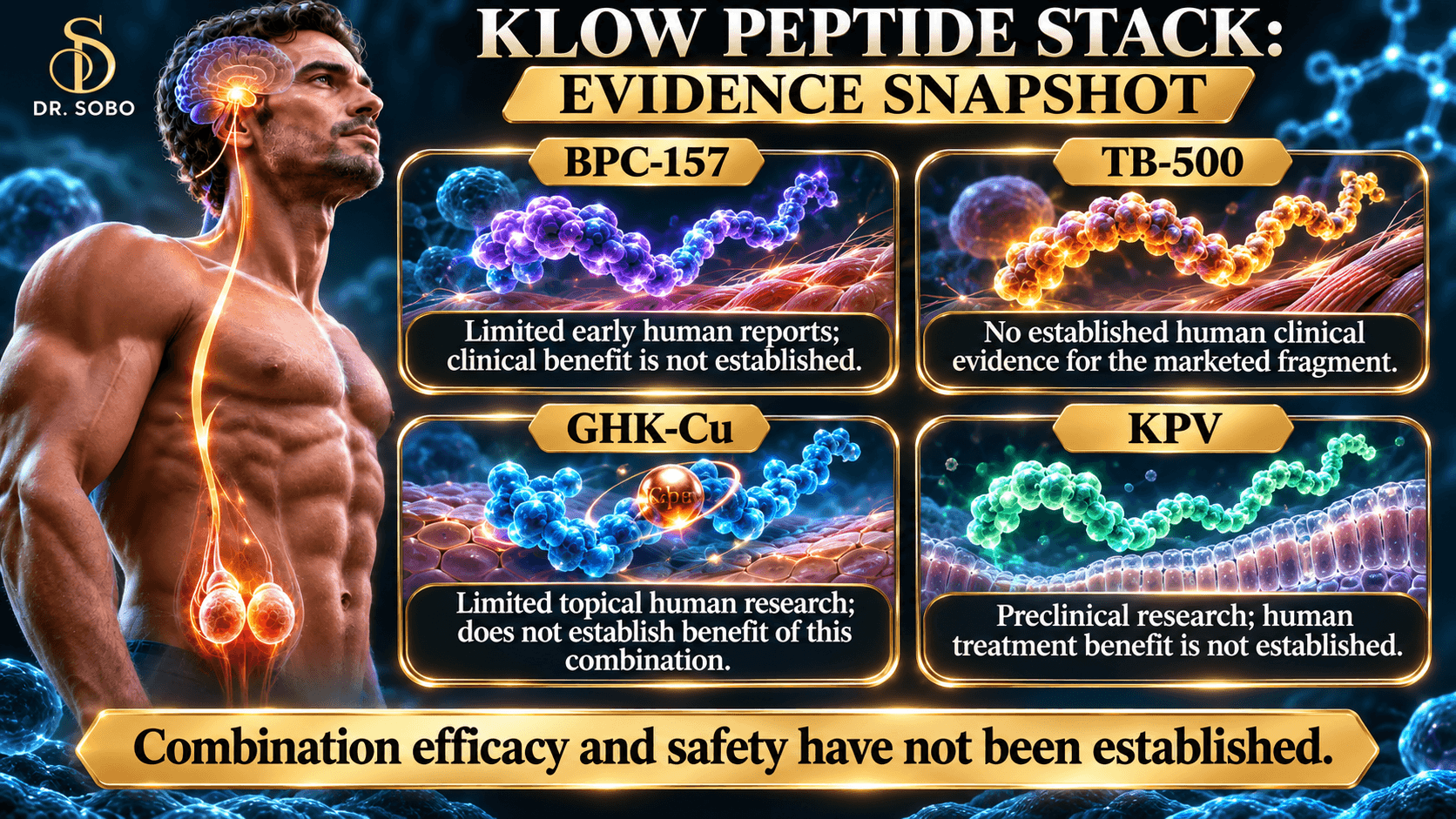
It would be misleading to combine the most favorable observation from each ingredient and describe the result as evidence for KLOW. Each study answers a narrower question about a particular substance, route, model, or patient group. None of those studies tests the four-ingredient formulation as a whole.
Why Is KPV Included in Discussions of KLOW?
KPV is commonly described as an anti-inflammatory research peptide because scientists have investigated its effects on inflammatory signaling. The scientific interest is real: cell and animal studies have examined how KPV interacts with cellular pathways and experimental inflammation. Those studies can inform future research, but they are not human clinical trials.
The positive possibility is that KPV’s small size and interaction with peptide transport and signaling pathways may help investigators study how inflammatory responses can be modulated. A mechanism can help researchers design a testable hypothesis. It does not determine whether a particular formulation reaches the right tissue, changes disease activity, improves symptoms, or is safe for a patient.
For KLOW, the proposed rationale is that KPV could add an inflammatory-signaling research dimension to the other three ingredients. That remains a hypothesis. Direct comparison would be needed to find out whether KPV contributes anything to the combination, whether the four ingredients remain stable together, and whether the blend changes risks.
FDA’s 2026 compounding safety information stated that it had not identified human exposure data for KPV drug products and lacked information to determine whether KPV could cause harm in humans. HHS’s subsequent interim policy includes KPV acetate for certain single-ingredient compounded products under specific conditions. That policy reflects a compounding enforcement approach; it is not a finding that KPV is effective for a disease or that KLOW has been studied.
For KPV-specific information, see Dr. Sobo’s KPV peptide page and the related article on peptides and gut-health research. Findings from cells and animal models should be distinguished from patient outcomes.
KPV Study-by-Study: What the Research Actually Tested
The best-known KPV studies are preclinical. They are useful for understanding why the compound attracts research interest, but they do not establish an effective or safe human treatment.
| Study | Model and methods | Reported finding | What it does not show |
|---|---|---|---|
| Dalmasso et al., 2008, PepT1-mediated KPV uptake | Experiments used human intestinal epithelial cell lines and a human T-cell line, along with two induced colitis models in mice. KPV was added to cell experiments and drinking water in the mouse models. | The authors reported cellular uptake and reduced inflammatory signaling measures in the cell experiments, as well as reduced inflammatory measures in the mouse models. | Cell lines are not people receiving a treatment. Mouse colitis models do not establish a clinical effect, effective human dose, or safe route in patients. |
| Kannengiesser et al., 2008, murine inflammatory bowel disease models | The researchers examined KPV in two experimental intestinal-inflammation models in mice and investigated possible signaling mechanisms. | The study reported anti-inflammatory potential in the models tested. | It did not test people with Crohn’s disease, ulcerative colitis, or another inflammatory condition. It did not test KLOW. |
| Brzoska et al., 2003, inflammatory models | Research compared KPV and other melanocortin-related peptides in mouse models of induced inflammation, including peritonitis models. | The study reported reductions in selected inflammatory-cell measures under specific experimental conditions. | It did not establish a treatment for human inflammation or prove that KPV adds benefit to a multi-peptide product. |
The Dalmasso study is sometimes summarized as “human research” because it included human-derived cell lines. That wording needs care: the experiment did not administer KPV to human participants. A cell line helps researchers examine a mechanism under controlled laboratory conditions, but it cannot show how a whole person will absorb, distribute, metabolize, or respond to a product.
FDA’s statement that it had not identified human exposure data refers to drug products containing KPV administered to people. It can coexist with laboratory experiments using human cells. HHS’s later interim policy also does not convert those cell and mouse findings into clinical evidence. It addresses specific compounding conditions and product controls, not treatment effectiveness.
BPC-157: Human Evidence Does Not Establish KLOW
BPC-157 has been investigated in preclinical models of tissue protection and repair. Its human literature is much smaller and consists of several reports with different indications and routes. Those reports are worth describing accurately, while avoiding the leap from a preliminary signal to a proven treatment.
In the Lee and Padgett 2021 retrospective knee-pain review, 17 patients were identified and 16 were reached by phone. Twelve had received BPC-157 alone and four had received BPC-157 together with thymosin beta-4. Fourteen of the 16 contacted patients reported improvement. Because there was no control group, participants were contacted retrospectively, and the combined-treatment group included only four people, the study cannot establish effectiveness or show that combining the two ingredients was better.
In a 2024 pilot report on interstitial cystitis, 12 women who had not responded to pentosan polysulfate received a single cystoscopic procedure involving intravesical BPC-157. The authors reported symptom resolution or substantial improvement in all 12 and reported no adverse events. The study was uncontrolled, small, and conducted in one setting. It does not establish effectiveness for other patients, conditions, or routes.
In a 2025 pilot report, two participants received intravenous BPC-157 on consecutive days at different amounts. The authors reported no adverse events and no clinically significant changes in the measured vital signs or laboratory results. A sample of two is far too small to detect uncommon events, evaluate long-term safety, or establish a general safety profile.
FDA’s 2026 briefing also reviewed early rectal-enema research. A Phase 1 tolerability and pharmacokinetic study, described in meeting abstracts, randomized 32 healthy volunteers, 24 of whom received BPC-157. The abstracts reported no significant treatment-attributed adverse events, with headache and flatulence occurring at similar frequency or severity to placebo. Because these reports are abstract-only and involved rectal administration, they do not establish safety for injectable or other products.
A 2005 ulcerative-colitis study was reported as a conference abstract. It randomized 53 participants to BPC-157 or placebo enema for two weeks. The reported difference in the Disease Activity Index had a confidence interval crossing zero, and the abstract did not fully define the outcome or methods. FDA concluded that the available data were inadequate to support efficacy or safety for ulcerative colitis.
Together, these studies show why the human evidence should be described as preliminary and route-specific. They do not show that BPC-157 improves KLOW, and the small knee subgroup that also received thymosin beta-4 cannot establish the effect of BPC-157 plus TB-500, much less a four-ingredient product that also contains GHK-Cu and KPV.
See Dr. Sobo’s BPC-157 page for additional ingredient information.
TB-500: Direct Evidence Is Different From Parent-Protein Research
TB-500 is commonly used to refer to a short thymosin beta-4-related fragment, but the term has not always been applied consistently. FDA’s 2026 briefing describes the fragment as a seven-amino-acid peptide and notes that TB-500 is a common name rather than a unique standard pharmaceutical name.
FDA’s evaluation did not identify clinical studies or human exposure data for drug products containing TB-500. The agency also described a limited in-vitro wound experiment in which TB-500 did not induce wound healing in a fibroblast scratch model at the tested concentration. This single laboratory result does not answer every biological question, but it cannot be used to claim a clinical wound-healing effect.
Clinical studies of full-length thymosin beta-4 have examined other conditions and formulations. They are not TB-500 trials. The difference matters because a shorter fragment may have different pharmacology, stability, and safety. Research about the parent molecule can guide scientific questions, but should not be described as proof for the fragment or for KLOW.
FDA’s compounding review discusses unknown human safety risks and possible concerns with injectable products, including aggregation, peptide-related impurities, and immunogenicity. It also notes challenges with inconsistent naming and chemical characterization. Those concerns support clear labeling and professional oversight; they do not justify claiming that all compounding pharmacies or compounded medicines are unsafe.
See Dr. Sobo’s TB-500 and thymosin beta-4 page for information about the component. When reviewing a study, it is important to identify which molecule the researchers actually tested.
GHK-Cu: A Small Topical Human Study, Not a KLOW Trial
GHK-Cu is a copper-binding form of GHK that has been studied in laboratory and topical skin contexts. A 2026 randomized, double-blind, vehicle-controlled split-face study enrolled 18 healthy adults aged 18 to 40. Participants applied 2% GHK-Cu serum to one eyebrow and a vehicle serum to the other twice daily for 12 weeks. The published report described greater improvements in eyebrow hair count, hair diameter, photographic assessment, and participant satisfaction on the treated side. No serious adverse effects or allergic reactions were reported in that small study.
This is a positive, preliminary signal for a narrow question: a topical serum and eyebrow hypotrichosis in a small group over 12 weeks. The sample was limited, the indication was specific, and the study did not evaluate injections, wound treatment, general skin aging, or a combination with BPC-157, TB-500, and KPV. It supports further investigation of that topical use; it does not validate KLOW.
Other GHK-Cu reports include small cosmetic studies and conference abstracts. The type of publication affects how much detail is available for evaluating methods, participants, outcomes, and bias. Findings from topical creams also should not be transferred to injectable products. Formulation and route can change exposure and potential risk.
FDA’s safety information notes limited human data for injectable GHK-Cu and potential immunogenicity concerns involving aggregation and peptide-related impurities. HHS’s interim peptide policy does not list GHK-Cu. FDA’s compounding materials separately address routes, so the status of topical, oral, and injectable formulations should be checked for the exact preparation rather than generalized.
See Dr. Sobo’s GHK-Cu page and the related GHK-Cu skin and hair article.
Has KLOW Been Studied as a Four-Ingredient Product?
A targeted search of PubMed and ClinicalTrials.gov did not identify a human clinical study testing the named KLOW combination as a defined four-ingredient product. This describes the search and date; it is not a claim that no unpublished or unregistered work exists. It does mean the combination should not be called clinically validated based on studies of separate ingredients.
A direct KLOW study would need to define the product and answer questions that component studies cannot resolve:
- Are the molecular identities and amounts of all four ingredients specified?
- Does the finished formulation remain stable, and can it be quality-tested consistently?
- What route is being studied, and does the evidence support that route?
- What condition or patient group is the product intended to address?
- Does adding KPV produce a measurable effect beyond the other three ingredients?
- How does the product compare with an appropriate control and established care?
- What short- and long-term adverse effects occur?
Combining ingredients creates more variables. If a patient reports an improvement or an adverse effect after using a four-peptide product, it may be impossible to determine which component contributed. Without a comparison group and component-specific analysis, a study could not determine whether KPV adds value or whether fewer ingredients would have the same effect.
Does KPV Add a Proven Anti-Inflammatory Effect to KLOW?
No study has established that KPV adds an anti-inflammatory benefit to KLOW in people. KPV has preclinical research interest, but the evidence described above concerns cell lines and induced mouse models, not a four-ingredient human treatment. An additional ingredient may be scientifically interesting, but that does not show it improves a clinical outcome.
To test this question, researchers could compare the four-ingredient formulation with the three-ingredient GLOW combination, KPV alone, and an appropriate control. The study would need a disease-specific outcome rather than a broad claim such as “reduces inflammation.” Inflammatory markers may be useful secondary measures, but patients also need outcomes that reflect symptoms, function, disease activity, or quality of life.
Researchers would also need to evaluate the product’s stability and safety, and to establish whether the same route makes sense for all four ingredients. Results from an oral KPV animal model do not establish the effects of an injectable KLOW product. Results from topical GHK-Cu do not establish the effect of a mixture intended for another route.
KLOW Compared With GLOW and the Wolverine Stack
KLOW is commonly described as GLOW plus KPV. GLOW is commonly described as BPC-157, TB-500, and GHK-Cu. The Wolverine stack is commonly described as BPC-157 plus TB-500. These names describe informal ingredient groupings; they are not standardized medical products.
| Name | Commonly listed ingredients | What the name does not establish |
|---|---|---|
| Wolverine | BPC-157 and TB-500 | A proven combined effect, a standardized product, or a validated protocol. |
| GLOW | BPC-157, TB-500, and GHK-Cu | That GHK-Cu improves outcomes or that the three ingredients have been studied together. |
| KLOW | BPC-157, TB-500, GHK-Cu, and KPV | That KPV adds benefit or that the four ingredients are compatible and effective as a blend. |
Dr. Sobo’s Wolverine stack page and Wolverine stack article cover the two-ingredient grouping. KLOW adds KPV to the GLOW grouping, but adding an ingredient does not establish a complementary or additive effect. This article considers that question through the available ingredient-specific research and the evidence gaps around the four-peptide combination.
For general considerations about using multiple peptide products, see the existing peptide-stacking safety article. This KLOW-specific discussion complements broader safety guidance by focusing on the four-ingredient formulation and the evidence questions around KPV.
Compounding and Regulatory Status
As of November 25, 2026, KLOW is not an FDA-approved drug product. Compounded drugs are not FDA-approved, and FDA does not review their safety, effectiveness, or quality before marketing in the same way it reviews approved drugs.
HHS’s interim enforcement-discretion policy names BPC-157, TB-500, and KPV among certain peptide bulk drug substances. It includes detailed conditions, including patient-specific prescription requirements, ingredient identity and quality documentation, reporting requirements, and a requirement that a compounded product contain only one active pharmaceutical ingredient from the policy’s list. GHK-Cu is not listed in that HHS policy. The policy therefore does not cover KLOW as a four-ingredient product.
The limits of that policy should be stated precisely. It is not FDA approval, evidence that the listed ingredients treat a specific condition, or blanket permission to sell or compound any peptide product. It also does not make all compounding illegitimate or unsafe. It describes limited enforcement discretion for products meeting the specified conditions while the federal list is developed.
HHS’s policy specifically addresses single-ingredient products and does not establish the safety or efficacy of multi-ingredient stacks. FDA’s individual ingredient evaluations describe different issues for BPC-157, TB-500, KPV, and injectable GHK-Cu. Those details should not be collapsed into a single statement about “peptides” as a group.
For KPV, HHS’s policy recognizes specific ingredient characterization and product-quality information and allows enforcement discretion for certain oral or topical single-ingredient products under its conditions. That does not establish a clinical benefit, and it does not extend to the KLOW combination. For BPC-157 and TB-500, the policy also specifies product and route requirements. Patients and prescribers should verify the current rules for the exact active ingredient, salt form, dosage form, route, pharmacy, and prescription.
Established Options for Inflammatory, Skin, and Musculoskeletal Concerns
A patient considering KLOW should first identify the condition they want addressed. “Inflammation” is not a diagnosis, and the appropriate options vary depending on the cause, affected tissue, severity, and medical history.
For a diagnosed inflammatory or gastrointestinal condition
Patients with persistent bowel symptoms need evaluation for the cause, including conditions that require prescription treatment or urgent care. For ulcerative colitis, FDA-approved options include medications such as 5-aminosalicylates, biologics, and small-molecule treatments, selected according to disease extent and severity. A patient should not delay established care or stop prescribed medication in favor of an unproven peptide combination.
For a wound or skin concern
Skin symptoms may reflect dermatitis, infection, vascular problems, a medication effect, a chronic wound, or another diagnosis. Appropriate care can involve wound assessment, pressure relief, dressings, infection management when indicated, dermatology evaluation, or other diagnosis-specific treatments. A small topical eyebrow study of GHK-Cu does not establish a treatment for chronic wounds or generalized skin inflammation.
For joint, tendon, or muscle symptoms
Care may include examination, imaging when clinically indicated, activity modification, physical therapy, progressive rehabilitation, and pain management. Treatment choices depend on the specific injury or diagnosis. Patients should not infer from an uncontrolled knee-pain chart review that BPC-157 or KLOW repairs cartilage or replaces standard rehabilitation.
These alternatives are not one-size-fits-all. A clinician can help determine which options fit the diagnosis and the patient’s circumstances. Patients can also review Dr. Sobo’s peptide therapy information as part of a broader discussion, without assuming that KLOW is available or appropriate.
Patient Safety and Candidacy: Questions to Resolve First
No clinical study has established who is an appropriate candidate for KLOW, what dose or route to use, or how to monitor treatment. Anyone considering a peptide combination should have a clinician review the underlying diagnosis, medical history, current medications, and exact product before making a decision.
Some situations deserve particular caution:
- Pregnancy, breastfeeding, or fertility planning: There is not an established safety profile for the KLOW combination in these circumstances.
- Cancer or a history of cancer: Do not rely on broad claims about tissue repair or immune signaling to infer safety. Discuss peptide use with the clinician responsible for cancer care.
- Autoimmune, allergic, or immune-related conditions: The effects and risks of these individual products and their combination are not well established.
- Chronic illness or multiple medications: A medication and medical-history review is important before introducing a product with uncertain pharmacology and interactions.
- Upcoming surgery, injections, or wound care: Tell the treating clinician about any peptide use. Do not substitute an unproven blend for procedural instructions or prescribed care.
- Competitive sports: Check current rules with the relevant sport organization. A substance’s regulatory status and anti-doping status are separate questions that can affect eligibility.
- Products sold as “research use only”: That label does not establish suitability for human use. Do not treat research-labeled material as a medication.
Product identity is a separate safety question from whether a molecule has a plausible mechanism. Patients and prescribers need to know the exact active ingredient, salt form, concentration, route, source, and quality information. For injectable products, sterile manufacturing and product-quality controls are especially important. A vendor’s product page or certificate image should not be treated as proof that a product is safe for a particular patient.
Patients should ask what is known about adverse effects, how a suspected reaction should be handled, what benefit would count as meaningful, how long the product would be considered, and what would trigger discontinuation. If no one can define those terms, the product is difficult to monitor responsibly.
Introducing several ingredients at once can also make it difficult to identify which one caused an effect or reaction. That uncertainty is especially relevant to a four-ingredient blend. A clinician-guided plan should make clear what is being evaluated and how follow-up will occur. The label “stack” does not substitute for an individualized medical rationale.
How Patients Can Discuss KLOW With Dr. Sobo
Patients who have questions about KLOW can bring the complete product label, ingredient list, route, source details, and research or claims they have encountered. The clinical conversation should begin with the symptom or condition, not with an assumption that the stack is the answer. A clinician can review the diagnosis, history, medications, prior care, and better-established options.
Dr. Sobo evaluates peptide questions within an individualized medical plan based on a patient’s goals, history, and clinical appropriateness. That does not establish that KLOW is available or appropriate for every patient. It means the exact product and the patient’s health context need to be evaluated before any treatment decision. Learn more about Dr. Sobo and peptide therapy.
Patients who have already used a peptide product should tell their clinician what they took, when they used it, how it was administered, and where it came from. Bring the packaging if possible. The product name may not reliably identify its contents.
What Would Establish Whether KLOW Works?
Research would need to begin with a defined, characterized four-ingredient formulation. Investigators would need to verify each ingredient, the amount, the salt form, purity, stability, compatibility, and route. They would need to determine whether KPV and the other ingredients remain stable together and whether their exposure or activity changes in a combined preparation.
Clinical studies should then address a specific diagnosis rather than broad claims about inflammation, healing, or wellness. A gastrointestinal study would need clinically relevant disease outcomes and an appropriate comparison with established care. A skin study would need a clearly defined skin condition and validated outcomes. A musculoskeletal study would need a defined injury, functional measures, and follow-up long enough to assess recovery and adverse events.
To learn whether KPV adds value, researchers should compare KLOW with a three-ingredient formulation that does not include KPV, as well as an appropriate control. If the combination produces a positive result, this design can help determine whether KPV contributed. If it does not, that finding can prevent unnecessary exposure to an additional ingredient.
Trials should report all outcomes, including negative and inconclusive findings. Transparent methods, prespecified results, adequate sample sizes, and complete safety reporting would help clinicians and patients understand whether any observed effect is real and clinically meaningful. Until direct studies are available, KLOW’s combined clinical effect remains unknown.
Frequently Asked Questions About the KLOW Peptide Stack
What ingredients are in KLOW?
KLOW is commonly described as BPC-157, TB-500, GHK-Cu, and KPV. The name is informal, so products may differ in ingredients, amounts, formulation, or route. The stack name does not establish what a particular product contains. Patients should review the exact label with a qualified healthcare professional.
How is KLOW different from GLOW?
GLOW is commonly described as BPC-157, TB-500, and GHK-Cu. KLOW adds KPV as a fourth ingredient. That difference identifies the commonly listed ingredients; it does not show that KPV improves outcomes or that either combination has been clinically tested as a full product.
Does KPV have proven anti-inflammatory effects in people?
No clinical benefit has been established for KPV in people based on the cell and animal studies described here. Those studies reported effects in specific experimental models. They do not establish a human treatment effect, a safe human dose, or an added benefit when KPV is combined with the other KLOW ingredients.
Has KLOW been tested in a clinical trial?
A targeted search of PubMed and ClinicalTrials.gov did not identify a human study testing the named four-ingredient KLOW combination as a defined product. Research on individual ingredients or other formulations cannot establish whether KLOW is effective or safe.
Is KLOW FDA-approved?
No. KLOW is not an FDA-approved drug product. Compounded drugs are not FDA-approved and do not receive the same premarket review of safety, effectiveness, and quality as approved medicines. Regulatory status should be checked for the exact ingredients, dosage form, route, and product.
Does HHS’s interim peptide policy cover KLOW?
No. The HHS policy includes certain peptide ingredients under specified conditions, but it requires one active ingredient per compounded product. It does not list GHK-Cu. The policy therefore does not cover KLOW as a four-ingredient product and does not establish that the combination works.
Does a study of KPV in mice prove KLOW reduces inflammation?
No. Mouse studies can help researchers develop hypotheses, but they do not demonstrate a treatment effect in people. They also do not test the four-ingredient KLOW formulation. A clinical study would need to evaluate the defined combination in people with a specific condition and measure meaningful outcomes.
Does human research on full-length thymosin beta-4 prove TB-500 works?
No. Full-length thymosin beta-4 and the short fragment commonly called TB-500 are different molecules. Studies of the parent protein do not automatically establish the safety or effectiveness of the fragment, a product marketed under the name TB-500, or a multi-peptide blend.
What established options should I consider instead of KLOW?
Alternatives depend on the diagnosis. Inflammatory bowel conditions may require prescription treatment and specialist care. Skin or wound concerns may need dermatology or wound evaluation. Musculoskeletal symptoms may call for examination, rehabilitation, activity changes, or other diagnosis-specific care. A clinician can help select appropriate options.
What should I bring to a clinician when asking about KLOW?
Bring the complete product label, ingredient list, dosage form, route, source information, and any research or claims you have seen. Also share your diagnosis, medical history, current medications, prior treatments, and goal. That gives the clinician information needed to assess the exact product and alternatives.
Sources
- HHS: Interim Enforcement-Discretion Policy Regarding 503A Compounding Using Certain Peptide Bulk Drug Substances
- FDA: 2026 BPC-157-Related Bulk Drug Substance Briefing Document
- FDA: 2026 TB-500-Related Bulk Drug Substance Briefing Document
- FDA: Certain Bulk Drug Substances That May Present Significant Safety Risks
- Dalmasso et al.: PepT1-Mediated KPV Uptake and Intestinal Inflammation Models
- Kannengiesser et al.: KPV in Murine Models of Inflammatory Bowel Disease
- Brzoska et al.: KPV in Experimental Inflammation Models
- Lee and Padgett: Intra-Articular Injection of BPC-157 for Multiple Types of Knee Pain
- Lee et al.: Effect of BPC-157 on Symptoms in Patients With Interstitial Cystitis
- Bo et al.: Randomized Split-Face Study of Topical 2% GHK-Cu Serum for Eyebrow Hypotrichosis