
By Dr. Henry Sobo, MD – Medical Weight Loss, Functional & Hormone Therapy, Connecticut
Larazotide Peptide Therapy: A Targeted Approach to Tight Junction Regulation and Leaky Gut
The term “leaky gut” has become a catch-all for a complex and often frustrating set of gastrointestinal and systemic symptoms. For many patients, it represents a breakdown of the body’s most critical defensive barrier: the intestinal lining. While dietary changes and supplements are foundational, emerging therapeutic options offer a more targeted approach. Dr. Sobo is pleased to offer Larazotide, a synthetic peptide clinically studied for its unique ability to regulate tight junctions—the “gatekeepers” of the gut. This page provides a comprehensive, data-driven overview of Larazotide, its mechanism of action, and how it fits into a broader, personalized treatment strategy for restoring intestinal health.

What is Larazotide? A Precision Peptide for Gut Health
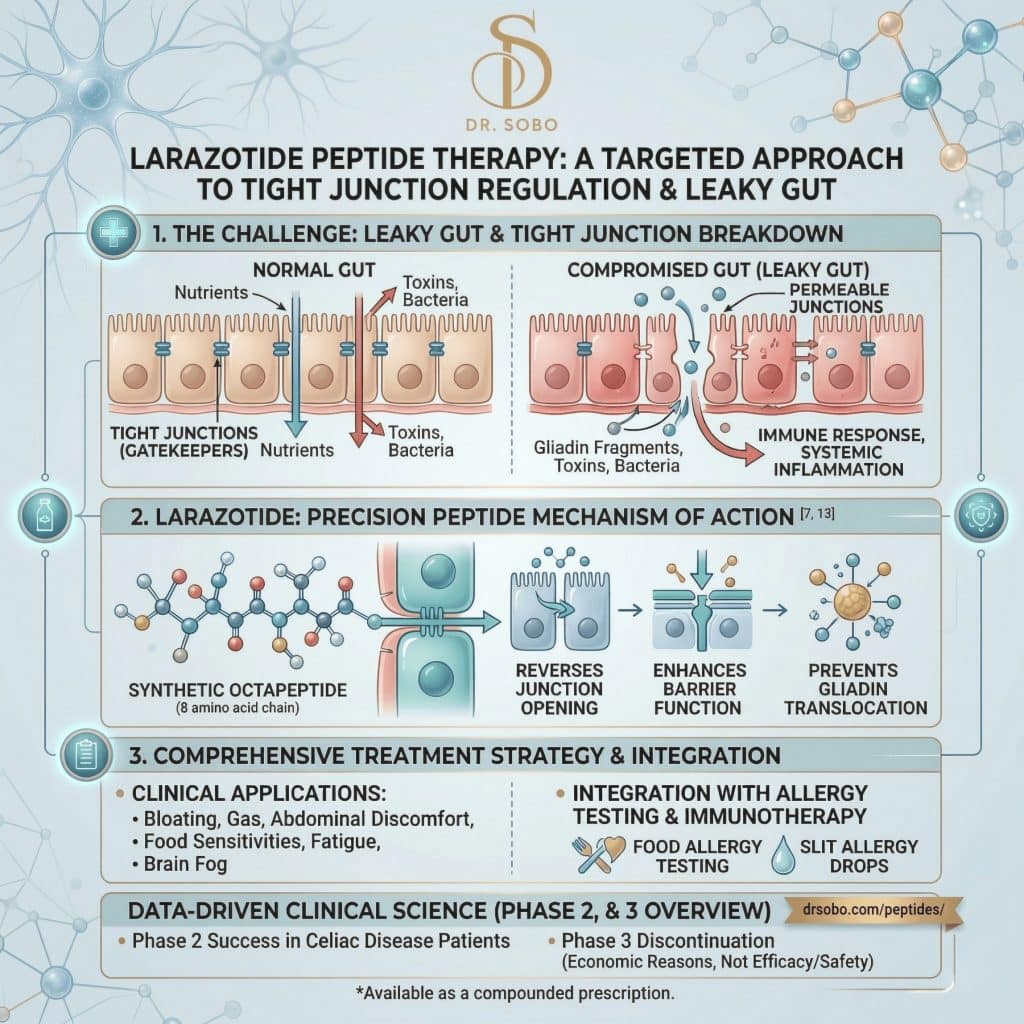
Larazotide is a synthetic octapeptide, meaning it is composed of eight amino acids. Unlike general supplements that aim to soothe the gut lining, Larazotide functions as a tight junction regulator. Its primary, well-researched role is to reverse the opening of these junctions, effectively returning them to their normally closed, selective state. This action directly counteracts the increased intestinal permeability commonly referred to as “leaky gut.”
While its most extensive research has been in the context of celiac disease, its mechanism of action makes it a highly relevant therapeutic candidate for a broad spectrum of inflammatory GI conditions where barrier dysfunction is a core component.
The Mechanism of Action: How Larazotide Restores Gut Barrier Function
To understand how Larazotide works, it is essential to understand the problem it solves. The cells lining the GI tract, known as the epithelium, are bound together by protein complexes called tight junctions. In a healthy state, these junctions act as a selective barrier, allowing nutrients to pass through while keeping out larger molecules, toxins, and bacteria.
In conditions like celiac disease, fragments of the gliadin protein (found in gluten) trigger a cascade of events. These fragments bind to a chemokine signaling protein on the inner lining of the epithelium, initiating a signaling pathway that causes the tight junctions to break down. This leads to intestinal permeability—or “leaky gut”—allowing unwanted substances to enter the bloodstream and trigger systemic immune and inflammatory responses.
Research published in ScienceDirect and other peer-reviewed sources demonstrates that Larazotide acetate directly intervenes in this process. It has been shown to:
- Enhance tight junction assembly and barrier function.
- Reduce permeability responses to gliadin fragments and proinflammatory cytokines.
- Prevent the translocation of gluten across the epithelium.
- Inhibit gliadin-induced macrophage accumulation and preserve normal tight junction structure.
In essence, Larazotide acts as a targeted stabilizer, preventing the physiological breakdown of the gut barrier at the cellular level.
The Science of Larazotide: A Review of Clinical Research
The clinical development of Larazotide provides a clear picture of its potential and the challenges of bringing new therapeutics to market.
Clinical Trial Success
The efficacy of Larazotide is not theoretical; it is backed by positive clinical data. A Phase 2 clinical trial involving 342 adult patients with celiac disease, who had been on a gluten-free diet for at least 12 months, concluded that Larazotide significantly reduced symptoms of celiac disease. [Beyond Celiac / Celiac Disease Foundation] This trial demonstrated the peptide’s ability to manage symptoms even in the face of accidental gluten exposure.
Trial and the Economics of Drug Development
Larazotide advanced to a Phase 3 trial, the final step before FDA approval. As reported by Beyond Celiac and the Celiac Disease Foundation, this trial was ultimately discontinued. It is critical to note that this decision was not due to a lack of efficacy or safety concerns. The pharmaceutical company, 9 Meters, determined that an interim analysis required a substantially larger patient group to achieve statistically meaningful results, making the continuation of the trial economically unfeasible. The significant cost—often tens to hundreds of millions of dollars—required to bring a new drug through the FDA approval process was the deciding factor, not the drug’s therapeutic potential.
Safety and Tolerability Profile
Throughout its clinical journey, Larazotide has consistently demonstrated a favorable safety profile.
- An early double-blind, randomized, placebo-controlled pilot study found that a single dose of Larazotide was well tolerated and safe in patients with celiac disease undergoing a gluten challenge.
- The study also showed that those receiving Larazotide experienced less intestinal permeability dysfunction, less production of the inflammatory substance IFN-γ, and fewer gastrointestinal symptoms compared to the placebo group.
- Multiple Phase 1 and Phase 2 studies have confirmed its safety and tolerability, with one Phase 2 study specifically noting that Larazotide acetate was well tolerated and prevented the increase in gastrointestinal symptom severity induced by gluten challenge.
This body of evidence led ScienceDirect to conclude that Larazotide acetate is, “The most promising pharmaceutical drug candidate for the treatment of altered intestinal barrier function.”
Clinical Applications: Beyond Celiac Disease to Broad-Spectrum GI Support
While the most rigorous research has been conducted on celiac patients, the underlying mechanism of Larazotide—tight junction regulation—has profound implications for the millions of people suffering from “leaky gut syndrome.” By reversing the permeability of the intestinal lining, Larazotide can help manage a wide array of symptoms associated with a compromised gut barrier, including:
- Chronic bloating, gas, and abdominal discomfort
- Diarrhea or constipation
- Food sensitivities
- Systemic inflammation
- Fatigue and brain fog
A Comprehensive Approach: Integrating Larazotide with Food Allergy Testing
At Dr. Sobo’s practice, Larazotide is not viewed as a standalone magic bullet, but as a powerful tool within a comprehensive, patient-centered strategy. For optimal and lasting results, it is critical to address the factors that contribute to ongoing gut inflammation.
The Critical Link Between Food Sensitivities and Gut Permeability
Larazotide helps close the “gates” (tight junctions), but if the “intruders” (inflammatory foods) keep knocking, the system remains under stress. Identifying and removing these triggers is essential to allow the gut lining to heal.
Identifying Triggers with Food Allergy Testing
Dr. Sobo offers comprehensive food allergy testing to pinpoint specific foods that may be contributing to your symptoms. This is a crucial step, as reactions can be delayed by hours or even days, making them difficult to identify through elimination diets alone. Symptoms of food sensitivities extend far beyond the GI tract and can include:
Category | Symptoms |
Head | Headaches, dizziness, fatigue, insomnia |
Eyes, Ears, Nose, Throat | Runny/stuffy nose, watery eyes, sore throat, chronic cough, sinusitis |
Gastrointestinal | Nausea, vomiting, diarrhea, constipation, bloating, cramps |
Skin | Hives, rashes, eczema |
Psychological | Anxiety, depression, irritability, brain fog |
Heart & Lungs | Palpitations, rapid heart rate, asthma |
Other | Chronic fatigue, joint pain, swelling, urinary urgency |
Long-Term Management with Sublingual Immunotherapy (SLIT)
For patients with identified environmental or food allergies, Dr. Sobo offers Sublingual Immunotherapy (SLIT) allergy drops. This innovative, non-invasive treatment involves placing small, customized doses of allergens under the tongue daily. This process helps the body gradually build long-term immunity, reducing the severity of allergic reactions and the inflammatory burden on the gut. By combining Larazotide’s barrier-restoring action with the immune-modulating effects of SLIT, patients can achieve more profound and durable relief.
Why Consider Larazotide Therapy with Dr. Sobo?
Dr. Sobo’s approach to care is defined by a commitment to data-driven, evidence-based medicine. Offering Larazotide reflects his dedication to providing patients with access to the most advanced and scientifically promising therapies available. This treatment is integrated into a broader functional medicine framework that seeks to identify and treat the root cause of dysfunction, not just manage symptoms. By combining cutting-edge peptide therapy with in-depth allergy testing and personalized treatment plans, Dr. Sobo offers a sophisticated, multi-layered path toward gut health restoration.
Conclusion & Next Steps
Leaky gut is a complex condition, but advances in peptide science offer new, targeted ways to address it. Larazotide represents a significant step forward in the ability to directly regulate and restore the gut barrier. To learn more about whether Larazotide peptide therapy is appropriate for you, contact Dr. Sobo’s office today to schedule a consultation.

HAVE QUESTIONS ABOUT Larazotide Peptide Therapy?
If you have questions about Larazotide Peptide Therapy and reside in Connecticut, Greenwich, or Norwalk area, contact us today for a Personalized Consultation. We focus on combining safe, effective medication with a realistic lifestyle plan.
For broader options, see our Conditions Treated page.
Frequently Asked Questions (FAQs) About Larazotide
What is Larazotide acetate?
Larazotide acetate is a synthetic peptide (a small chain of amino acids) that functions as a tight junction regulator. It helps restore the integrity of the intestinal lining by preventing the junctions between cells from opening too wide, a condition known as “leaky gut.”
How does Larazotide differ from other gut-healing supplements?
Most supplements aim to reduce inflammation or provide nutritional support. Larazotide has a highly specific mechanism of action: it directly targets and stabilizes the tight junctions at a cellular level, addressing the primary structural defect in leaky gut.
Is Larazotide only for people with celiac disease?
While the most extensive clinical research has been conducted on celiac disease, its mechanism of action applies to anyone with increased intestinal permeability. It is a tool for managing the symptom of “leaky gut,” which can arise from various causes.
Is Larazotide FDA approved?
Larazotide is currently available as a compounded prescription medication. It successfully completed Phase 2 clinical trials. The Phase 3 trial was discontinued for economic reasons related to the required patient enrollment size, not due to safety or lack of efficacy.
Is Larazotide safe? What are the side effects?
Across multiple Phase 1 and Phase 2 clinical trials, Larazotide has been found to be safe and well-tolerated. Your specific risks and potential side effects will be discussed in detail during your consultation with Dr. Sobo.
How is Larazotide taken?
Larazotide is typically administered orally. Dr. Sobo will provide specific dosing instructions based on your individual health needs and treatment plan.
How do I know if I am a candidate for Larazotide therapy?
The best way to determine if Larazotide is right for you is to schedule a consultation with Dr. Sobo. He will review your medical history, symptoms, and any relevant test results to create a personalized treatment strategy.
More Helpful Articles

PRP for Rotator Cuff Tendinopathy: What the 2025 AAOS Guideline and 2026 Evidence Say
A new systematic review and updated orthopedic guidance create timely, local treatment-intent content. This article was evidence-checked on September 6, 2026. Regulatory status, labels, and trial publications can change; verify

Tirzepatide and Birth Control: What Oral Contraceptive Users Need to Know
Tirzepatide and birth control require extra planning when the contraceptive is taken by mouth. The current FDA prescribing information advises patients using oral hormonal contraceptives to switch to a non-oral

Forzinity FDA Approval Explained: Elamipretide, Barth Syndrome, and SS-31 Claims
Forzinity FDA approval has created understandable questions about elamipretide, Barth syndrome and products marketed as “SS-31.” The central distinction is straightforward: the FDA approved a specific elamipretide product for a
Sources
- Beyond Celiac. “Phase 3 Study of Larazotide Acetate Discontinued.” https://www.beyondceliac.org/research-news/phase-3-study-discontinued/
- Celiac Disease Foundation. “9 Meters Discontinues Phase 3 Clinical Trial for Potential Celiac Disease Drug Larazotide.” June 21, 2022. https://celiac.org/2022/06/21/9-meters-discontinues-phase-3-clinical-trial-for-potential-celiac-disease-drug-larazotide/
- ScienceDirect Topics. “Larazotide Acetate.” https://www.sciencedirect.com/topics/medicine-and-dentistry/larazotide
- TargetMol. “Tight Junction Modulator: Larazotide Acetate.” https://www.targetmol.com/compound/larazotide%20acetate
- Wikipedia. “Larazotide.” https://en.wikipedia.org/wiki/Larazotide
