
Larazotide Peptide Therapy
Larazotide for Your Best Gut Health: The Science of Tight Junction Regulation
Introduction: The Hidden Epidemic of Intestinal Permeability
Millions of people suffer daily from chronic digestive distress, unexplained fatigue, brain fog, joint pain, and systemic inflammation. They visit specialists, undergo tests, and are often told, “All your results are normal.” Yet they know something is wrong.
For many, the root cause lies in a condition that conventional medicine has only recently begun to acknowledge: intestinal hyperpermeability, more commonly known as “leaky gut syndrome.”
At the center of this condition is a structural breakdown of the body’s most critical defensive barrier—the intestinal lining. When this barrier becomes compromised, toxins, undigested food particles, and bacteria escape into the bloodstream, triggering widespread inflammation that can manifest in virtually any organ system.
Enter Larazotide, a synthetic peptide that represents one of the most scientifically promising approaches to directly addressing the root mechanism of leaky gut: the dysfunction of tight junctions.
This comprehensive guide explores the science, clinical research, and practical application of Larazotide as a tool for restoring gut health, reducing systemic inflammation, and reclaiming your well-being.
What Is Larazotide? A Precision Tool for Gut Barrier Restoration
Larazotide (larazotide acetate) is a synthetic octapeptide—a small protein chain composed of eight amino acids. Unlike broad-spectrum anti-inflammatory drugs or acid blockers that manage symptoms indirectly, Larazotide functions as a tight junction regulator.
In simple terms, it helps reverse the “leaky junctions” of the gastrointestinal tract, returning them to their normally closed, selective state. This action directly counteracts the increased intestinal permeability that underlies leaky gut syndrome.
Key Characteristics of Larazotide:
Property | Description |
Type | Synthetic octapeptide |
Mechanism | Tight junction regulator |
Administration | Oral |
Primary Research | Celiac disease, intestinal permeability |
Safety Profile | Well-tolerated across multiple Phase 1 and Phase 2 trials |
While Larazotide has been most extensively studied in patients with celiac disease, its mechanism of action makes it relevant for anyone suffering from intestinal barrier dysfunction, regardless of the underlying cause.
The Science of Tight Junctions: Understanding the Gut Barrier
To appreciate how Larazotide works, it is essential to understand the structure it targets.
What Are Tight Junctions?
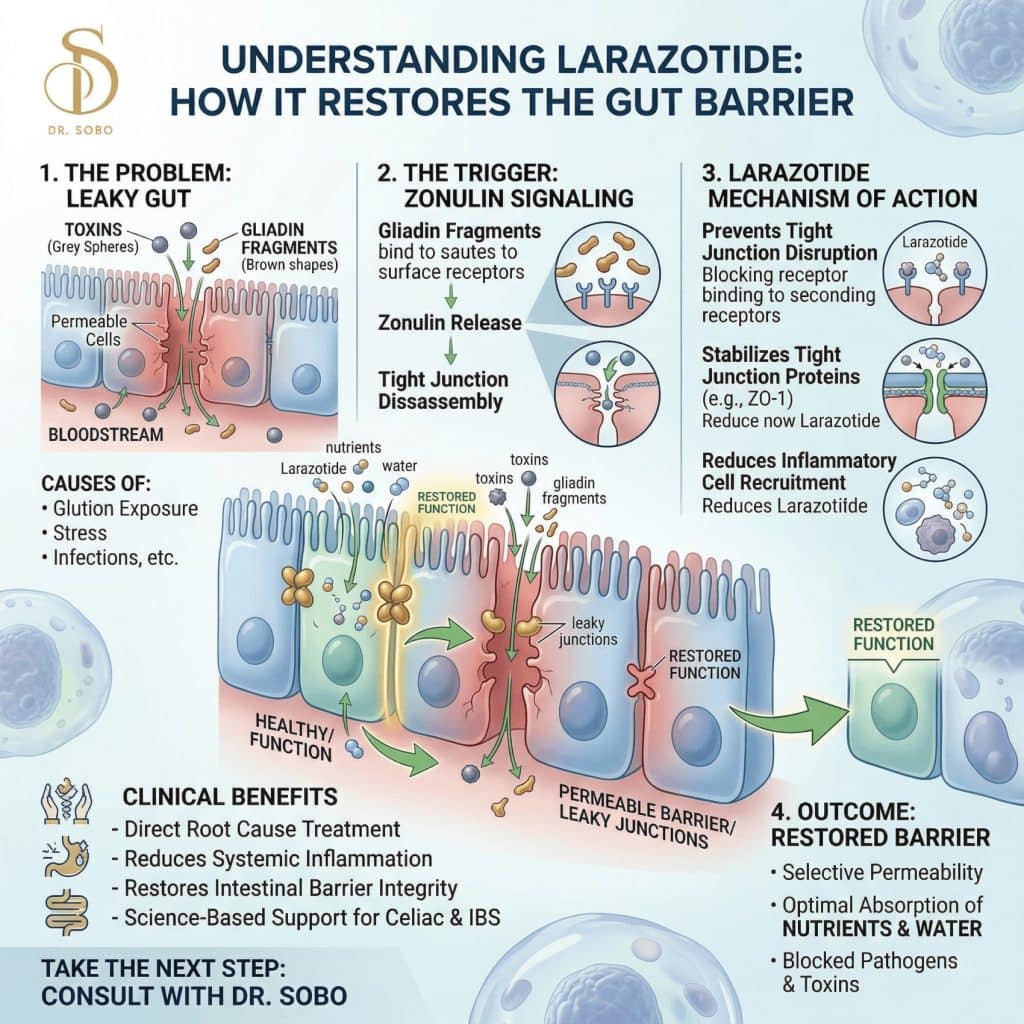
The lining of the gastrointestinal tract—known as the intestinal epithelium—is a single layer of cells that separates the contents of your gut from your bloodstream. These cells are bound together by protein complexes called tight junctions.
Think of tight junctions as the “gatekeepers” of your gut. In a healthy state, they:
- Allow essential nutrients, water, and electrolytes to pass through
- Prevent large molecules, toxins, and bacteria from entering the bloodstream
- Maintain the selective permeability required for proper digestion and immune function
What Happens When Tight Junctions Fail?
When tight junctions become compromised—due to factors like gluten exposure, infections, stress, medications, or food sensitivities—the barrier becomes hyperpermeable. This condition, known as leaky gut, allows unwanted substances to cross into the bloodstream.
The consequences are systemic:
- Immune activation: The body mounts an inflammatory response against substances that should never enter the circulation
- Food sensitivities develop: Partially digested food proteins trigger immune reactions
- Systemic inflammation: Inflammatory cytokines travel throughout the body, affecting the brain, joints, skin, and other organs
The Gliadin Connection: How Gluten Triggers Leaky Gut
In celiac disease and non-celiac gluten sensitivity, fragments of the protein gliadin (found in gluten) resist complete digestion. These fragments bind to a chemokine receptor called CXCR3 on the surface of intestinal cells. This binding initiates a signaling cascade that triggers the release of zonulin—a protein that modulates tight junction permeability.
Zonulin causes the tight junctions to open, creating intestinal permeability. This allows gliadin fragments and other substances to cross the barrier, triggering the immune response characteristic of celiac disease.
*Source: Fasano, A. (2011). Zonulin and its regulation of intestinal barrier function: the biological door to inflammation, autoimmunity, and cancer. Physiological Reviews, 91(1), 151-175.*
How Larazotide Works: Mechanism of Action
Larazotide directly interrupts this destructive cascade. According to research published in ScienceDirect and other peer-reviewed sources, Larazotide acetate:
- Prevents Tight Junction Disruption
Larazotide inhibits the binding of gliadin fragments to the CXCR3 receptor on intestinal epithelial cells. By blocking this initial interaction, it prevents the signaling cascade that leads to zonulin release and tight junction opening.
- Stabilizes Tight Junction Proteins
The peptide preserves the structural integrity of key tight junction proteins, particularly zonula occludens-1 (ZO-1). ZO-1 is essential for maintaining the seal between adjacent intestinal cells. When ZO-1 is redistributed or degraded, the barrier fails. Larazotide prevents this redistribution, keeping the tight junction complex intact.
- Reduces Inflammatory Cell Recruitment
Larazotide has been shown to inhibit gliadin-induced macrophage accumulation in the intestine. Macrophages are inflammatory immune cells that, when recruited to the gut wall, release pro-inflammatory cytokines that further damage the barrier. By reducing this recruitment, Larazotide breaks the cycle of inflammation and permeability.
- Prevents Cytokine-Induced Permeability
Inflammatory cytokines like tumor necrosis factor-alpha (TNF-α) and interferon-gamma (IFN-γ) are known to increase intestinal permeability. Larazotide inhibits the increase in tight junction permeability elicited by these inflammatory cytokines, providing an additional layer of barrier protection.
Sources:
- *Gopalakrishnan, S., et al. (2012). Larazotide acetate regulates epithelial tight junctions in vitro and in vivo. Peptides, 35(1), 86-94.*
- TargetMol. “Tight Junction Modulator: Larazotide Acetate.”
Clinical Research: Evidence for Larazotide Efficacy
Larazotide has undergone rigorous clinical investigation, with results published in peer-reviewed journals and presented at major gastroenterology conferences.
Phase 2 Clinical Trial: Symptom Reduction in Celiac Disease
The most significant clinical data comes from a Phase 2b clinical trial involving 342 adult patients with celiac disease who had been on a gluten-free diet for at least 12 months. The study concluded that Larazotide significantly reduced symptoms of celiac disease compared to placebo.
Key findings:
- Patients receiving Larazotide reported fewer gastrointestinal symptoms
- The peptide was well-tolerated with no significant safety concerns
- Symptom improvement was dose-dependent, with the 0.5 mg three-times-daily dose showing optimal results
*Source: Leffler, D. A., et al. (2015). Larazotide acetate for persistent symptoms of celiac disease despite a gluten-free diet: a randomized controlled trial. Gastroenterology, 148(7), 1311-1319.e6.*
Gluten Challenge Studies: Protection Against Accidental Exposure
In a small, double-blind, randomized, placebo-controlled pilot study, patients with celiac disease received a single 12-mg dose of Larazotide followed by a gluten challenge. Researchers measured intestinal permeability using the urinary excretion of lactulose and mannitol (LA/MA ratio)—a validated test for gut barrier function.
Results showed that patients receiving Larazotide experienced:
- Less intestinal permeability dysfunction compared to placebo
- Lower production of IFN-γ, a key inflammatory cytokine
- Fewer gastrointestinal symptoms in response to gluten challenge
- Excellent safety and tolerability
*Source: Paterson, B. M., et al. (2007). Larazotide acetate (AT-1001) reduces gluten-induced intestinal permeability in celiac disease: a randomized, double-blind, placebo-controlled pilot study. Gastroenterology, 132(4), A-59.*
Safety Across Multiple Trials
Across all Phase 1 and Phase 2 clinical trials, Larazotide has consistently demonstrated a favorable safety profile. Adverse events were generally mild and comparable to placebo, with no serious drug-related safety signals identified.
This safety history, combined with its targeted mechanism of action, led ScienceDirect to conclude that Larazotide acetate is:
“The most promising pharmaceutical drug candidate for the treatment of altered intestinal barrier function.”
The Phase 3 Story: Economics vs. Efficacy
Larazotide advanced to a Phase 3 clinical trial (the CEdlara trial), the final step before FDA approval. This trial was designed to confirm efficacy in a larger patient population and establish the foundation for a New Drug Application (NDA).
However, in 2022, the pharmaceutical company 9 Meters Biopharma announced the discontinuation of the Phase 3 trial.
Why Was the Trial Discontinued?
It is critical to understand that this decision was not due to safety concerns or lack of efficacy. According to statements from the company and organizations like the Celiac Disease Foundation and Beyond Celiac:
“An interim analysis of patient data showed that a substantial number of new patients would have to be added to the existing trial in order to get scientifically meaningful results. 9 Meters determined that the additional number of patients needed was too large to support the continuation of the trial.”
Source: Celiac Disease Foundation. (2022). “9 Meters Discontinues Phase 3 Clinical Trial for Potential Celiac Disease Drug Larazotide.”
The pharmaceutical industry faces immense economic pressures in drug development. Bringing a new drug to market typically costs tens to hundreds of millions of dollars. When a trial requires an unexpectedly large patient enrollment, the economics can become prohibitive—even for a drug that is safe and effective.
What This Means for Patients
The discontinuation of the Phase 3 trial does not diminish the substantial body of evidence supporting Larazotide’s mechanism and safety. Rather, it reflects the challenging economics of pharmaceutical development. For functional medicine practitioners and patients seeking innovative solutions for leaky gut, Larazotide remains a valuable, evidence-based option.
Source: Beyond Celiac. “Phase 3 Study of Larazotide Acetate Discontinued.”
Clinical Applications: Beyond Celiac Disease
While Larazotide’s most rigorous research has been in celiac disease, its mechanism—tight junction regulation—has broad applicability for anyone suffering from intestinal permeability.
Conditions Associated with Leaky Gut
Increased intestinal permeability has been implicated in a wide range of conditions, including:
Condition | Relationship to Leaky Gut |
Irritable Bowel Syndrome (IBS) | Altered permeability is well-documented in IBS patients, particularly those with diarrhea-predominant symptoms |
Non-Celiac Gluten Sensitivity (NCGS) | Similar zonulin-mediated permeability as celiac disease, without the autoimmune component |
Inflammatory Bowel Disease (IBD) | Permeability increases before clinical flares and contributes to disease activity |
Food Allergies & Sensitivities | Leaky gut allows food proteins to trigger immune responses |
Autoimmune Diseases | Increased permeability is thought to precede and contribute to autoimmune activation |
Chronic Fatigue Syndrome | Systemic inflammation from gut-derived toxins contributes to fatigue |
Fibromyalgia | Gut-brain axis dysfunction and inflammation play significant roles |
Symptoms That May Respond to Barrier Restoration
When the gut barrier is restored, patients often report improvements in:
Gastrointestinal:
- Bloating and gas
- Abdominal pain and cramping
- Diarrhea or constipation
- Nausea
Systemic:
- Brain fog and cognitive dysfunction
- Fatigue
- Joint and muscle pain
- Headaches
- Skin conditions (eczema, acne, rashes)
Psychological:
- Anxiety
- Depression
- Irritability
The Integrative Approach: Larazotide as Part of a Comprehensive Protocol
Larazotide is not a standalone “magic bullet.” For optimal results, it must be integrated into a comprehensive approach that addresses the underlying factors driving gut inflammation.
Step 1: Identify Triggers with Food Allergy Testing
Larazotide helps close the tight junctions, but if inflammatory foods continue to assault the gut lining, the system remains under stress. Identifying and removing these triggers is essential.
Dr. Sobo offers comprehensive food allergy and sensitivity testing to pinpoint specific foods that may be contributing to your symptoms.
Why Testing Matters
Food reactions are not always immediate. Many are delayed (IgG-mediated) , occurring hours or even days after consumption. This makes them nearly impossible to identify through elimination diets alone.
Common Symptoms of Food Sensitivities
Category | Symptoms |
Head | Headaches, dizziness, brain fog, insomnia |
Eyes, Ears, Nose, Throat | Runny nose, congestion, watery eyes, sinusitis, chronic cough, canker sores |
Gastrointestinal | Nausea, bloating, gas, diarrhea, constipation, abdominal pain |
Skin | Eczema, hives, rashes, dermatitis |
Psychological | Anxiety, depression, irritability, hyperactivity |
Heart & Lungs | Palpitations, rapid heart rate, asthma |
Other | Chronic fatigue, joint pain, muscle aches, urinary frequency, swelling |
Source: Dr. Sobo. “Food Allergy Testing.”
Step 2: Address Environmental Allergies with Sublingual Immunotherapy (SLIT)
For patients with environmental allergies that contribute to systemic inflammation, Dr. Sobo offers Sublingual Immunotherapy (SLIT) allergy drops .
SLIT is an innovative, non-invasive alternative to traditional allergy shots:
- Small doses of allergens are placed under the tongue daily
- The body gradually builds long-term immunity
- Treatment is self-administered at home
- It has been the standard of care in Europe, South America, and Asia for decades
Step 3: Support the Gut Healing Process
Additional interventions may include:
- Dietary modifications based on testing results
- Targeted supplementation (e.g., zinc, glutamine, butyrate)
- Stress management (chronic stress increases zonulin and permeability)
- Sleep optimization (gut repair occurs during deep sleep)
Conclusion: Taking the Next Step Toward Gut Health Restoration
Leaky gut is not a simple condition, but it is one that can be addressed with the right tools and the right guidance. Larazotide represents a significant advancement in the ability to directly regulate and restore the gut barrier at the cellular level.
When combined with comprehensive food allergy testing, targeted dietary modifications, and a functional medicine approach that addresses root causes, Larazotide offers a powerful path forward for those who have been suffering without answers.
You do not have to live with chronic digestive distress, fatigue, brain fog, or unexplained inflammation. Relief is possible—and it begins with understanding the health of your gut barrier.
Take the Next Step
Contact Dr. Sobo’s office today to schedule a consultation. Together, we will evaluate your symptoms, review your health history, and determine whether Larazotide peptide therapy is the right addition to your personalized gut health restoration protocol.
For more information click the link below to download the Larazotide Peptide Therapy Comprehensive Patient Guide: A Targeted Approach to Tight Junction Regulation and Leaky Gut
Frequently Asked Questions (FAQ) About Larazotide
What exactly is Larazotide?
Larazotide is a synthetic octapeptide (a chain of eight amino acids) that functions as a tight junction regulator. It helps reverse intestinal permeability—commonly known as “leaky gut”—by preventing the breakdown of the barriers between cells in the gut lining.
Source: Wikipedia. “Larazotide.”
Is Larazotide only for people with celiac disease?
While the most extensive clinical research has been conducted on celiac disease patients, Larazotide’s mechanism of action—tight junction regulation—applies to anyone with intestinal hyperpermeability. It can be beneficial for individuals with irritable bowel syndrome (IBS), non-celiac gluten sensitivity, food sensitivities, and other inflammatory conditions where leaky gut is a contributing factor.
How is Larazotide taken?
In clinical studies, Larazotide acetate was administered orally, typically three times daily. As a peptide therapy in a functional medicine setting, it is taken orally to ensure it acts directly on the lining of the small intestine where tight junctions are located. Your specific dosing will be determined by your healthcare provider.
Is Larazotide safe?
Yes. Across multiple Phase 1 and Phase 2 clinical trials involving hundreds of patients, Larazotide was consistently found to be safe and well-tolerated. Adverse events were generally mild and comparable to placebo. No serious drug-related safety concerns were identified.
Source: Leffler, D. A., et al. (2015). Gastroenterology.
Is Larazotide FDA approved?
Larazotide is not currently FDA approved as a mass-market prescription drug. The Phase 3 clinical trial was discontinued for economic reasons related to patient enrollment requirements—not due to safety concerns or lack of efficacy. However, Larazotide is available as a compounded peptide for use by physicians in functional and integrative medicine practice.
Will Larazotide allow me to eat gluten again?
No. For individuals with celiac disease, a strict gluten-free diet remains the cornerstone of treatment. Larazotide may provide a “safety net” by reducing the immune response and permeability caused by accidental gluten cross-contamination, but it is not a cure that allows for the resumption of a gluten-containing diet.
How long does it take to see results?
Response times vary by individual. Some patients report improvements in bloating, brain fog, and digestive comfort within a few weeks. Others may require a longer course of treatment—typically 8 to 12 weeks or more—combined with dietary modifications to achieve significant and sustained results.
Do I need to follow a special diet while taking Larazotide?
For optimal results, Larazotide therapy is most effective when paired with a personalized nutrition plan based on food allergy and sensitivity testing. Identifying and avoiding trigger foods reduces the inflammatory load on the gut, allowing the peptide to rebuild the barrier more effectively.
Can Larazotide be taken with other medications or supplements?
Larazotide acts locally in the gut and has no known significant drug interactions. However, you should always discuss your complete medication and supplement regimen with your healthcare provider before starting any new therapy.
How do I know if I am a candidate for Larazotide?
Ideal candidates for Larazotide therapy are individuals with documented or suspected intestinal permeability, including those with:
- Chronic gastrointestinal symptoms (bloating, gas, abdominal pain, diarrhea, constipation)
- Diagnosed celiac disease with persistent symptoms despite a gluten-free diet
- Non-celiac gluten sensitivity
- Food sensitivities and multiple food intolerances
- Systemic inflammation, brain fog, or fatigue linked to gut dysfunction
A comprehensive evaluation with a qualified functional medicine practitioner is the first step.
Call our office at (203) 348-8805 to schedule a consultation. We will evaluate your medical history to determine if Larazotide is right for you.
Sources & References
- Fasano, A. (2011). Zonulin and its regulation of intestinal barrier function: the biological door to inflammation, autoimmunity, and cancer. Physiological Reviews, 91(1), 151-175.
- Leffler, D. A., et al. (2015). Larazotide acetate for persistent symptoms of celiac disease despite a gluten-free diet: a randomized controlled trial. Gastroenterology, 148(7), 1311-1319.e6.
- Paterson, B. M., et al. (2007). Larazotide acetate (AT-1001) reduces gluten-induced intestinal permeability in celiac disease: a randomized, double-blind, placebo-controlled pilot study. Gastroenterology, 132(4), A-59.
- Gopalakrishnan, S., et al. (2012). Larazotide acetate regulates epithelial tight junctions in vitro and in vivo. Peptides, 35(1), 86-94.
- Beyond Celiac. “Phase 3 Study of Larazotide Acetate Discontinued.” Available at: https://www.beyondceliac.org/research-news/phase-3-study-discontinued/
- Celiac Disease Foundation. (2022). “9 Meters Discontinues Phase 3 Clinical Trial for Potential Celiac Disease Drug Larazotide.” Available at: https://celiac.org/2022/06/21/9-meters-discontinues-phase-3-clinical-trial-for-potential-celiac-disease-drug-larazotide/
- ScienceDirect Topics. “Larazotide Acetate.” Available at: https://www.sciencedirect.com/topics/medicine-and-dentistry/larazotide
- TargetMol. “Tight Junction Modulator: Larazotide Acetate.” Available at: https://www.targetmol.com/compound/larazotide%20acetate
- Wikipedia. “Larazotide.” Available at: https://en.wikipedia.org/wiki/Larazotide
- Kelly, C. P., et al. (2013). Larazotide acetate in patients with celiac disease undergoing a gluten challenge: a randomized placebo-controlled study. Alimentary Pharmacology & Therapeutics, 37(2), 252-262.
Disclaimer: This information is for educational purposes only and is not intended as medical advice. Always consult with a qualified healthcare provider before starting any new treatment or supplement regimen.