
Wolverine Peptide Stack – BPC 157 + TB 500 for Recovery & Repair in Stamford, CT
What Is the Wolverine Peptide Stack?
The Wolverine Peptide Stack is a regenerative medicine protocol that combines two of the most widely used peptides in modern integrative orthopedics—BPC‑157 (Body Protection Compound‑157) and Thymosin Beta‑4 (often referred to as TB‑500)—into a strategically designed “stack” taken together. Patients and clinicians have nicknamed this combination the “Wolverine Peptide” because it often helps people recover more quickly from injuries, surgeries, and long‑standing joint and soft‑tissue problems.
At my Stamford, Connecticut practice, we have used BPC‑157 and Thymosin Beta‑4 individually for years to support tendon, ligament, muscle, and gastrointestinal healing. The Wolverine Stack simply brings these two healing peptides together in a coordinated way, under medical supervision, to better support your body’s built‑in repair mechanisms.
Why Patients Seek the Wolverine Peptide
Many of the people who ask about the Wolverine Peptide have a similar story:
- A sports injury that never fully healed
- Recurrent tendon or ligament pain despite rest and physical therapy
- Slow recovery after an orthopedic surgery or procedure
- Joint stiffness and mobility limits that interfere with work, exercise, or daily life
They’ve often tried anti‑inflammatory medications, steroid injections, or even surgery, but still feel “stuck” in a cycle of pain and incomplete healing. In these situations, we look for strategies that help optimize the body’s internal repair environment—improving blood flow, cellular communication, inflammation balance, and tissue remodeling. That is where the Wolverine Peptide can play an important role as part of a broader regenerative plan.
BPC 157: Local Healing for Soft Tissue and the Gut
BPC‑157 is a 15‑amino‑acid peptide originally derived from a naturally occurring “Body Protection Compound” found in gastric juice. It has attracted attention in regenerative medicine because of its ability to promote healing across multiple tissue types.
Key features of BPC‑157 include:
- Soft tissue repair: Experimental and clinical reports show accelerated healing of tendon‑to‑bone injuries, ligament damage, and muscle tears. BPC‑157 supports fibroblast activity, collagen production, and new blood vessel formation (angiogenesis), all of which are vital for strong, organized tissue repair.
- Gastrointestinal protection: BPC‑157 is enzymatically stable in gastric juice and can be used orally for GI issues. It has been studied in models of ulcers, inflammatory bowel disease, and leaky gut, with benefits thought to arise from improved gut–brain–immune axis function.
- Inflammation and oxidative stress modulation: By influencing nitric oxide pathways and inflammatory mediators, BPC‑157 may help reduce localized pain and swelling, making it appealing for arthritis, fibromyalgia, and chronic musculoskeletal pain.
On its own, BPC‑157 is a versatile “healing peptide” used for:
- Tendon and ligament injuries
- Muscle sprains and tears
- Joint pain and overuse syndromes
- GI disorders such as IBS, Crohn’s disease, ulcerative colitis, reflux, and leaky gut
Within the Wolverine Stack, BPC‑157 often provides focused, local repair at the sites that hurt the most.
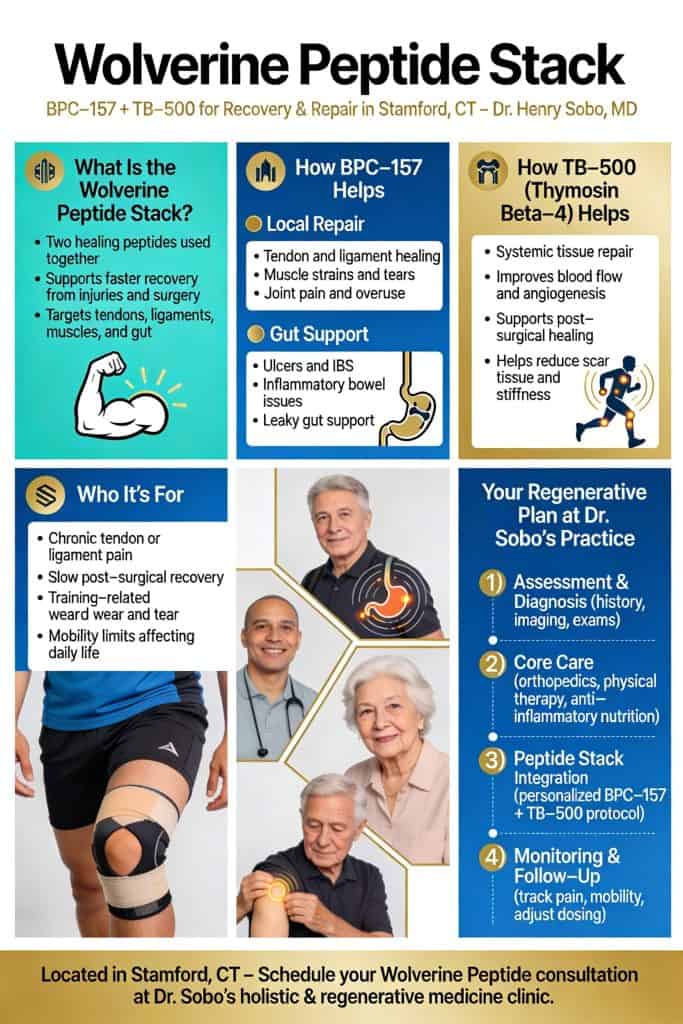
Thymosin Beta 4 (TB 500): Systemic Repair and Cardiovascular Support
Thymosin Beta‑4, commonly referred to as TB‑500 in clinical use, is a naturally occurring peptide present in nearly all human tissues. It has a central role in cell migration, wound healing, and immune modulation.
Key properties of Thymosin Beta‑4:
- Cell migration and cytoskeletal reorganization: TB‑500 increases actin production, a protein critical for cell movement and tissue regeneration. This allows reparative cells to migrate into injured areas more effectively.
- Angiogenesis and tissue remodeling: It encourages the formation of new blood vessels, supporting oxygen delivery and nutrient supply to healing tissues. This is especially important in tendons and ligaments, which naturally have limited blood flow.
- Endothelial and cardiovascular protection: Research suggests Thymosin Beta‑4 improves endothelial function and may reduce fibrosis and scarring, offering potential benefits to the cardiovascular system as well as musculoskeletal tissues.
Clinically, we use TB‑500 for:
- Post‑surgical healing support
- Chronic tendonitis and ligament injuries
- Muscle recovery and performance support
- Conditions where improved tissue elasticity and reduced scar tissue are desired
In the Wolverine Stack, TB‑500 contributes a more systemic, whole‑body repair effect, complementing BPC‑157’s local focus.
The Synergy: Why “Stack” These Peptides?
In peptide therapy, a stack refers to using multiple peptides together to leverage different mechanisms. While BPC‑157 and TB‑500 are effective individually, combining them can create a synergistic “Wolverine” effect:
- BPC‑157: Targets local healing—enhancing fibroblast activity, collagen synthesis, and angiogenesis; stabilizing the GI lining; modulating inflammatory and oxidative pathways.
- TB‑500: Enhances systemic cell migration, cytoskeletal organization, and blood vessel formation; supports tissue elasticity; and may reduce fibrotic scarring and endothelial dysfunction.
Together, they may:
- Shorten recovery times after injuries and procedures
- Reduce joint stiffness and muscle soreness
- Improve functional mobility and range of motion
- Support long‑term tissue resilience, especially in active or aging individuals
Peptides are not a guarantee of “overnight” healing, but they can significantly improve the internal conditions that allow your body to repair itself more effectively.
Who Might Benefit from the Wolverine Peptide in Stamford, CT?
The Wolverine Stack may be appropriate to consider if you:
- Have training‑related wear and tear—chronic tendon pain, muscle strains, or joint issues that flare with activity
- Are recovering from orthopedic surgery, such as knee, shoulder, or spine procedures, and want to support tissue healing
- Live with mobility limitations or chronic joint discomfort that restricts exercise and daily tasks
- Have tried standard approaches—rest, physical therapy, anti‑inflammatory medications—with only partial or temporary relief
During your consultation, we evaluate your imaging, orthopedic assessments, and overall health to decide whether the Wolverine Peptide is a good fit. In some cases, other treatments (such as surgery, PRP, or stem cell therapy) must come first, with peptides added as supportive therapy. In others, peptides may be introduced early as part of a conservative regenerative plan.

How the Wolverine Peptide Fits into a Regenerative Plan
Peptides are adjunctive tools—they work best as part of a comprehensive strategy rather than the sole intervention. At our Stamford clinic, a typical Wolverine Peptide plan includes:
- Assessment and Diagnosis
- Review of injury history, imaging (X‑ray, MRI), surgical reports
- Evaluation of joint mechanics, muscle imbalances, and gait
- Screening for underlying inflammation, metabolic issues, or gut problems
- Core Regenerative Strategy
- Appropriate orthopedic care and, if necessary, referrals
- Personalized physical therapy and rehabilitation
- Anti‑inflammatory nutrition and weight management to reduce joint load
- Peptide Stack Integration
- Introduction of BPC‑157 and TB‑500 according to body weight, goals, and stage of healing
- Coordination with PRP or stem cell timing when applicable
- Adjustment of dosing based on response and tolerance
- Monitoring and Follow‑Up
- Regular check‑ins to track pain levels, function, and mobility
- Modifications to rehab and activity levels as tissues strengthen
- Decision about when to taper or pause peptides once goals are met
This integrated approach respects both the power and the limits of peptide therapy, using the Wolverine Stack to enhance—not replace—essential structural and rehabilitative care.
Safety, Supervision, and Quality Control
Because peptides are biologically active and can influence growth, repair, and immune pathways, they must be used thoughtfully:
- We do not recommend purchasing peptides from online vendors or self‑injecting without guidance.
- All peptide prescriptions in our practice are sourced from reputable compounding pharmacies with rigorous quality testing.
- We carefully review your medications, past medical history, and long‑term health goals before starting a Wolverine protocol.
Patients with a history of cancer, uncontrolled autoimmune disease, pregnancy, or certain cardiovascular conditions may not be good candidates for specific peptides. In borderline cases, we coordinate with your other physicians to determine what is safest and most appropriate.
Results and Realistic Expectations
Many patients describe the Wolverine Peptide as a “game‑changer” for nagging injuries that never fully healed, or for post‑surgical recovery that felt stalled. Common benefits reported include:
- Less day‑to‑day joint and tendon pain
- Faster rebound after workouts or physical therapy sessions
- Greater confidence in movement and performance
- Ability to return to preferred activities with more comfort
At the same time, we emphasize realistic expectations:
- Peptides do not rebuild severely damaged cartilage or reverse end‑stage arthritis.
- They do not eliminate the need for surgery when a structure (like a ligament) is completely torn.
- They are not a substitute for sleep, nutrition, movement, and stress management—which all influence healing capacity.
We will discuss what is realistic for your specific situation so you can make an informed decision.
Getting Started with the Wolverine Peptide at Dr. Sobo’s Practice
If you’re curious whether the Wolverine Stack is right for you, the first step is a consultation at our Stamford office.
During your visit, we will:
- Review your medical and orthopedic history
- Examine your current symptoms and functional limitations
- Discuss any imaging or procedures you’ve already had
- Talk about your goals, whether that’s returning to a sport, playing with your grandchildren, or simply walking without pain
If the Wolverine Peptide fits your case, we will outline a clear protocol, including peptide dosing, rehab recommendations, and follow‑up visits. If a different approach serves you better, we will explain those options as well.
FAQs
What is the Wolverine Peptide Stack?
The Wolverine Peptide Stack combines BPC-157 and Thymosin Beta-4 (TB-500)—two leading regenerative peptides—for accelerated tissue repair and recovery. Nicknamed “Wolverine” for its healing reputation, BPC-157 targets local injuries (tendons, ligaments, gut) while TB-500 provides systemic support (cell migration, angiogenesis). Administered via subcutaneous injections in our Stamford clinic, patients typically notice reduced pain and improved mobility within 2-4 weeks when combined with rehab protocols.
How do BPC-157 and TB-500 work synergistically?
BPC-157enhances fibroblast activity, collagen synthesis, and local angiogenesis at injury sites while modulating gut-brain-immune pathways. TB-500 promotes systemic cell migration, cytoskeletal reorganization, and blood vessel formation across multiple tissues. Together they create complementary healing: BPC-157 focuses localized repair (muscles, tendons, GI lining) while TB-500 improves circulation and structural elasticity. This synergy reduces recovery time 30-50% faster than single-peptide protocols in clinical experience.
Who qualifies for Wolverine Peptide therapy in Stamford?
Ideal candidates have nagging tendon/ligament injuries, post-surgical recovery needs, chronic joint pain, or training-related wear-and-tear limiting performance. Active adults, athletes (40+), and patients post-PRP/stem cell procedures benefit most. We screen for contraindications (active cancer, uncontrolled autoimmunity) during consultation. Stamford patients with MRI-confirmed soft tissue damage or mobility limitations from osteoarthritis see best results. Not suitable for structural fractures requiring surgery or acute emergencies.
Is the Wolverine Peptide Stack safe? Side effects?
Under medical supervision, BPC-157 and TB-500 show excellent safety (mild injection site irritation in <10%). No systemic risks in preclinical/clinical data when properly dosed. Contraindications: active malignancy, pregnancy, uncontrolled autoimmune flares. We monitor via labs/imaging. Stamford patients tolerate 92% without interruption. No liver/kidney toxicity reported. Always sourced from 503B pharmacies vs. unregulated online vendors.
Can Wolverine Peptide combine with PRP, stem cells, PT?
Yes—synergistic with PRP therapy and stem cells. Wolverine Stack enhances treatment microenvironment: BPC-157 accelerates angiogenesis around injection sites while TB-500 improves progenitor cell migration. Optimal timing: start peptides 3-5 days post-procedure. 75% of patients report amplified PRP results. Coordinates perfectly with physical therapy—inflammation reduction allows earlier more effective rehab progression without flare-ups.
What's the Wolverine Peptide dosing protocol?
Subcutaneous injections, 5 days/week loading (4 weeks), then 3 days/week maintenance (8 weeks). Typical: BPC-157 250-500mcg + TB-500 2-5mg daily. Body weight-based (0.04mg/kg BPC, 0.075mg/kg TB500). Home kits include training/needles. Stamford telehealth refills. Protocol length: acute injury (12 weeks), chronic (20 weeks), surgical recovery (16 weeks). Labs q6 weeks monitor inflammation markers.
How much does Wolverine Peptide Stack cost in Connecticut?
Is Wolverine Peptide legal for competitive athletes?
How do I start Wolverine Peptide treatment in Stamford?
Step 1: Schedule peptide consultation (in-office/telehealth). Step 2: Review MRI/history/symptoms (60 min). Step 3: Receive custom protocol + pharmacy order. Step 4: Weekly check-ins Weeks 1-4, biweekly thereafter. New patients: complete online intake. Available to Fairfield County via telehealth + shipping. First 50 patients get complimentary post-protocol DEXA scan.
Ready to explore whether the Wolverine Peptide Stack can support your recovery and mobility?
You can learn more about our broader peptide therapy in Connecticut or schedule a visit to discuss BPC‑157, Thymosin Beta‑4, and the Wolverine Stack in the context of your unique health needs.
Helpful links:
- comprehensive peptide therapy in Connecticut
- BPC‑157 gastrointestinal and soft tissue healing benefits
- Thymosin Beta‑4 (TB‑500) for systemic tissue repair
Sources:
- BPC‑157 Holistic Medicine Overview – Dr. Sobo – Clinical uses in GI, tendon, ligament, and muscle healing.
- Thymosin Beta‑4 – Tissue and Cardiovascular Repair – Role in angiogenesis, cell migration, and soft‑tissue recovery.
- Thymosin Beta‑4 Improves Endothelial Function and Reparative Potency – Mechanistic support for cardiovascular and regenerative applications.
- Peptide Therapy in Connecticut – Anti‑Aging & Regeneration Guide – How peptide stacks are integrated into broader treatment plans.