
Epitalon Peptide Therapy in Connecticut: Evidence, Safety and Medical Evaluation
Epitalon is a synthetic four-amino-acid peptide studied in laboratory, animal and limited human research involving telomerase, telomeres, melatonin-related biology and aging. It is not FDA-approved, and its clinical benefits, human dosing, injectable safety and long-term risks have not been established. Optimal Health Medical helps Connecticut patients understand the evidence, investigate the reasons behind sleep or healthy-aging concerns and compare appropriate options through an individualized medical evaluation.
What Is Epitalon?
Epitalon is a laboratory-made tetrapeptide composed of four amino acids: alanine, glutamic acid, aspartic acid and glycine. It is commonly written as Ala–Glu–Asp–Gly or AEDG. The names Epitalon, Epithalon and Epithalone are sometimes used interchangeably, although product names alone may not identify the precise chemical form or formulation. Epitalon should not be confused with epithalamin. Epithalamin is a more complex polypeptide preparation historically associated with pineal-gland research. Findings from a complex extract cannot automatically be assigned to the defined synthetic AEDG peptide. A responsible evidence review must confirm the exact substance, salt form, route, dose, study population and outcome. FDA evaluated Epitalon free base and Epitalon acetate as separate bulk drug substances. Neither form is an FDA-approved drug component, and the two should not be assumed to be interchangeable. Differences in molecular form can affect characteristics such as molecular weight, solubility, stability, manufacturing controls and formulation behavior.How Is Epitalon Thought to Work?
Most interest in Epitalon comes from two areas: telomere biology and melatonin-related signaling. These are research hypotheses and mechanistic observations, not established patient benefits.Telomerase and Telomeres
In cultured human fetal lung fibroblasts, researchers reported increased telomerase activity and longer telomeres after exposure to Epitalon. This was an in-vitro experiment. It does not show that an Epitalon preparation safely lengthens telomeres throughout the human body, reverses biological aging or improves health outcomes.Melatonin and Circadian Biology
Limited human and animal research has examined melatonin or melatonin-related markers. FDA identified one small study in healthy adults that measured a urinary melatonin metabolite after sublingual AEDG. It did not enroll patients with insomnia or measure sleep onset, sleep duration, awakenings or daytime function.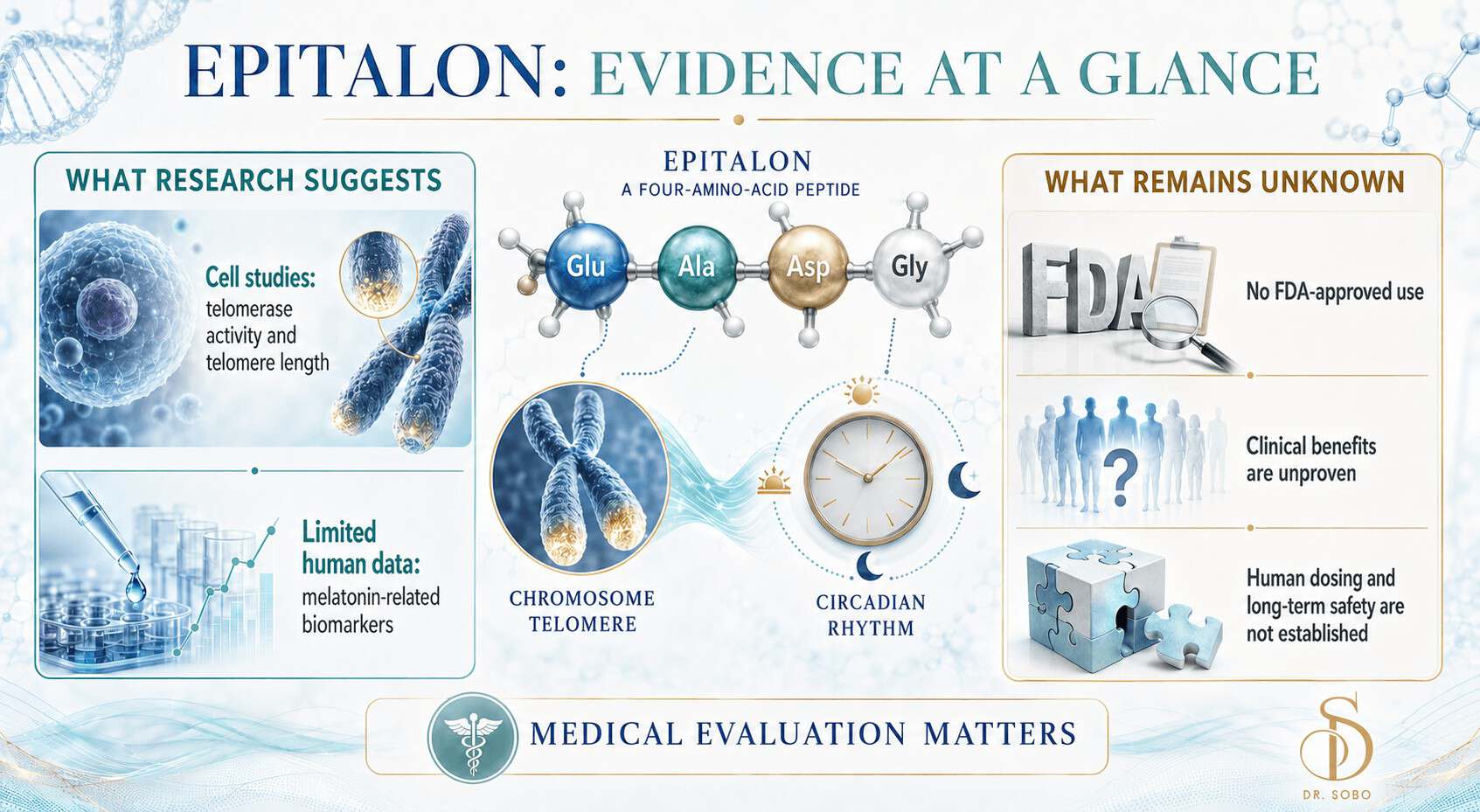
What Potential Epitalon Benefits Are Being Studied?
Epitalon is marketed online for sleep, healthy aging, telomere support, skin quality, energy, cognition, tissue repair and longevity. These claims vary greatly in evidentiary strength. The most accurate way to discuss them is to identify where the evidence comes from and what it cannot establish.| Claim or Research Area | Current Evidence Position | Responsible Conclusion |
|---|---|---|
| Telomerase activation and telomere length | Reported in cultured human cells | Mechanistically interesting, but not proof of safe telomere lengthening or improved health in patients |
| Sleep and circadian rhythm | Limited biomarker research involving melatonin-related pathways; no clinical efficacy studies identified by FDA in patients with insomnia | Epitalon is not an established insomnia treatment |
| Longevity or life extension | Primarily animal and mechanistic research | No proof that Epitalon extends human lifespan or health span |
| Skin, energy, cognition and recovery | Claims are based largely on indirect, preclinical, theoretical or anecdotal information | Meaningful patient benefits have not been established in adequate controlled trials |
| Antioxidant or anti-inflammatory activity | Reported in laboratory research | Laboratory activity does not establish treatment of a disease or improvement in clinical outcomes |
Does Epitalon Improve Sleep or Treat Insomnia?
Epitalon has not been established as an effective treatment for insomnia. In its 2026 review, FDA found no clinical efficacy studies evaluating Epitalon in patients with insomnia, including no studies using the proposed subcutaneous route. A small study in healthy adults measured a melatonin-related urinary biomarker after sublingual use, but it did not measure clinically meaningful insomnia outcomes. Persistent sleep problems deserve a diagnosis rather than an automatic peptide protocol. Insomnia symptoms can be associated with sleep apnea, restless legs syndrome, circadian-rhythm disorders, anxiety, depression, pain, reflux, menopause symptoms, thyroid conditions, alcohol, stimulants, medications and inconsistent sleep schedules. The National Heart, Lung, and Blood Institute describes cognitive behavioral therapy for insomnia, or CBT-I, as the usual first treatment for long-term insomnia. Depending on the patient, appropriate care may also include evaluation for another sleep disorder, treatment of a contributing condition, sleep-habit changes or carefully selected medication. A consultation should compare investigational questions with established options rather than assume Epitalon is the answer.Is Epitalon FDA-Approved or Available for Compounding?
No Epitalon product is FDA-approved in the United States. It has no FDA-approved indication, prescribing information, dosage, route, contraindication section or agency-reviewed safety and effectiveness profile. In July 2026, the Pharmacy Compounding Advisory Committee considered Epitalon-related bulk drug substances for possible inclusion on the 503A Bulks List. The committee’s role is advisory. A favorable recommendation does not approve a drug, prove safety or effectiveness, amend federal regulations or create blanket permission for pharmacies to compound a substance. As of August 1, 2026, Epitalon does not appear in 21 CFR 216.23. FDA may later accept, reject, modify or place conditions around an advisory recommendation. Patients, prescribers and pharmacies must verify the current federal and state position for the exact substance and formulation at the time a decision is considered. For a detailed explanation, read what the FDA 503A Bulks List means for compounded peptides and the broader update on the July 2026 FDA peptide compounding vote.For a detailed, date-specific analysis, read what the 2026 Epitalon FDA advisory committee vote means.
What Is Known About Epitalon Safety and Side Effects?
Human safety has not been adequately established. FDA reported that it did not identify clinical studies assessing the safety of Epitalon-related bulk drug substances administered in humans. The agency also found no pharmacokinetic data for Epitalon free base or Epitalon acetate. Pharmacokinetic data are needed to understand absorption, distribution, metabolism and elimination. FDA’s adverse-event search found no Epitalon reports through December 8, 2025. That absence does not demonstrate safety. Reporting can be incomplete, compounded products may be recorded inconsistently, and traditional 503A compounders do not have the same adverse-event reporting framework as manufacturers of FDA-approved drugs.Telomerase and Cancer-Risk Uncertainty
Current evidence does not prove that Epitalon causes cancer. It also does not establish that long-term use is free of carcinogenic risk. FDA noted a theoretical concern that continuous telomerase activation could help abnormal cells avoid senescence. Limited animal research did not resolve this question, and FDA identified no conventional two-year carcinogenicity studies adequate to characterize human risk. People with active cancer, a recent cancer history, unexplained masses, abnormal cancer-screening results or substantial inherited cancer risk should not make self-directed decisions based on online longevity claims. These issues require individualized medical review and, when appropriate, coordination with an oncologist or other specialist.Why Product Quality Matters With Injectable Peptides
Injectable quality involves more than a posted purity percentage. Relevant controls can include correct chemical identity, concentration, peptide-related impurities, truncated sequences, residual solvents, aggregates, sterility, endotoxins, bioburden, stability, storage conditions and testing of the finished preparation. A certificate of analysis that reports identity or purity alone does not prove that a finished injectable product is sterile, correctly concentrated, stable throughout use or suitable for a patient. Peptides may be sensitive to temperature, moisture, light, pH, concentration, formulation ingredients and handling. Storage and beyond-use instructions must come from the dispensing pharmacy for the exact preparation; they should not be copied from a generic internet protocol. Physician-prescribed care involving an appropriately licensed pharmacy is not equivalent to buying a “research use only” vial from an online peptide laboratory. Patients should avoid sellers that operate without a legitimate medical and pharmacy relationship or cannot provide accountable information about identity, sourcing, sterility, labeling, storage and follow-up. Learn more about evaluating peptide information online.What Happens During an Epitalon or Peptide-Therapy Consultation?
An evidence-informed consultation begins with the patient’s goal—not with a predetermined peptide cycle. At Optimal Health Medical, the evaluation may include:- Clarifying the primary concern. Sleep symptoms, fatigue, cognitive concerns, skin changes and healthy-aging goals may have different causes and require different evaluations.
- Reviewing medical history and risks. This includes medications, supplements, allergies, prior treatments, cancer history, pregnancy or reproductive planning and relevant family history.
- Identifying conditions that should be diagnosed first. Symptoms may point to sleep apnea, thyroid dysfunction, hormone changes, metabolic disease, nutritional issues or another condition with an established diagnostic pathway.
- Reviewing the evidence. Laboratory findings, animal research, small human studies and established clinical outcomes are separated rather than blended together.
- Checking current regulatory and pharmacy requirements. Availability must be evaluated for the exact substance, formulation, route, pharmacy and date.
- Comparing alternatives. Established treatments, lifestyle strategies and other medically appropriate options should be discussed before an investigational approach is considered.
- Defining monitoring and stop criteria. Any treatment plan should specify what will be monitored, when it will be reassessed and what symptoms require discontinuation or urgent care.
Who Should Avoid Self-Directed Epitalon Use?
Because clinical safety and dosing are not established, no one should self-prescribe Epitalon from an online research supplier. Extra caution and specialist input may be appropriate for people with active or recent cancer, abnormal screening findings, immune disorders, complex chronic illness, multiple medications, a history of severe allergic reactions, pregnancy, breastfeeding or reproductive planning. Patients should seek appropriate evaluation rather than experimenting with a peptide when sleep symptoms include loud snoring, witnessed breathing pauses, gasping, severe daytime sleepiness or falling asleep while driving. Urgent medical or mental-health care is warranted for chest pain, suicidal thoughts, severe neurological symptoms or another acute concern.Epitalon and Peptide-Therapy Evaluation in Stamford, Connecticut
Optimal Health Medical is located at 111 High Ridge Road in Stamford, Connecticut. Dr. Henry C. Sobo evaluates patients from Stamford, Greenwich, Norwalk, Darien, New Canaan, Westport, Fairfield County and surrounding communities who want a medically responsible discussion about sleep, healthy aging, peptide research and established alternatives. A consultation does not guarantee that Epitalon will be recommended or available. The purpose is to understand the patient’s goals, identify conditions that may require diagnosis, review evidence and safety limits, verify the current regulatory pathway and determine whether any proposed plan is medically appropriate. Patients comparing peptide options can also review the main peptide therapy in Connecticut page, the Connecticut peptide therapy guide and Dr. Sobo’s approach to anti-aging medicine.The Bottom Line
Epitalon is an investigational four-amino-acid peptide with interesting laboratory and preclinical research involving telomerase, telomeres and melatonin-related biology. That research does not establish that Epitalon reverses aging, extends human lifespan, treats insomnia, improves skin or cognition, or safely produces clinical telomere changes. The most accurate position as of August 1, 2026 is that Epitalon is not FDA-approved; human efficacy, dosing, pharmacokinetics, injectable safety and long-term risk remain insufficiently characterized; and a 503A advisory recommendation is not drug approval or automatic authorization. Connecticut patients should use dated primary sources, avoid online research-product sellers and begin with individualized medical evaluation.Frequently Asked Questions About Epitalon Peptide Therapy
What is Epitalon?
Epitalon is a synthetic tetrapeptide made from alanine, glutamic acid, aspartic acid and glycine, written as Ala–Glu–Asp–Gly or AEDG. It has been studied in laboratory, animal and limited human research involving telomerase, telomeres and melatonin-related biology. Epitalon is investigational and is not an FDA-approved anti-aging, longevity or insomnia treatment.Is Epitalon FDA-approved?
No. Epitalon is not an FDA-approved drug in the United States. It has no FDA-approved indication, dosage, route, prescribing information or agency-reviewed safety and effectiveness profile. A July 2026 FDA advisory-committee recommendation concerning possible 503A Bulks List inclusion was nonbinding and did not approve Epitalon or any finished compounded preparation.Does Epitalon lengthen telomeres?
Researchers have reported telomerase activation and telomere lengthening in cultured human cells exposed to Epitalon. That in-vitro finding does not prove that Epitalon safely lengthens telomeres throughout a patient’s body, reverses biological aging or improves health outcomes. Human clinical benefits, appropriate dosing and long-term consequences have not been established.Can Epitalon improve sleep or treat insomnia?
Epitalon has not been proven to treat insomnia. FDA found no clinical efficacy studies in patients with insomnia. One small study in healthy adults measured a melatonin-related urinary biomarker, but it did not evaluate sleep onset, sleep duration, nighttime awakenings or daytime function. Persistent sleep problems should be assessed for established causes and treatments.Is Epitalon safe?
Human safety has not been adequately established. FDA reported no human pharmacokinetic data and no clinical studies sufficient to support the safety of Epitalon-related bulk drug substances, particularly by subcutaneous administration. The lack of reports in an adverse-event database does not prove safety because reporting and product identification may be incomplete.Can Epitalon cause cancer?
Current evidence does not prove that Epitalon causes cancer. FDA nevertheless identified a theoretical concern that sustained telomerase activation could help abnormal cells avoid senescence. Available animal studies were too limited to resolve human risk, and adequate long-term carcinogenicity studies were not identified. Cancer history and screening findings require careful medical review.Are Epitalon free base and Epitalon acetate the same?
No. They share the AEDG peptide active moiety but are chemically distinct bulk drug substances. Differences may affect molecular weight, solubility, stability and formulation. FDA evaluated the free base and acetate forms separately. A prescription, pharmacy documentation and finished-product label should identify the exact substance rather than use “Epitalon” ambiguously.What is a typical Epitalon dose or treatment cycle?
FDA has not established an Epitalon dose, route, cycle length or treatment frequency. Online schedules such as fixed multiweek cycles or twice-yearly use should not be presented as validated clinical protocols. Any discussion must consider the exact substance and formulation, the patient’s goal and risks, current law, pharmacy instructions and the absence of adequate dosing and safety data.Can I buy Epitalon online?
Patients should avoid online peptide laboratories and sellers that do not meet medical-provider and pharmacy standards. “Research use only” products may have uncertain identity, concentration, purity, sterility, endotoxin levels, stability and storage. A posted certificate of analysis does not replace a prescription, an appropriately licensed pharmacy, medical screening, accountable labeling and follow-up.Is Epitalon peptide therapy available in Connecticut?
Availability cannot be assumed from an advisory-committee vote or an online advertisement. Federal policy, Connecticut pharmacy requirements, the exact chemical form, formulation, route, pharmacy licensure and patient-specific prescription requirements must be checked at the time of consideration. Optimal Health Medical can evaluate the clinical question and discuss current evidence and appropriate alternatives.What happens at an Epitalon consultation with Dr. Sobo?
Dr. Sobo reviews the patient’s symptoms, goals, medical and cancer history, medications, supplements, prior treatments and relevant testing. The visit also examines possible underlying causes, evidence limitations, established alternatives and current regulatory requirements. A consultation does not guarantee that Epitalon will be recommended, prescribed or available.Where can Connecticut patients request an Epitalon evaluation?
Connecticut patients can contact Optimal Health Medical at 111 High Ridge Road in Stamford by calling 203-348-8805 or using the practice’s contact page. The office serves Stamford, Greenwich, Norwalk, Darien, New Canaan, Westport and surrounding Fairfield County communities. Telehealth availability depends on location and clinical needs.Sources
- FDA: July 23–24, 2026 Pharmacy Compounding Advisory Committee Meeting
- FDA: Review of Epitalon-Related Bulk Drug Substances
- Electronic Code of Federal Regulations: 21 CFR 216.23
- FDA: Human Drug Compounding Laws
- PubMed: Epithalon Peptide Induces Telomerase Activity and Telomere Elongation in Human Somatic Cells
- National Heart, Lung, and Blood Institute: Insomnia Treatment

Medical Disclaimer
This page is for general educational purposes and does not provide medical advice, diagnosis or treatment. Epitalon is not FDA-approved. Its evidence, regulatory status, availability and applicable pharmacy policies may change. Consult a qualified healthcare professional before making treatment decisions. Seek urgent care for severe or rapidly worsening symptoms.