
By Dr. Henry Sobo, MD – Medical Weight Loss, Functional & Hormone Therapy, Connecticut
Why Your Thyroid Panel Needs More Than Just TSH
If you’ve been struggling with fatigue, weight gain, brain fog, hair loss, or feeling cold all the time, chances are you’ve already had your thyroid checked. And chances are, your doctor only ordered one test: TSH (thyroid‑stimulating hormone). When the result came back “normal,” you were probably told everything was fine.
But what if your symptoms say otherwise?
In functional medicine, we know that relying solely on TSH is like trying to understand a complex movie by watching only the trailer. It gives you a glimpse, but it misses the full story. To truly understand what’s happening with your thyroid—and why you still feel unwell—you need a complete thyroid panel. This includes free T3, free T4, reverse T3, and thyroid antibodies.
Let’s break down why a more comprehensive approach is essential, and how you can finally get the answers you deserve.
The Thyroid’s Essential Role
Your thyroid is a small, butterfly-shaped gland in your neck, but its influence is enormous. It produces hormones that regulate your metabolism, heart rate, body temperature, energy production, and even mood. When thyroid function is out of balance, virtually every system in your body can be affected.
The standard approach in conventional medicine is to screen for thyroid dysfunction using TSH alone. While TSH is a useful starting point, it’s only one piece of a much larger puzzle.
The Limitations of TSH-Only Testing
TSH is produced by the pituitary gland in your brain. Its job is to signal your thyroid to produce more or less hormone. When TSH is high, it usually means the thyroid isn’t making enough hormone (hypothyroidism). When TSH is low, it often suggests hyperthyroidism (too much hormone).
But here’s the catch: TSH only tells you what your brain thinks is happening. It doesn’t measure the actual thyroid hormones circulating in your blood, nor does it reveal how well those hormones are being converted into their active forms or utilized by your cells.
Consider these common scenarios:
Normal TSH, low free T3 – You may have a conversion problem where your body isn’t turning the inactive T4 into active T3. Symptoms of hypothyroidism persist despite a “normal” TSH.
Normal TSH, high reverse T3 – Stress, inflammation, or other factors can cause your body to produce excessive reverse T3, which blocks T3 receptors and creates a functional hypothyroidism.
Normal TSH, positive antibodies – Hashimoto’s, an autoimmune thyroid disease, can be present for years before TSH becomes abnormal. During that time, you can experience significant symptoms and glandular damage.
This is why TSH alone is simply not enough.
What a Complete Thyroid Panel Includes
A thorough thyroid evaluation in functional medicine typically includes four key components that go far beyond TSH. The visual below summarizes them clearly.
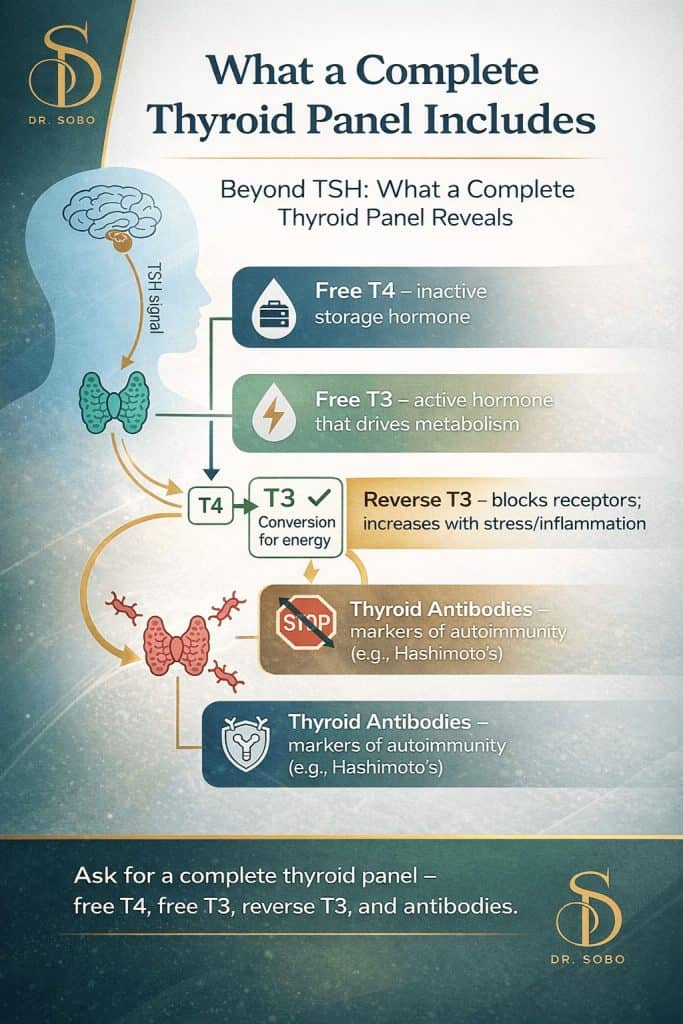
Each of these markers tells a unique part of your thyroid story. Let’s explore why free T3 and free T4 deserve special attention, how reverse T3 can silently block your metabolism, and why testing antibodies is the only way to detect autoimmune thyroid disease.
Why Free T3 and Free T4 Matter More Than You Think
Many patients are told their “thyroid is fine” because their TSH is normal, yet they struggle with:
Unexplained weight gain or inability to lose weight
Fatigue that doesn’t improve with sleep
Hair thinning or brittle nails
Cold hands and feet
Constipation
Depression or anxiety
Brain fog and poor memory
These symptoms often correlate with low free T3 levels. Even if your thyroid produces enough T4, if you aren’t converting it efficiently to T3, your cells are starved for active hormone.
Nutrient deficiencies (such as selenium, zinc, and iron), chronic stress, blood sugar imbalances, and gut inflammation can all impair conversion. In fact, the connection between gut health and thyroid function is so critical that we dedicated a full article to it: A Healthy Gut May Save Your Brain and Your Life . Since 20% of T4 to T3 conversion occurs in the gut, addressing digestive health is often a key step in optimizing thyroid function.
The Reverse T3 Connection: Stress, Inflammation, and Blocked Receptors
Hashimoto’s is an autoimmune condition where your immune system mistakenly attacks your thyroid tissue. It is the leading cause of hypothyroidism, yet many people are never tested for antibodies.
Antibodies can be elevated for years before TSH becomes abnormal. During that time, the gland is gradually being destroyed, and symptoms often appear. Early detection through a complete thyroid panel allows for proactive management—dietary changes, stress reduction, targeted supplements, and sometimes low‑dose medications—to reduce the autoimmune attack and preserve thyroid function.
At Dr. Sobo’s practice, we often use peptide therapy to help regulate immune function in autoimmune conditions like Hashimoto’s. Learn more on our Peptide Therapy page .
Autoimmunity: The Hidden Driver
Hashimoto’s is an autoimmune condition where your immune system mistakenly attacks your thyroid tissue. It is the leading cause of hypothyroidism, yet many people are never tested for antibodies.
Antibodies can be elevated for years before TSH becomes abnormal. During that time, the gland is gradually being destroyed, and symptoms often appear. Early detection through a complete thyroid panel allows for proactive management—dietary changes, stress reduction, targeted supplements, and sometimes low‑dose medications—to reduce the autoimmune attack and preserve thyroid function.
At Dr. Sobo’s practice, we often use peptide therapy to help regulate immune function in autoimmune conditions like Hashimoto’s. Learn more on our Peptide Therapy page .
A Functional Medicine Approach to Hypothyroidism Diagnosis
Functional medicine doesn’t just treat lab numbers; it treats the person. When we evaluate thyroid health, we look at:
The full thyroid panel (TSH, free T4, free T3, reverse T3, TPOAb, TgAb)
Nutrient status (selenium, zinc, vitamin D, iron/ferritin)
Adrenal function (cortisol patterns)
Gut health (because 20% of T4 to T3 conversion occurs in the gut)
Inflammation markers and blood sugar regulation
By understanding the whole picture, we can create a personalized plan that addresses why your thyroid is out of balance, not just what the number says.
If you’re struggling with weight and metabolic issues alongside thyroid symptoms, our Functional Medicine Weight Loss guide outlines how we address root causes—including thyroid dysfunction—to support sustainable results.
What to Do If You’ve Only Had Your TSH Tested
If you’ve been told your thyroid is normal but you still feel unwell, it’s time to ask for a more complete evaluation. You can say to your provider:
“I’d like to have a full thyroid panel, including free T3, free T4, reverse T3, and thyroid antibodies. I want to understand what’s really happening with my thyroid, not just what my pituitary is signaling.”
If your current doctor is unwilling or unable to order these tests, seeking a functional medicine practitioner can make all the difference.
Dr. Sobo’s Approach to Thyroid Optimization
At Dr. Sobo’s practice, we take a comprehensive, root‑cause approach to thyroid health. We understand that your symptoms are real and that a single lab value rarely tells the whole story.
Our process begins with a thorough evaluation, including a complete thyroid panel when indicated. We then look at the interconnected systems—adrenals, gut, immune function, and nutrition—to identify what’s driving your thyroid imbalance.
We offer personalized treatment plans that may include:
Targeted dietary and lifestyle modifications
Nutritional supplementation to support conversion and reduce inflammation
Bioidentical thyroid hormone optimization (when necessary) using both T4 and T3 to match your body’s needs
Stress management and adrenal support
Gut healing protocols to improve nutrient absorption and conversion
IV NAD+ therapy to support mitochondrial energy production—especially helpful for fatigue—as detailed on our NAD+ IV Therapy page
Our goal is not just to normalize your labs, but to restore your energy, mental clarity, and overall well‑being.
Ready to Go Beyond TSH?
If you’re tired of being told “everything is normal” while you continue to struggle with hypothyroid symptoms, we invite you to take the next step.
Explore how peptide therapy can support autoimmune thyroid conditions on our Peptide Therapy page .
Read our article on A Healthy Gut May Save Your Brain and Your Life to understand the gut‑thyroid connection.
Discover how our functional medicine approach to weight loss can help when metabolism is affected by thyroid imbalance.
For those suffering from persistent fatigue, our NAD+ IV Therapy page explains how mitochondrial support can help restore energy.
Contact our office at (203) 348-8805 to schedule a consultation and finally get the answers you deserve.
Final Thoughts
Your thyroid plays a central role in your health, and understanding its function requires looking beyond TSH alone. A complete thyroid panel—including free T3, free T4, reverse T3, and thyroid antibodies—provides the clarity needed to uncover hidden imbalances and guide effective treatment.
In functional medicine, we don’t settle for “normal.” We aim for optimal. And we believe that with the right information and a personalized approach, you can reclaim your vitality and finally feel like yourself again.
Disclaimer: This article is for informational purposes only and does not constitute medical advice. Always consult with a qualified healthcare provider before making any changes to your health regimen.
FAQS
Why is TSH not enough to diagnose thyroid problems?
TSH (thyroid‑stimulating hormone) is a signal from the pituitary gland. It tells you what your brain thinks is happening, but it doesn’t measure actual thyroid hormone levels (free T3, free T4) or how well those hormones are being converted and used by your cells. It also misses autoimmune activity (antibodies) and conversion issues like high reverse T3. Many people with “normal” TSH still suffer from hypothyroid symptoms because these other factors are out of balance.
What tests are included in a complete thyroid panel?
A complete thyroid panel typically includes: free T4 (inactive storage hormone), free T3 (active hormone that drives metabolism), reverse T3 (blocks T3 receptors; increases with stress/inflammation), and thyroid antibodies (TPOAb and TgAb) – markers of autoimmune Hashimoto’s. Some functional medicine practitioners also include TSH to get the full picture.
What is reverse T3, and why does it matter?
Reverse T3 (rT3) is an inactive form of T3 that binds to the same cellular receptors as active T3 but blocks them. When your body is under chronic stress, inflammation, or has nutrient deficiencies, it produces more reverse T3 instead of active T3. This creates a state of “cellular hypothyroidism” where you have normal TSH and T4 levels but still feel fatigued, cold, and brain‑fogged.
Can I have Hashimoto’s with normal TSH?
Yes. Hashimoto’s is an autoimmune disease where your immune system attacks the thyroid. Thyroid antibodies can be elevated for years before TSH becomes abnormal. During that time, the gland is gradually damaged and symptoms often appear. Testing antibodies is the only way to detect Hashimoto’s early.
What is the functional medicine approach to hypothyroidism?
Functional medicine looks beyond lab numbers to find the root cause. We evaluate not only the full thyroid panel but also nutrient status (selenium, zinc, iron), adrenal function, gut health (since 20% of T4 to T3 conversion happens in the gut), inflammation, and blood sugar balance. Treatment is personalized and may include dietary changes, targeted supplements, stress management, and sometimes thyroid hormone optimization with both T4 and T3.
How do I ask my doctor for a complete thyroid panel?
You can say: “I’d like a full thyroid panel including free T3, free T4, reverse T3, and thyroid antibodies. I want to understand what’s really happening with my thyroid, not just my TSH.” If your doctor is unwilling, consider seeking a functional medicine practitioner who is trained to interpret these markers.
What symptoms suggest I need more than TSH testing?
Persistent symptoms despite a “normal” TSH include: unexplained fatigue, weight gain or difficulty losing weight, brain fog and poor memory, hair thinning or loss, feeling cold all the time, constipation, depression or anxiety, dry skin and brittle nails.
Does gut health affect thyroid function?
Absolutely. About 20% of the conversion of T4 to active T3 occurs in the gut. Poor gut health, dysbiosis, leaky gut, or inflammation can impair this conversion, leading to low T3 symptoms even if your thyroid produces enough T4. That’s why gut healing is often part of a functional medicine thyroid protocol.
Can stress cause thyroid problems?
Yes. Chronic stress raises cortisol, which can inhibit the conversion of T4 to T3 and promote reverse T3 production. It also affects the immune system and can trigger or worsen autoimmune thyroid disease. Managing stress is a key component of thyroid optimization.
How can I get a comprehensive thyroid evaluation at Dr. Sobo’s practice?
You can schedule a consultation by calling (203) 348-8805. Dr. Sobo’s team will take a thorough history, order the appropriate tests (including a complete thyroid panel when indicated), and develop a personalized plan to address the root causes of your thyroid issues.