
Medication absorption · Daily routines · Stamford, Connecticut
Thyroid Medication Timing Your Daily Routine
Your prescription is more than a dose. The formulation, food, coffee, supplements, and consistency of your routine can all matter when reviewing thyroid treatment.

Thyroid medication timing can become confusing when a morning routine includes coffee, breakfast, calcium, iron, and other prescriptions. A person may take every scheduled dose yet unknowingly combine it with something that affects absorption. Another may follow tablet instructions even though a different formulation has been prescribed. The starting point is identifying the exact product and its directions.
Timing is one part of treatment, not a diagnosis or a guarantee that changing a routine will resolve symptoms. Persistent tiredness, abnormal laboratory results, or difficulty following instructions should prompt a review of the complete situation. Do not increase thyroid medication to compensate for coffee or supplements.
Patients in Stamford, Connecticut can discuss their treatment routine with Dr. Henry C. Sobo, M.D. and learn about thyroid care at Optimal Health Medical. This article concentrates on administration and interactions; it does not determine which thyroid preparation is best for an individual patient.
Evidence checked October 13, 2026: Product labels, clinical guidelines, and human studies support attention to food and supplement interactions. Timing instructions differ between formulations. A laboratory change after a new routine does not establish that timing is the only cause, and studies of absorption do not prove that one product is best for every patient.
Identify the drug, strength, formulation, and directions before selecting a schedule.
Breakfast and coffee timing are different from the interval needed around calcium or iron.
A new supplement, refill, meal pattern, or dosing time may warrant follow-up.
Which Thyroid Medication Are You Taking?
Start with the drug name and formulation, not just the phrase “thyroid pill.” Levothyroxine supplies T4. Other regimens may contain liothyronine, or T3, or a combination of thyroid hormones. A tablet, soft-gel capsule, and oral solution are not interchangeable descriptions of how a medicine should be administered.
Copy the name, strength, units, pharmacy directions, and manufacturer when available. A photograph of the current label helps when a product has changed or the prescription was filled through another office. Tell the clinician how you actually take it, including meals and supplements, rather than describing only the intended routine.
The American Thyroid Association’s thyroid-hormone treatment resource explains the different hormone preparations. The timing discussion should support the prescribed treatment without becoming an unverified comparison of “natural” and “synthetic” products.
If you use T3, a combination regimen, desiccated thyroid, or a prescribed compounded preparation, obtain specific instructions from the prescriber and pharmacist. A compounded medicine needs preparation-specific directions from an appropriately licensed pharmacy; the breakfast interval for a commercial levothyroxine product should not be assumed to apply automatically.
Why Can Timing Affect Thyroid Medication Absorption?
Absorption is the process by which an oral medicine enters the body from the digestive tract. Food, interacting substances, and gastrointestinal conditions can affect how much levothyroxine becomes available. The concern is not that coffee or calcium necessarily damages the thyroid gland.
Calcium and iron can interfere with levothyroxine through interactions in the digestive tract. A 2023 systematic review of medications and foods affecting levothyroxine discusses several mechanisms and emphasizes that the evidence varies by substance and formulation.
Timing and prescribed dose should be reviewed together. If someone changes from taking a tablet with breakfast to taking it under fasting conditions, exposure may change even though the number of micrograms stays the same. That is why “taking it better” is still something to report, especially when treatment was adjusted around the previous routine.
Do not estimate the amount absorbed from a study percentage or take extra tablets to replace a presumed loss. Research averages cannot calculate your dose. Your clinician uses the history, laboratory findings, and clinical response to decide what adjustment, if any, is needed.
How Long After Levothyroxine Can You Drink Coffee?
For levothyroxine tablets, waiting about an hour before coffee is a commonly supported approach, subject to your prescribed instructions. The 2025 European Thyroid Association guidance discusses a one-hour interval based on evidence of reduced absorption when coffee is taken together with levothyroxine.
The original 2008 coffee study involved a small group and absorption testing; it was not a trial proving that every coffee drinker has inadequately treated hypothyroidism. Its practical message is to review co-administration, not to diagnose yourself from your beverage preference.
Take the tablet with water rather than using coffee to swallow it. Tell the clinician whether you drink coffee immediately, wait an interval, or vary the pattern between workdays and weekends. Include the milk, creamer, or nutritional drink added to it when describing the routine.
This does not require every patient to stop drinking coffee. It requires a schedule appropriate to the specific medicine. Do not transfer a finding about tablets to all liquid preparations, or assume that switching to decaffeinated coffee guarantees there is no interaction. Ask what interval your product and regimen require.
Is the Breakfast Interval the Same as the Coffee Interval?
Not necessarily. For example, the Synthroid prescribing information specifies administration on an empty stomach 30–60 minutes before breakfast. Clinical guidance may use a more consistent one-hour interval when planning meals and coffee. The prescription and clinician’s instructions should settle your actual routine.
“Before breakfast” does not mean swallowing the medicine with the first bite. Record the interval between the dose and eating or drinking something other than water. Small details are relevant when the office is trying to understand an unexpected result.
If your prescription instructions and advice from another source appear different, ask the pharmacist to compare them for your exact product. Do not select the shortest interval by default or assume that a longer wait permits an additional dose.
A workable schedule should fit the responsibilities that make mornings difficult. Explain early shifts, caregiving, nausea, or meals that must accompany other medicines. The clinician may help organize an alternative; repeatedly missing doses while trying to follow an unrealistic plan is information the care team needs.
How Far Apart Should Calcium and Thyroid Medication Be Taken?
Common levothyroxine labeling calls for at least four hours before or after calcium-containing products that interfere with absorption. Calcium carbonate is a familiar example, including some antacids. Check the actual ingredients instead of assuming that only a bottle labeled “calcium supplement” matters.
A human study published in 2000 found that taking calcium carbonate together with levothyroxine could affect thyroid measurements. It supports the interaction concern, but does not establish that every calcium-containing food has the same effect or needs the same interval.
Tell the pharmacist about supplements, antacids, and combination products. A bone-health preparation may contain more than one mineral, and a multivitamin may contain calcium even when the front label emphasizes something else. A complete ingredient list is more useful than the category name.
Do not stop medically indicated calcium on your own. The task is to coordinate its use with thyroid treatment. Ask where it belongs in the daily plan, whether its own administration instructions affect the choice, and what to do when meals or work hours change.
How Far Apart Should Iron and Thyroid Medication Be Taken?
For common levothyroxine regimens, iron supplements such as ferrous sulfate generally need at least four hours of separation. The MedlinePlus levothyroxine resource provides this instruction for ferrous sulfate and calcium carbonate. Follow the plan for your actual preparation.
A 1992 human study found reduced thyroxine efficacy when ferrous sulfate was taken simultaneously. This is an interaction between treatments that can both be clinically appropriate, not a reason to assume prescribed iron should be abandoned.
Include prenatal vitamins, multivitamins, and other combination products in the review. Ask which contain iron and whether the dose or schedule has changed. If different clinicians prescribe thyroid medicine and iron, make sure both know the complete regimen.
The interval around the thyroid dose does not determine how iron should be taken with food or other medicines. Those are additional instructions to coordinate. Request one written schedule that reconciles them rather than maintaining two separate plans that conflict at the same time of day.
Does Milk in Coffee Change the Discussion?
It can add another consideration. A small 2018 study found reduced levothyroxine absorption when it was taken simultaneously with cow’s milk. The study did not establish one universal interval for every amount of milk, every fortified beverage, or every thyroid preparation.
Describe the whole drink: black coffee, a latte, calcium-fortified plant milk, or a meal-replacement drink. “I only had coffee” can leave out ingredients relevant to the review. Bring the nutrition label of a fortified product if you are unsure what it contains.
Do not automatically apply the supplement rule to every ordinary food containing calcium. Food effects, supplement interactions, and the product’s breakfast instructions need contextual interpretation. A label on a beverage cannot supply the correct thyroid-medication schedule by itself.
Rather than removing entire food groups, ask how meals and drinks should fit around treatment. A sustainable routine should protect nutrition while following the medication plan. If you change the type or quantity of a daily drink, mention it at follow-up when reviewing the treatment response.
Do Tablets, Capsules, and Liquid Levothyroxine Have the Same Instructions?
No. Even two oral solutions can have different breakfast directions. The examples below are drawn from current product labeling and demonstrate why the exact prescription matters. They do not authorize switching products or transferring one brand’s directions to another.
| Product example | Formulation | Labeled breakfast interval | Additional point |
|---|---|---|---|
| Synthroid | Levothyroxine tablet | 30–60 minutes before breakfast on an empty stomach. | Separate drugs known to interfere with absorption by at least four hours. |
| Tirosint | Levothyroxine capsule | 30–60 minutes before breakfast on an empty stomach. | Swallow whole; do not cut, crush, or chew. Interaction instructions still apply. |
| Tirosint-SOL | Levothyroxine oral solution | 15 minutes before breakfast on an empty stomach. | Its label still specifies four-hour separation from drugs known to interfere with absorption. |
| Thyquidity | Levothyroxine oral solution | 30–60 minutes before breakfast on an empty stomach. | Use the calibrated oral syringe supplied by the pharmacy, not a household spoon. |
These are administration examples, not evidence of superiority. Do not assume that a liquid is free from interactions, that capsule directions match solution directions, or that a shorter labeled interval guarantees better symptom control.
If the pharmacy supplies a different formulation, ask which instructions change and whether follow-up is needed. Retain the old and new product names in your record. A photograph of a generic tablet or a medication bottle in this article cannot identify the treatment you should use.
Four Checks for a More Consistent Thyroid Routine
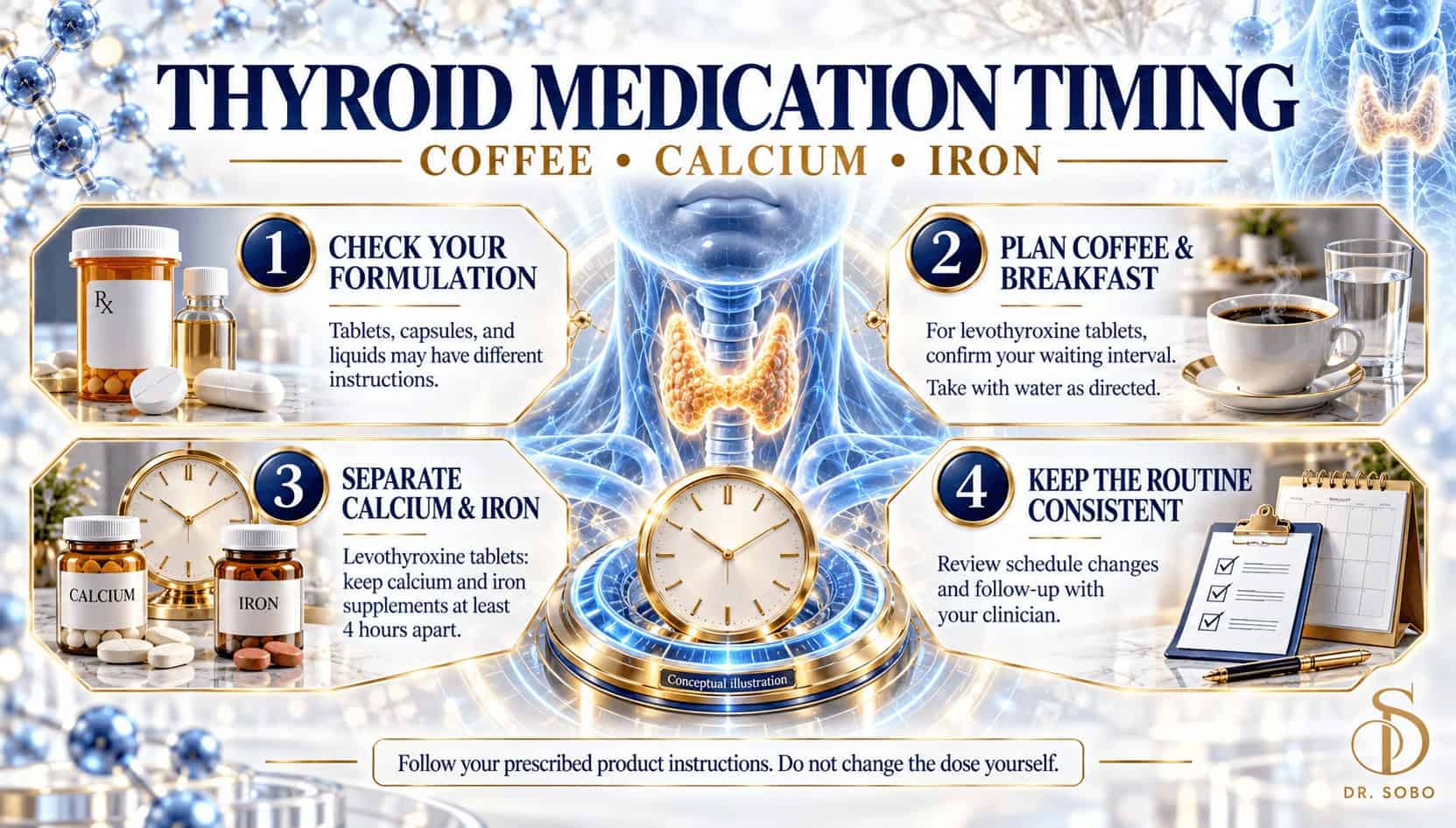
What Could a Morning Levothyroxine-Tablet Routine Look Like?
A schedule can translate intervals into an understandable routine, but it needs clinical approval for the person using it. The example below assumes a levothyroxine tablet, a one-hour wait before breakfast and coffee, and a minimum four-hour interval before calcium or iron. Other medications may require a different arrangement.
| Example time | Activity | What the example illustrates |
|---|---|---|
| 6:30 AM | Take the prescribed levothyroxine tablet with water. | This is the reference time for the intervals. |
| 7:30 AM or later | Breakfast and coffee, if consistent with the agreed plan. | One hour after the thyroid dose. |
| 10:30 AM or later | Calcium or iron if indicated and consistent with their own directions. | At least four hours after the thyroid dose; lunch may be more practical. |
These times are educational, not a prescription. The table does not establish that calcium and iron should be taken together, that they are needed, or that this schedule fits other medicines. Ask the pharmacist to check the entire plan.
Once a schedule is agreed, make it easy to remember. A reminder, written medication list, or clearly separated storage locations may help. Keep medicines in their appropriate containers and avoid a system that makes it difficult to identify which dose was taken.
Can You Take Levothyroxine at Bedtime Instead?
Bedtime administration can be an option for some patients when their clinician agrees. ATA guidance discusses consistent dosing either 60 minutes before breakfast or at bedtime, at least three hours after the evening meal. Bedtime dosing still needs attention to supplements and the prescribed product.
A 2010 randomized crossover trial recruited 105 patients; 90 completed it. Bedtime dosing changed thyroid-hormone measurements compared with morning dosing, but measured quality-of-life outcomes did not significantly improve. The result does not establish that everyone should switch.
Think about whether evenings are more predictable than mornings. Late meals, snacks, and nighttime calcium or iron can make a bedtime plan difficult. The best practical choice is one that fits the clinical instructions and can be followed consistently, rather than one that sounds convenient in isolation.
Do not move a morning dose to bedtime and accidentally take an extra dose during the transition. Ask exactly how to make the change, whether the product directions permit the agreed approach, and when treatment should be reassessed. This article does not provide transition dosing instructions.
What If You Work Night Shifts or Eat at Irregular Times?
An irregular schedule needs a plan anchored to meals, sleep, and other medicines rather than the word “morning” alone. Explain what a typical workday and nonworkday look like, including when you first eat, drink coffee, and take supplements.
Ask whether one dosing pattern can work across both schedules. If it cannot, obtain explicit instructions instead of switching independently between fasting morning dosing and post-meal evening dosing. A calendar time can be consistent while its relationship to food varies substantially.
For travel, time-zone changes, or fasting, contact the prescriber or pharmacist ahead of time when possible. Bring enough medication in its original packaging and check storage instructions. Do not assume a missed meal or a longer flight requires an additional dose.
The goal is a manageable routine that preserves the relevant intervals. If the plan repeatedly leads to missed doses or confusion, tell the care team. That problem deserves practical adjustment rather than blame or a silent change in how the medicine is used.
Which Supplements and Other Medicines Should Be Reviewed?
Review the full prescription and supplement list, including occasional products. Calcium and iron are prominent examples, but antacids, acid-suppressing medicines, and other treatments can also affect thyroid-hormone management. Do not assume four-hour separation solves every interaction.
A pharmacy review can identify whether the issue is binding, a change in stomach conditions, another pharmacologic interaction, or something unrelated to absorption. These differences matter because the appropriate response may involve monitoring or treatment review rather than simply moving the product to lunch.
Tell the clinician when a product started or stopped. Include the ingredient panel, dose, frequency, and whether symptoms or test changes followed. A refill of a supplement may have a different formulation from the old bottle.
Do not stop a medically necessary prescription to simplify the routine. Ask which clinician should coordinate changes, particularly when thyroid treatment, reflux medicine, bone-health treatment, and iron are prescribed by different offices. A single accurate list helps everyone work from the same information.
Do Fiber, Soy, and Protein Drinks Need Attention Too?
Some foods and supplements can affect levothyroxine absorption, but the clinical importance varies with the product and routine. A 2021 systematic review of food and supplement interactions found evidence of differing quality across substances. A possible interaction is not a reason to remove every nutritious food from the diet.
Describe major changes in fiber intake, soy consumption, fortified drinks, or nutritional supplements. Consistency is useful information when comparing laboratory results. An occasional food and a daily concentrated supplement are not necessarily equivalent exposures.
Ask how the specific product should fit around treatment. Avoid replacing a balanced diet with a restrictive “thyroid-safe” menu based on an internet list. If nutrition support is necessary because of reduced appetite or another illness, coordinate that need with the medication plan.
Bring labels for powders and shakes. Their contents may include minerals or multiple active ingredients not apparent from the front of the container. The goal is to identify meaningful conflicts and solve them without creating avoidable nutritional problems.
What Should You Do After an Accidental Timing Mistake?
Do not automatically take a replacement tablet because you drank coffee, ate sooner than planned, or took a supplement too close to the dose. The amount absorbed cannot be calculated at home, and an extra dose can create a different problem.
Record what happened and follow your established instructions. Ask the pharmacist or prescriber what to do if you are unsure, especially when mistakes recur. The relevant information includes the product, dose, times, food or supplement, and whether an additional dose was taken.
Missed-dose instructions can depend on the regimen and clinician’s plan. Obtain them before you need them, rather than applying a generic rule from another patient. Clarify the difference between a missed dose and a dose already taken under less-than-ideal conditions.
One incident does not establish that treatment has failed. Repeated difficulties are more useful to address as a routine problem. If a suspected overdose or serious symptoms are involved, seek appropriate help rather than waiting for the next laboratory check.
When Should Thyroid Tests Be Rechecked After a Change?
Ask the clinician to set the follow-up interval after changes in dose, formulation, or routine. In adults with primary hypothyroidism, product labeling commonly uses a six-to-eight-week interval after dose adjustment. A change in administration may also justify review, but the timing should fit the actual situation.
Do not use a test taken the next morning to judge the full effect of a new routine. Thyroid treatment is generally assessed over time, and pregnancy, central hypothyroidism, thyroid cancer care, or other circumstances can require different targets and monitoring.
Tell the office exactly when the change began. If the result is unexpected, it matters whether the product changed, supplements stopped, or the dose was taken differently during the same period. Keep the prior and current schedule with the laboratory report.
The ATA hypothyroidism resource describes clinical follow-up. Ask what test is being used, what question it answers, and who will communicate the next step. A target should come from the clinician managing your diagnosis, not a universal range copied from social media.
How Is Biotin Interference Different From an Absorption Problem?
Biotin can affect some laboratory assays, creating misleading thyroid measurements. That is different from calcium or iron reducing the absorption of a dose. The distinction matters because an abnormal result may require assessment of the test method as well as the treatment routine.
Tell the ordering clinician and laboratory the biotin amount and last dose time. Some product labels provide a pause instruction, while the actual assay and supplement exposure may require additional guidance. Do not assume that stopping biotin means stopping thyroid medication.
Confirm instructions for prescription timing on the day of collection separately. Depending on the treatment and tests, the clinician may want a standardized relationship between the dose and the blood draw. Follow that plan rather than changing several things at once for a “better” result.
A useful record distinguishes ordinary administration, test-day administration, and supplements that may affect the assay. This helps the clinician decide whether an unexpected result reflects physiology, an interaction, test interference, or a combination.
What If Symptoms Continue Despite a Consistent Routine?
Persistent symptoms need a broader review. Timing is worth checking, but it does not prove the cause of fatigue, hair shedding, constipation, or difficulty concentrating. A consistent regimen and an apparently reassuring test do not eliminate every possible medical explanation.
Describe what persists and how it affects daily function. Include sleep, other medicines, recent illness, and any change in weight or nutrition. Ask what evidence supports further thyroid adjustment and whether another condition should be evaluated.
Dr. Sobo’s article on persistent symptoms during hypothyroidism treatment provides related practice context. This timing guide has a narrower purpose: identifying administration questions before assuming a dose or product change is needed.
Do not use thyroid hormone as an energy enhancer or weight-loss treatment. Levothyroxine labeling carries a boxed warning against its use for obesity or weight loss. More medication is not a substitute for investigating symptoms, and improving absorption does not authorize self-directed dose escalation.
What Changes Deserve Prompt Contact With Your Clinician?
Contact the prescribing team if you become pregnant, plan pregnancy, develop significant new symptoms, or cannot follow the treatment instructions. Thyroid requirements and monitoring can change during pregnancy, so do not wait for a routine appointment to disclose it. ATA pregnancy guidance explains why this needs coordinated care.
Report a formulation switch, a substantial routine change, or a new interacting medicine. Tell the office if a product was stopped after a higher thyroid dose had been prescribed around its use. The clinician needs the sequence before deciding what to change next.
A rapid or irregular heartbeat, marked tremor, or worsening symptoms should not be managed by experimenting with coffee intervals. Seek clinical advice about the symptom itself. A suspected medication interaction does not make another explanation impossible.
When Should You Seek Emergency Help?
Seek urgent or emergency assessment for chest pain, severe breathing difficulty, fainting, or a serious allergic reaction. Do not assume a timing mistake explains a new emergency. Tell responders which thyroid preparation and other medicines were taken.
For suspected overdose in the United States, contact Poison Control at 1-800-222-1222. Call 911 for collapse, seizure, inability to wake the person, or serious breathing difficulty. Do not wait for symptoms to prove that an extra dose was harmful.
For stable questions about meals or supplements, use the prescribing office or pharmacist. Distinguishing routine planning from acute safety concerns helps ensure that urgent symptoms receive appropriate attention.
How Can You Prepare for a Thyroid Medication Review in Stamford?
Bring the exact prescription, current supplement labels, recent laboratory reports, and a short description of your daily routine. Record what happens on ordinary workdays and weekends; a plan that works only occasionally may need adjustment.
- What is my exact formulation? Identify the drug, strength, units, and product.
- What goes with the dose? Record water, meals, coffee, and other medicines.
- Which supplements need separation? Include calcium, iron, antacids, and combination products.
- What recently changed? Note refills, meals, work hours, symptoms, and supplement use.
- What is the follow-up plan? Ask about testing, missed doses, and when to contact the office.
Patients can discuss these questions with Dr. Sobo at Optimal Health Medical. The practice’s thyroid-care page provides service information. If another clinician manages the prescription, clarify who will authorize changes and interpret follow-up results.
The appointment should produce an understandable plan that fits the prescribed product and your circumstances. It may involve maintaining the current schedule, resolving an interaction, considering a different arrangement, or further evaluation. It should not require guessing which internet rule to follow.
Discuss Your Thyroid Medication Routine With Dr. Sobo
Contact Optimal Health Medical to discuss thyroid care and medication-timing questions. Bring your product information, supplement list, and recent results to the consultation.
Optimal Health Medical, LLC
111 High Ridge Road, Stamford, CT 06905
Frequently Asked Questions About Thyroid Medication Timing
How long after levothyroxine can I drink coffee?
For levothyroxine tablets, waiting about an hour before coffee is a commonly supported approach. Follow the prescription and clinician’s instructions for your actual product. Take the tablet with water rather than coffee, and describe milk, creamer, or fortified ingredients when reviewing the routine. Directions for a liquid or another thyroid preparation should not be assumed to match tablet guidance.
Can I take levothyroxine with breakfast?
Common tablet labeling specifies an empty stomach 30–60 minutes before breakfast. Taking a dose with food can affect absorption, but the appropriate instructions depend on the exact product and prescribed plan. If mornings are difficult, discuss an alternative rather than changing the dose yourself. A formulation with different instructions does not make every thyroid medicine suitable for breakfast co-administration.
How far apart should calcium and levothyroxine be taken?
Common levothyroxine directions call for at least four hours before or after calcium products that interfere with absorption. Calcium carbonate, including some antacids, is an important example. Ask the pharmacist to check the complete ingredient list and medication schedule. Do not stop necessary calcium independently, and do not assume every ordinary calcium-containing food requires the same supplement interval.
Can I take iron with thyroid medication?
Iron supplements such as ferrous sulfate can interfere with levothyroxine absorption and commonly require at least four hours of separation. Confirm the directions for your product, including any prenatal vitamin or multivitamin containing iron. If different clinicians manage the treatments, share the complete list with both. Separating thyroid medication does not replace the iron product’s own administration instructions.
Does liquid levothyroxine have the same breakfast instructions as tablets?
Not always. Current Tirosint-SOL labeling specifies 15 minutes before breakfast, while Thyquidity labeling specifies 30–60 minutes. These examples show why the actual product matters. They do not authorize switching medicines or assuming that liquids are free from interactions. Check the prescription, administration method, and supplement-spacing instructions with the prescriber or pharmacist before changing your routine.
Can I take levothyroxine at bedtime?
Bedtime dosing may be an option when your clinician agrees. Clinical guidance discusses an interval of at least three hours after the evening meal, with attention to calcium, iron, and other interacting products. Late snacks and supplements can complicate the plan. Ask how to transition without duplicating a dose and when monitoring is needed; do not move the schedule independently.
Does decaffeinated coffee avoid the interaction?
Do not assume that removing caffeine makes coffee an appropriate drink for swallowing levothyroxine tablets. The timing concern is not established as a caffeine-only effect, and evidence does not supply a universal clearance rule for every coffee preparation. Use water as directed and ask what interval applies to your product. Include milk or fortified ingredients when describing the drink.
What if I accidentally drank coffee right after taking my tablet?
Do not automatically take an extra tablet to compensate. You cannot calculate the amount absorbed at home. Follow your established plan and contact the pharmacist or prescriber if unsure, particularly when timing problems recur. Record the medicine, dose, coffee time, and any supplement use. A dose already taken with an interaction concern is different from a missed dose.
Should I change my dose after improving the timing?
No self-directed dose change is appropriate. Moving from a meal-associated routine to fasting administration may change exposure even when the prescribed amount stays the same. Tell the clinician what changed and when, so the response and follow-up can be reviewed. Symptoms alone cannot determine the correct adjustment, and improved absorption does not guarantee that every symptom will resolve.
Can biotin affect thyroid treatment results?
Biotin can interfere with some laboratory assays and produce misleading thyroid measurements. That differs from an absorption interaction involving calcium or iron. Tell the ordering clinician and laboratory the supplement amount and last dose time, and obtain test-specific preparation instructions. Do not assume a biotin pause means stopping prescribed thyroid medication or that every abnormal result is an assay error.
When should thyroid testing be repeated after a change?
The clinician should set the interval based on the diagnosis, product, and type of change. Adult primary hypothyroidism commonly involves reassessment six to eight weeks after a dose adjustment, while pregnancy and other conditions may need different monitoring. A formulation or routine change can also warrant review. Record its start date and follow the agreed test-day medication instructions.
Do these instructions apply to every thyroid preparation?
No. This guide’s numerical examples mainly concern named levothyroxine products and clinical guidance for levothyroxine. T3, combination treatment, desiccated thyroid, and prescribed compounded preparations need instructions matched to the regimen. Identify the exact medicine and formulation before applying a schedule. The infographic is an educational summary, not a universal dosing protocol or a reason to switch treatment.
Sources
- AbbVie: Synthroid prescribing information.
- DailyMed: Tirosint capsule prescribing information.
- DailyMed: Tirosint-SOL prescribing information.
- DailyMed: Thyquidity prescribing information.
- MedlinePlus: Levothyroxine.
- American Thyroid Association: Thyroid Hormone Treatment.
- American Thyroid Association: Adult Hypothyroidism.
- American Thyroid Association: Hypothyroidism in Pregnancy.
- European Thyroid Association: Guidelines for levothyroxine preparations in monotherapy, 2025.
- Benvenga and colleagues: Altered intestinal absorption of L-thyroxine caused by coffee, 2008.
- Singh and colleagues: Effect of calcium carbonate on levothyroxine absorption, 2000.
- Campbell and colleagues: Ferrous sulfate reduces thyroxine efficacy, 1992.
- Chon and colleagues: Concurrent milk ingestion decreases levothyroxine absorption, 2018.
- Bolk and colleagues: Evening versus morning levothyroxine, randomized crossover trial, 2010.
- Medications and food affecting levothyroxine bioavailability, systematic review, 2023.
- Levothyroxine interactions with food and dietary supplements, systematic review, 2021.