
By Dr. Henry Sobo, MD – Medical Weight Loss, Functional & Hormone Therapy, Connecticut
The Mind-Body Connection in Sexual Wellness: Beyond Pills to True Desire
If you have ever found yourself staring at a prescription for Viagra or Cialis, wondering why it addresses the mechanics but not the desire, you are not alone. Millions of men and women across Fairfield County—and around the world—struggle with a disconnect between physical function and genuine sexual desire.
For decades, the conversation around sexual health has been dominated by a simple paradigm: erectile dysfunction equals blood flow; low libido equals hormones. But reality is far more complex. Sexual wellness is not a mechanical problem—it is a mind-body phenomenon that involves your brain, your hormones, your nervous system, your emotional state, and your relationship with yourself and your partner.
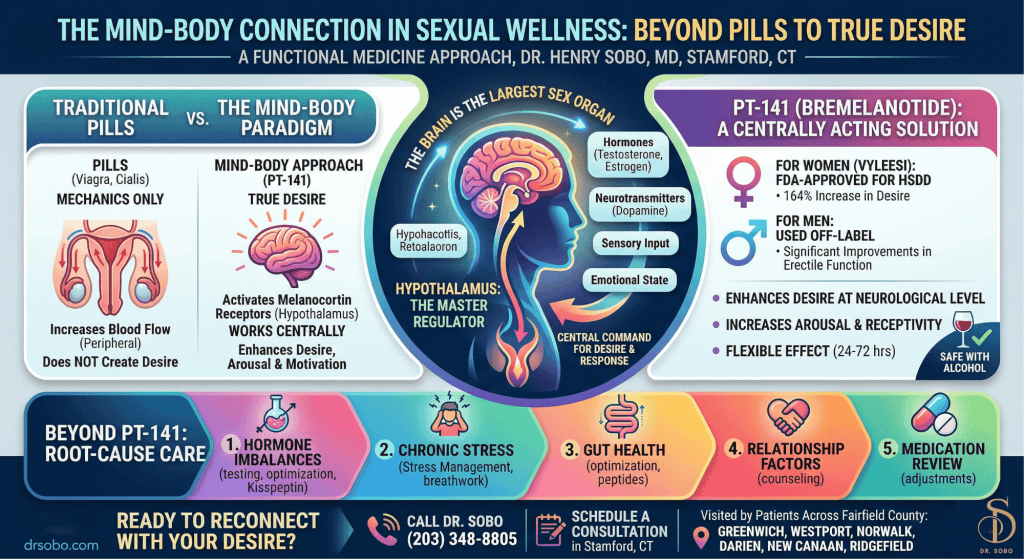
In my Stamford, CT functional medicine practice, I have helped countless patients—from men in Greenwich who lost their spark after years of stress, to women in Westport navigating the hormonal shifts of perimenopause—rediscover not just function, but genuine desire. One of the innovative tools I use is PT-141 (bremelanotide) , a synthetic peptide that activates melanocortin receptors in the brain to enhance sexual desire. Unlike traditional medications that focus on blood flow, PT-141 works centrally, addressing desire at its source. It is FDA-approved as Vyleesi for women with hypoactive sexual desire disorder (HSDD) and is used off-label for men with excellent results.
This blog explores the science of sexual desire, why traditional treatments often fall short, and how a functional medicine approach—including innovative options like PT-141—can help you reconnect with your sexuality from the inside out.
The Missing Piece: Why Pills Alone Don't Restore Desire
When most people think of sexual health medications, they think of PDE5 inhibitors—Viagra (sildenafil), Cialis (tadalafil), Levitra. These medications work by inhibiting an enzyme that restricts blood flow to the genitals. For men with vascular erectile dysfunction, they can be life changing.
But here is what they do not do: they do not create desire.
Desire originates in the brain. It is a complex interplay of:
- Neurotransmitters (dopamine, serotonin, oxytocin)
- Hormones (testosterone, estrogen, progesterone)
- Melanocortin receptors (which regulate sexual motivation)
- Psychological factors (stress, anxiety, self-image, relationship dynamics)
- Nervous system state (sympathetic vs. parasympathetic dominance)
When you take a PDE5 inhibitor, it helps blood flow to the genitals—but if your brain is not sending the signal of desire, the result can be mechanical function without genuine arousal. Many men describe this as feeling “disconnected”—their body responds, but their mind is not engaged.
For women, the gap is even wider. There are no FDA-approved PDE5 inhibitors for women, and until recently, there were no FDA-approved medications for female sexual desire at all. The conversation often stopped at “it’s hormonal” or “it’s normal,” leaving women without real solutions.
The Brain Is the Largest Sex Organ
This is not just a saying—it is a biological fact. The brain is the central command center for sexual desire, arousal, and response.
The Role of the Hypothalamus
Deep within the brain, the hypothalamus acts as the master regulator of sexual function. It receives signals from:
- Hormones (testosterone, estrogen, progesterone)
- Neurotransmitters (dopamine, serotonin, norepinephrine)
- Melanocortin peptides (which influence sexual motivation)
- Sensory input (touch, sight, sound, smell)
- Emotional state (stress, safety, connection)
When the hypothalamus receives the right signals, it initiates a cascade that leads to desire, arousal, and—in men—erection. When any part of this system is out of balance, desire suffers.
Central vs. Peripheral: A Critical Distinction
Mechanism | What It Does | Examples |
Central (Brain) | Creates desire, arousal, motivation | PT-141, dopamine, oxytocin, testosterone |
Peripheral (Body) | Facilitates blood flow, physical response | Viagra, Cialis, vacuum devices |
Traditional ED medications work on the peripheral side. They help the body respond if the brain sends the signal. But if the brain is not sending the signal—if desire is absent—they cannot create it.
This is why a growing number of patients and clinicians are turning to centrally acting therapies that address desire at its source.
PT-141: A Centrally Acting Solution
PT-141 (bremelanotide) is one of the few therapies that work directly in the brain to enhance sexual desire. It was discovered serendipitously during research on Melanotan II—a peptide developed for tanning—when researchers noticed participants reporting unexpected increases in sexual desire and arousal [1].
Unlike PDE5 inhibitors, PT-141 activates melanocortin receptors (MC4R and MC3R) in the hypothalamus—the very region of the brain that regulates sexual motivation [2]. When these receptors are activated, they initiate a cascade of neural signals that:
- Enhance sexual desire at the neurological level
- Increase arousal and receptivity to sexual stimuli
- Facilitate erectile response through central nervous system activation
- Improve the subjective experience of intimacy and pleasure
FDA Approval and Clinical Evidence
In 2019, PT-141 received FDA approval under the brand name Vyleesi for the treatment of hypoactive sexual desire disorder (HSDD) in premenopausal women [3][4]. In clinical trials, women taking Vyleesi experienced a 164% increase in desire compared to a 22% increase in the placebo group [5].
For men, PT-141 is used off-label with strong clinical evidence. A Phase IIB trial in men with diabetes-induced erectile dysfunction reported significant improvements in erectile function [6]. Research also shows that PT-141 can work synergistically with PDE5 inhibitors—the combination produces significantly greater erectile response than either agent alone [7].
Beyond PT-141: A Functional Medicine Approach to Sexual Wellness
While PT-141 is a powerful tool, it is most effective when used as part of a comprehensive, root-cause approach. In my Stamford practice, I investigated the underlying factors that may be suppressing desire:
- Hormonal Imbalances
Testosterone is not just a male hormone—it plays a critical role in female desire as well. Low testosterone, estrogen dominance, thyroid dysfunction, and cortisol dysregulation can all suppress libido.
Solutions:
- Comprehensive hormone testing
- Bioidentical hormone therapy when appropriate
- Kisspeptin therapy to restore natural hormone production
- Chronic Stress and Nervous System Dysregulation
When the body is in chronic “fight or flight” mode (sympathetic dominance), sexual function shuts down. The body prioritizes survival over reproduction.
Solutions:
- Stress management protocols
- Nervous system regulation (breathwork, heart rate variability training)
- Adaptogenic herbs and lifestyle restructuring
- Gut Health and Inflammation
The gut-brain axis plays a significant role in mood, hormone balance, and neurotransmitter production. Chronic gut inflammation can directly impact desire.
Solutions:
- Gut health optimization with BPC-157 and other gut-healing peptides
- Anti-inflammatory nutrition
- Addressing dysbiosis and leaky gut
- Relationship and Psychological Factors
Desire does not exist in a vacuum. Relationship dynamics, past trauma, self-image, and emotional safety all influence sexual function.
Solutions:
- Counseling or sex therapy referrals when appropriate
- Open communication with partners
- Addressing underlying anxiety or depression
- Medications and Substances
Many common medications—including antidepressants (SSRIs), blood pressure medications, and hormonal contraceptives—can suppress libido.
Solutions:
- Medication review and adjustment when possible
- Alternative treatments for underlying conditions
The Social Context: Alcohol and Intimacy
One of the unique advantages of PT-141 is its safety profile when combined with alcohol. Because sexual intimacy often occurs in social settings, this is a practical consideration.
A Phase I study published in The Journal of Sexual Medicine specifically evaluated the safety of bremelanotide administered with ethanol. The study concluded:
“In healthy adult women and men, single IN doses of BMT administered with or without ethanol were safe and generally well tolerated, with no clinically relevant hemodynamic effects, PK interactions, or serious AEs” [8].
This means PT-141 can be used in real-world situations where intimacy may follow a social drink—without compromising safety or efficacy.
What to Expect: A Comprehensive Approach
When patients come to my Stamford practice with concerns about low desire or sexual dysfunction, I take a systematic approach:
Step 1: Comprehensive Evaluation
- Detailed medical and sexual history
- Hormone panel (testosterone, estradiol, progesterone, cortisol, thyroid)
- Assessment of stress, sleep, and lifestyle factors
- Review of medications and supplements
Step 2: Identify Root Causes
- Is it hormonal?
- Is it neurological (central vs. peripheral)?
- Is it psychological or relational?
- Is it medication-related?
- Is it inflammatory (gut, autoimmune)?
Step 3: Personalized Treatment Plan
Depending on the root causes identified, the plan may include:
- PT-141 therapy for centrally mediated desire
- Kisspeptin therapy for hormonal balance
- Hormone optimization for testosterone or thyroid
- Gut healing protocols to reduce inflammation
- Stress management and nervous system regulation
- Referrals for relationship counseling or sex therapy when appropriate
Step 4: Monitoring and Adjustment
- Regular follow-up to assess response
- Adjust protocols as needed
- Celebrate progress—desire is not a switch but a journey
Why Choose Dr. Sobo for Sexual Wellness in Stamford, CT?
At my Stamford, CT functional medicine practice, I take a comprehensive, root-cause approach to sexual wellness. I do not simply prescribe a medication—I investigate the underlying factors that may be suppressing your desire:
- Hormonal imbalances
- Chronic stress and nervous system dysregulation
- Gut inflammation and the gut-brain axis
- Medication side effects
- Relationship and psychological factors
Patients come to my practice from across Fairfield County—Greenwich, Norwalk, Westport, Darien, New Canaan, Wilton, and Ridgefield—because I take the time to understand the full picture of their health, not just their symptoms.
For those who need it, I offer PT-141 therapy as one tool in a comprehensive toolkit. But I also offer hormone optimization, gut healing, stress management, and other peptide therapies like Kisspeptin and Oxytocin to address the full spectrum of factors that influence sexual wellness.
Ready to Reconnect with Your Desire?
If you are ready to move beyond the limitations of traditional treatments and address the root causes of low desire, I invite you to schedule a consultation.
Call us today at (203) 348-8805 or use our online scheduling tool to book your appointment.
For more information on PT-141 specifically, please visit our dedicated PT-141 page .
FAQS
What is the difference between PT-141 and Viagra?
Viagra (and similar PDE5 inhibitors) work by increasing blood flow to the genitals. PT-141 works in the brain to enhance desire and arousal. PT-141 addresses the “want” component; Viagra addresses the “can” component.
Is PT-141 FDA-approved?
Yes. PT-141 is FDA-approved under the brand name Vyleesi for premenopausal women with hypoactive sexual desire disorder (HSDD). For men, it is used off label with strong clinical evidence.
Can women use PT-141?
Yes. PT-141 is FDA-approved specifically for women with HSDD. It is one of the only medications approved for female sexual desire disorders.
Can men use PT-141?
Yes. While FDA-approved for women, PT-141 is used off-label for men with excellent results, particularly for those who do not respond adequately to standard ED medications or who struggle with low libido.
How long does PT-141 last?
The effects of a single dose typically last 24-72 hours, providing flexibility and spontaneity.
Can I use PT-141 with alcohol?
Yes. Clinical studies have shown that PT-141 can be safely coadministered with alcohol, with no clinically relevant interactions or serious adverse events.
What are the side effects of PT-141?
The most common side effects are nausea, flushing, headache, and injection-site reactions. Nausea affects approximately 40% of users but is usually mild and transient.
Can PT-141 be combined with Viagra or Cialis?
Yes. Research shows that PT-141 and sildenafil (Viagra) work synergistically, producing significantly greater erectile response than either agent alone. This should be done under medical supervision.
Is PT-141 effective for diabetes-related erectile dysfunction?
Yes. A Phase IIB trial showed significant improvements in erectile function in men with diabetes-induced ED after three months of bremelanotide treatment.
How do I know if my low libido is hormonal or psychological?
This is precisely what a comprehensive evaluation determines. In my Stamford practice, I use hormone testing, clinical assessment, and a detailed history to identify the root causes. Often, multiple factors are at play.
How do I get started with a sexual wellness evaluation in Stamford, CT?
Call our office at (203) 348-8805 to schedule a consultation. We will take a comprehensive history, order appropriate testing, and develop a personalized plan to help you reconnect with your desire.
Sources
- PMC: Bremelanotide Review – PMC8788464
- PMC: Melanocortin System and Sexual Function
- Vyleesi (bremelanotide) Official Site
- PMC: FDA Approval of Bremelanotide – PMC6819023
- Vyleesi Clinical Trial Results
- PubMed: Bremelanotide and Erectile Function – 12851303
- Tower Urology – Combination Therapy Research
- ScienceDirect: Bremelanotide and Alcohol Safety Study