
PRP for Plantar Fasciitis: Evidence, Procedure, and Recovery Timeline
For persistent heel pain, PRP is one possible tool—but confirming the diagnosis and rebuilding load tolerance remain essential.
Why plantar fasciitis can become persistent
The plantar fascia is a strong band of tissue that supports the arch and helps the foot manage load. Plantar fasciitis usually causes pain near the inside of the heel, often with the first steps after rest. Symptoms may ease as the foot warms up and return after prolonged standing, walking, or running.
Persistent symptoms are not always caused by a simple inflammatory process. Tissue degeneration, reduced ankle mobility, rapid changes in training, footwear, calf capacity, body-weight changes, and work demands can all contribute. That is why treatment must address load and mechanics rather than relying on an injection alone.
Other problems can mimic plantar fasciitis, including nerve irritation, stress injury, heel-pad pain, inflammatory arthritis, and referred symptoms. Examination and selective imaging help confirm the target before an invasive treatment is considered.
Where PRP fits in treatment
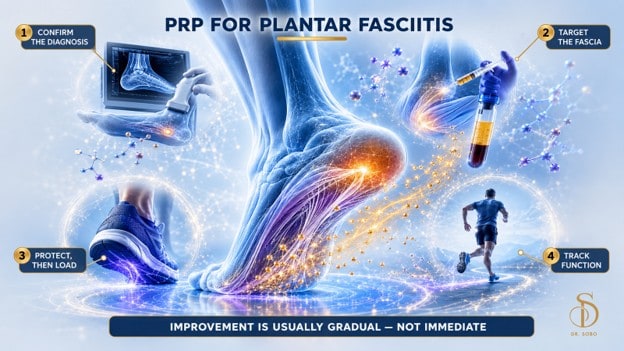
First-line care commonly includes load modification, plantar fascia and calf stretching, progressive strengthening, footwear changes, and time. Many cases improve without an injection. PRP is generally discussed when symptoms remain limiting despite a well-executed conservative plan.
The procedure uses a patient’s own blood to prepare a platelet concentrate. The clinician injects the product into the selected portion of the plantar fascia. Ultrasound may be used to confirm the tissue and guide placement. The purpose is to influence the local biologic response while rehabilitation restores capacity.
PRP is not instant pain relief. A temporary flare may occur, and improvement—if it happens—is typically evaluated over weeks to months. Patients who need a guaranteed immediate return to sport or standing work should understand that this timeline may not fit.
What clinical studies show
Randomized trials comparing PRP with corticosteroid injections have often found different time courses: steroid may provide faster short-term relief in some patients, while PRP may show more durable improvement at later follow-up. Not every study reaches the same conclusion.
Differences in how PRP is prepared, how chronic the condition is, how injections are guided, and which rehabilitation program is used make the literature difficult to reduce to one number. A result from a trial population does not guarantee the same outcome for an individual.
The evidence supports describing PRP as an option for selected chronic cases—not as a first treatment for every patient and not as a cure. Shared decision-making should include cost, recovery demands, alternatives, and the consequences of continuing current activity.
The procedure and early aftercare
Before treatment, the clinician reviews the diagnosis, medication and supplement list, medical conditions, and practical needs such as driving and work. Never stop an anticoagulant or other prescribed medication without instruction from the prescribing clinician.
After injection, the heel may be sore. Instructions may include a period of reduced loading and, in some cases, temporary use of supportive footwear or an assistive device. Skin care, bathing, and medication guidance should be followed exactly as provided.
The goal is not permanent rest. Once the initial phase settles, movement and loading are reintroduced. Calf strength, foot-intrinsic strength, ankle mobility, and walking mechanics may all be part of the plan.
Recovery timeline and return to activity
Early recovery focuses on protecting the injection site and keeping daily activity within an acceptable symptom range. The next phase restores comfortable walking and targeted exercise. Later phases build endurance, hopping, running, or long-standing tolerance when those tasks matter to the patient.
Pain should not be the only outcome. Track first-step pain, minutes of standing, walking distance, tolerance for work shoes, exercise volume, and recovery the next morning. These measures show whether the foot is becoming more capable.
Return to running or impact sport should be earned through progressive loading rather than selected by the calendar alone. If symptoms repeatedly escalate and do not settle, the diagnosis, exercise dose, footwear, and overall plan should be reassessed.
Can peptides be incorporated into plantar-fascia PRP recovery?
Dr. Sobo may consider the Wolverine Peptide Stack—BPC-157 plus TB-500—as a physician-supervised adjunct after plantar-fascia PRP for selected patients. The purpose is to support a broader recovery plan while the treated foot moves through protection, comfortable walking, progressive loading, and return-to-function milestones.
Peptide therapy does not replace confirmation of the diagnosis or the mechanical work required to rebuild plantar-fascia and calf capacity. Direct high-quality human research showing that BPC-157 and TB-500 improve plantar-fascia PRP outcomes is limited, so faster healing or a specific result should not be promised.
Learn more about the Wolverine Peptide Stack offered by Dr. Sobo in Stamford and review the related guide to BPC-157 and TB-500 for recovery.
Important: BPC-157 and TB-500 are not FDA-approved specifically to enhance recovery after plantar-fascia PRP. The treatment decision, timing, formulation, safety review, sourcing, and follow-up plan should be individualized and coordinated with rehabilitation.
Risks and alternatives
Possible risks include temporary pain, bruising, bleeding, infection, nerve irritation, and lack of improvement. Any new numbness, marked swelling, spreading redness, fever, drainage, or severe worsening should be reported promptly.
Alternatives include physical therapy, a structured home-loading program, footwear and orthotic strategies, extracorporeal shockwave therapy, selected injections, and—less commonly—surgery. The right sequence depends on duration, severity, diagnosis, and prior care.
For a diagnosis-first discussion, learn about PRP at Optimal Health Medical or contact Dr. Sobo’s office in Stamford.
Confirming the cause of heel pain
Classic plantar-fascia pain is often worst with the first steps after sleep or sitting and is tender near the medial heel. But symptoms can vary, and persistent night pain, neurologic symptoms, trauma, systemic inflammatory signs, or inability to bear weight may require a different workup.
Ultrasound can show fascia thickness and guide injection, while x-rays or MRI may be used selectively. A heel spur does not automatically explain symptoms and does not by itself determine treatment. The clinician should match the examination and history to the imaging.
The diagnosis should also include the cause of repeated overload. Training errors, limited ankle motion, weak calf capacity, prolonged occupational standing, recent weight change, and footwear can all contribute and should be addressed.
Why progressive loading matters
The plantar fascia must tolerate force every time the foot accepts body weight. Permanent rest can reduce irritation temporarily but does not rebuild capacity. Rehabilitation gradually exposes the tissue to a dose it can recover from.
A program may include calf raises, foot-intrinsic exercises, mobility work, balance, and gradual walking or running progression. The exact exercises and repetitions depend on irritability and baseline capacity. Sudden jumps in volume are a common reason symptoms flare.
A pain-monitoring model can help: the exercise response should be acceptable during the session, settle afterward, and not produce a major worsening the next morning. The thresholds should be agreed upon with the clinician or therapist.
PRP, shockwave, and corticosteroid
Extracorporeal shockwave therapy is a noninvasive option used for some chronic cases. It may require a series of visits and can be combined with rehabilitation. Its suitability depends on the diagnosis, device, protocol, and patient preference.
Corticosteroid can provide relief, but the potential risks around the plantar fascia and fat pad should be considered. PRP is generally chosen for a slower biologic approach rather than immediate anesthetic-like relief. Direct comparisons show that timing matters when outcomes are interpreted.
No procedure replaces load management. If the daily mechanical demand remains much greater than the foot can tolerate, symptoms may persist even after technically successful treatment.
Planning work, footwear, and travel
Patients who stand or walk for work should discuss temporary restrictions before the procedure. A short-term change in shift length, footwear, floor surface, or walking distance may be more realistic than taking complete leave.
Supportive shoes, inserts, taping, or a temporary boot may be considered, but these tools should serve a defined purpose and duration. Long-term dependence without rebuilding strength can become a new problem.
Air travel or a long drive soon after treatment can complicate activity and swelling management. Ask about timing, movement breaks, medication, and warning signs before booking. The office should know if follow-up will be delayed by travel.
Key takeaways
- Begin with an accurate diagnosis and a clearly defined goal.
- Use evidence and risk information for the exact therapy—not the category name alone.
- Track function, symptoms, side effects, and relevant objective measures.
- Coordinate treatment through a qualified clinician and keep follow-up appointments.
- Seek prompt care for severe or rapidly worsening symptoms.
Frequently asked questions
Is PRP effective for plantar fasciitis?
Trials suggest PRP can help some people with chronic plantar fasciitis, particularly at later follow-up, but outcomes vary.
How painful is the injection?
Discomfort can occur during and after injection. Ask the clinician what comfort measures and post-procedure plan will be used.
How long until I can walk normally?
The timeline depends on severity, procedure details, and work demands. Walking is usually progressed in stages.
Can I run after PRP?
Running should return after walking and strength benchmarks are met and the treating team approves progression.
Is PRP better than cortisone?
PRP and corticosteroid injections have different goals and time courses. Neither is best for every patient.
Will I need more than one injection?
Some protocols use one injection and others use a series. Repeat treatment should follow a clinical reassessment.
Can peptides support recovery after plantar-fascia PRP?
Dr. Sobo may consider BPC-157 and TB-500 as adjuncts for selected patients, but direct evidence for improving plantar-fascia PRP outcomes is limited. Progressive loading remains essential, and peptide timing and monitoring should be individualized.
Sources
- Randomized trial: PRP versus steroid for plantar fasciitis
- Randomized controlled trial: PRP for chronic plantar fasciitis
- AAOS OrthoInfo: Plantar Fasciitis and Bone Spurs
- Dr. Sobo: Wolverine Peptide Stack in Stamford, CT
- Dr. Sobo: Wolverine Peptide Stack—BPC-157 + TB-500 for Recovery
- FDA: July 23–24, 2026 Pharmacy Compounding Advisory Committee meeting materials
- FDA: Compounding and the FDA—Questions and Answers
Medically reviewed by