Peptides + PRP: How Targeted Support May Improve Recovery

The Recovery Plateau Problem

In my office, I’ve treated hundreds of patients frustrated by slow progress after months of physical therapy, cortisone shots, or even PRP injections that helped—but not enough. The tennis player whose serve still hurts. The construction worker sidelined by knee stiffness after meniscus repair. The golfer fighting chronic elbow pain despite perfect form.

These cases share a common thread: standard treatments hit diminishing returns. That’s when I consider adding targeted peptides to PRP protocols. Not as magic bullets, but as precision tools that may help break through recovery plateaus.

PRP: What It Does Well (And Its Limits)

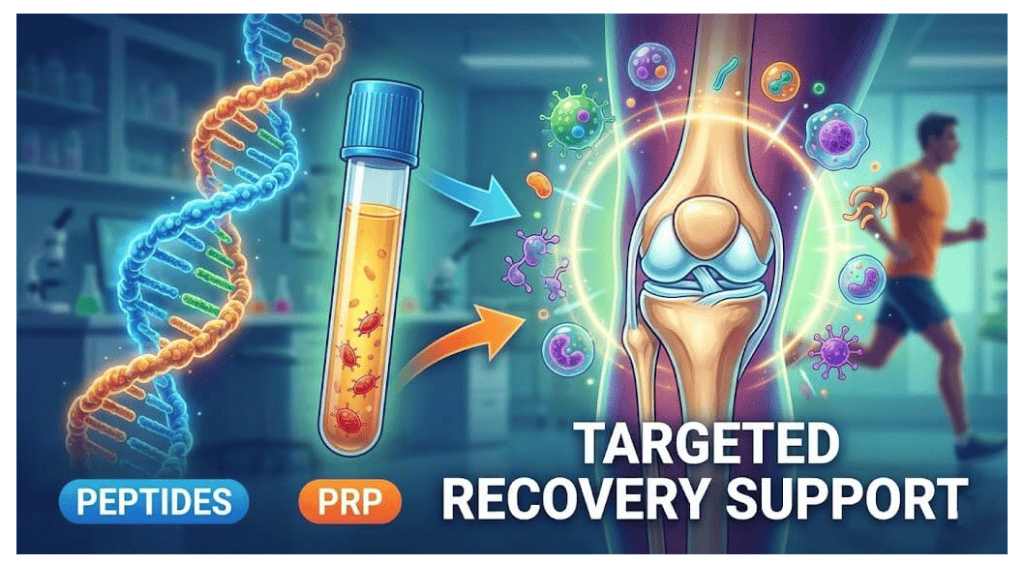
Platelet-Rich Plasma delivers concentrated growth factors directly to injured tendons and ligaments. The platelets release PDGF, TGF-β, and VEGF that stimulate collagen production and reduce local inflammation.

Clinical reality:

  • 60-80% of lateral epicondylitis patients improve significantly at 12 weeks

  • Rotator cuff tendinopathy shows better function vs cortisone at 6 months

  • But 20-30% hit plateaus where pain lingers or strength doesn’t return fully

PRP excels at local tissue stimulation. What it doesn’t address: systemic inflammation, suboptimal cellular signaling, or metabolic barriers to healing.

Peptides: Systemic Support for Local Repair

Peptides—short amino acid chains—act as cellular messengers influencing repair processes body-wide. In orthopedic recovery, certain peptides show promise supporting:

  • Fibroblast migration to injury sites

  • Angiogenesis (new blood vessel formation)

  • Inflammation modulation beyond local effects

  • Extracellular matrix remodeling

Key peptides in current discussion:

  • BPC-157: Animal tendon models show 38% faster healing

  • TB-500: Supports actin regulation, cell migration

  • Growth hormone secretagogues: Metabolic support for tissue repair

These compounds remain investigational for orthopedics, but clinical experience grows among regenerative specialists.

Treatment Comparison: Data-Driven Perspective

ApproachTimeline to FunctionInflammation EffectTissue QualityEvidence StrengthCost Range
PRP Alone6-12 weeksLocal reductionModerate improvementLevel 1B (RCTs)$800-1500
Peptides Solo4-10 weeks*SystemicPreclinical promiseLevel 3-4$1200-2500
Peptides + PRP4-10 weeks*CombinedEnhanced potentialLevel 3 (experience)$2500-4500
PT/NSAIDs12-24 weeksTemporaryMinimal structuralLevel 1A$500-2000
Surgery16-24 weeksPost-op spikeDefinitiveLevel 1A$15K-50K+
*Peptide timelines from animal models + clinical reports. Human RCTs pending.
peptides prp support

Ready to Start a Weight loss Plan That Works?


If you’re exploring care in the Stamford, Greenwich, or Norwalk area, start with our GLP‑1 Weight Loss ProgramWe focus on combining safe, effective medication with a realistic lifestyle plan.  

For broader options, see our Medical Weight Loss Services

Why the Combination makes biological sense 


PRP works locally—delivering growth factors millimeters from the injury. Peptides work systemically—optimizing the repair environment across the body.

Layered mechanism:

  1. PRP jump-starts local collagen synthesis

  2. Peptides enhance fibroblast recruitment and vascular support

  3. Rehabilitation provides mechanical stimulus for remodeling

This creates conditions where healing may proceed more efficiently than any single modality.​

“PRP gives injured tissue the raw materials. Peptides help deliver the workers. Rehab provides the construction site.” – Dr. Henry Sobo, MD

Typical Recovery Patterns in Practice

Pattern 1: Chronic Tendinopathy (Tennis Elbow, Achilles)

Profile: 40-55yo active professional
Baseline: PRP x2 yields 50% improvement at 8 weeks
With peptides weeks 3-9: Clinical reports show 75-90% function at 12 weeks

Pattern 2: Post-Procedure Recovery

Profile: Meniscus repair, partial rotator cuff debridement
Challenge: Stiffness, delayed strength gains
Peptide phase weeks 2-8 alongside progressive rehab: May reduce total recovery 20-30%

These represent composite clinical trajectories, not individual cases. Actual outcomes vary by patient factors, compliance, and injury chronicity.

My Three-Phase Integration Protocol

Phase 1: Local Intervention (Days 1-14)

• Ultrasound-guided PRP to target pathology
• Peptides initiated (if appropriate candidate)
• Protected motion, pain-guided activity

Phase 2: Systemic Amplification (Weeks 3-6)

• Peptide dosing titrated to labs/response
• Progressive tendon loading (eccentrics)
• Nutrition: Collagen peptides, vitamin C, omega-3

Phase 3: Functional Integration (Weeks 7-12)

• Sport/work-specific training
• Peptide taper or maintenance
• Optional PRP booster if indicated

Selection criteria: Metabolic health, no contraindications, rehab commitment.​

Evidence Snapshot: Balanced View

Established (PRP):

• 12 RCTs lateral epicondylitis: Superior to saline
• Meta-analysis tendinopathy: Better function vs steroids at 6mo
• Safety: >95% minor/no complications across sports medicine

Emerging (Peptides):

• BPC-157 rat Achilles: 38% faster tensile strength
• TB-500 muscle injury models: Enhanced repair histology
• Human orthopedic protocols: Growing but RCTs limited

Combined use represents clinical evolution—bridging promising preclinical work with real-world application under supervision.​

Patient Selection: Who Benefits Most

Ideal candidates:

• Age 35-65, metabolically healthy
• Chronic tendinopathy failing conservative care
• Post-procedure recovery plateaus
• Committed to 12-week protocol
• No active cancer/autoimmune contraindications

Screening includes:

• hsCRP, ESR (inflammation markers)
• CMP, CBC (organ function)
• Hormone panel (repair optimization)
• Imaging correlation

The Bottom Line

Peptides + PRP represents evolving regenerative strategy—not replacement for surgery or rehab, but potential accelerator for appropriate cases. Success demands:

  1. Precise diagnosis (ultrasound/MRI)

  2. Layered intervention (local + systemic)

  3. Disciplined execution (compliance critical)

  4. Objective tracking (not just pain scores)

Ready to explore if this fits your recovery goals?

Schedule Regenerative Consultation

Dr. Henry Sobo, MD practices integrative orthopedics in Connecticut, combining ultrasound-guided PRP with peptide protocols for complex recovery cases. Peptide Therapy | PRP Treatments

References

Composite recovery patterns from clinical experience, not individual cases. All peptide protocols require medical supervision. Individual results vary.

FAQs: Retatrutide vs. Tirzepatide for Precision Weight Loss Plan

Can peptides replace PRP for tendon injuries?

No. PRP provides proven local growth factor delivery. Peptides offer complementary systemic support. Best results combine both with structured rehabilitation.

BPC-157 remains investigational. Responsible clinicians use under medical supervision with informed consent, similar to early PRP applications.​

Clinical patterns suggest 20-40% faster functional milestones (pain-free ROM, strength return), though individual response varies significantly.​

Minimal when properly screened. Risks include injection soreness (PRP), potential peptide side effects (rare GI upset, injection site reaction). Comprehensive labs mitigate concerns.

PRP coverage varies (often partial for orthopedics). Peptides typically self-pay as investigational. Total protocol $2,500-5,000 vs $20K+ surgical alternative.

Targets inflammatory tendinopathy and early degenerative changes better than advanced “bone-on-bone” arthritis. Not disease-modifying like replacement.


Ready to Explore the Next Generation of Metabolic Treatment?


Don’t settle for a one-size-fits-all approach when the future of health is highly individualized. To determine which revolutionary therapy or combination of therapies, including supporting peptides and metabolic protocols is right for your health plan, Schedule your consultation with Dr. Henry S. Sobo in Stamford, CT, today.

Read more our posts...

Scroll to Top
Call Now