
Peptide Therapy for Women Over 40: Metabolism, Recovery, Muscle, and Healthy Aging
For many women, the 40s are the decade when the old health strategies stop working as predictably. A diet that once produced results may feel less effective. Workouts may take longer to recover from. Sleep may become lighter. Weight may shift toward the midsection. Energy may fluctuate. Muscle may become harder to maintain. These changes can be frustrating, especially for women who are already eating well, staying active, and trying to age proactively.
Peptide therapy is one reason many women over 40 are asking new questions about metabolism, recovery, muscle, hormone-related changes, inflammation, and healthy aging. Peptides are short chains of amino acids that act as signaling molecules in the body. Depending on the peptide and the clinical context, peptide-related conversations may involve appetite regulation, tissue repair, sleep quality, metabolic support, body composition, immune balance, or recovery.
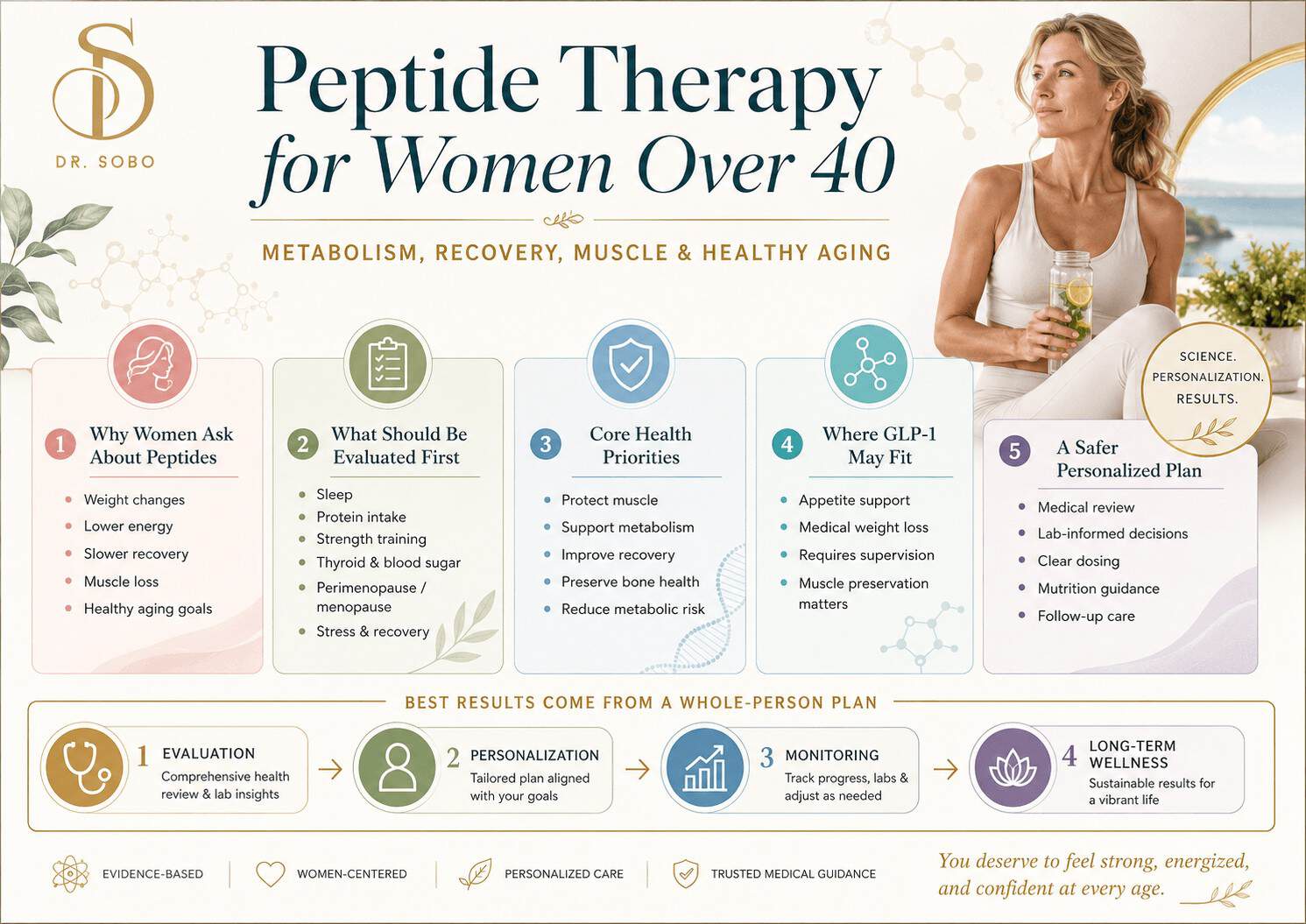
However, peptide therapy should not be treated as a one-size-fits-all wellness shortcut. Women over 40 often need a broader evaluation that considers perimenopause, menopause, thyroid health, insulin resistance, sleep, stress, protein intake, strength training, inflammation, nutrient status, medications, and long-term goals. A peptide may be part of a medically guided plan for some patients, but it should not replace a careful review of why symptoms are happening in the first place.
At Optimal Health Medical, Dr. Sobo provides physician-guided care for patients who want a more personalized approach to peptide therapy, medical weight loss, GLP-1 weight loss, and functional medicine. The goal is not to chase trends. The goal is to determine what is appropriate for the individual woman, what should be evaluated first, and how treatment can support strength, metabolism, recovery, and healthy aging over time.
Women interested in this topic may also want to review peptide therapy, medical weight loss, GLP-1 weight loss, and Optimal Health Medical resources to better understand how these services can fit into a broader care plan.
Peptide Therapy for Women Over 40 at a Glance
Peptide therapy for women over 40 is best understood as a possible tool within a larger health strategy. The most important question is not “Which peptide is best?” The better question is, “What is driving the change in metabolism, recovery, muscle, sleep, weight, or energy, and what type of plan is medically appropriate?”
| Concern Women Often Report | What May Be Involved | Why Medical Evaluation Matters |
|---|---|---|
| Weight gain or abdominal fat | Hormonal transition, insulin resistance, sleep disruption, stress, lower muscle mass, medication effects | The plan should address root drivers, not only appetite. |
| Slower recovery | Training load, inflammation, sleep, protein intake, hormones, thyroid function, injury history | Recovery support should not mask an undiagnosed problem. |
| Loss of strength or tone | Age-related muscle loss, low protein intake, reduced resistance training, low energy availability | Muscle preservation is central to metabolism and long-term health. |
| Fatigue or brain fog | Sleep, thyroid, anemia, blood sugar, stress, nutrient status, medication effects | Peptides are not a substitute for diagnostic evaluation. |
| Healthy aging goals | Metabolic health, body composition, bone health, mobility, inflammation, cardiovascular risk | A whole-person plan is more useful than a product-focused approach. |
Why Women Over 40 Often Feel Their Metabolism Has Changed
Midlife metabolism is not just a matter of willpower. Women commonly experience body-composition and energy changes because of a combination of aging, hormonal transition, lifestyle demands, sleep disruption, stress, muscle loss, and changes in activity patterns. The Menopause Society notes that midlife weight gain is influenced by aging and menopause-related changes, with aging associated with muscle loss and menopause contributing to a shift toward more abdominal fat.
This matters because muscle is metabolically active tissue. When muscle mass and strength decline, resting energy expenditure may decrease, glucose handling may worsen, and daily movement may become less efficient. A woman may feel that she is doing the same things she always did, but her body may be responding differently because the underlying physiology has changed.
For many women, the issue is not simply “low metabolism.” It may be a combination of lower lean mass, poor sleep, increased stress hormones, insulin resistance, reduced recovery capacity, inadequate protein intake, and perimenopausal or menopausal symptoms that make consistent habits harder to maintain.
That is why peptide therapy should be discussed in context. A patient who asks about peptides for weight loss, recovery, or energy may first need a review of blood sugar, thyroid markers, iron status, vitamin D, hormone-related symptoms, medication effects, sleep quality, nutrition, and resistance-training consistency.
What Peptides Are and Why Women Are Asking About Them
Peptides are small chains of amino acids that help the body send signals. Some peptides occur naturally in the body. Others are studied or used in medical contexts because they may influence specific pathways. In patient conversations, peptides are often discussed in relation to metabolism, appetite, recovery, tissue repair, inflammation, sleep, immune balance, body composition, or healthy aging.
Women over 40 are often interested in peptides because they want more targeted support than a generic diet or supplement plan. They may be dealing with stubborn weight gain, increased soreness, lower energy, reduced muscle tone, sleep disruption, or slower progress in the gym. They may also be hearing about peptides from podcasts, social media, wellness clinics, or online sellers.
The challenge is that online peptide information is often incomplete. It may focus on benefits while skipping safety, dosing complexity, contraindications, quality control, side effects, follow-up, and the difference between legitimate medical care and internet-seller products. A physician-guided consultation helps put the conversation back where it belongs: the individual patient’s goals, risks, labs, medications, and health history.
Metabolism: Why a Peptide Plan Should Start With the Basics
For women over 40, metabolic support often starts with fundamentals: sleep, protein, strength training, blood sugar stability, thyroid review, stress physiology, digestion, medications, and nutrient status. Peptide therapy may be considered only after the clinician understands the patient’s baseline.
Some women may be better served by a medical weight-loss plan, a GLP-1-based strategy, a hormone-related evaluation, thyroid assessment, nutritional correction, or a resistance-training plan before advanced peptide therapy is considered. Others may need a combination of approaches.
A responsible metabolic evaluation may include review of weight history, waist circumference, blood pressure, fasting glucose, hemoglobin A1c, insulin resistance risk, lipid markers, thyroid function, liver and kidney markers, medications, family history, sleep quality, and symptoms that suggest perimenopause or menopause. Dr. Sobo may also consider whether inflammation, digestive issues, or nutrient deficiencies are contributing to the patient’s symptoms.
The key point is that peptide therapy should not be used to skip the diagnostic work. If metabolism feels different after 40, the care plan should ask why.
Recovery: Why Women Over 40 May Need a Different Strategy
Recovery often changes in midlife. Women may notice that intense workouts leave them sore longer, old injuries flare more easily, sleep does not restore them as well, or stress has a bigger impact on energy. This does not mean women should stop training or become less ambitious. It means recovery needs to be planned more deliberately.
Recovery depends on protein intake, total calories, micronutrients, hydration, sleep, resistance-training programming, inflammation, connective tissue health, and hormone-related changes. Peptides are sometimes discussed in recovery conversations, but they should not be the first or only answer. A woman who is under-eating, sleeping poorly, lifting without a plan, or training through pain may not get the result she wants from any therapy.
A medically guided recovery plan may evaluate training load, injury history, medication use, inflammatory symptoms, gut health, sleep quality, stress level, and whether the patient has signs of overtraining or under-recovery. The goal is to build a plan that supports performance and resilience instead of pushing harder on a body that is already depleted.
Muscle: The Metabolic Asset Women Should Protect
Muscle is one of the most important health assets for women over 40. It supports strength, mobility, insulin sensitivity, balance, bone health, metabolism, independence, and healthy aging. Unfortunately, muscle can become harder to build and easier to lose with age, especially when protein intake is low, resistance training is inconsistent, sleep is poor, or weight loss is too aggressive.
The CDC recommends that adults get at least 150 minutes of moderate-intensity aerobic activity each week and perform muscle-strengthening activity at least two days per week. For women over 40, those strength-training sessions are not optional extras. They are central to preserving metabolism and long-term function.
Protein also matters. The International Society of Sports Nutrition has noted that resistance exercise and protein intake work together to stimulate muscle protein synthesis. For women who are trying to lose weight, use GLP-1 therapy, improve body composition, or recover from exercise, adequate protein and strength training should be part of the care plan.
Peptides should not be viewed as replacements for strength training or protein. They may be discussed as part of a broader recovery or body-composition strategy, but the foundation still includes progressive resistance training, adequate nutrition, and enough recovery to adapt.
Healthy Aging Is Not Just About Looking Younger
Healthy aging is often marketed as a cosmetic concept, but for women over 40 it should be defined much more broadly. A strong healthy-aging plan supports muscle, bones, metabolic health, cardiovascular risk, sleep, mood, mobility, cognition, sexual health, skin, hair, immune balance, and long-term quality of life.
Bone health deserves special attention. After menopause, lower estrogen levels can contribute to bone-density changes. The National Institute of Arthritis and Musculoskeletal and Skin Diseases notes that calcium and vitamin D are important nutrients for strong bones. This does not mean every woman should self-prescribe supplements without guidance. It means bone health, vitamin D status, dietary intake, strength training, and screening history should be part of the conversation.
Peptide therapy may be one tool some women ask about, but healthy aging is not built from a single therapy. It is built from a coordinated plan that addresses movement, protein, sleep, stress, metabolic markers, nutrient status, hormone-related symptoms, and follow-up.
Where GLP-1 Therapy Fits for Women Over 40
Some women over 40 ask about peptide therapy when the more specific issue is weight loss or appetite regulation. In those cases, GLP-1 or GIP/GLP-1 medications may be part of the conversation if the patient is an appropriate candidate. These medications can help reduce appetite and support weight loss, but they require medical screening, dose management, nutrition planning, side-effect monitoring, and maintenance strategy.
For women in midlife, GLP-1 care should be especially focused on muscle preservation. Appetite reduction can make it easier to lose weight, but it can also make it easier to under-eat protein, skip nutrient-dense meals, and lose lean mass if the plan is not guided. Women over 40 should not pursue weight loss in a way that weakens muscle, worsens fatigue, or reduces long-term resilience.
A medically supervised GLP-1 plan may include protein targets, resistance training, hydration strategies, constipation prevention, side-effect management, body-composition awareness, and a long-term maintenance plan. This is where personalized care matters. The medication may help reduce appetite, but the plan must protect metabolism.
Peptide Therapy vs. Hormone Therapy: They Are Not the Same
Women over 40 may ask about peptides, hormones, GLP-1s, thyroid support, or supplements in the same conversation because their symptoms overlap. Weight gain, fatigue, sleep disruption, low libido, mood changes, hot flashes, brain fog, and reduced recovery can have multiple causes.
Peptide therapy is not the same as menopause hormone therapy. ACOG explains that hormone therapy can help relieve menopause and perimenopause symptoms for appropriate patients, but it should be individualized based on risks, benefits, and medical history. Peptides, by contrast, involve different signaling pathways and should be evaluated separately.
A woman should not assume that peptides will fix a hormone-related problem, nor should she assume hormone therapy is the right answer for every midlife symptom. A careful evaluation may show that the best plan includes lifestyle changes, lab review, nutrition support, medical weight loss, hormone-related care, peptide therapy, or referral when appropriate.
What Dr. Sobo May Evaluate Before Recommending Peptide Therapy
Before recommending peptide therapy or peptide-related care, Dr. Sobo may evaluate the patient’s broader health picture. This helps avoid a one-size-fits-all plan and reduces the risk of using a therapy for the wrong reason.
- Weight history and recent body-composition changes
- Perimenopause or menopause symptoms
- Sleep quality and recovery capacity
- Protein intake and nutrition patterns
- Strength-training experience and activity level
- Thyroid, glucose, lipid, liver, kidney, and inflammatory markers when appropriate
- Medication and supplement list
- Digestive health, constipation, reflux, bloating, or food sensitivity patterns
- History of autoimmune, cardiovascular, metabolic, or hormone-related conditions
- Treatment goals, timeline, expectations, and safety concerns
This type of evaluation helps clarify whether peptide therapy is appropriate, whether another step should come first, and how progress should be monitored.
Common Mistakes Women Make When Exploring Peptides Online
The online peptide marketplace can make therapy sound simple: choose a peptide, copy a dosing schedule, and wait for results. That approach is not appropriate for women over 40, especially when symptoms may involve hormones, blood sugar, thyroid function, medications, stress, and sleep.
| Mistake | Why It Can Backfire | Better Approach |
|---|---|---|
| Choosing a peptide based on social media | The recommendation may not account for health history, labs, medications, or contraindications. | Start with a medical evaluation and clear goals. |
| Stacking several peptides at once | Side effects become harder to identify and dosing becomes more complex. | Use the fewest appropriate tools with clear monitoring. |
| Ignoring protein and strength training | Weight loss or appetite changes may come with muscle loss. | Protect lean mass with nutrition and resistance training. |
| Assuming fatigue means a peptide is needed | Fatigue can come from sleep, thyroid, anemia, blood sugar, stress, or other causes. | Evaluate common causes before starting therapy. |
| Buying from internet sellers | Products may lack patient-specific labeling, supervision, quality controls, or clear dosing. | Use legitimate medical care and licensed pharmacy pathways. |
What a Safe, Personalized Plan Should Include
A safe plan for women over 40 should be specific enough to follow and flexible enough to adjust. It should not leave the patient guessing about dose, timing, side effects, storage, follow-up, or what to track.
- A clear reason for considering peptide therapy
- A review of medical history, medications, supplements, and symptoms
- Lab review when clinically appropriate
- Discussion of alternatives, including nutrition, exercise, GLP-1 therapy, hormone-related care, or referral
- A dosing and administration plan when therapy is appropriate
- Side-effect guidance and when to call the office
- Nutrition and protein targets matched to the patient’s goals
- A strength-training or activity plan scaled to the patient’s ability
- Follow-up to assess response and adjust the plan
- Maintenance strategy so results are not temporary
Questions Women Over 40 Should Ask During a Peptide Consultation
Women who are considering peptide therapy should come prepared with practical questions. The goal is to understand whether a therapy fits the patient’s biology and goals, not simply whether it is popular online.
- What health issues should we evaluate before considering peptide therapy?
- Could my symptoms be related to perimenopause, menopause, thyroid function, insulin resistance, nutrient status, sleep, or stress?
- What labs or baseline markers would help guide the decision?
- What results are realistic for my age, health history, and goals?
- How will we protect muscle and metabolism if weight loss is part of the plan?
- What side effects or warning signs should I understand?
- How will dosing, follow-up, and monitoring work?
- How does this fit with nutrition, strength training, sleep, and recovery?
- What should I avoid buying or using online?
- How will we decide whether to continue, adjust, or stop therapy?
Who May Be a Good Candidate?
A woman over 40 may be a potential candidate for peptide therapy if she has clear goals, has completed appropriate medical screening, understands that results require consistency, and wants medical supervision instead of online guesswork. Possible goals may include metabolic support, recovery, body composition, appetite-related support, healthy aging, or inflammation-related evaluation depending on the therapy being discussed.
Candidacy depends on the specific peptide, health history, medications, lab markers, pregnancy status when relevant, cancer history, autoimmune history, metabolic risk, digestive symptoms, and overall treatment goals. A therapy that may be reasonable for one woman may be inappropriate for another.
Who Should Be More Cautious?
Some women should be especially cautious before considering peptide therapy. This includes patients with unexplained symptoms, complex medical histories, multiple medications, active cancer treatment, pregnancy or plans for pregnancy, significant autoimmune disease, uncontrolled metabolic conditions, or prior serious medication reactions.
Women with severe digestive symptoms, rapid unexplained weight changes, chest pain, neurological symptoms, or signs of infection should seek appropriate medical evaluation rather than starting a wellness protocol.
Caution does not always mean “never.” It means the plan should be individualized, medically reviewed, and coordinated with appropriate specialists when needed.
How Optimal Health Medical Helps Women Build a Better Plan
At Optimal Health Medical, peptide therapy conversations for women over 40 are approached as part of a broader health strategy. Dr. Sobo provides care that considers metabolism, body composition, recovery, symptoms, lifestyle, nutrition, lab markers when appropriate, and long-term health goals.
For some women, the next step may be peptide therapy. For others, it may be GLP-1 weight loss, medical weight loss, nutrition changes, resistance training, sleep support, functional medicine evaluation, hormone-related discussion, or a different medical pathway. The value of the consultation is that it helps identify the right next step instead of assuming the answer.
The goal is a plan that supports strength, metabolism, recovery, and healthy aging without relying on hype, shortcuts, or unsafe online protocols.
The Bottom Line on Peptide Therapy for Women Over 40
Peptide therapy may be an important conversation for women over 40 who are struggling with metabolism, recovery, muscle, weight, energy, or healthy aging goals. But the best results come from a medically guided plan that evaluates the whole person, not a one-size-fits-all peptide recommendation.
Women in midlife deserve care that recognizes real physiological changes: shifts in hormones, body composition, fat distribution, sleep, stress, muscle, bone health, and metabolic risk. Peptides may be one tool, but they should be considered alongside protein, strength training, nutrition, sleep, lab review, medical weight-loss options, and long-term follow-up.
If you are considering peptide therapy, GLP-1 treatment, medical weight loss, or a broader functional medicine plan, Dr. Sobo can help you understand what is appropriate for your goals, health history, and long-term wellness needs.
Schedule a Peptide Therapy Consultation
If you are a woman over 40 and feel like your metabolism, recovery, muscle, or energy has changed, a consultation can help you get clarity. Dr. Sobo can review your health history, symptoms, medications, lifestyle, labs when appropriate, and treatment goals to determine whether peptide therapy or another medically guided plan may be appropriate.
Learn more about peptide therapy, medical weight loss, GLP-1 weight loss, and Optimal Health Medical.
FAQs About Peptide Therapy for Women Over 40
Is peptide therapy safe for women over 40?
Peptide therapy should only be considered after a medical review. Safety depends on the specific peptide, the patient’s health history, medications, symptoms, lab markers, goals, and whether treatment is monitored appropriately.
Women over 40 may have overlapping concerns involving menopause, perimenopause, thyroid function, blood sugar, medications, inflammation, sleep, and nutrient status. Medical supervision helps determine whether peptide therapy is appropriate and what should be evaluated first.
Can peptides help with weight gain after 40?
Some peptide-related therapies may be discussed in the context of appetite, metabolism, or body composition, but weight gain after 40 can involve hormones, muscle loss, insulin resistance, sleep, stress, thyroid function, medications, and nutrition. A consultation helps determine the right approach.
For some women, GLP-1 weight loss or medical weight loss may be more relevant than a general peptide plan. For others, the first step may be improving protein intake, strength training, sleep, thyroid evaluation, or metabolic markers.
Are peptides the same as hormones?
No. Peptides and hormones are different signaling molecules. Some symptoms overlap between peptide, hormone, thyroid, and metabolic conversations, so women should have a personalized evaluation before assuming which therapy is appropriate.
Peptide therapy is not the same as menopause hormone therapy. A woman with hot flashes, sleep disruption, mood changes, low libido, or menstrual changes may need a broader discussion that considers menopause-related care, metabolic health, and other medical factors.
Can peptide therapy replace strength training?
No. Strength training remains one of the most important tools for women over 40 because muscle supports metabolism, mobility, glucose control, bone health, and long-term independence. Peptides should not replace resistance training.
A medically guided plan should protect muscle, especially if the patient is pursuing weight loss or using appetite-reducing medication. Strength training and adequate protein intake remain foundational.
Why is protein important for women considering peptide therapy?
Protein helps support muscle maintenance, recovery, satiety, and metabolic health. Women over 40 who are trying to lose weight, use GLP-1 therapy, or improve body composition should make protein intake part of the plan.
Protein works best when paired with resistance training and enough total nutrition to support recovery. A patient who under-eats may feel weaker, recover more slowly, or lose lean mass during weight loss.
Can peptides help with recovery?
Some peptides are discussed in recovery and tissue-support contexts, but evidence varies by peptide. Recovery also depends on sleep, training load, protein, hydration, inflammation, injury history, and medical conditions.
Women should not use peptide therapy to push through pain, ignore injury, or delay evaluation. A safer recovery plan looks at the cause of poor recovery and builds support around the patient’s actual needs.
Should women over 40 consider GLP-1 therapy instead of peptides?
It depends on the goal. If the main concern is appetite, obesity, insulin resistance, or weight-related metabolic risk, GLP-1 therapy may be part of the discussion. If the concern is recovery, inflammation, or other wellness goals, a different approach may be needed.
Dr. Sobo can help determine whether GLP-1 care, medical weight loss, peptide therapy, nutrition changes, lab evaluation, or another plan is most appropriate based on the patient’s health history and goals.
What labs should women ask about before peptide therapy?
Useful labs depend on symptoms and goals, but may include blood sugar markers, thyroid markers, lipid panel, liver and kidney function, inflammatory markers, vitamin D, iron status, hormones when appropriate, and other tests based on medical history.
Testing should be individualized. The purpose is not to order every possible lab, but to understand what may be contributing to weight changes, fatigue, poor recovery, sleep disruption, or metabolic concerns.
Are online peptide protocols safe to follow?
No. Online peptide protocols often fail to account for the patient’s medical history, medications, dosing needs, side effects, and monitoring. Women should avoid self-directed peptide use from internet sellers or research-only products.
A legitimate prescription process should include medical oversight, patient-specific labeling, clear dosing instructions, pharmacy information, and follow-up. Internet sellers that are not pharmacies do not provide the same safeguards.
How does Dr. Sobo personalize peptide therapy for women over 40?
Dr. Sobo reviews the patient’s goals, health history, symptoms, medications, lifestyle, labs when appropriate, and safety factors before determining whether peptide therapy, medical weight loss, GLP-1 care, functional medicine, or another plan is appropriate.
The goal is not to chase a trend. The goal is to build a medically guided plan that supports metabolism, muscle, recovery, healthy aging, and long-term wellness in a way that fits the individual patient.
Sources
- The Menopause Society: Midlife Weight Gain — https://menopause.org/wp-content/uploads/for-women/MenoNote-Weight-Gain.pdf
- CDC: Adding Physical Activity as an Adult — https://www.cdc.gov/physical-activity-basics/adding-adults/index.html
- ACOG: Hormone Therapy for Menopause — https://www.acog.org/womens-health/faqs/hormone-therapy-for-menopause
- NIAMS: Calcium and Vitamin D: Important for Bone Health — https://www.niams.nih.gov/health-topics/calcium-and-vitamin-d-important-bone-health
- International Society of Sports Nutrition Position Stand: Protein and Exercise — https://pmc.ncbi.nlm.nih.gov/articles/PMC5477153/
- Proceedings of the Nutrition Society: Dietary Protein Recommendations to Support Healthy Muscle Ageing — https://www.cambridge.org/core/journals/proceedings-of-the-nutrition-society/article/dietary-protein-recommendations-to-support-healthy-muscle-ageing-in-the-21st-century-and-beyond-considerations-and-future-directions/A60A684B6FA52A6C5BFC315A98BF8146
- Nature: Metabolic Health, Menopause, and Physical Activity — https://www.nature.com/articles/s41366-021-01022-x

Medically reviewed by
Dr. Henry C. Sobo is a physician focused on holistic, integrative, and patient-centered medical care at Optimal Health Medical.