
KPV for Ulcerative Colitis and Gut Inflammation: What the Research Suggests
KPV is becoming a more common topic in conversations about peptides, gut inflammation, immune balance, and inflammatory bowel disease research. Patients who live with ulcerative colitis or chronic digestive inflammation may hear about KPV online and wonder whether it is a practical option for symptoms, flares, mucosal irritation, or long-term gut support.
The medically responsible answer is more nuanced than the marketing language patients may see online. KPV is a short peptide sequence derived from alpha-melanocyte-stimulating hormone, often discussed for its anti-inflammatory activity in cell and animal research. Some of the most relevant research involves intestinal epithelial cells, immune cells, peptide transporters, and mouse models of colitis. However, KPV is not an FDA-approved treatment for ulcerative colitis, and it should not be presented as a replacement for gastroenterology care, colonoscopy-based monitoring, prescription treatment, or urgent medical evaluation during a flare.
The most useful way to discuss KPV is to understand what the research suggests, what it does not yet prove, and how patients should think about gut inflammation safely. KPV may be scientifically interesting because it appears to influence inflammatory signaling pathways such as NF-kappaB and because certain gut transport mechanisms may help deliver small peptides into inflamed intestinal tissue. But promising mechanisms are not the same as proven patient outcomes.
At Optimal Health Medical, peptide-related conversations are approached through medical screening, health history review, symptom context, lab-informed decisions when appropriate, realistic expectations, and coordinated care. Dr. Sobo provides patient education around emerging peptide science while emphasizing safety, appropriate diagnosis, and individualized medical decision-making.
KPV for Ulcerative Colitis at a Glance
KPV is an emerging research peptide, not an established ulcerative colitis medication. The main reason researchers are interested in KPV is its potential anti-inflammatory activity in gut-related models. The most important patient takeaway is that KPV research is still developing and should be interpreted as supportive science, not proof that patients should self-treat ulcerative colitis with peptides.
| Question | Patient-Focused Answer |
|---|---|
| What is KPV? | A three-amino-acid peptide sequence, lysine-proline-valine, derived from the C-terminal portion of alpha-MSH. |
| Why is it discussed for gut inflammation? | Research suggests KPV may reduce inflammatory signaling in intestinal epithelial and immune cell models. |
| Is KPV approved for ulcerative colitis? | No. KPV is not an FDA-approved ulcerative colitis treatment. |
| What does the research include? | Cell studies, animal colitis models, PepT1 transporter research, and drug-delivery studies. |
| What is missing? | Large, controlled human clinical trials showing safety, dosing, and effectiveness in ulcerative colitis patients. |
| What should patients do first? | Work with a qualified clinician and gastroenterologist to evaluate symptoms, diagnosis, inflammation markers, and proven treatment options. |
What Is Ulcerative Colitis?
Ulcerative colitis is a chronic inflammatory bowel disease that affects the lining of the colon and rectum. It can cause symptoms such as diarrhea, blood in the stool, abdominal cramping, urgency, fatigue, and weight changes. Symptoms often occur in flares, with periods of worsening and periods of remission.
Because ulcerative colitis can look different from patient to patient, diagnosis and monitoring usually require more than symptom tracking. Gastroenterology evaluation may involve colonoscopy, biopsy, stool testing, blood work, imaging when appropriate, and ongoing assessment of inflammation. Patients with blood in the stool, severe abdominal pain, fever, dehydration, rapid worsening, or unexplained weight loss should seek medical care promptly.
Conventional ulcerative colitis treatment is designed to reduce inflammation, control flares, maintain remission, and prevent complications. Treatment may include 5-aminosalicylates, corticosteroids for short-term flare control, immunomodulators, biologics, small-molecule therapies, nutrition support, and sometimes surgery. The right plan depends on disease severity, extent of disease, prior response, risks, and patient goals.
KPV should be discussed within this broader context. It is not a replacement for ulcerative colitis diagnosis or standard medical care. Instead, it is best understood as an emerging research topic that may help explain future directions in inflammation-targeted peptide science.
What Is KPV?
KPV stands for lysine-proline-valine, a three-amino-acid sequence found at the C-terminal end of alpha-melanocyte-stimulating hormone, commonly shortened to alpha-MSH. Alpha-MSH is a naturally occurring peptide involved in multiple biological processes, including inflammation signaling. Researchers became interested in KPV because the small C-terminal fragment appears to retain important anti-inflammatory activity without carrying all of the broader effects of the full alpha-MSH peptide.
In research settings, KPV has been studied in immune cells, epithelial cells, skin models, wound-healing models, and gut inflammation models. For ulcerative colitis and gut inflammation, the most relevant research focuses on how KPV may affect inflammatory signaling inside intestinal cells and how it may reach inflamed tissue.
The simplicity of KPV is part of its scientific appeal. A three-amino-acid sequence is small enough to raise questions about oral delivery, transporter-mediated uptake, and localized tissue effects. But simplicity should not be confused with proven clinical certainty. Even small peptides can have complex dosing, delivery, stability, safety, and patient-selection questions.
Patients who want a broader foundation on this topic can also review Dr. Sobo’s overview of KPV peptide benefits and his information about peptide therapy.
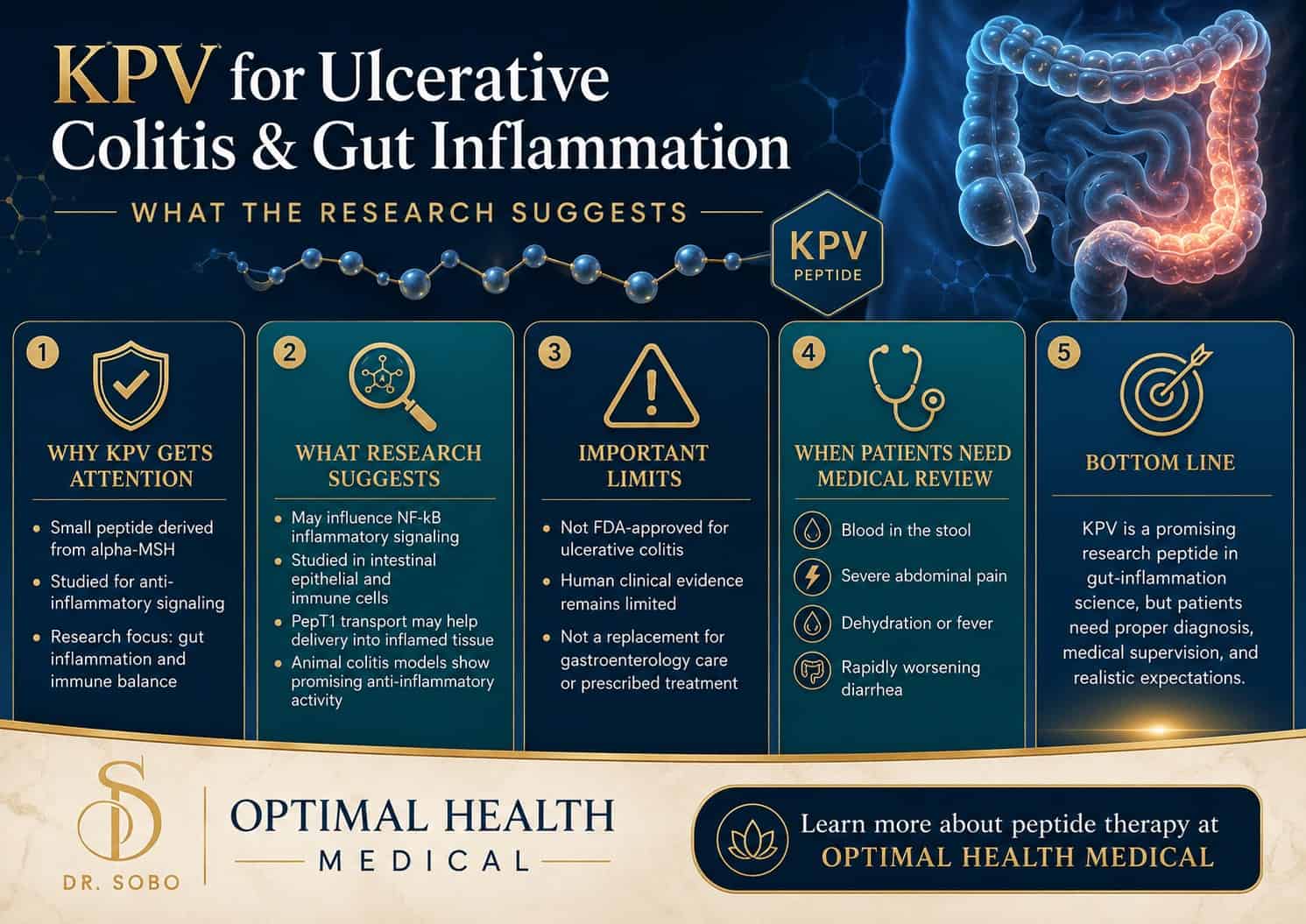
Why KPV Is Being Studied for Gut Inflammation
Gut inflammation involves communication between intestinal epithelial cells, immune cells, microbes, barrier integrity, cytokines, and inflammatory signaling pathways. In ulcerative colitis, the lining of the colon becomes inflamed and ulcerated. This can disrupt barrier function, increase immune activation, and perpetuate symptoms.
KPV has attracted research interest because it appears to affect inflammatory pathways that are relevant to gut inflammation. One major pathway discussed in the literature is NF-kappaB, a transcription factor that helps regulate inflammatory gene expression. When NF-kappaB signaling is activated, cells can increase production of inflammatory mediators such as cytokines and chemokines.
Research suggests KPV may interfere with inflammatory signaling in intestinal epithelial and immune cells. This does not mean it has been proven to treat ulcerative colitis in real-world patients. It means the mechanism is biologically plausible and worthy of continued study.
The PepT1 Connection: Why Delivery Matters
One of the most important gut-specific concepts in KPV research is PepT1, also known as peptide transporter 1. PepT1 is a transporter that helps move small peptides across intestinal cells. It is normally most active in the small intestine, but research has shown that it may be expressed in the colon during inflammatory bowel disease.
This matters because KPV is a tripeptide. If inflamed intestinal tissue expresses more peptide transport activity, researchers can study whether KPV may enter relevant cells more efficiently in inflammatory states. A key Gastroenterology study investigated PepT1-mediated KPV uptake and reported anti-inflammatory effects in intestinal epithelial cells, immune cells, and mouse models of colitis.
For patients, the takeaway is not that KPV is automatically absorbed, targeted, or clinically effective. The takeaway is that delivery is one of the central scientific questions. A peptide can look promising in a dish or animal model, but patient outcomes depend on formulation, route of administration, stability, dose, timing, disease severity, and safety.
What the Preclinical KPV Research Suggests
The strongest KPV gut-inflammation research is preclinical. That means it has been conducted in laboratory cells, animal models, and formulation studies rather than large human ulcerative colitis trials.
Preclinical studies have suggested that KPV may reduce inflammatory signaling in intestinal epithelial cells and immune cells. Mouse models of chemically induced colitis have also been used to study whether KPV can influence inflammation severity. These models are useful for understanding mechanisms, but they do not perfectly replicate human ulcerative colitis.
More recent research has explored targeted delivery systems, including nanoparticle strategies designed to improve localization to inflamed gut tissue. These studies are scientifically interesting because they address a major real-world challenge: how to deliver a peptide to the right place in the gastrointestinal tract without losing stability or causing unintended effects.
The pattern across the research is encouraging but incomplete. KPV appears to have a plausible anti-inflammatory mechanism in preclinical gut models, but the field still needs stronger human evidence before it can be described as a proven ulcerative colitis therapy.
What the Research Does Not Prove Yet
It is important to be direct about the limits of the evidence. KPV research does not currently prove that KPV can induce remission in ulcerative colitis patients. It does not establish a standard human dose. It does not define the best route of administration for ulcerative colitis. It does not replace colonoscopy, gastroenterology care, or proven therapies for moderate to severe inflammatory bowel disease.
Patients should be especially careful with claims that make KPV sound like a guaranteed solution for ulcerative colitis, Crohn’s disease, leaky gut, autoimmune disease, histamine intolerance, or mast cell symptoms. A biologically interesting peptide can still require years of clinical research before it becomes a standard patient treatment.
The right language is: KPV is being studied for anti-inflammatory effects relevant to gut inflammation. The wrong language is: KPV cures ulcerative colitis or replaces conventional treatment.
KPV vs. Standard Ulcerative Colitis Treatment
Standard ulcerative colitis treatment is guided by disease severity, symptom burden, endoscopic findings, inflammatory markers, prior response, and complication risk. Many therapies used in ulcerative colitis have human clinical trial data, safety monitoring frameworks, and formal guideline recommendations.
KPV does not belong in the same category at this time. It is an emerging research peptide rather than an established ulcerative colitis medication. Patients should not stop prescribed therapies, delay gastroenterology follow-up, or avoid needed evaluation because they read about KPV online.
A better comparison is to view KPV as a research topic that may help scientists understand localized anti-inflammatory signaling, peptide transport, and future drug-delivery approaches. It may eventually inform new treatment strategies, but that is different from being ready to replace current care.
KPV Research: Practical Interpretation for Patients
| Research Finding | What It May Suggest | What Patients Should Not Assume |
|---|---|---|
| KPV may reduce inflammatory signaling in cell models | There may be a biologically plausible anti-inflammatory mechanism | That it has proven symptom benefits in ulcerative colitis patients |
| PepT1 may help transport KPV in inflamed intestinal tissue | Delivery to gut cells is a key research direction | That any oral KPV product will reach the colon effectively |
| Animal colitis models show anti-inflammatory effects | KPV is worth continued research in gut inflammation | That animal results equal human remission outcomes |
| Nanoparticle delivery systems are being studied | Formulation may be critical for future applications | That all routes or products are equivalent |
| KPV is derived from alpha-MSH biology | It may share anti-inflammatory signaling properties | That it has the same evidence base as approved UC therapies |
Where KPV May Fit in a Functional Medicine Conversation
Patients with gut inflammation often want a broader plan than medication alone. They may ask about nutrition, food triggers, stress, sleep, micronutrients, histamine patterns, mast cell symptoms, microbiome health, and peptides. Those questions can be appropriate, but they should be organized around diagnosis and safety first.
Dr. Sobo provides a whole-person approach that can help patients think through gut health in a structured way. That may include symptom timeline, medication review, supplement review, diet patterns, prior testing, inflammatory markers, sleep and stress patterns, and whether the patient is already under the care of a gastroenterologist.
For ulcerative colitis, functional medicine support should complement, not replace, evidence-based gastroenterology care. A patient with active bleeding, severe diarrhea, fever, anemia, dehydration, or worsening abdominal pain needs medical evaluation, not experimentation.
Questions Patients Should Ask Before Considering KPV
Patients who are interested in KPV should start with practical questions. What diagnosis has been confirmed? Is inflammation currently active? What testing has been done? What medications are being used? What symptoms are changing? Has a gastroenterologist been involved? Are there red flags that need urgent evaluation?
Specific questions may include: Is my diagnosis ulcerative colitis, Crohn’s disease, microscopic colitis, irritable bowel syndrome, infection, food intolerance, medication side effect, or another issue? Are my symptoms stable or worsening? Do I need stool testing, blood work, colonoscopy, or imaging? Am I missing a proven therapy that should come first?
Only after those questions are addressed does it make sense to discuss emerging peptide research. KPV should be considered within a medically supervised conversation, especially for patients with inflammatory bowel disease or immune-related symptoms.
How Medical Supervision Protects Patients
Medical supervision matters because gut symptoms can be misleading. Diarrhea, cramping, urgency, fatigue, bloating, and food sensitivity can come from many different causes. Treating the wrong problem can delay appropriate care.
A supervised process helps clarify whether the patient needs diagnostic evaluation, medication adjustment, nutrition support, hydration strategies, anemia screening, inflammatory marker testing, or referral back to gastroenterology. It also helps prevent patients from stacking multiple therapies without understanding interactions, side effects, or the limits of the evidence.
The goal is not to dismiss emerging peptide science. The goal is to place it in the right order: diagnosis first, safety first, proven care first, then careful discussion of emerging options when appropriate.
When Gut Symptoms Need Prompt Medical Attention
Patients with ulcerative colitis or suspected inflammatory bowel disease should not wait if symptoms are severe or rapidly worsening. Prompt medical attention is important for significant rectal bleeding, black stools, fever, persistent vomiting, dehydration, severe abdominal pain, fainting, rapid weight loss, severe weakness, or inability to keep fluids down.
Patients should also contact their healthcare team if they are having more frequent stools, nighttime diarrhea, worsening urgency, new blood, medication side effects, or signs that a flare may be developing. Early communication can help prevent complications and reduce the risk of delayed treatment.
The Bottom Line on KPV for Ulcerative Colitis
KPV is one of the more interesting peptides in gut-inflammation research because it connects alpha-MSH biology, NF-kappaB inflammatory signaling, PepT1 peptide transport, and colitis models. The science is promising enough to deserve attention, especially for patients who are trying to understand the future of inflammation-targeted peptide research.
But the current evidence does not support presenting KPV as a proven ulcerative colitis treatment. Patients should not use KPV as a substitute for diagnosis, gastroenterology care, medication management, flare monitoring, or proven therapies. The safest approach is to discuss KPV within a medically guided framework that respects both the potential of emerging research and the seriousness of inflammatory bowel disease.
If you are dealing with gut inflammation, ulcerative colitis symptoms, or questions about peptide therapy, Dr. Sobo can help you think through your options, understand the research, and decide what should be evaluated first.
Schedule a Peptide and Gut Health Consultation
If you are interested in peptide therapy, gut inflammation support, or a broader functional medicine approach, a consultation can help clarify the safest next step. Dr. Sobo can review your health history, symptoms, medications, prior testing, nutrition patterns, and treatment goals while helping you understand what is currently supported by research and what remains investigational.
Learn more about peptide therapy, integrative medicine, and new patient care.
How Patients Can Track Gut Inflammation More Safely
Patients often want to know whether a gut-focused peptide is “working,” but symptom changes alone can be misleading. Some symptoms improve temporarily because of diet changes, stress reduction, hydration, sleep, or natural fluctuation in disease activity. Other patients may feel better while inflammation remains active. That is why ulcerative colitis care often relies on objective information in addition to symptom reports.
A safer tracking plan may include stool frequency, urgency, visible blood, abdominal pain, fatigue, appetite, weight changes, hydration status, medication changes, and side effects. Depending on the patient, clinicians may also review blood counts, inflammatory markers, nutrient status, stool studies, fecal calprotectin, colonoscopy findings, or communication from the gastroenterologist. These details help separate general digestive discomfort from active inflammatory bowel disease.
If a patient is asking about KPV because symptoms are worsening, the first step should be to evaluate the flare risk and rule out urgent issues. Peptide research should not distract from needed medical care. The more specific the patient’s symptom history and testing history, the more useful the conversation can be.
KPV, Gut Barrier Function, and Immune Balance
One reason KPV is interesting in gut research is that ulcerative colitis is not only an “inflammation problem.” It also involves the intestinal barrier, immune signaling, epithelial repair, and communication between the gut lining and the immune system. When the barrier is irritated or disrupted, immune activation can become more intense, and symptoms may become harder to control.
KPV research is often discussed in relation to mucosal inflammation because it may influence inflammatory signaling within epithelial and immune cells. Delivery-system studies are also important because they focus on how an anti-inflammatory peptide might be directed toward inflamed intestinal tissue. This is a key distinction for patients: the concept is not simply “take a peptide for gut symptoms.” The scientific question is whether the right form, route, dose, and delivery strategy can influence inflammation in a clinically meaningful way.
That is why current KPV research should be viewed as a foundation for future investigation, not a finished clinical answer. Patients with ulcerative colitis need a plan that addresses diagnosis, inflammation severity, nutrition, medication response, relapse prevention, cancer-surveillance recommendations when applicable, and quality of life. KPV may be part of an emerging research conversation, but it cannot replace that larger framework.
Why This Topic Matters for Patients Hearing About KPV Online
KPV is exactly the kind of topic that can be oversimplified online. A patient may see a statement such as “KPV reduces inflammation” and assume it applies directly to their ulcerative colitis flare. The responsible interpretation is more careful: KPV has shown anti-inflammatory activity in research models that are relevant to gut inflammation, but human ulcerative colitis care requires diagnosis-specific decision-making and monitoring.
This distinction protects patients from two opposite mistakes. The first mistake is dismissing all emerging peptide research as meaningless. The second mistake is treating early-stage research as if it were established medical care. A balanced approach allows patients to learn from the science without stepping outside appropriate medical guidance.
For patients, the most productive next step is not to memorize peptide mechanisms. It is to bring informed questions to a qualified clinician: What is driving my symptoms? Is inflammation active? Are my current therapies controlling the disease? What markers should we monitor? What supportive strategies are reasonable? What remains investigational? That kind of conversation is where KPV research can be discussed responsibly.
FAQs About KPV for Ulcerative Colitis and Gut Inflammation
What is KPV?
KPV is a three-amino-acid peptide sequence, lysine-proline-valine, derived from the C-terminal portion of alpha-melanocyte-stimulating hormone. It is studied for anti-inflammatory activity in cell, animal, and gut-inflammation research models.
Is KPV approved for ulcerative colitis?
No. KPV is not an FDA-approved treatment for ulcerative colitis. It should be discussed as an emerging research peptide, not as a proven replacement for gastroenterology care or prescribed ulcerative colitis medication.
Why is KPV being studied for gut inflammation?
KPV is being studied because it may reduce inflammatory signaling in intestinal epithelial and immune cells. Research has also focused on PepT1, a peptide transporter that may be expressed in the colon during inflammatory bowel disease.
Does KPV cure ulcerative colitis?
No. Current evidence does not show that KPV cures ulcerative colitis. Research is promising at the preclinical level, but large human clinical trials are still needed before KPV can be described as a proven ulcerative colitis therapy.
What is PepT1 and why does it matter?
PepT1 is a peptide transporter that helps move small peptides across intestinal cells. Research suggests PepT1 may be expressed in inflamed colon tissue, which makes it an important delivery-related concept in KPV gut-inflammation research.
Can KPV replace my current ulcerative colitis medication?
No. Patients should not stop prescribed ulcerative colitis treatment or delay gastroenterology care because of KPV research. Medication changes should always be discussed with the treating clinician.
What symptoms should prompt medical evaluation?
Rectal bleeding, severe abdominal pain, fever, dehydration, persistent vomiting, rapid weight loss, black stools, fainting, or rapidly worsening diarrhea should prompt medical evaluation. Patients with known ulcerative colitis should also contact their care team if a flare appears to be worsening.
Is KPV the same as BPC-157?
No. KPV and BPC-157 are different peptides with different research backgrounds and proposed mechanisms. KPV is mainly discussed for anti-inflammatory signaling, while BPC-157 is often discussed in relation to tissue repair and healing research.
Who should be cautious about KPV?
Anyone with active inflammatory bowel disease, unexplained gut symptoms, immune conditions, multiple medications, pregnancy considerations, or a history of severe gastrointestinal symptoms should be cautious and seek medical guidance before considering peptide-related options.
How can Dr. Sobo help with KPV questions?
Dr. Sobo can help patients understand what KPV research suggests, what remains unproven, what symptoms or testing should be evaluated first, and how peptide-related questions may fit into a broader medically supervised plan.
Sources
- Gastroenterology: PepT1-Mediated Tripeptide KPV Uptake Reduces Intestinal Inflammation
- Frontiers in Pharmacology: PepT1-Targeted Nanodrug Based on Co-Assembly of Anti-Inflammatory Peptide and Immunosuppressant for Colitis
- Alpha-MSH Related Peptides: A New Class of Anti-Inflammatory and Immunomodulating Drugs
- NIDDK: Ulcerative Colitis
- Crohn’s & Colitis Foundation: Ulcerative Colitis Treatment Options
- American College of Gastroenterology: Updated 2025 Guidelines to Manage Adult Ulcerative Colitis

Medically reviewed by