By Dr. Henry Sobo, MD – Medical Weight Loss, Functional & Hormone Therapy, Connecticut
IV Nutrition for Metabolic Repair: How Infusions Support Weight Loss
What Is IV Nutrition?
Many patients find themselves in a frustrating cycle: adhering strictly to diet and exercise protocols, yet seeing the scale plateau. This disconnect often signals that the issue isn’t just caloric intake; it’s foundational metabolic inefficiency.
At our Stamford practice, we view weight management through a metabolic lens. When cellular machinery lacks the necessary fuel, metabolism stalls. IV (intravenous) nutrition therapy is a powerful clinical tool designed to bridge this gap, delivering essential nutrients directly to the cells to repair metabolic pathways and support sustainable weight loss efforts.
It is important to state clearly: IV nutrient therapy is not a “magic bullet” that replaces diet and exercise. It is an advanced adjunct therapy designed to optimize the body’s physiological terrain so that diet and exercise can work effectively.
The Weight Loss Roadblock: Nutrient Deficiency and Metabolic Stalling
A common misconception is that overweight individuals are over-nourished. Clinically, the opposite is often true. Many patients struggle with sub-clinical nutrient deficiencies that hinder metabolic processes.
Modern agricultural practices have depleted soil nutrients, and processed foods offer little nutritional value. Furthermore, chronic stress, inflammation, and gut health issues (like malabsorption or leaky gut) severely limit the body’s ability to absorb nutrients from oral food or supplements.
When the body lacks essential cofactors—such as specific B vitamins, magnesium, or amino acids—the mitochondria (the cellular “power plants”) cannot efficiently convert fats and glucose into usable energy (ATP). The result is a sluggish metabolism, fatigue, and a body resistant to weight loss.
The Mechanism: How IV Nutrition for Metabolic Repair “Repairs” Metabolism
IV nutrition therapy addresses metabolic stalling by fundamentally changing how nutrients are delivered to the body.
Bypassing the Digestive System for Cellular Bioavailability
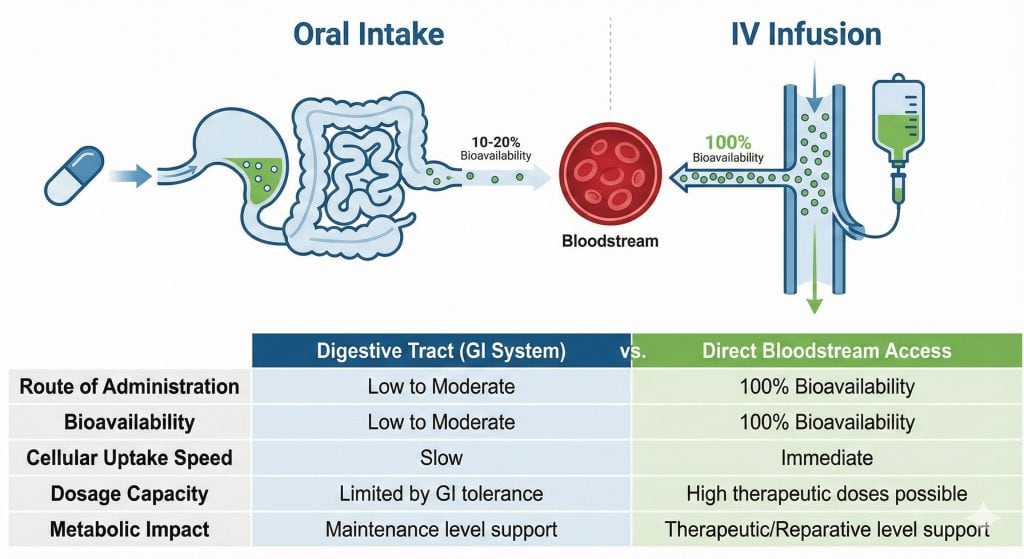
When you take an oral supplement, it must navigate the harsh environment of the digestive tract. Stomach acid, digestive enzymes, and liver filtration (first-pass metabolism) significantly reduce the amount of the nutrient that actually reaches the bloodstream. For some nutrients, oral bioavailability can be as low as 10-20%.
IV infusions bypass the digestive system entirely. Nutrients are delivered directly into the bloodstream. This achieves 100% bioavailability, flooding the cells with immediate access to the cofactors required to restart stalled metabolic engines. This therapeutic dosage level is often impossible to achieve through oral supplementation without causing gastrointestinal distress.
Key IV Ingredients Targeted for Metabolic Support
While IV Nutrition for Metabolic Repair protocols are customized to the individual, several key compounds are frequently utilized for metabolic repair and weight management support.
NAD+ (Nicotinamide Adenine Dinucleotide)
NAD+ is perhaps the most critical coenzyme for metabolic function. It exists in every living cell and is essential for mitochondrial health and ATP (energy) production. NAD+ levels naturally decline with age and stress.
IV NAD+ therapy replenishes these levels directly. By optimizing mitochondrial function, NAD+ helps the cells more efficiently convert macronutrients into energy rather than storing them as fat. It is known for improving cellular resilience and energy levels essential for maintaining activity during weight loss programs.
Lipotropic Compounds (MIC and Carnitine)
“Lipotropic” literally means “fat-stimulating.” These are compounds that assist the liver in processing fats and preventing excessive fat buildup in the liver.
MIC (Methionine, Inositol, Choline): A blend of amino acids and nutrients that support liver function and aid in the breakdown and metabolism of fats.
L-Carnitine: An amino acid derivative that transports long-chain fatty acids into the mitochondria to be burned for energy. Without sufficient carnitine, fatty acids have difficulty entering the cellular furnaces to be utilized as fuel.
Ready to Start a Plan That Works?
If you’have questions about IV Nutrition for Metabolic Repair in Stamford Connecticut, Greenwich, or Norwalk area, contact us today. We focus on combining safe, effective medication with a realistic lifestyle plan.
For broader options, see our Medical Weight Loss Services.
Comparison: IV Therapy vs. Oral Supplements for Metabolism
To understand the clinical advantage of IV therapy for metabolic repair, it is helpful to compare it directly with standard oral supplementation.
| Feature | Oral Supplements | IV Nutrition Therapy |
| Route of Administration | Digestive Tract (GI System) | Direct Bloodstream Access |
| Bioavailability | Low to Moderate (Variable due to gut health/age) | 100% Bioavailability |
| Cellular Uptake Speed | Slow (Requires digestion and transport) | Immediate |
| Dosage Capacity | Limited by GI tolerance (e.g., high dose Vitamin C causes upset) | High therapeutic doses possible |
| Metabolic Impact | Maintenance level support | Therapeutic/Reparative level support |
Dr. Sobo’s Approach: Integrating IVs into a Comprehensive Plan
IV nutrition is most effective when integrated into a broader medical strategy. In our Stamford, CT office, we do not offer “menu-based” IVs for casual use.
Our process begins with a comprehensive evaluation of the patient’s metabolic health, often including lab work to identify specific nutrient deficiencies, hormonal imbalances, or inflammatory markers. If metabolic inefficiency is identified as a roadblock to weight loss, a tailored series of IV infusions may be recommended to restore cellular reserves.
For patients in Fairfield County, IV therapy serves as a foundational step to repair metabolism, increase energy for movement, and maximize the results of dietary changes.
Frequently Asked Questions
How often are IV infusions needed for weight loss support?
Frequency depends heavily on the patient’s baseline deficiency status and goals. A typical metabolic repair protocol might involve weekly infusions for 4-6 weeks to build cellular reserves, followed by less frequent maintenance sessions. This is determined clinically.
Will I lose weight just by getting IV infusions?
No. IV therapy is not a fat-burning procedure itself. It is a metabolic support tool. It repairs the cellular machinery so that your diet and exercise efforts actually yield results. It makes your body’s engine run more efficiently.
Are IV infusions safe?
When administered by qualified medical professionals after a proper health review, IV nutrient therapy is generally considered safe. We use high-quality, compounded nutrients in a sterile clinical setting.
Where can I get metabolic repair IV therapy in Stamford, CT?
Dr. Sobo offers customized IV nutrition and metabolic repair protocols at his medical office in Stamford, CT. Serving patients throughout Fairfield County and Greenwich, our practice integrates advanced nutrient therapy with comprehensive medical weight loss strategies to address the root causes of metabolic stalling.
Sources
On Bioavailability (IV vs. Oral):
Source: The Journal of Parenteral and Enteral Nutrition
Article: Bioavailability of Intravenous vs. Oral Micronutrients (Explains the 100% absorption rate of IV administration).
On NAD+ and Metabolic Health:
Source: Cell Metabolism / National Institutes of Health (PMC)
Article: NAD+ Metabolism and Cardiometabolic Health: The Human Evidence (Discusses how NAD+ levels decline with obesity and age, and the metabolic benefits of replenishment).
On L-Carnitine and Fat Oxidation:
Source: PubMed (National Library of Medicine)
Article: L-Carnitine Supplementation and Weight Loss in Healthy Volunteers (A clinical trial exploring the role of L-carnitine in fatty acid transport and weight management).
On Nutrient Deficiencies and Metabolism:
Source: The American Journal of Clinical Nutrition
Article: Micronutrient Deficiencies and Their Impact on Metabolic Syndrome (Provides the scientific basis for how vitamin deficiencies can impair weight loss).
Official Standards for Compounding:
Source: U.S. Food & Drug Administration (FDA)
Article: Current Good Manufacturing Practice (cGMP) Regulations (Verifies the quality standards for sterile processing of IV nutrients).
Read more our posts...
GLP-1 Microdosing: Evidence, Risks, and What “Low Dose” Really Means
Evidence review date: September 6, 2026. GLP-1 microdosing has attracted substantial consumer and telehealth interest, but direct clinical-trial evidence remains limited. Medication approvals, prescribing information, safety communications, and clinical evidence
Wegovy HD vs. Zepbound: How 7.2 mg Semaglutide and Tirzepatide Compare
Wegovy HD vs. Zepbound is a more complicated comparison than simply placing two weight-loss percentages side by side. Wegovy HD contains semaglutide and uses a higher 7.2 mg once-weekly dose
GLP-1 Weight Loss Plateau: Why It Happens
Hitting a GLP-1 weight loss plateau can be frustrating. A patient may have been losing weight consistently with semaglutide, tirzepatide, nutrition changes, increased activity, and medical follow-up—then suddenly the scale