
How to Verify a Compounded GLP-1 Prescription: Pharmacy Label, Dose, and Safety Checklist
GLP-1 medications have changed the way many patients think about weight loss, appetite control, blood sugar, metabolic health, and long-term disease prevention. Medications such as semaglutide and tirzepatide have created real interest because they may help appropriate patients reduce appetite, improve satiety, and lose weight when used as part of a medically supervised plan.
That interest has also created a practical question for patients: if a clinician recommends a compounded GLP-1 prescription, how can the patient verify that the medication, label, dose instructions, pharmacy source, and follow-up plan look legitimate?
This guide is designed to answer that question. It does not treat all compounding pharmacies as unsafe. Dr. Sobo supports properly licensed compounding pharmacies when they are used appropriately through physician-supervised care. Compounding pharmacies are pharmacies. They are regulated by their states and must follow quality-control procedures. The patient safety issue is not legitimate pharmacy care. The safety issue is using a product without knowing whether it was legally prescribed, properly labeled, accurately dosed, and medically supervised.
For patients considering GLP-1 weight loss, medical weight loss, semaglutide, or tirzepatide, the safest question is not only, “Where did this medication come from?” A better question is: “Can I clearly verify the prescription, pharmacy, label, dose, instructions, and medical follow-up before I use it?”
Patients in Stamford, Greenwich, Fairfield County, and throughout Connecticut can call 203-348-8805 to discuss medically supervised weight loss options with Dr. Sobo.
Quick Answer: How to Verify a Compounded GLP-1 Prescription
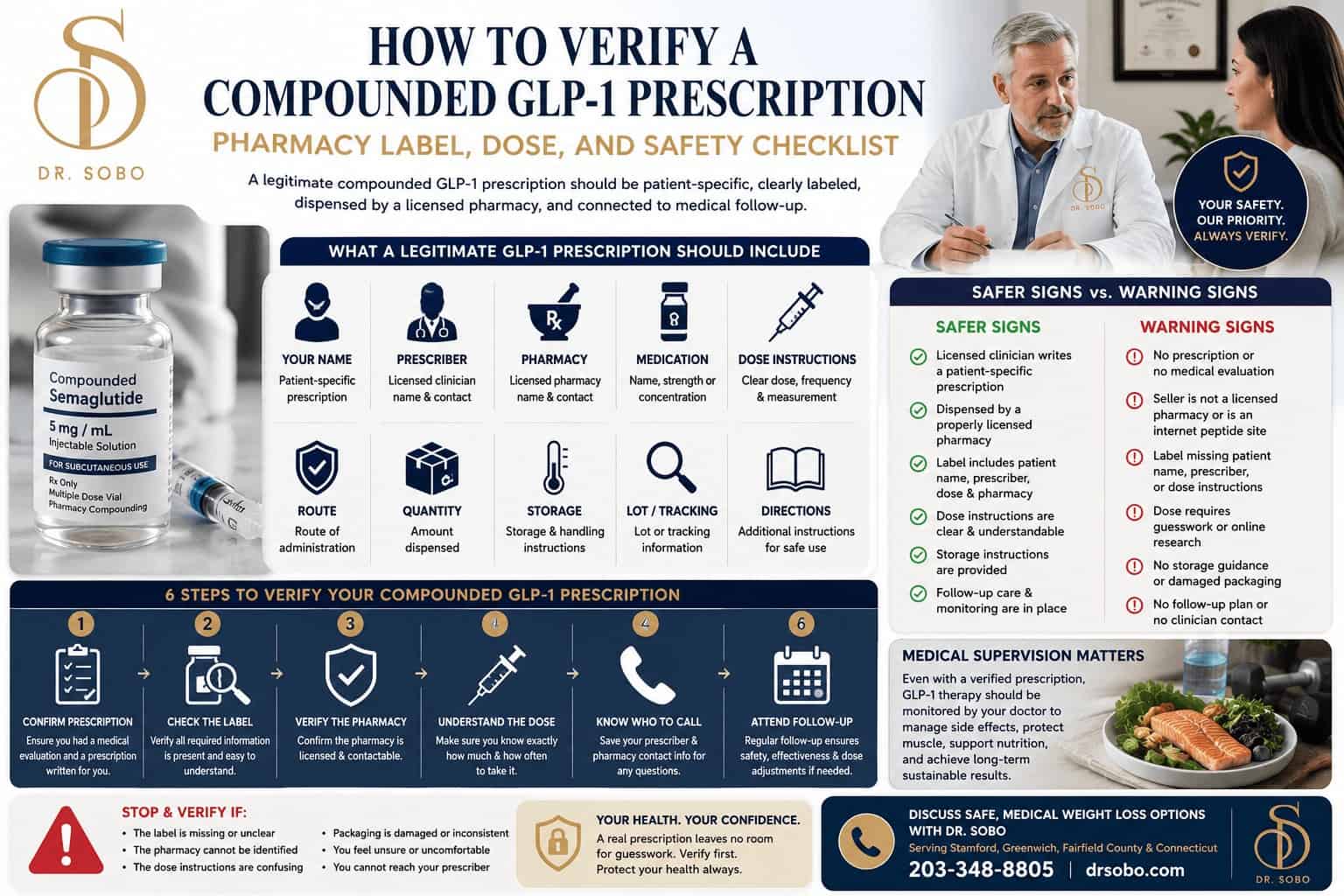
A compounded GLP-1 prescription should be patient-specific, prescribed by a qualified clinician, dispensed by a properly licensed pharmacy, clearly labeled, and connected to follow-up medical care. A patient should be able to identify the patient name, prescriber name, pharmacy name, medication, strength or concentration, dose instructions, route of administration, quantity, storage instructions, and beyond-use or expiration date.
If the product does not clearly identify the patient, prescriber, pharmacy, dose, and directions, the patient should pause before using it. The patient should contact the prescribing clinician or pharmacy for clarification rather than guessing, copying another person’s dose, or relying on online instructions.
The simplest rule is this: a legitimate prescription should look like a real prescription. It should not feel like a mystery vial, an unlabeled product, or a product that requires the patient to figure out medical dosing alone.
Who Should Read This Guide?
This guide is for patients who are researching GLP-1 medications, compounded semaglutide, compounded tirzepatide, or medical weight loss options and want a practical way to evaluate a prescription before using it. It is especially important for patients who have questions about pharmacy labels, vial concentrations, dose instructions, medication packaging, side effects, or how to confirm that the medication came through a legitimate medical process.
It is also useful for patients who have already received a compounded GLP-1 prescription and want to know what should be on the label, what questions to ask the pharmacy, and when to contact the doctor before injecting or continuing treatment.
Why GLP-1 Prescription Verification Matters
GLP-1 medications can affect appetite, digestion, hydration, blood sugar, body composition, medication tolerance, and nutritional intake. That means verification is not a minor administrative detail. It is part of patient safety.
A patient using a GLP-1 medication should know what medication they have, how much to take, how often to take it, what side effects to watch for, who prescribed it, which pharmacy dispensed it, how it should be stored, and who to contact if symptoms or dosing questions arise.
Confusion can happen when patients receive non-standard concentrations, multi-dose vials, syringes, unclear directions, or instructions written in unfamiliar units. Dose clarity is especially important because patients may confuse milligrams, milliliters, and syringe units. A dose should never require guesswork.
What a Legitimate GLP-1 Prescription Label Should Include
A legitimate compounded GLP-1 prescription should include enough information for the patient, clinician, and pharmacy to identify the medication and use it safely. The label should be patient-specific and clear.
Patients should look for the following items on the label or accompanying documentation:
- Patient name
- Prescribing clinician name
- Pharmacy name and contact information
- Medication name
- Medication strength or concentration
- Dose instructions
- Route of administration
- Quantity dispensed
- Storage instructions when relevant
- Beyond-use date or expiration information
- Lot or tracking information when applicable
- Proper packaging information
- Instructions for questions or follow-up
The label should not be vague. A patient should not need to search online or watch a video to understand the intended dose. If the label is incomplete or confusing, the patient should call the prescribing office or pharmacy before using the medication.
Compounded GLP-1 Verification Table: Safer Signs vs. Warning Signs
| What to Check | Safer Sign | Warning Sign |
|---|---|---|
| Prescription | A licensed clinician evaluates the patient and writes a patient-specific prescription. | No prescription or no meaningful medical evaluation. |
| Pharmacy | The medication is dispensed by a properly licensed pharmacy. | The seller does not clearly identify a pharmacy or appears to be a peptide website. |
| Label | The label includes the patient name, prescriber, medication, dose, and pharmacy information. | The vial has no patient name, no clinician name, unclear dose information, or vague directions. |
| Dose instructions | Dose instructions are clear and understandable. | The patient must guess between milligrams, milliliters, units, or internet dosing instructions. |
| Storage | Storage and handling instructions are provided when relevant. | No storage instructions are included, or the packaging is inconsistent with the medication requirements. |
| Monitoring | The patient has follow-up for side effects, dose adjustments, nutrition, hydration, and progress. | No follow-up, no clinician contact, and no clear plan for side effects. |
How to Verify the Pharmacy
Patients should know which pharmacy dispensed the medication. A legitimate prescription should identify the pharmacy clearly enough that the patient can contact it with questions. The pharmacy name, phone number, and location or identifying information should not be hidden or difficult to find.
Patients can also ask whether the pharmacy is properly licensed and whether the prescription was prepared for them specifically. If a patient cannot identify the pharmacy, cannot reach the pharmacy, or receives only vague company branding with no clear dispensing information, that is a reason to pause and ask questions before using the medication.
This does not mean patients should distrust legitimate compounding pharmacies. It means they should verify that the pharmacy is real, identifiable, and connected to their actual prescription.
Why Patient-Specific Labeling Matters
Patient-specific labeling is one of the clearest differences between a real prescription and an unclear product. A prescription should be prepared for a specific person based on a clinician’s evaluation and treatment plan.
When a label includes the patient’s name, prescriber, pharmacy, and dose, it creates accountability. The patient can confirm that the medication was intended for them, that the dose matches the plan, and that the pharmacy and clinician can answer questions.
If the vial or package does not include patient-specific information, the patient should not assume it is appropriate for use. The next step should be a call to the prescribing office or pharmacy.
Why the Prescribing Clinician’s Name Matters
The prescribing clinician’s name matters because it confirms that a licensed medical professional is responsible for the treatment plan. GLP-1 therapy should not be separated from medical decision-making.
A clinician should review the patient’s medical history, current medications, diabetes risk, kidney function, liver markers, gastrointestinal symptoms, gallbladder history, thyroid history, pregnancy considerations, appetite symptoms, and long-term goals before recommending treatment.
If no clinician is identified, the patient may not know who selected the medication, who determined the dose, or who should be contacted if side effects occur.
How Dose Instructions Should Be Written
Dose instructions should be written in a way the patient can understand. This is especially important when a compounded medication is dispensed in a vial and the patient uses a syringe. Confusion can happen when labels include a concentration but the patient is not sure how that concentration translates into the syringe amount.
A clear plan should tell the patient the intended dose, how often it is taken, when or whether the dose changes, and who to call before making any adjustment. Patients should not change doses based on social media, online charts, or another person’s prescription.
If instructions mention units, milligrams, milliliters, or concentration in a way that feels unclear, the patient should stop and ask for clarification before using the medication.
What Proper Packaging Should Include
Packaging should support safe handling and use. Depending on the medication and formulation, the packaging may include refrigeration instructions, storage guidance, supplies, labeling, patient instructions, and a way to contact the pharmacy or prescribing office.
Patients should be cautious if a medication arrives with no clear pharmacy label, no storage guidance, no identifiable source, damaged packaging, unclear instructions, or conflicting information. The patient should not try to solve those problems alone.
When medication packaging creates uncertainty, the safest next step is to contact the prescribing clinician or pharmacy before using it.
What to Do If the Label Is Missing or Unclear
If the label is missing or unclear, do not guess. Do not inject the medication based on a social media post, an online dosing chart, or advice from someone using a different concentration.
Patients should save the packaging, medication container, receipt, and any instructions that came with it. Then they should contact the prescribing clinician or pharmacy and ask for written clarification. If the pharmacy or clinician cannot be identified, that is a serious concern.
Patients should also seek medical guidance promptly if they have already used a product and experience severe nausea, vomiting, abdominal pain, dehydration, dizziness, low blood sugar symptoms, fainting, or confusion about dosing.
GLP-1 Prescription Verification Checklist
| Question to Confirm | Why It Matters |
|---|---|
| Does the label include my name? | Confirms the medication was prepared for the patient. |
| Does the label include the prescribing clinician? | Confirms medical accountability and a point of contact. |
| Does the label identify the pharmacy? | Confirms the medication came from an identifiable dispensing pharmacy. |
| Is the medication name clear? | Helps prevent confusion about what the patient received. |
| Is the strength or concentration listed? | Allows the clinician and pharmacy to confirm the dose correctly. |
| Are dose instructions clear? | Reduces the risk of dosing errors. |
| Are storage instructions included? | Helps protect medication quality when storage matters. |
| Do I know who to call with questions? | Ensures the patient is not managing side effects or dosing alone. |
| Do I have follow-up scheduled? | Supports safety, dose adjustment, side-effect management, and long-term results. |
Questions to Ask Before Using a Compounded GLP-1 Prescription
Before starting a compounded GLP-1 prescription, patients should feel comfortable asking direct questions. These questions are not confrontational. They are part of safe medical care.
- Which medication am I receiving?
- What is the exact dose?
- How often should I take it?
- How do I measure the dose correctly?
- When should I increase or hold the dose?
- What side effects should I watch for?
- What should I do if I have nausea, vomiting, constipation, reflux, or fatigue?
- How should I store the medication?
- Who do I call if the label or instructions are unclear?
- How will we protect muscle mass during weight loss?
- What is my follow-up schedule?
- What is the long-term maintenance plan?
A patient who cannot get clear answers should not proceed by guessing.
Why Medical Supervision Still Matters After the Prescription Is Verified
Verifying the prescription is only the first step. GLP-1 therapy should be monitored because patient needs can change during treatment. Appetite may drop quickly. Constipation may develop. Reflux may worsen. Hydration may decrease. Protein intake may fall. Muscle loss may become a concern. Blood sugar may change, especially in patients taking diabetes medications.
A doctor-supervised program can monitor weight trend, waist circumference, appetite, food noise, side effects, hydration, bowel function, protein intake, resistance training, blood pressure, blood sugar markers, liver markers, kidney function, cholesterol, triglycerides, and long-term maintenance planning.
Dr. Sobo’s approach to medical weight loss focuses on physician-guided care, patient safety, and sustainable results rather than medication access alone.
Why Muscle, Nutrition, and Hydration Are Part of Verification
Many patients think medication safety means only confirming that the medication came from a legitimate source. That is essential, but it is not the whole picture.
GLP-1 medications reduce appetite. For some patients, that can be helpful. For others, appetite suppression may become strong enough that the patient eats too little, skips protein, drinks less fluid, or avoids fiber and nutrient-dense foods. This can contribute to fatigue, constipation, dizziness, dehydration, muscle loss, weakness, and difficulty maintaining results.
A safe plan should help patients lose weight in a way that protects function. That means protein, strength, hydration, sleep, digestion, and long-term nutrition all matter.
How This Guide Fits With Other GLP-1 Safety Content
Dr. Sobo’s website already includes broader discussions of GLP-1 misinformation, peptide safety, medication handling, and medical supervision. This guide is intentionally more specific. Its purpose is to help patients verify a compounded GLP-1 prescription by reviewing the pharmacy label, dose instructions, packaging, and follow-up plan before use.
Patients who want a broader discussion of online claims can also read Dr. Sobo’s guide to GLP-1 myths and social media misinformation. Patients who want to understand body composition concerns can read Dr. Sobo’s article on GLP-1 weight loss and muscle loss.
When to Call the Doctor or Pharmacy Before Using the Medication
Patients should call the prescribing doctor or pharmacy before using a compounded GLP-1 prescription if the label is missing, the dose is unclear, the concentration is confusing, the patient name is missing, the prescriber name is missing, the pharmacy cannot be identified, the product arrived damaged, the storage instructions are unclear, or the patient is unsure how to measure the dose.
Patients should also contact a clinician if they experience persistent vomiting, severe abdominal pain, signs of dehydration, severe constipation, worsening reflux, dizziness, fainting, low blood sugar symptoms, rapid weakness, inability to eat enough protein, or confusion after taking the medication.
Side effects should not be managed by guesswork. A physician can help determine whether the dose should be adjusted, paused, slowed, or changed.
Final Thoughts
Verifying a compounded GLP-1 prescription is not about creating fear. It is about helping patients use medication responsibly when it is part of a physician-guided plan.
A properly prescribed compounded medication from a licensed pharmacy may have a role in medical care when it is legal, patient-specific, clearly labeled, and physician supervised. Patients should be able to identify the patient name, prescriber, pharmacy, medication, dose, directions, storage instructions, and follow-up plan before using it.
The safest approach is a physician-guided plan that evaluates the patient’s health history, identifies the right treatment option, confirms the medication source, explains the dose, monitors side effects, protects muscle, and plans for long-term maintenance.
Patients in Stamford, Greenwich, Fairfield County, and throughout Connecticut can call 203-348-8805 to discuss whether GLP-1 therapy, semaglutide, tirzepatide, or another medically supervised weight-loss option may be appropriate.
FAQs About Verifying a Compounded GLP-1 Prescription
How do I verify a compounded GLP-1 prescription?
Verify that the prescription includes your name, the prescribing clinician’s name, the dispensing pharmacy, medication name, strength or concentration, dose instructions, route of administration, quantity, storage instructions, and beyond-use or expiration date. You should also know who to call if you have questions. If any of this information is missing or confusing, contact the prescribing clinician or pharmacy before using the medication.
What should be on a compounded GLP-1 prescription label?
A compounded GLP-1 prescription label should include the patient’s name, medication name, strength or concentration, dose instructions, route of administration, pharmacy name, prescribing clinician’s name, quantity dispensed, beyond-use date or expiration information, and storage instructions when relevant. The patient should not have to guess how much to take or rely on online instructions to understand dosing.
Does Dr. Sobo support compounding pharmacies?
Yes. Dr. Sobo supports properly licensed compounding pharmacies when they are used appropriately through physician-supervised care. Compounding pharmacies are pharmacies. They are regulated by their states and must follow quality-control procedures. The important issue is making sure the medication is legally prescribed, patient-specific, clearly labeled, dispensed by a legitimate pharmacy, and medically monitored.
Are compounded GLP-1 medications illegal?
Compounded medications are not automatically illegal. Properly licensed compounding pharmacies may prepare patient-specific medications when legally permitted and prescribed by a qualified clinician. The concern is not legitimate compounding pharmacies as a category. The concern is with products sold outside proper medical and pharmacy channels, especially products without prescriptions, patient-specific labels, clinician oversight, or pharmacy accountability.
Why does the prescribing clinician’s name matter?
The prescribing clinician’s name confirms that a qualified medical professional is responsible for the treatment plan. GLP-1 therapy should be based on a medical evaluation, not guesswork. If no clinician is identified, the patient may not know who selected the medication, who determined the dose, or who should be contacted if side effects or dosing questions occur.
What should I do if my GLP-1 label is unclear?
Do not guess. Do not inject the medication based on social media, online dosing charts, or another patient’s instructions. Save the packaging and label, then contact the prescribing clinician or pharmacy for clarification. If the pharmacy or clinician cannot be identified, do not use the product until you receive medical guidance.
Why is GLP-1 dosing easy to misunderstand?
GLP-1 dosing can be confusing when patients receive vials, syringes, or non-standard concentrations. Patients may confuse milligrams, milliliters, and syringe units. The prescription should clearly explain the dose and how to measure it. If the dose instructions are unclear, the patient should contact the clinician or pharmacy before using the medication.
What should I do if I already used a GLP-1 product and I am unsure about the source?
Save the packaging, label, receipt, and any instructions, then contact a qualified clinician or pharmacist. If you experience severe nausea, vomiting, abdominal pain, dehydration, dizziness, low blood sugar symptoms, fainting, or confusion about dosing, seek medical advice promptly. Do not continue dosing based on uncertainty.
Why does medical supervision matter with GLP-1 therapy?
Medical supervision matters because GLP-1 therapy can affect appetite, digestion, blood sugar, hydration, body composition, nutrition, and medication tolerance. A doctor can evaluate whether treatment is appropriate, select a dose strategy, monitor side effects, review labs, adjust the plan, protect muscle mass, and help build a long-term maintenance strategy.
Where can I discuss safe GLP-1 weight loss in Connecticut?
Patients in Stamford, Greenwich, Fairfield County, and throughout Connecticut can schedule a medical weight loss consultation with Dr. Sobo to discuss GLP-1 therapy, semaglutide, tirzepatide, medication verification, and physician-supervised weight loss options. Treatment should be based on a personalized medical evaluation. Call 203-348-8805 to discuss whether medical weight loss may be appropriate.
Sources
- FDA — Concerns With Unapproved GLP-1 Drugs Used for Weight Loss
- FDA — Policies for Compounders as National GLP-1 Supply Stabilizes
- FDA — Proposed Exclusion of Semaglutide, Tirzepatide, and Liraglutide From the 503B Bulks List
- FDA — Green List to Protect Americans From Illegal Imported GLP-1 Drug Ingredients
- Dr. Sobo — Medical Weight Loss
- Dr. Sobo — GLP-1 Weight Loss
- Dr. Sobo — Semaglutide
- Dr. Sobo — Tirzepatide
- Dr. Sobo — GLP-1 Myths vs. Facts: What Social Media Gets Wrong
- Dr. Sobo — GLP-1 Weight Loss and Muscle Loss

Medically reviewed by
Dr. Henry C. Sobo, M.D.
Founder of Optimal Health Medical and physician specializing in holistic, integrative, and medical weight loss care.