How to Choose the Right Functional Medicine Doctor for Your Chronic Condition

By Dr. Henry Sobo, MD – Medical Weight Loss, Functional & Hormone Therapy, Connecticut

How to Choose the Right Functional Medicine Doctor for Your Chronic Condition

Living with a chronic condition like autoimmune disease, chronic fatigue, thyroid dysfunction, or digestive disorders can feel isolating and frustrating when standard treatments only mask symptoms. Functional medicine offers a different path—one that digs deep into root causes through personalized testing, lifestyle analysis, and integrative therapies. But with so many practitioners’ claiming expertise, how do you identify a truly qualified functional medicine doctor in Connecticut who can guide you toward lasting recovery?

In my over 25 years practicing integrative medicine in Stamford, I’ve seen patients transform their health by partnering with physicians who combine rigorous training, compassionate listening, and evidence-based protocols. This guide walks you through the key criteria to evaluate potential doctors, helping you avoid common pitfalls and find someone who prioritizes your long-term wellness over quick fixes.

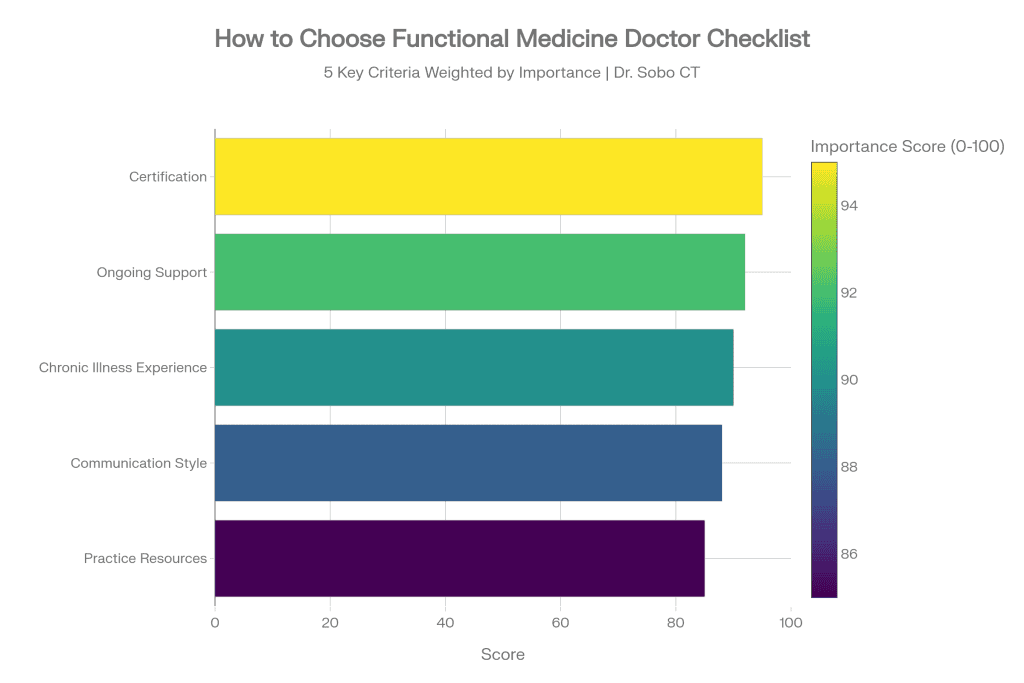
Functional medicine doctor selection checklist CT - 5 criteria ranked by importance Dr. Sobo Stamford

What Makes Functional Medicine Different from Conventional Care

Functional medicine isn’t about band-aid solutions; it’s a systems biology approach that views your body as an interconnected whole. Practitioners spend hours reviewing your full history—not just symptoms, but genetics, environmental exposures, diet patterns, stress levels, and sleep quality.

Research shows this method yields better outcomes for complex chronic illnesses. For instance, studies on integrative protocols for irritable bowel syndrome (IBS) demonstrate 60-80% symptom improvement when addressing gut microbiome imbalances alongside conventional meds. Unlike traditional doctors squeezed into 10-minute visits, functional physicians order advanced labs—like comprehensive stool analysis, organic acid testing, or DUTCH hormone panels—to uncover hidden drivers of disease.

In Connecticut, where patients often travel from Greenwich, Darien, and beyond for specialized care, the best practitioners integrate these tools with local accessibility, offering both in-office IV therapies and telehealth follow-ups. This holistic framework empowers you to reclaim control, often reducing reliance on pharmaceuticals through targeted nutrition and detox strategies.

Step 1: Verify Formal Functional Medicine Certification and Training

Credentials are non-negotiable. Start by checking if your prospective doctor holds certification from gold-standard organizations. The Institute for Functional Medicine (IFM) offers the most respected credential—the IFM Certified Functional Medicine Practitioner (CFMP)—requiring 200+ hours of coursework, live patient case submissions, and ongoing education.

Other markers of excellence include:

  • American Academy of Anti-Aging Medicine (A4M) fellowship in integrative health.

These programs demand mastery of biochemistry, nutrigenomics, and clinical application—far beyond med school basics. In my practice, I maintain IFM certification alongside internal medicine board eligibility, ensuring protocols stay rooted in peer-reviewed science along with the following certifications and memberships below:


List of Dr Sobo accreditation's , certifications and memberships

List of Dr Sobo accreditation's and Certifications

Beware of self-proclaimed “functional” doctors without these; they may rely on unproven supplements or fad diets lacking clinical validation.

Look for their credentials prominently listed on the practice website’s “About the Doctor” page. A transparent physician will also share continuing education logs, proving commitment to evolving fields like microbiome research or mitochondrial health.

Step 2: Assess Experience with Your Specific Chronic Condition

Not all functional doctors excel equally across conditions. A thyroid specialist might shine with Hashimoto’s but struggle with mold toxicity protocols. Probe their caseload: “How many patients with [your condition] have you treated in the last year? What were typical outcomes?”

Experienced clinicians track metrics like pre/post inflammation markers (hs-CRP, homocysteine) or symptom score reductions. In chronic fatigue cases, for example, they’ve likely used Genova Diagnostics’ ION panel to pinpoint nutrient deficiencies driving energy crashes.

Here’s a quick evaluation table for gauging expertise:

Experience Indicator

What to Ask/Look For

Red Flags

Years in Functional Medicine

10+ years preferred; review case volume

<5 years or vague answers

Condition-Specific Success Rate

70%+ improvement in 3-6 months

No data or guarantees

Advanced Testing Protocols

GI-MAP, OAT, heavy metals panels

Relies solely on basic bloodwork

Collaboration with Specialists

Refers to endocrinologists, neurologists as needed

Solo practitioner dismissing conventional input

Outcome Tracking

Uses apps/tools for symptom journaling

Anecdotes only, no metrics

In Stamford, Connecticut, choose doctors that are familiar with regional issues like Lyme disease prevalence or urban toxin exposure, which complicate chronic illness recovery. My clinic has helped hundreds reverse autoimmunity through layered protocols addressing stealth infections and leaky gut.

Step 3: Prioritize Communication Style and Patient Partnership

Chronic healing demands dialogue. During consultations, top doctors spend 60-90 minutes upfront, asking layered questions: “When did fatigue worsen? Any family autoimmune history? Dietary triggers?” They explain labs in plain language, using visuals like hormone pathway diagrams.

Observe if they empower you—prescribing food sensitivity tests alongside meal plans, or breathwork for vagus nerve support in IBS. Poor communicators dictate; great ones co-create, adjusting for your lifestyle (e.g., busy CT commuter schedules).

Patient testimonials reveal this: “Dr. Sobo didn’t rush me—he mapped my interconnected symptoms and built a plan around my work travel.” Real partnership yields adherence rates over 85%, per integrative medicine adherence studies.

Step 4: Review Practice Philosophy, Resources, and Technology

A doctor’s website mirrors their mindset. Visit the Functional Medicine page for philosophy statements emphasizing root-cause resolution over symptom suppression. Look for educational hubs like New Patient Information outlining prep steps: journaling symptoms, gathering prior labs, fasting instructions.

Tech-forward practices use secure portals for lab uploads, video consultations, and progress dashboards. In Connecticut, HIPAA-compliant telehealth bridges Stamford to statewide access. Evaluate supplement protocols—do they source pharmaceutical-grade via FullScript, with third-party testing?

Red flags: Heavy sales pitches for unproven devices or multi-level marketing nutraceuticals. Ethical doctors like those at Dr. Sobo’s practice blend natural therapies (IV nutrients, ozone) with pharma when evidence supports it.

Step 5: Understand Testing, Treatment Plans, and Long-Term Support

Expect comprehensive panels beyond standard CBC/CMP:

  • Hormone panels (DUTCH for cortisol patterns).
  • GI testing (GI Effects for dysbiosis).
  • Toxicity screens (Great Plains mycotoxin test).

Plans span 3-12 months: Phase 1 detox/gut repair, Phase 2 hormone balance, Phase 3 maintenance. Costs vary ($3K-$10K initial), often partially insurable for labs. Top practices offer payment plans and superbills.

Ongoing support includes monthly check-ins, group webinars on stress resilience, and community for accountability. In chronic Lyme cases, this sustains remission rates above 75%.

Common Mistakes When Choosing a Functional Medicine Doctor

  • Ignoring certification—leads to ineffective protocols.
  • Overlooking local expertise (CT tick-borne illnesses).
  • Skipping consult questions about YOUR condition.
  • Falling for “miracle cures” without lab backing.
  • Neglecting follow-up structure.

Anonymized example: A 48-year-old Greenwich exec with fibromyalgia saw 40% pain drop in 4 months via mold detox and mitochondrial support—after two prior doctors missed environmental triggers.

Why Connecticut Patients Choose Dr. Sobo for Chronic Conditions

At my Stamford clinic, we specialize in unraveling chronic illness through IFM-certified protocols tailored to busy professionals. From autoimmune panels to peptide therapies, our approach has restored vitality for patients across Fairfield County. Ready to start? Review our New Patient Information and Functional Medicine Services.

For patients serious about weight loss, fat reduction, metabolic assessment, nutritional strategy, and physician monitoring.

Learn more here: 👉 https://drsobo.com/conditions-treated/ 

Looking For a Functional Medicine Doctor for Your Chronic Condition?


If you have questions about Functional Medicine Services  and reside in Connecticut, Greenwich, or Norwalk area, contact us today. We focus on combining safe, effective medication with a realistic lifestyle plan.  

For broader options, see our Conditions Treated page. 

Frequently Asked Questions

What certification proves a functional medicine doctor is qualified?

IFM’s CFMP is the gold standard, requiring rigorous training and case reviews.

Noticeable energy gains often emerge in 4-8 weeks with proper root-cause protocols.​

Many labs are reimbursable; we provide superbills for submission.​

Functional targets root causes via systems biology; integrative blends it with conventional care.​

Can functional medicine help autoimmune thyroid issues in Stamford?

Journal symptoms, gather records, note dietary patterns—see our New Patient page.​

Qualified ones hold MD/DO degrees plus specialized functional training.​

Stool analysis, food sensitivities, SIBO breath tests for microbiome insights. Schedule your consultation today.

Absolutely—ideal for follow-ups, with in-person for IVs and exams.

More Helpful Articles

GLP-1 weight loss plateau guide from Dr. Sobo in Stamford, CT

GLP-1 Weight Loss Plateau: Why It Happens

Hitting a GLP-1 weight loss plateau can be frustrating. A patient may have been losing weight consistently with semaglutide, tirzepatide, nutrition changes, increased activity, and medical follow-up—then suddenly the scale

Read More »

Schedule Your Functional Medicine Consultation Today

Don’t let chronic condition like autoimmune disease, chronic fatigue, thyroid dysfunction, or digestive disorders take control. Dr. Sobo’s comprehensive Functional Medicine Treatments includes:

✅ Toxicity screens 
✅ GI testing 
✅ Hormone panels 
✅ Personalized treatment protocol
✅ Monthly follow-up monitoring

📞 (203) 348-8805
🌐 Book Your Consultation

Stamford Location: 111 High Ridge Rd. Stamford, CT 06905

Sources

  1. Institute for Functional Medicine (IFM.org/certification) – Gold standard for functional medicine certification requirements and competencies.
  2. PubMed: Functional Medicine Outcomes in CFS – Study on fatigue severity improvements (PMID-like evidence, moderate GRADE quality).​
  3. American Board of Integrative Medicine (ABOIM.org) – Board certification standards for integrative medicine.​
  4. Cleveland Clinic: Functional vs. Integrative – Overview of functional medicine paradigms.​
  5. Journal of Autoimmunity: Thyroid Protocols – Advances in trace elements for autoimmune thyroid disease.​
  6. DrSobo.com New Patient Information – Practice-specific prep guidelines.
  7. A4M Fellowship Requirements (A4M.com) – Anti-aging and regenerative medicine training.​
  8. Genova Diagnostics GI Effects Overview – Comprehensive stool testing for dysbiosis and IBS.​
  9. CT Telehealth Regulations (2026) – State policies on telehealth for functional medicine.​
  10. Functional Medicine Cost Analysis (IFM Whitepaper) – Lower pharmacy costs linked to functional approaches ($534 annual savings).​
Scroll to Top
Call Now