
Hitting a GLP-1 weight loss plateau can be frustrating. A patient may have been losing weight consistently with semaglutide, tirzepatide, nutrition changes, increased activity, and medical follow-up—then suddenly the scale barely moves.
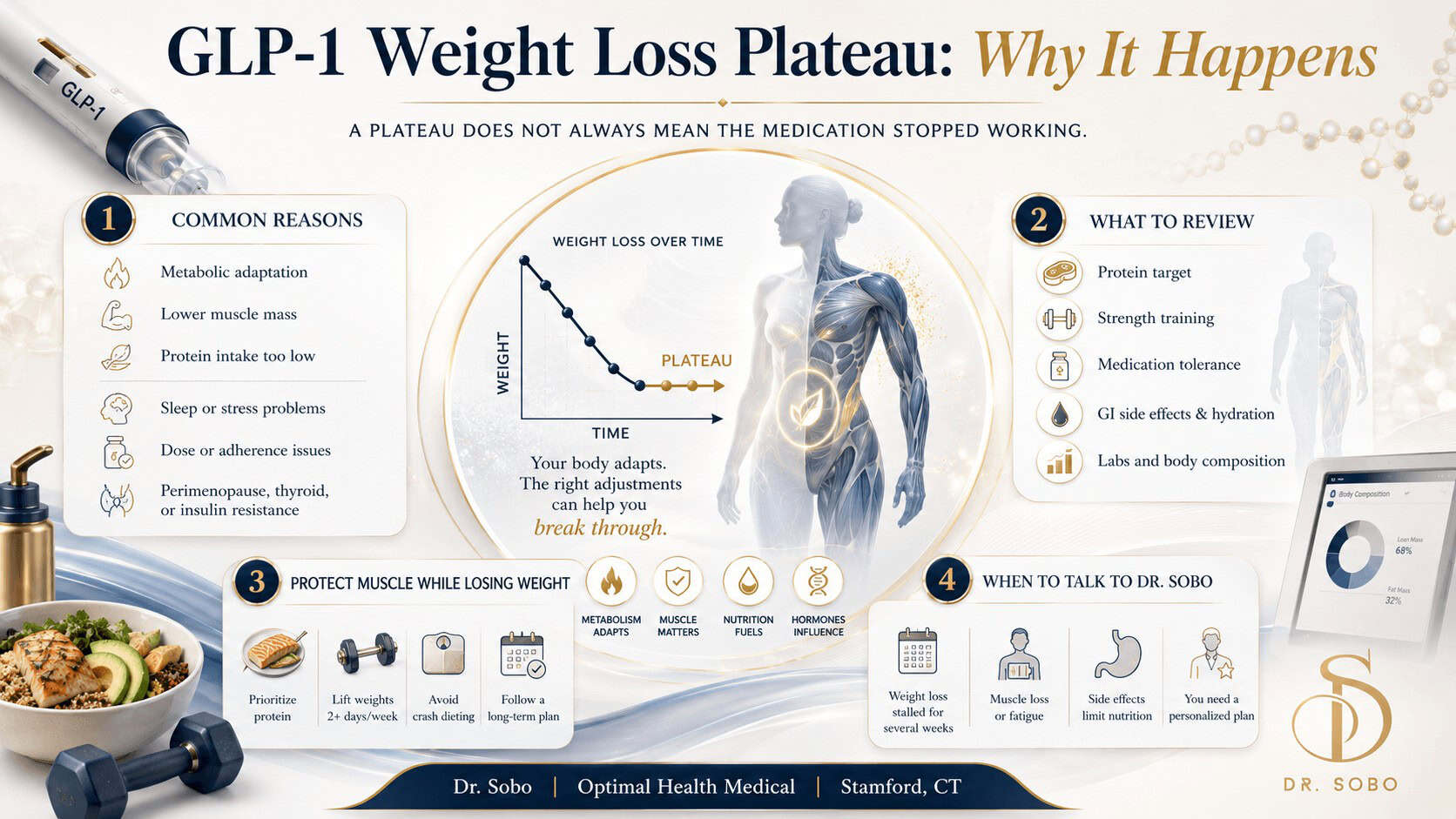
That does not automatically mean the medication has stopped working. Weight loss naturally changes over time as body weight falls, energy needs decrease, appetite changes, activity shifts, and the body adapts. Constipation, fluid changes, inadequate protein, loss of lean mass, poor sleep, medication side effects, hormonal factors, and other medical issues can also make progress appear slower than it really is.
The important question is therefore not simply, “How do I make the scale move again?” A better question is: “Why has my weight loss slowed, and what part of my treatment plan should be reviewed?”
At Optimal Health Medical in Stamford, Connecticut, Dr. Henry C. Sobo, M.D. evaluates GLP-1 treatment as part of a broader medical weight-management plan that can include nutrition, muscle preservation, metabolic health, medication tolerance, laboratory testing when appropriate, and long-term maintenance.
Patients considering or currently using these medications can also learn more about GLP-1 weight loss in Connecticut, medical weight loss, semaglutide, and tirzepatide.
Quick Answer: What is a GLP-1 weight loss plateau?
A GLP-1 weight loss plateau is a period when body weight stops declining or declines much more slowly after an earlier period of weight loss. It does not necessarily mean semaglutide, tirzepatide, or another prescribed weight-management treatment has failed. As body weight decreases, calorie needs change and biological adaptations can slow further loss. A physician may also review nutrition, protein intake, lean mass, physical activity, constipation, medication tolerance, sleep, medical conditions, laboratory findings, and whether the patient is moving into a maintenance phase.
Evidence status — updated August 30, 2026
Weight plateaus have been observed during long-term anti-obesity medication trials. In the STEP 5 trial, mean weight loss with semaglutide 2.4 mg leveled off at approximately week 60 and was largely maintained through 104 weeks. A later post-hoc analysis of the SURMOUNT-1 and SURMOUNT-4 trials found that most tirzepatide-treated participants in the analysis had reached a defined weight plateau by week 72. These studies involved different trial designs and populations and do not establish superiority of one medication over another.
Does a GLP-1 Plateau Mean the Medication Stopped Working?
No. A weight plateau by itself does not prove that a GLP-1-based medication stopped working. The medication may still be affecting appetite, fullness, food intake, blood sugar or other metabolic measures even when body weight is temporarily stable.
Weight loss is also not perfectly linear. Daily and weekly scale readings can change because of hydration, sodium intake, bowel contents, menstrual-cycle changes, travel, inflammation, carbohydrate intake and other short-term factors. That is why one or two unchanged weigh-ins should not automatically trigger a medication change.
The longer-term trend matters more. A clinician may look at several weeks of weight measurements together with waist circumference, appetite, side effects, strength, body composition when available, activity, laboratory results and the patient’s overall health goals.
Clinical trials also demonstrate that slowing weight loss is expected during successful treatment. In the two-year STEP 5 trial of semaglutide 2.4 mg, average weight reduction eventually plateaued rather than continuing indefinitely. A plateau can therefore be part of the biological course of weight management rather than evidence of treatment failure.
Why Does Weight Loss Plateau on Semaglutide or Tirzepatide?
A semaglutide plateau or tirzepatide plateau can have more than one cause. Often several factors are occurring at the same time.
1. A Smaller Body Requires Less Energy
As a person loses weight, the body generally requires fewer calories to maintain its new size. Moving a smaller body also requires less energy. As a result, an eating and activity pattern that produced a substantial calorie deficit earlier in treatment may produce a smaller deficit later.
This is normal physiology. It occurs with many forms of weight loss, not only GLP-1-based treatment.
A physician-guided review may consider the patient’s current body weight, eating pattern, protein and fiber intake, beverages, alcohol, activity and weight trend rather than assuming that the medication simply needs to be increased.
2. The Body Adapts to Weight Loss
Weight regulation involves complex biological systems. During weight reduction, the body can adapt through changes in energy expenditure, appetite signaling, spontaneous movement and other mechanisms that tend to resist continued loss.
This biological adaptation helps explain why obesity is treated as a chronic medical condition rather than a temporary failure of willpower.
It also explains why a plateau should be approached strategically rather than by dramatically reducing food intake or copying another person’s dosing schedule.
3. Daily Movement May Decrease Without Being Obvious
Exercise is only one part of daily energy expenditure. Walking through the house, taking stairs, standing, shopping, doing household work and other routine movement all contribute.
Some people unconsciously move less while losing weight, particularly if they are eating less, feeling fatigued, experiencing nausea, or losing strength. A person may therefore maintain the same scheduled workouts but expend less energy during the rest of the day.
A plateau review may include steps, walking, resistance exercise, occupational activity and barriers such as fatigue, joint pain or deconditioning.
4. Lean Muscle May Be Declining
Weight loss is not automatically the same as fat loss. Some lean tissue can also be lost during calorie restriction and medication-assisted weight management.
Muscle matters because it supports strength, mobility, physical function, glucose metabolism and healthy aging. Patients who are eating very little protein or who stop resistance training because appetite and energy are low may be particularly concerned about preserving lean mass.
This does not mean every plateau is caused by muscle loss. It means body composition and strength can provide information that the scale alone cannot.
For a more detailed discussion, read GLP-1 weight loss and muscle loss.
5. Protein or Total Nutrition May Be Too Low
Strong appetite suppression can create an unexpected problem: the patient may have difficulty eating enough nutrient-dense food.
Someone may lose interest in meals, stop planning food carefully, eat only small snack portions, or choose whatever feels easiest when nausea or fullness is present. Over time, inadequate protein and overall nutrition can contribute to fatigue, weakness, reduced activity and concern about lean-mass loss.
There is no universal protein target that is appropriate for every patient. Requirements can vary with body size, age, kidney function, health conditions, activity and treatment goals. Protein planning should therefore be individualized rather than copied from a social-media recommendation.
6. Constipation or Fluid Changes May Hide Progress on the Scale
Gastrointestinal effects are among the common adverse effects associated with GLP-1-based medications, and constipation is listed in prescribing information for both Wegovy and Zepbound.
Constipation can temporarily increase scale weight or create the impression that fat loss has stopped. Fluid retention, sodium intake, menstrual-cycle changes and changes in carbohydrate intake can have a similar effect.
This is one reason a clinician may evaluate several weeks of averages, waist measurements and symptoms rather than treating a single number as definitive.
7. Side Effects May Be Disrupting the Plan
Nausea, vomiting, reflux, diarrhea, constipation or excessive fullness can interfere with hydration and nutrition. If a patient is barely able to eat or drink adequately, simply increasing the medication may not be the appropriate solution.
The prescribing clinician may instead need to review dose escalation, meal size, food choices, hydration, bowel function, other medications and the overall risk-benefit balance.
8. Sleep and Stress May Be Affecting Weight Management
Sleep duration, sleep apnea, irregular sleep schedules, chronic stress and fatigue can affect appetite, eating behavior, physical activity and metabolic health.
A persistent plateau may therefore warrant questions beyond calories and medication. A patient who sleeps poorly or has untreated sleep apnea may need that problem addressed as part of the weight-management plan.
9. Hormonal or Medical Factors May Need Review
Thyroid disease, menopause-related changes, diabetes, insulin resistance, certain medications and other medical conditions can influence weight or make weight management more complicated.
That does not mean every person experiencing a plateau needs extensive hormone testing. Testing should be based on symptoms, medical history, physical findings, medications and clinical judgment.
What Counts as a Real GLP-1 Weight Loss Plateau?
There is no single clinical definition used in every practice or study.
A few days without weight change is generally not enough to establish a meaningful plateau. Even a week can be influenced heavily by hydration and bowel patterns.
In a 2025 post-hoc analysis of SURMOUNT-1 and SURMOUNT-4, researchers used a specific research definition: less than 5% weight change over a 12-week interval and subsequent 12-week intervals. That definition was created for the analysis and should not be treated as a universal rule for individual patients.
In clinical practice, the more useful approach is often to evaluate the trajectory over time:
- Has weight actually been stable for several weeks?
- Is the trend based on comparable measurements?
- Has waist circumference changed?
- Has constipation increased?
- Has physical activity fallen?
- Has hunger or food noise returned?
- Is nutrition adequate?
- Has strength changed?
- Has medication adherence changed?
- Has the patient reached a medically appropriate maintenance weight?
GLP-1 Weight Loss Plateau Checklist
| Question to Review | Why It Matters | What May Be Reviewed |
|---|---|---|
| Has weight truly been stable for several weeks? | Short fluctuations can reflect fluid, bowel contents or normal scale variability. | Weekly averages, waist measurement and longer-term trend. |
| Has appetite or food noise returned? | Changes in hunger may affect portion size, snacking and adherence. | Medication use, meal structure, sleep, stress and appetite patterns. |
| Is protein intake adequate? | Inadequate protein can make preservation of muscle and strength more difficult. | Individualized protein goals and nutrient-dense meals. |
| Has daily movement declined? | Lower spontaneous activity can reduce daily energy expenditure. | Walking, steps, resistance exercise and activity barriers. |
| Are side effects limiting food or fluids? | Nausea, vomiting, reflux or constipation can interfere with nutrition and hydration. | Medication tolerance, dose escalation and symptom management. |
| Could constipation or fluid shifts be masking progress? | Scale weight does not measure fat alone. | Bowel pattern, hydration, waist circumference and weight averages. |
| Is the prescribed dose appropriate? | Higher dosing is not automatically better or appropriate. | Current prescription, response, tolerance, adherence and FDA-labeled dosing when applicable. |
| Are medical factors contributing? | Thyroid disease, sleep problems, diabetes, medications or other conditions may affect progress. | History, medication review, examination and targeted laboratory evaluation when clinically appropriate. |
| Has the patient reached maintenance? | Stable weight after meaningful loss can represent successful chronic weight management. | Long-term goals, metabolic health, body composition and maintenance planning. |
Should You Increase Your GLP-1 Dose When Weight Loss Stops?
Not automatically. A plateau alone is not a reason to self-increase semaglutide, tirzepatide or another prescription medication.
FDA-approved products have specific dose-escalation and maintenance instructions. Those instructions also differ by medication, indication and formulation. A prescribing clinician may consider the patient’s current dose, time at that dose, treatment response, side effects, medical history and whether the medication is being tolerated.
If nausea, vomiting, constipation, reflux, dehydration or inadequate nutrition are already significant, escalating the dose without medical guidance could worsen the problem.
Patients should never double a dose, shorten dosing intervals, copy another patient’s dose, or change medication concentration based on online advice.
Semaglutide vs. Tirzepatide: Does Plateau Timing Differ?
Clinical studies show that weight loss eventually slows with both treatment approaches, but the available studies should not be used to make a simple head-to-head plateau comparison.
| Treatment / Evidence | What Was Observed | Important Limitation |
|---|---|---|
| Semaglutide 2.4 mg — STEP 5 | Average weight loss plateaued at about week 60 and was maintained through week 104. | This describes the average trajectory in a clinical trial, not the expected plateau date for every individual. |
| Tirzepatide — SURMOUNT post-hoc plateau analysis | Most participants included in the analysis reached the study’s defined plateau by week 72. | This was a post-hoc analysis using a specific plateau definition and was not a head-to-head comparison with semaglutide. |
Tirzepatide is also more precisely described as a dual GIP/GLP-1 receptor agonist, whereas semaglutide is a GLP-1 receptor agonist. Patients and media often group the medications together under the general phrase “GLP-1 medications,” but their receptor activity is not identical.
Which medication is appropriate depends on the individual patient’s diagnosis, FDA-approved indication, medical history, contraindications, previous treatment response, side-effect profile, access and physician assessment.
Can Eating Too Little Contribute to a Plateau?
Extremely low intake is not the goal of medically supervised GLP-1 weight management.
When appetite becomes very low, some patients may unintentionally reduce protein, fiber, fluids and total nutrition too far. That can contribute to fatigue, weakness, constipation and lower physical activity. It may also make preservation of lean mass more difficult.
Therefore, “eat less” is not automatically the correct response when the scale stalls.
A better review considers:
- overall meal structure;
- protein intake;
- hydration;
- fiber and bowel function;
- nutrient density;
- strength and energy;
- medication side effects; and
- whether the current eating pattern is sustainable.
Why Muscle Preservation Matters During a GLP-1 Plateau
During weight loss, the goal should generally be to reduce excess adipose tissue while preserving as much healthy lean tissue and physical function as reasonably possible.
Muscle supports mobility, glucose disposal, strength and independence. This becomes especially important for adults in midlife and later life, where age-related muscle loss may already be occurring.
A physician-guided plan may therefore consider resistance training, protein intake, total nutrition and body composition rather than chasing the lowest possible scale number.
Adults are generally advised by the CDC to include muscle-strengthening activity on at least two days each week, although the appropriate type and intensity depend on the individual patient’s health and physical capabilities.
What Laboratory Tests Might Be Reviewed During a Plateau?
There is no single mandatory “GLP-1 plateau lab panel” that every patient needs.
Laboratory testing should be selected according to the patient’s symptoms, diagnosis, medications, medical history and risk factors. Depending on the situation, a physician may consider tests related to:
- blood glucose or hemoglobin A1C;
- thyroid function;
- kidney function;
- liver function;
- lipid levels;
- electrolytes when clinically indicated;
- nutrient status when deficiency is suspected; or
- other hormone or metabolic testing when symptoms and medical history support it.
Testing should answer a clinical question. More testing is not necessarily better testing.
What Patients Should Not Do During a GLP-1 Plateau
A stalled scale can tempt patients to make aggressive changes. Some of those changes can undermine treatment rather than improve it.
- Do not double the medication dose.
- Do not take doses closer together than prescribed.
- Do not copy dosing instructions from social media.
- Do not crash diet to force the scale downward.
- Do not allow protein and overall nutrition to become chronically inadequate.
- Do not ignore persistent vomiting, dehydration or severe gastrointestinal symptoms.
- Do not stop resistance activity solely because weight loss has slowed.
- Do not assume one unchanged week equals treatment failure.
- Do not switch medications without discussing the transition with the prescribing clinician.
- Do not assume maintenance is failure.
GLP-1 Plateau vs. Maintenance: They Are Not Always the Same Thing
A patient who has lost meaningful weight and then stabilized may not necessarily need to keep pushing the scale downward indefinitely.
There is an important difference between an unexplained plateau before health goals have been reached and a stable weight that represents an appropriate maintenance phase.
Obesity is a chronic disease, and clinical evidence shows that weight regain can occur after anti-obesity medication is withdrawn. In the STEP 1 extension, participants who stopped semaglutide after the treatment period regained a substantial portion of prior weight loss during the following year. In the SURMOUNT-4 randomized withdrawal trial, participants switched from tirzepatide to placebo regained weight on average, while participants who continued tirzepatide maintained and furthered their earlier reduction.
Those findings do not mean every patient must remain on the same medication indefinitely. They show why discontinuation, dose changes and maintenance should be planned rather than treated as an afterthought.
Read what happens after GLP-1 weight loss for a more detailed discussion of maintenance, muscle and long-term metabolic health.
FDA Status and Safety: What Patients Should Know
As of August 30, 2026, FDA-approved prescription products include Wegovy (semaglutide) and Zepbound (tirzepatide) for specific weight-management indications. Indications, formulations and dosing instructions differ, so patients should rely on the prescribing information applicable to their actual medication.
Wegovy and Zepbound carry boxed warnings concerning the risk of thyroid C-cell tumors observed in rodents. Both are contraindicated in patients with a personal or family history of medullary thyroid carcinoma or Multiple Endocrine Neoplasia syndrome type 2. Current prescribing information also addresses other clinically important warnings and precautions.
Patients should seek medical guidance promptly for significant or persistent adverse symptoms. Severe abdominal pain, repeated vomiting, inability to maintain hydration, signs of a serious allergic reaction, or other severe symptoms warrant medical evaluation.
In January 2026, the FDA announced that its review did not identify an increased risk of suicidal ideation or behavior associated with GLP-1 receptor agonist medications and requested removal of that warning language from affected product labeling. This illustrates why older articles and online medication advice can become outdated and why current prescribing information matters.
Compounded medication note: A compounded preparation is not FDA-approved simply because its active ingredient is also found in an FDA-approved drug. Dr. Sobo and Optimal Health Medical may use compounding pharmacies when clinically appropriate. Patients should obtain compounded medications through physician-guided care and an appropriately licensed pharmacy rather than online research-peptide sellers, unverified vendors, or products supplied without clear prescribing, pharmacy, identity, dosing, storage and follow-up information.
Can You Switch From Semaglutide to Tirzepatide After a Plateau?
Some patients may be candidates for a medication change, but a plateau alone does not establish that switching is necessary.
A physician may first review:
- how long the plateau has lasted;
- the current medication and dose;
- adherence;
- appetite and food noise;
- side effects;
- constipation and hydration;
- protein and overall nutrition;
- weight and waist trends;
- physical activity and strength;
- relevant laboratory findings;
- medical history and contraindications;
- insurance, cost and access; and
- long-term treatment goals.
If a switch is appropriate, the transition should be directed by the prescribing clinician. Semaglutide and tirzepatide are not dose-for-dose equivalents.
How Dr. Sobo Evaluates a GLP-1 Weight Loss Plateau
At Optimal Health Medical, the goal of evaluating a plateau is not simply to force faster weight loss. It is to determine whether treatment remains medically appropriate and whether the overall plan supports long-term health.
Depending on the patient, Dr. Sobo may review:
- starting weight and current weight trajectory;
- waist circumference or body composition when useful;
- prescribed medication and dose history;
- appetite and food-noise changes;
- side effects and gastrointestinal tolerance;
- protein and nutrition patterns;
- hydration and bowel function;
- walking, daily movement and resistance training;
- sleep and stress;
- other medications that may affect weight;
- thyroid, glucose, liver, kidney or other laboratory markers when clinically appropriate; and
- whether the patient should continue active loss or transition toward maintenance.
This approach is especially relevant for patients who want more than a prescription-only weight-loss program. The scale is one outcome. Strength, nutrition, metabolic health, medication safety and the ability to maintain results also matter.
When Should You Contact Your Doctor During a Plateau?
Contact the prescribing clinician if the plateau is persistent and you are unsure whether your medication, nutrition or activity plan should change.
Medical review is particularly important when weight changes are accompanied by:
- persistent or severe nausea or vomiting;
- difficulty drinking enough fluids;
- significant constipation;
- worsening reflux or inability to eat normally;
- dizziness or weakness;
- symptoms of low blood sugar, particularly when other glucose-lowering medications are used;
- substantial loss of strength;
- unexplained fatigue;
- severe or persistent abdominal pain;
- confusion about the dose or concentration; or
- a plan to stop, restart or switch medication.
Urgent or severe symptoms should not wait for a routine weight-loss follow-up appointment.
GLP-1 Weight Loss Plateau Care in Stamford, Connecticut
Patients in Stamford, Greenwich, Fairfield County and surrounding Connecticut communities may benefit from medical evaluation when weight loss has stalled, medication side effects are interfering with nutrition, muscle preservation has become a concern, or the long-term treatment plan is unclear.
Dr. Sobo provides physician-guided GLP-1 weight-loss care through Optimal Health Medical in Stamford, CT. Treatment is individualized according to medical history, weight-management goals, medication response and clinical appropriateness.
Patients can also review Dr. Sobo’s medical weight-loss program for a broader explanation of physician-supervised weight management.
Has Your GLP-1 Weight Loss Stalled?
A plateau can be a reason to review the plan—not a reason to guess at your next dose. Dr. Sobo can evaluate weight trends, medication tolerance, nutrition, muscle preservation, metabolic factors and long-term goals.
Frequently Asked Questions About GLP-1 Weight Loss Plateaus
How long does a GLP-1 weight loss plateau last?
There is no universal duration. A brief period without scale movement may reflect normal fluid, sodium, bowel or hormonal fluctuations rather than a true plateau. A longer period of stable weight may justify review of nutrition, protein intake, physical activity, medication use, side effects, constipation, sleep, medical factors and overall treatment goals. Clinical trials show that average weight loss eventually slows during successful long-term treatment, so a plateau does not automatically indicate medication failure.
Does a plateau mean semaglutide stopped working?
No. A semaglutide plateau does not automatically mean the medication stopped working. Appetite, fullness, portion control and metabolic measures may still be improved even when the scale has stabilized. In the STEP 5 trial, average weight reduction with semaglutide eventually plateaued and was then largely maintained through two years of treatment. Individual patients should have their longer-term weight trend, medication tolerance, nutrition and clinical goals reviewed before changing treatment.
Does a plateau mean tirzepatide stopped working?
No. Weight loss eventually slows for many patients using tirzepatide as well. A 2025 analysis of SURMOUNT clinical-trial data specifically evaluated time to weight plateau and found that most participants included in the analysis had reached the study-defined plateau by week 72. That reflects an expected treatment trajectory in many patients, not proof that tirzepatide suddenly became inactive. Individual response and next steps should be assessed clinically.
Should my GLP-1 dose be increased if I hit a plateau?
Not automatically. Dose decisions should follow the prescribing plan and be individualized by the clinician. Before increasing a dose, the doctor may review how long weight has been stable, appetite, medication adherence, side effects, constipation, hydration, protein intake, activity, medical history and whether the patient is already at an appropriate maintenance dose. Self-increasing or shortening the interval between doses can create unnecessary risk.
Can constipation make it look like GLP-1 weight loss has stopped?
Yes. Constipation can temporarily affect scale weight, and constipation is a recognized gastrointestinal adverse effect of GLP-1-based weight-management medications. Fluid retention, sodium intake and normal digestive changes can also mask fat loss. A physician may consider bowel patterns, hydration, weekly weight averages, waist circumference and symptoms before deciding that a true treatment plateau has occurred.
Can eating too little cause problems during a GLP-1 plateau?
Yes. Severe or prolonged under-eating can contribute to fatigue, weakness, reduced physical activity, constipation, inadequate protein intake and concern about loss of lean mass. GLP-1 treatment is intended to support medically appropriate weight management, not starvation. When appetite becomes extremely low, the solution is not automatically greater restriction. Nutrition quality, protein, hydration and medication tolerance should be reviewed.
How much protein should I eat while using a GLP-1 medication?
There is no single protein number that is appropriate for every patient. Protein needs depend on factors such as body size, age, kidney function, health conditions, exercise, current nutrition and body-composition goals. Because GLP-1-based medications can substantially reduce appetite, some patients need more deliberate meal planning to maintain adequate protein. A physician or qualified nutrition professional can help establish an individualized target.
Why am I losing inches but not pounds on a GLP-1 medication?
Body weight can remain stable while waist circumference, fluid balance or body composition changes. Scale weight includes fat, lean tissue, water and gastrointestinal contents, so it cannot identify what component changed. If clothing fits differently or waist measurements are decreasing despite a stable scale, the clinician may review the longer trend, body composition when useful, strength, nutrition and metabolic health rather than judging progress from body weight alone.
Can I switch from semaglutide to tirzepatide if I plateau?
Some patients may be appropriate candidates for switching medications, but plateauing alone does not prove that a switch is needed. The prescribing clinician may review dose, adherence, appetite, side effects, weight trajectory, nutrition, activity, laboratory findings, medical history and treatment goals before recommending a change. Semaglutide and tirzepatide have different pharmacology and dosing and should not be treated as interchangeable dose-for-dose.
What labs should be checked if my GLP-1 weight loss has stalled?
There is no universal laboratory panel for a GLP-1 plateau. Testing should be based on the patient’s medical history and symptoms. Depending on the clinical situation, a physician may consider glucose or A1C, thyroid function, kidney and liver markers, lipid levels, electrolytes, nutrient testing, or other targeted studies. Laboratory testing is most useful when it answers a specific medical question rather than being ordered routinely without context.
Is maintaining my weight after GLP-1 weight loss a failure?
No. Maintenance after meaningful weight reduction can be an important treatment success. Obesity is a chronic disease, and long-term studies show that weight regain can occur when anti-obesity medications are withdrawn. The appropriate goal is not unlimited weight loss. It is a sustainable weight and metabolic-health plan that considers strength, nutrition, body composition, medical risk, quality of life and long-term follow-up.
Where can I get help with a GLP-1 weight loss plateau in Connecticut?
Patients in Stamford, Greenwich, Fairfield County and surrounding Connecticut communities can schedule a consultation with Dr. Henry C. Sobo at Optimal Health Medical. A plateau evaluation may include weight history, prescribed medication, side effects, appetite, protein and nutrition, muscle preservation, activity, sleep, medical history, relevant laboratory testing and maintenance goals. Treatment recommendations depend on the individual patient’s health and clinical appropriateness.
Sources
- U.S. Food and Drug Administration — Wegovy (semaglutide) Prescribing Information, 2026
- U.S. Food and Drug Administration — Zepbound (tirzepatide) Prescribing Information, 2026
- FDA Drug Safety Communication — GLP-1 RA Suicidal Ideation and Behavior Labeling Update, January 13, 2026
- Nature Medicine — Two-Year Effects of Semaglutide in Adults With Overweight or Obesity: STEP 5
- PubMed — Time to Weight Plateau With Tirzepatide Treatment in SURMOUNT-1 and SURMOUNT-4
- PubMed — Weight Regain and Cardiometabolic Effects After Withdrawal of Semaglutide: STEP 1 Extension
- PubMed — Continued Tirzepatide Treatment for Maintenance of Weight Reduction: SURMOUNT-4
- Dr. Sobo — GLP-1 Weight Loss in Connecticut
- Dr. Sobo — Medical Weight Loss
- Dr. Sobo — GLP-1 Weight Loss and Muscle Loss
- Dr. Sobo — What Happens After GLP-1 Weight Loss?

Medically reviewed by
Director of Optimal Health Medical, LLC in Stamford, Connecticut, with decades of experience in conventional, integrative and physician-guided weight-management care.