
GLP-1 kidney health: Risks and Warning Signs for GLP-1 Medications
GLP-1 kidney health questions usually come down to one practical safety issue: semaglutide and tirzepatide can cause gastrointestinal symptoms in some patients, and persistent nausea, vomiting, or diarrhea can lead to dehydration that may stress the kidneys. FDA labeling for these medicines includes postmarketing reports of acute kidney injury, often in the setting of fluid loss. For adults in Stamford, Fairfield County, and nearby Westchester County considering GLP-1 care, the key is not panic and not guesswork. It is a careful review of kidney history, current symptoms, medication source, and whether lab monitoring is clinically appropriate. Existing kidney disease does not automatically rule these medicines in or out, but it does make physician-supervised decision-making more important.
Quick answer: the kidney risk is usually about fluid loss, not a simple yes-or-no rule
Semaglutide and tirzepatide are GLP-1-based medicines used in different FDA-approved products for specific indications. Their labels include acute kidney injury warnings. In the labeling, many reported events occurred when patients had gastrointestinal reactions that caused dehydration, such as nausea, vomiting, or diarrhea. This does not prove that every kidney problem is direct drug toxicity, and it does not mean every patient will have kidney complications.
The practical question is whether a person can maintain hydration, recognize warning signs, and be monitored appropriately when risk factors are present. Someone with chronic kidney disease, prior acute kidney injury, reduced urination, recurrent vomiting, diarrhea, or other medical conditions may need a more detailed discussion before and during treatment.
For patients exploring GLP-1 weight loss, Dr. Sobo’s Stamford practice focuses on physician-supervised care rather than one-size-fits-all prescribing. This article is kidney-specific patient education, not dosing guidance and not an instruction to start, stop, or change any medicine.
What GLP-1 kidney health means in practical terms
When people ask about GLP-1 kidney health, they are usually asking several different questions at once: Can the medicine directly harm the kidneys? Can dehydration from side effects cause kidney stress? Can a person with chronic kidney disease use semaglutide or tirzepatide? What symptoms should trigger a call to a clinician?
Those questions are related, but they are not identical. The kidneys filter waste products, help regulate fluid and electrolyte balance, and respond quickly to changes in circulating blood volume. If a person loses fluid through vomiting or diarrhea and cannot replace it, kidney filtration may drop. In some cases, this can contribute to acute kidney injury.
Volume depletion means the body has lost enough fluid that circulation and organ perfusion may be affected. In the GLP-1 context, volume depletion is often discussed because nausea, vomiting, diarrhea, and reduced intake can occur with these medicines in some patients.
Acute kidney injury is a sudden decline in kidney function. It is usually assessed with clinical findings and laboratory testing, not by symptoms alone. Reduced urination, severe weakness, dizziness, fainting, confusion, or inability to keep fluids down can be warning signs that medical assessment is needed.
Chronic kidney disease is different. It refers to a longer-term abnormality or reduction in kidney function. The National Institute of Diabetes and Digestive and Kidney Diseases explains chronic kidney disease as a condition in which the kidneys are damaged and cannot filter blood as well as they should. Chronic kidney disease may make fluid balance more fragile, but it does not automatically answer whether a GLP-1 medicine is appropriate.
GLP-1 dehydration and why it matters for the kidneys
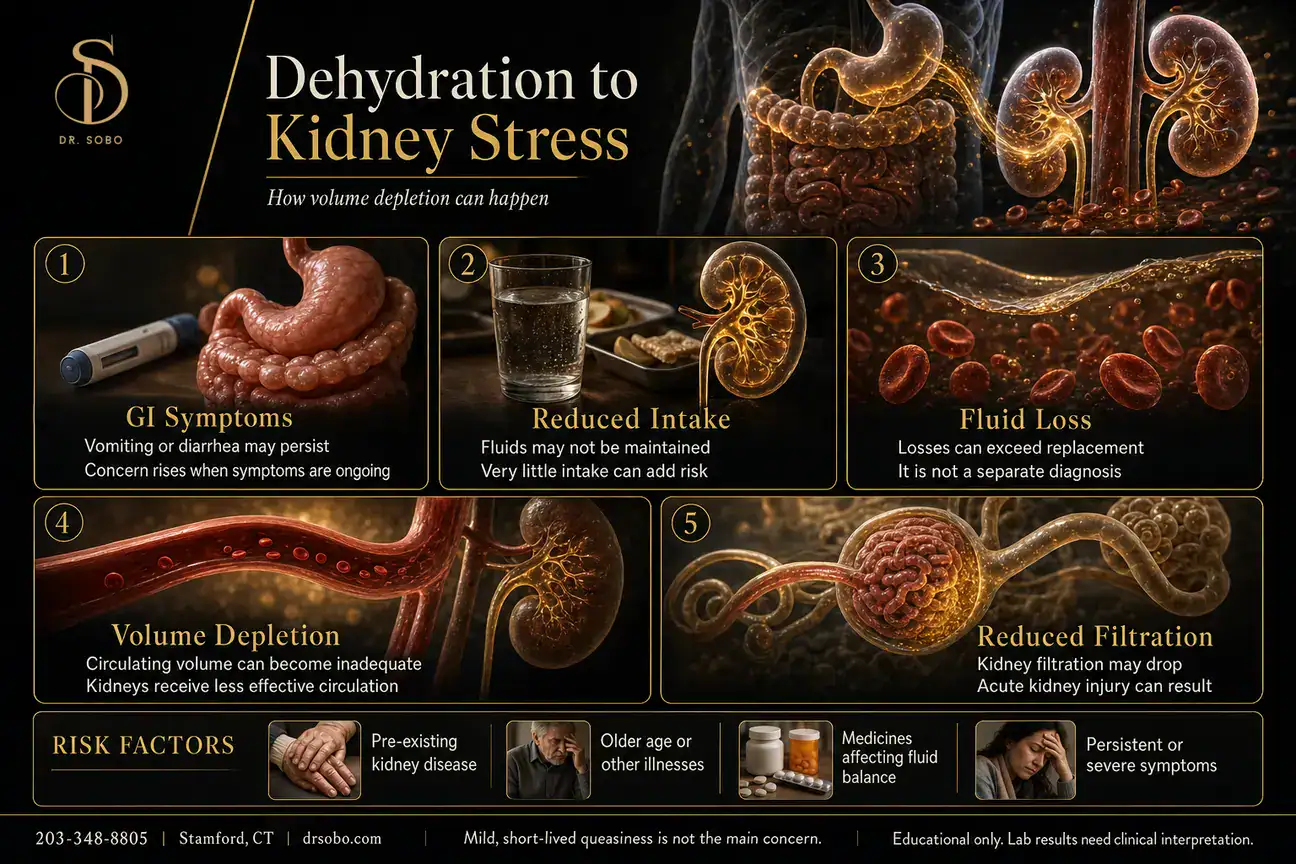
GLP-1 dehydration is not a separate diagnosis; it is a practical way patients describe dehydration that may occur when GLP-1-related gastrointestinal symptoms are persistent or severe. The concern is not mild, short-lived queasiness. The concern is ongoing vomiting, diarrhea, reduced intake, or inability to maintain fluids.
When fluid loss continues, the kidneys may receive less effective circulation. This can reduce filtration and may contribute to acute kidney injury, especially in someone with pre-existing kidney disease, older age, other illnesses, or medications that affect fluid balance. The risk is not the same for every person.
FDA labeling for semaglutide products reports postmarketing cases of acute kidney injury, including cases requiring hemodialysis, and notes that most reported events occurred in people who had gastrointestinal reactions leading to dehydration. The FDA Drugs@FDA Wegovy labeling access page provides access to the official Wegovy prescribing information. Wegovy labeling states: “Monitor renal function when initiating or escalating doses of WEGOVY in patients reporting severe adverse gastrointestinal reactions.”
Patient-directed semaglutide Medication Guide language also emphasizes dehydration. It warns about “kidney problems (kidney failure)” and explains that “diarrhea, nausea, and vomiting may cause a loss of fluids (dehydration), which may cause kidney problems to get worse.” It also tells patients: “It is important for you to drink fluids to help reduce your chance of dehydration.” This language is especially relevant when nausea, vomiting, or diarrhea does not go away.
Tirzepatide labeling contains a similar practical warning. The FDA Drugs@FDA Zepbound labeling access page provides access to Zepbound prescribing information, which includes postmarketing acute kidney injury events and instructs clinicians to monitor renal function in patients reporting adverse reactions that could lead to volume depletion. That is why tirzepatide kidney function questions should include hydration and symptom tolerance, not only baseline kidney numbers.
GLP-1 dehydration is also a reason not to minimize reduced urination. A person may not be able to tell whether lower urine output reflects simple fluid loss, medication-related intolerance, another illness, or impaired kidney function. That distinction often requires a clinician’s assessment and, when appropriate, laboratory testing.
Acute kidney injury during GLP-1 treatment: how it can happen
Acute kidney injury means kidney function has worsened over a relatively short period. It can occur for many reasons, and a general article cannot determine the cause in an individual patient. In the GLP-1 setting, the most important recognized pathway in labeling is fluid loss from gastrointestinal adverse reactions.
The sequence can look like this: a patient develops persistent nausea, vomiting, or diarrhea; fluid intake drops or fluid losses rise; circulating volume becomes inadequate; kidney perfusion falls; kidney function worsens. This is a simplified explanation, but it captures why clinicians take ongoing gastrointestinal symptoms seriously.
The NIDDK acute kidney injury resource describes acute kidney injury as a sudden episode of kidney failure or kidney damage that happens within a few hours or days. It can lead to waste buildup and difficulty maintaining fluid balance. In GLP-1 care, symptoms and labs both matter because kidney injury may not be obvious from symptoms alone.
Acute kidney injury warnings in prescribing information should be interpreted carefully. They are authoritative safety warnings, but postmarketing reports do not prove that a medicine directly caused every reported event, and they do not provide a precise risk estimate for every patient. They identify a recognized concern that should be discussed and monitored when clinically appropriate.
This distinction matters because patients sometimes search for “semaglutide kidney problems” or “tirzepatide kidney function” and find confusing claims. The more accurate patient-facing message is this: kidney-related events have been reported, dehydration from gastrointestinal symptoms is a major concern in the labels, and individualized medical review is important when risk factors or warning signs are present.
5 kidney warning signs that should not be ignored
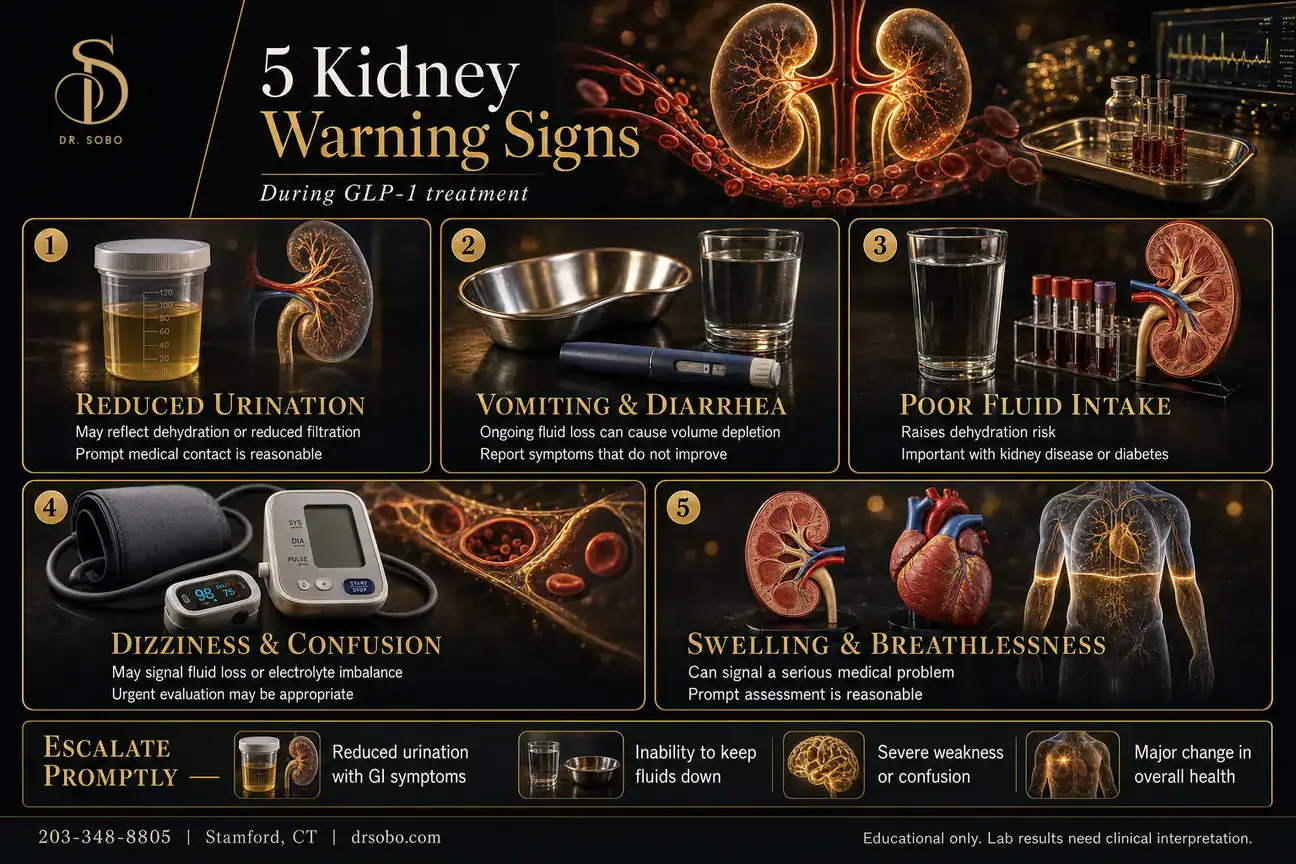
Kidney warning signs during GLP-1 treatment often overlap with dehydration symptoms and other urgent medical issues. A symptom does not prove acute kidney injury, but it can be a reason to contact the prescribing clinician promptly or seek urgent evaluation depending on severity.
1. Markedly reduced urination
Markedly reduced urination can reflect dehydration, reduced kidney filtration, urinary obstruction, or another medical issue. It is one of the clearest symptoms patients can notice at home, but it is not specific enough to diagnose the cause. If urination drops substantially, especially with vomiting, diarrhea, dizziness, or weakness, prompt medical contact is reasonable.
2. Persistent vomiting or diarrhea
Persistent vomiting or diarrhea matters because ongoing fluid loss can lead to GLP-1 dehydration and volume depletion. FDA labeling connects many reported acute kidney injury events with gastrointestinal reactions that caused dehydration. Symptoms that do not improve, prevent normal fluid intake, or occur in a person with kidney disease should be reported to the treating clinician.
3. Inability to maintain fluid intake
Inability to maintain fluid intake raises dehydration risk even when vomiting or diarrhea is not dramatic. A person who cannot drink enough, is eating very little, or feels progressively weaker may be developing fluid and electrolyte imbalance. This is especially important for patients with chronic kidney disease, prior acute kidney injury, diabetes, blood pressure issues, or multiple medications.
4. Severe dizziness, fainting, confusion, or unusual weakness
Severe dizziness, fainting, confusion, or unusual weakness may indicate significant fluid loss, low blood pressure, electrolyte imbalance, acute kidney injury, or another urgent problem. These symptoms should not be treated as routine medication discomfort. Depending on severity, urgent evaluation may be appropriate rather than waiting for symptoms to pass.
5. New swelling, shortness of breath, or a major change in health
New swelling, shortness of breath, chest symptoms, or a major change in overall health can have many possible causes and may not be directly related to GLP-1 treatment. Still, these changes can signal a serious medical problem and deserve prompt assessment. People with kidney, heart, or metabolic conditions should be especially cautious about dismissing new symptoms.
| Warning sign | Why it matters | Reasonable escalation |
|---|---|---|
| Markedly reduced urination | May reflect dehydration, reduced kidney filtration, urinary obstruction, or another medical issue | Prompt medical contact |
| Persistent vomiting or diarrhea | Can cause volume depletion and raise acute kidney injury concern | Contact the treating clinician promptly |
| Inability to maintain fluid intake | Raises dehydration risk, especially with ongoing fluid loss | Prompt clinical assessment |
| Severe dizziness, fainting, confusion, or unusual weakness | May indicate significant fluid loss, low blood pressure, electrolyte imbalance, or another urgent problem | Urgent evaluation |
| New swelling, shortness of breath, or major change in health | May reflect a serious medical issue with multiple possible causes | Urgent medical assessment |
This table is not a self-diagnosis tool. It is a way to recognize when symptoms should not be dismissed. The same symptom can have different meanings depending on kidney history, heart history, medications, age, baseline health, and how long symptoms have been occurring.
FDA labeling for oral semaglutide instructs patients to promptly report signs or symptoms of acute kidney injury and persistent or extended nausea, vomiting, and diarrhea to their healthcare provider. Rybelsus labeling is one source of this patient-directed warning language.
Can people with chronic kidney disease use semaglutide or tirzepatide?
Some people with chronic kidney disease may be candidates for GLP-1-based treatment, while others may not be appropriate candidates or may need closer monitoring. Kidney disease is not a universal yes-or-no answer. The decision depends on the product, indication, kidney function, recent trends, symptoms, other medicines, and the clinician’s judgment.
For semaglutide, a clinician may consider the FDA-approved indication, the patient’s renal history, gastrointestinal tolerability, and whether renal-function monitoring is appropriate if symptoms could lead to volume depletion. Patients researching semaglutide should avoid reducing the decision to a single internet answer about semaglutide kidney problems.
For tirzepatide, labeling for Zepbound states that no dosage adjustment is recommended for patients with renal impairment. That statement is about dose adjustment in renal impairment. It should not be stretched into a claim that tirzepatide is appropriate for every patient with kidney disease, that monitoring is never needed, or that dehydration risk can be ignored.
People asking about tirzepatide should discuss current kidney function, prior acute kidney injury, gastrointestinal symptoms, hydration, and other medications with the treating clinician. Tirzepatide kidney function considerations are especially relevant when vomiting, diarrhea, reduced intake, or reduced urination occurs.
The safest framing is balanced: kidney disease does not automatically prohibit treatment, and it does not automatically make treatment safe. It makes individualized medical evaluation more important.
When clinicians may review kidney history and laboratory results
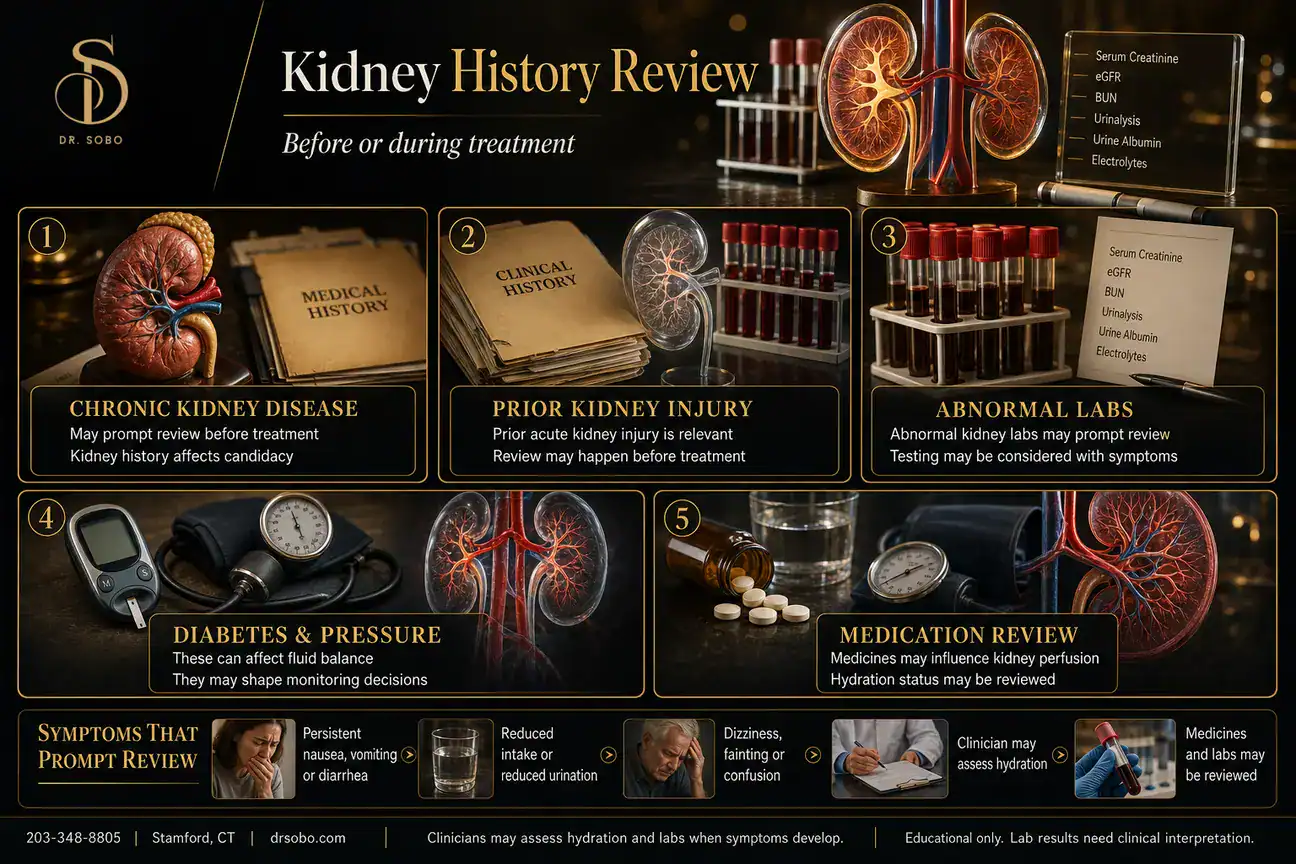
A clinician may review kidney history before treatment when a patient has chronic kidney disease, prior acute kidney injury, abnormal kidney labs, diabetes, high blood pressure, recurrent dehydration, heart disease, or other conditions that affect fluid balance. The review may also include medications that influence kidney perfusion, blood pressure, or hydration status.
During treatment, kidney history becomes especially relevant if persistent nausea, vomiting, diarrhea, reduced intake, dizziness, fainting, confusion, or reduced urination develops. These symptoms may prompt a clinician to assess hydration, review medications, and consider kidney-related laboratory testing.
Semaglutide labeling supports monitoring renal function in patients reporting adverse reactions that could lead to volume depletion, particularly around initiation and dose escalation in relevant labeling. This is not a universal home-testing schedule and not an instruction for patients to adjust dosing. The treating clinician determines when labs are appropriate.
Common clinical discussions may include prior estimated glomerular filtration rate, creatinine trends, urine changes, blood pressure, current symptoms, and recent illnesses. However, the exact tests and timing depend on the patient’s situation. A general article should not replace individualized medical judgment.
At Dr. Sobo’s office, the new patient visit information describes a detailed intake process that includes health history and evaluation. For GLP-1 candidates, bringing prior kidney labs, medication lists, and details about past dehydration or kidney events can make the physician visit more useful.
Semaglutide kidney problems: what the label does and does not prove
Searches for semaglutide kidney problems often lead to oversimplified answers. The FDA-approved labeling identifies acute kidney injury as a postmarketing safety concern and connects many reported cases with gastrointestinal reactions and dehydration. That is important and should be taken seriously.
At the same time, postmarketing reports have limitations. They can identify safety signals and recognized warnings, but they do not prove that every kidney event in every patient was directly caused by semaglutide. They also do not tell a specific patient what will happen to them.
The practical takeaway is that semaglutide kidney problems should be discussed in terms of risk factors, warning signs, symptom tolerance, product source, and monitoring. A patient who has no kidney disease and tolerates treatment well is different from a patient with chronic kidney disease who develops persistent vomiting and reduced urination.
Semaglutide kidney problems should also be discussed in relation to product source. FDA-approved products have official labeling. A compounded preparation has a different regulatory status and should not be described as FDA-approved unless that exact preparation has FDA approval.
Tirzepatide kidney function: what patients should understand
Tirzepatide kidney function questions should include both baseline kidney status and what happens during treatment. Baseline kidney impairment is one factor. Ongoing vomiting, diarrhea, reduced intake, or dehydration symptoms are another. Both can matter.
The labeling for tirzepatide products includes postmarketing reports of acute kidney injury, often in the setting of gastrointestinal adverse reactions causing dehydration. For patients, this means that new or persistent symptoms deserve attention even if prior kidney labs were stable.
The statement that no dosage adjustment is recommended for patients with renal impairment should be read narrowly. It does not mean every patient with kidney disease is an appropriate candidate. It does not mean the medicine cannot be associated with kidney-related warnings. It does not mean laboratory monitoring is never clinically indicated.
Tirzepatide kidney function conversations should also include whether symptoms are new, persistent, or severe. A stable lab result before treatment does not remove the need to report vomiting, diarrhea, reduced intake, dizziness, or reduced urination during treatment.
Patients comparing semaglutide and tirzepatide should avoid assuming that separate trials prove one is safer for kidneys. Different trials enroll different people, use different designs, and measure outcomes differently. Kidney-related findings from separate trials cannot by themselves establish comparative kidney safety.
Why separate trials cannot rank kidney safety
It is understandable to ask whether semaglutide or tirzepatide is safer for the kidneys. A careful answer is that the available labeling does not establish, from separate trials alone, that one medicine is safer for kidney outcomes than the other.
Separate trials can be informative, but they are not the same as a head-to-head comparison designed to answer a specific safety question. Trial populations may differ in age, baseline kidney function, diabetes status, weight, medication use, follow-up duration, and definitions of kidney outcomes.
Postmarketing reports also do not provide a simple comparison. Reporting patterns can be influenced by how often a medicine is used, how long it has been on the market, patient characteristics, clinician awareness, and many other factors. A warning in both labels means the concern is clinically relevant for both; it does not prove identical risk.
A more useful question is: which medication, formulation, indication, monitoring plan, and symptom-management strategy is appropriate for this individual patient? That question belongs in a physician-supervised visit, especially when kidney disease or dehydration risk is part of the history.
FDA-approved products, compounded formulations, and product-source safety
FDA-approved products and compounded formulations should be discussed distinctly. FDA-approved GLP-1 products are approved for specific indications and have official labeling that describes warnings, adverse reactions, contraindications, and other prescribing information. Compounded preparations are not FDA-approved products merely because they contain semaglutide or tirzepatide.
Compounded treatment may be prescribed by a physician and prepared by a licensed pharmacy when clinically appropriate, but it should not be represented as identical to an FDA-approved product. Patients should understand what they are receiving, why it is being considered, and how it will be supervised.
The FDA has published safety communications about dosing errors and adverse events associated with compounded semaglutide products, emphasizing that compounded drugs are not FDA-approved and that dosing errors have occurred. The FDA alert on compounded semaglutide dosing errors is a useful source for understanding why product source, labeling, and clinical oversight matter.
This does not mean every compounded medication or every compounding pharmacy should be described as unsafe or illegitimate. It means patients should avoid unsupervised online sellers, products sold without appropriate medical oversight, “research use only” products, and any source where identity, purity, sterility, storage, labeling, or dosing instructions are unclear.
Dr. Sobo and Optimal Health Medical use compounding pharmacies when clinically appropriate. Patients should obtain peptide therapy and GLP-1-related care through a qualified healthcare professional and an appropriately licensed pharmacy, not through unsupervised sellers or self-directed dosing.
What to discuss with a physician before or during treatment
A kidney-focused GLP-1 visit should be specific. General side-effect questions are useful, but they may not be enough for someone with kidney disease, reduced urination, dehydration history, or persistent gastrointestinal symptoms.
- Known chronic kidney disease, kidney stones, prior acute kidney injury, or abnormal kidney labs
- Recent creatinine, estimated glomerular filtration rate, urine findings, or other kidney-related results if available
- Current medicines, including diuretics, blood pressure medicines, diabetes medicines, anti-inflammatory medicines, and supplements
- History of dehydration, fainting, dizziness, vomiting, diarrhea, or poor fluid intake
- Any current reduced urination or major change in urination pattern
- The FDA-approved indication being considered and whether the product is FDA-approved or compounded
- How to report persistent symptoms and when the clinician may want labs
- How care will be supervised during initiation, escalation, or symptom changes
Patients should not use this list to self-prescribe, change dosing, or decide whether to stop a medication. Dosing and titration are set by the treating physician. If symptoms are concerning, the appropriate next step is clinical contact, not internet-based dose adjustment.
How physician-supervised peptide therapy fits into monitoring conversations
GLP-1 medicines are often discussed alongside peptide therapy because semaglutide and tirzepatide are peptide-based treatments. That does not mean all peptides have the same evidence, regulatory status, approved uses, or risks. Each treatment should be evaluated on its own terms.
In physician-supervised peptide therapy, the safety conversation should include the treatment’s evidence level, whether it is FDA-approved for the intended use, whether compounding is involved, what symptoms should be reported, and what laboratory history may be relevant. For GLP-1 medicines, kidney-related monitoring conversations often focus on dehydration risk, acute kidney injury warnings, and renal history.
This is especially important for patients with chronic conditions who may already be taking multiple medications or supplements. A root-cause and integrative approach still requires careful attention to conventional safety signals, prescribing information, and patient-specific risk factors.
Physician-supervised GLP-1 care in Stamford, CT
Dr. Henry C. Sobo, M.D. and Optimal Health Medical, LLC provide integrative, physician-led care in Stamford, CT. Adults considering GLP-1 medicines for weight management can discuss candidacy, medical history, kidney-related concerns, and the difference between FDA-approved products and compounded options when clinically appropriate.
Patients come to the Stamford office from surrounding communities such as Greenwich, Darien, and nearby areas of Fairfield County and Westchester County. The important point is not the town name; it is having a qualified clinician review the full picture before treatment decisions are made.
If you have chronic kidney disease, prior acute kidney injury, persistent nausea, vomiting, diarrhea, reduced urination, or questions about product source, consider contacting a clinician before continuing to guess about risk. You can contact the office or review what to expect at your first visit if you are considering physician-supervised care.
Evidence-status note for GLP-1 kidney health
Evidence status for this draft: label language and regulatory status should be rechecked against the exact current FDA or DailyMed prescribing information immediately before publication. As of the drafting date, FDA labeling access pages for semaglutide and tirzepatide products identify postmarketing reports of acute kidney injury, commonly in the context of gastrointestinal adverse reactions and dehydration. The labeling supports renal-function monitoring when clinically indicated, especially when adverse reactions may lead to volume depletion.
The available material does not establish, from separate trials alone, that semaglutide or tirzepatide is safer for the kidneys than the other. Because GLP-1 labeling, indications, and availability can change, clinicians should confirm the current product label, indication, warnings, contraindications, and formulation details before treatment decisions. Patients should not rely on a general article as a substitute for individualized medical evaluation.
Key takeaways for safer kidney-focused conversations
GLP-1 kidney health is best understood as a risk-review conversation, not a single alarming headline. Acute kidney injury has been reported with semaglutide and tirzepatide products, and dehydration from persistent gastrointestinal symptoms is a major pathway described in labeling.
Reduced urination, inability to keep fluids down, persistent vomiting or diarrhea, fainting, confusion, severe weakness, or major health changes should not be minimized. These symptoms deserve timely clinical attention, particularly in a person with kidney disease or prior acute kidney injury.
FDA-approved and compounded formulations should be discussed clearly. A compounded preparation should not be called FDA-approved unless that exact preparation has FDA approval. Patients should use qualified healthcare professionals and appropriately licensed pharmacies rather than unsupervised online or “research use only” sources.
The most useful next step is a physician-supervised discussion that reviews kidney history, symptoms, medications, product source, and monitoring needs. This article is for general education and is not medical advice. Talk with a qualified healthcare professional about your own situation.
Frequently Asked Questions
Can semaglutide cause kidney problems?
Semaglutide prescribing information reports postmarketing cases of acute kidney injury. Many reported cases occurred when gastrointestinal reactions led to dehydration, including nausea, vomiting, or diarrhea. This does not mean semaglutide directly damages the kidneys in every patient. Persistent fluid loss, reduced urination, or inability to maintain hydration should be discussed promptly with a healthcare professional.
Can tirzepatide cause acute kidney injury?
Tirzepatide prescribing information reports postmarketing cases of acute kidney injury, including cases requiring hemodialysis. The labeling states that most reported events occurred in people who experienced gastrointestinal adverse reactions leading to dehydration. Persistent vomiting, diarrhea, reduced urination, dizziness, fainting, or unusual weakness should be reported to the treating clinician.
Is GLP-1-related kidney injury usually caused by dehydration?
FDA labeling for semaglutide and tirzepatide describes many reported acute kidney injury events as occurring in the setting of gastrointestinal reactions that caused dehydration. This supports dehydration or volume depletion as an important pathway in reported cases. It does not prove that every kidney event has the same cause or that other medical factors were absent.
Can someone with chronic kidney disease take semaglutide?
Chronic kidney disease does not automatically determine whether semaglutide is appropriate. The decision depends on kidney function, medical history, hydration status, gastrointestinal symptoms, other medicines, and the FDA-approved indication being considered. A clinician may review renal history and laboratory results when clinically appropriate rather than applying one rule to every person with kidney disease.
Can someone with chronic kidney disease take tirzepatide?
Some people with kidney disease may be considered for tirzepatide, but candidacy requires individualized medical assessment. Zepbound labeling states that no dosage adjustment is recommended for patients with renal impairment. That statement does not mean every patient with kidney disease is an appropriate candidate or that monitoring is never needed.
What kidney symptoms should be reported while taking a GLP-1 medicine?
Report markedly reduced urination, persistent or severe nausea, vomiting, diarrhea, inability to maintain fluid intake, severe dizziness, fainting, confusion, or unusual weakness. These symptoms may reflect dehydration, impaired kidney function, or another urgent medical issue. A clinician can determine whether evaluation, laboratory testing, or treatment changes are needed.
Should a person stop semaglutide or tirzepatide if vomiting or diarrhea occurs?
Medication changes should not be made based on a general article. Persistent vomiting or diarrhea can cause dehydration and may require prompt clinical assessment, especially in someone with kidney disease or other medical conditions. Contact the prescribing clinician for individualized guidance rather than changing the dose or stopping treatment without medical direction.
Do semaglutide and tirzepatide have the same kidney risk?
The available labeling identifies acute kidney injury reports for both semaglutide and tirzepatide, especially in the context of gastrointestinal symptoms and dehydration. However, separate trials do not prove that the medicines have identical risks or that one is safer for kidneys. A valid comparison requires appropriate comparative evidence.
Are compounded semaglutide and tirzepatide FDA-approved?
A compounded preparation should not be called FDA-approved merely because it contains semaglutide or tirzepatide. FDA-approved products and compounded preparations have different regulatory statuses and labeling. Patients should obtain treatment through a qualified healthcare professional and appropriately licensed pharmacy, and avoid unsupervised products sold without appropriate medical oversight.
What kidney tests might a clinician review?
Depending on the situation, a clinician may review prior kidney results and order or interpret laboratory testing used to assess kidney function and related changes. The need and timing depend on medical history, symptoms, hydration status, concurrent medicines, and treatment context. Renal-function monitoring may be appropriate when adverse reactions could lead to volume depletion.
Sources
- FDA Drugs@FDA: Wegovy labeling access page
- FDA Drugs@FDA: Ozempic labeling access page
- FDA Drugs@FDA: Rybelsus labeling access page
- FDA Drugs@FDA: Zepbound labeling access page
- FDA Drugs@FDA: Mounjaro labeling access page
- NIDDK: Acute Kidney Injury
- NIDDK: Chronic Kidney Disease
- FDA: Dosing errors associated with compounded semaglutide injectable products