
Men researching options for low testosterone often encounter enclomiphene as a medication that may raise the body’s own testosterone while supporting sperm production. That description captures its proposed mechanism, but it does not answer the most important clinical questions: who might respond, what outcomes have actually been studied, what remains uncertain, and what does its regulatory status mean for patients?
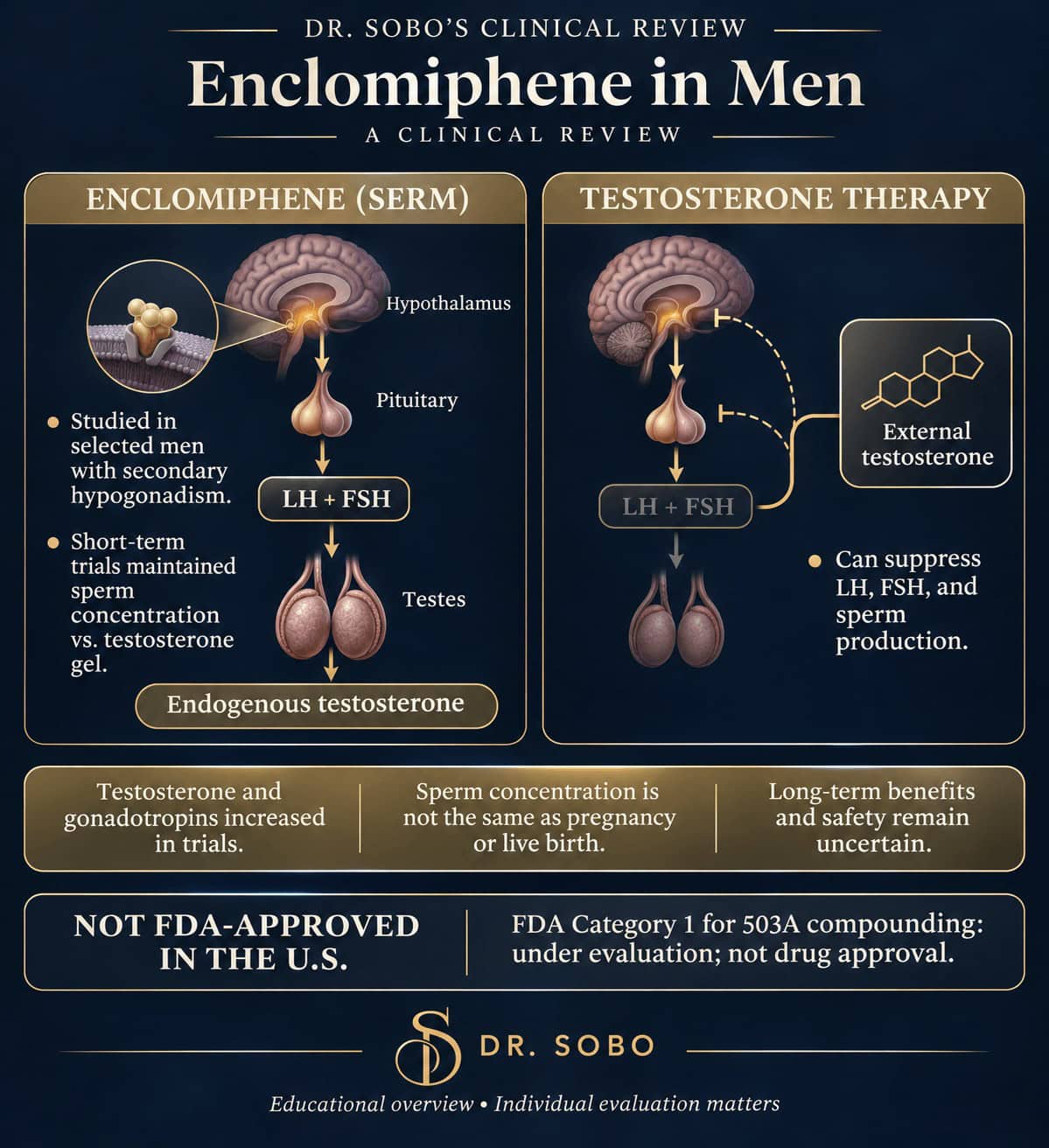
Quick answer: Enclomiphene citrate is the trans-isomer of clomiphene and a selective estrogen receptor modulator (SERM). It has been studied in men with secondary hypogonadism, where low testosterone occurs with low or inappropriately normal LH and FSH. Trials show increases in testosterone and gonadotropins, and short-term studies found sperm concentration was maintained better than with testosterone gel. However, enclomiphene is not FDA-approved in the United States, evidence for symptom improvement and long-term health outcomes is limited, and it is not appropriate for every cause of low testosterone.
This review separates measured clinical findings from proposed benefits. It is educational and does not recommend a medication, dose, or treatment plan for any individual. A clinician must evaluate symptoms, repeat laboratory findings, fertility goals, underlying causes, risks, and current regulatory requirements.
What is enclomiphene?
Enclomiphene citrate is one of the two geometric isomers found in clomiphene citrate. It is the trans-isomer and acts as a selective estrogen receptor modulator. Researchers have studied it as an oral treatment intended to stimulate endogenous testosterone production in some men with secondary hypogonadism.
Enclomiphene is not a peptide. It is a small-molecule prescription drug candidate in the SERM class. A site may group it with hormone-related therapies for navigation, but product and educational copy should identify it accurately as a SERM rather than describing it as peptide therapy.
Clomiphene citrate is a mixture of enclomiphene and zuclomiphene isomers. Enclomiphene has been investigated separately because of its effects on the hypothalamic-pituitary-gonadal axis. Findings from clomiphene research cannot automatically be treated as findings for enclomiphene alone. The same caution applies to pooled research that combines both medications.
How does enclomiphene work?
Enclomiphene is thought to reduce estrogen-mediated negative feedback at the hypothalamus and pituitary. In a responsive hormonal system, this can increase signals from the pituitary to the testes:
- LH (luteinizing hormone) signals Leydig cells in the testes to produce testosterone.
- FSH (follicle-stimulating hormone) supports Sertoli cell activity involved in sperm production.
- Testosterone may rise because the testes are stimulated to make more of the body’s own hormone.
The mechanism depends on an intact hypothalamus-pituitary signal pathway and testes that can respond. It is therefore not a universal solution for low testosterone. Men with primary testicular failure may already have elevated LH and FSH; further stimulation may not address the underlying problem. Pituitary disease, medications, obesity, sleep disorders, acute illness, and other conditions also require appropriate evaluation rather than assuming a medication response.
What does the clinical evidence show?
The clearest evidence for enclomiphene is biochemical: changes in testosterone, LH, and FSH during treatment. A 2016 publication reported results from two randomized, double-blind, multicenter phase III studies involving overweight men aged 18 to 60 with secondary hypogonadism. Enclomiphene raised testosterone and maintained sperm concentration over the trial period, while testosterone gel raised testosterone but suppressed gonadotropins and reduced sperm concentration in the study groups.
These findings matter when fertility is a treatment priority, but they do not establish that enclomiphene improves live-birth rates, fertility for every patient, libido, energy, mood, strength, bone density, cardiovascular outcomes, or longevity. Sperm concentration is a laboratory measure; it is not the same as a successful pregnancy. The trials were relatively short and enrolled selected participants.
A 2025 systematic review and meta-analysis included randomized trials of clomiphene or enclomiphene. The pooled SERM results showed higher testosterone, LH, and FSH compared with placebo. The analysis reported substantial heterogeneity for several outcomes, and its estimates combine medicines and study populations. The average pooled testosterone change of about 274 ng/dL should not be presented as an expected response to enclomiphene alone or as a promise to an individual patient.
| Question | What the evidence supports | What it does not establish |
|---|---|---|
| Can enclomiphene raise testosterone? | Short-term clinical trials found higher testosterone in selected men with secondary hypogonadism. | A predictable response for every man, or a durable benefit after treatment ends. |
| Can it preserve sperm concentration compared with testosterone gel? | In studied trial groups, sperm concentration was maintained with enclomiphene while it declined with testosterone gel. | Improved fertility or pregnancy rates for every patient; semen analysis and reproductive evaluation still matter. |
| Does it reliably improve symptoms? | Symptom outcomes have been assessed, but evidence is less consistent and less conclusive than hormone-level findings. | Established, clinically meaningful improvement in fatigue, libido, mood, strength, or quality of life. |
| Does it prevent long-term disease? | Long-term outcomes have not been adequately established. | Prevention of cardiovascular disease, fractures, diabetes, prostate disease, or age-related decline. |
Who might be considered for an evaluation?
A discussion about an endogenous testosterone-stimulating approach may be relevant for a man who has compatible symptoms, repeatedly low testosterone, low or inappropriately normal LH and FSH, functioning testes, and a reason to avoid suppressing sperm production. That description identifies a clinical pattern for further evaluation. It does not make someone an automatic candidate for enclomiphene.
Low testosterone should not be diagnosed from fatigue or a single lab result alone. The Endocrine Society recommends diagnosing hypogonadism only when compatible symptoms or signs occur with consistently and unequivocally low testosterone. Its guideline recommends confirming a low result with a repeat morning fasting total testosterone measurement. Clinicians may use free testosterone when total testosterone is near the lower limit or when sex hormone-binding globulin (SHBG) may affect interpretation.
LH helps distinguish primary testicular dysfunction from secondary or central causes. Depending on the history and findings, evaluation may include FSH, prolactin, estradiol, CBC/hematocrit, thyroid or metabolic testing, medication review, sleep assessment, and evaluation for pituitary or other medical conditions. A semen analysis and reproductive specialist input may be appropriate when fertility is a current goal.
Enclomiphene compared with testosterone replacement therapy
Testosterone replacement therapy (TRT) supplies testosterone from outside the body. Enclomiphene was studied as a way to stimulate the body’s own hormonal signaling. These are different treatment strategies, and the right option depends on diagnosis, goals, risks, availability, and evidence. A testosterone level rising on treatment does not by itself prove that symptoms or long-term health improve.
| Feature | Enclomiphene | Testosterone therapy |
|---|---|---|
| Basic approach | Stimulates pituitary LH and FSH signaling in some men. | Provides exogenous testosterone. |
| Testosterone level | Raised in short-term clinical trials of selected men. | Raised when treatment is appropriately prescribed and monitored. |
| LH and FSH | Generally increased in the enclomiphene studies. | Often suppressed through hormonal feedback. |
| Sperm production | Short-term trials found sperm concentration was maintained compared with a decline in testosterone-gel groups. | Testosterone monotherapy can suppress sperm production and may cause severe oligospermia or azoospermia. |
| FDA status in the United States | No FDA-approved finished drug product containing enclomiphene had been identified as of November 12, 2026. FDA’s separate Category 1 listing for compounding means the substance is under evaluation; it is not drug approval. | Some testosterone products are FDA-approved for appropriately diagnosed patients and specific labeled indications. |
| Evidence and duration | More limited long-term and symptom-outcome evidence. | Larger body of clinical use and product-specific evidence, with important risks and monitoring requirements. |
The AUA/ASRM male infertility guideline advises against testosterone monotherapy for men interested in current or future fertility. That guidance does not mean enclomiphene is proven to produce a pregnancy or that it is suitable for every fertility concern. Men trying to conceive should discuss semen testing, the cause of low testosterone, timelines, and options with a clinician experienced in reproductive health.
Why a testosterone result needs clinical context
Testosterone varies with time of day, sleep, food intake, acute illness, medications, and laboratory method. A single result can therefore mislead. Clinicians interpret repeated morning measurements alongside symptoms, age, medical history, and the laboratory’s reference range. When total testosterone is borderline, SHBG and a reliable free-testosterone assessment may help clarify whether the circulating level is truly low.
Symptoms also have many possible causes. Low libido may relate to relationship factors, depression, vascular disease, medication effects, or sleep problems. Fatigue can reflect anemia, thyroid disease, sleep apnea, infection, stress, or inadequate sleep. Changes in muscle or body composition can relate to nutrition, activity, chronic illness, or medication. Treating a number without examining the person can miss a reversible cause and expose someone to medication without a clear expected benefit.
When testosterone and LH/FSH are low or inappropriately normal, the finding can point toward a central cause, but it does not identify the cause by itself. Persistent prolactin elevation, very low testosterone, headaches or visual symptoms, or other pituitary hormone abnormalities may call for further evaluation. The decision to use any hormone-directed medication follows that diagnostic work; it is not a replacement for it.
How to interpret fertility findings
Preserving sperm concentration in a short trial is a meaningful laboratory observation, but it should be described precisely. Fertility depends on sperm count and movement, semen volume, reproductive anatomy, timing, partner factors, and the time available to conceive. One semen analysis can vary, and a testosterone result cannot substitute for semen testing. If a couple is actively trying to conceive, the plan should account for both partners and the couple’s timeline.
Men who have used testosterone may also need counseling about recovery time. Suppression of sperm production from testosterone can take months to improve after treatment changes, and the timing is variable. Men should not stop prescribed testosterone or add enclomiphene on their own in an attempt to restore fertility. A reproductive urologist or other fertility specialist can evaluate the situation and discuss options based on semen results, hormone levels, prior treatment, and family-building goals.
Likewise, “fertility-preserving” should not be treated as a guarantee. The available enclomiphene studies were not designed to establish that it improves conception or live-birth outcomes. Clear wording protects patients from confusing a possible difference in sperm concentration with a proven fertility treatment.
What evidence gaps remain?
Several limitations shape how confidently enclomiphene can be discussed. The controlled trials were comparatively short, involved selected men, and focused heavily on laboratory values. Their results cannot establish long-term cardiovascular, prostate, skeletal, metabolic, or fertility outcomes. The studies also do not fully answer which symptoms improve, which men are most likely to feel better, how durable the response is, or how risk changes with age and coexisting illness.
The 2025 meta-analysis is useful for summarizing randomized SERM research, but its combined clomiphene and enclomiphene results are not a head-to-head estimate for a single drug. Differences among trials in participants, duration, doses, and outcome definitions contribute to heterogeneity. A pooled mean describes the average of included studies; it does not predict an individual response. In addition, the literature search ended in July 2024, so it is not a review of every study published after that cutoff.
Regulatory review also asks whether a treatment produces meaningful clinical benefit, not only whether a laboratory value changes. FDA’s briefing reported that the Phase III program did not demonstrate clinically meaningful improvement in hypogonadal signs or symptoms to support the proposed use. This distinction is central: biological activity can be real while evidence for patient-important benefits remains incomplete.
What doses have been studied?
There is no FDA-approved enclomiphene product or FDA-approved dosing regimen in the United States. Published clinical studies have investigated oral doses including 6.25 mg, 12.5 mg, and 25 mg daily; trial protocols, durations, populations, and endpoints differed. The fact that a dose appeared in a study does not make it a recommended dose, an appropriate starting dose, or a substitute for a prescription.
Do not use online dosing charts or another person’s protocol to self-treat. Treatment decisions, if considered at all, require a clinician to review the diagnosis, fertility goals, medication interactions, medical history, laboratory data, product source, and current legal and regulatory requirements. The medication should not be obtained from research-chemical sellers or products labeled “research use only.”
Potential side effects and safety questions
Clinical-trial reports have included headache, hot flashes, nausea, dizziness, and changes in estradiol, hematocrit, or prostate-specific antigen. Any medication that changes the sex-hormone axis can also affect mood, sexual symptoms, breast symptoms, or other lab results. The available trials are not large or long enough to precisely quantify uncommon events or establish long-term safety.
FDA’s 2022 Pharmacy Compounding Advisory Committee briefing described safety concerns reported in the enclomiphene clinical program, including thromboembolic and cardiac events, elevated hematocrit, increased PSA, eye disorders, and psychiatric events. The briefing noted four thromboembolic cases, including one fatality, in the reviewed trial data. These were uncommon events in a limited dataset and do not establish the exact risk for an individual, but they are a reason for careful risk review rather than reassurance based only on short-term hormone results.
New visual symptoms, severe headache, chest pain, shortness of breath, one-sided leg swelling or pain, sudden weakness, or speech difficulty require urgent medical evaluation. A clinician should give a patient-specific safety plan and explain which symptoms need immediate care. Do not stop or start prescription treatment solely from an online article.
FDA approval and compounding status
As of November 12, 2026, enclomiphene is not FDA-approved in the United States for male hypogonadism or another indication. FDA’s 2022 briefing states that there were no FDA-approved drug products containing enclomiphene citrate as the active ingredient. FDA also summarized that the sponsor received a Complete Response Letter in 2015; the agency said the Phase III study design was no longer adequate to demonstrate clinical benefit and recommended additional Phase III evidence.
FDA’s updated May 14, 2026 list places enclomiphene citrate in Category 1, “Bulk Drug Substances Under Evaluation,” for possible use in section 503A compounding. FDA’s interim policy says the agency does not intend to take action against a compounder using a Category 1 substance when the stated policy conditions are met. This category listing is not FDA approval of enclomiphene or of any finished compounded product. It also does not verify a particular prescription’s legal or clinical appropriateness.
In 2022, FDA recommended against adding enclomiphene to the 503A Bulks List, and its advisory committee voted 8 to 4 against inclusion. That was an advisory-stage decision; the current Category 1 listing reflects that the substance remains under evaluation under FDA’s interim compounding policy. Compounded drugs are not FDA-approved, and FDA does not review each compounded prescription for safety, effectiveness, or quality before dispensing. The prescriber and pharmacist should verify the current federal and state requirements, the patient-specific rationale, and the pharmacy’s role before treatment.
Patients should distinguish a prescription made for an individual by a properly licensed pharmacy under applicable rules from an unverified product sold online as a supplement or research chemical. A product listing, certificate image, or National Drug Code listing alone does not establish FDA approval or prove that a specific product is appropriate for a patient. Ask the prescriber which pharmacy will dispense the medication, how it is regulated, and what follow-up is planned.
Does enclomiphene work in older men?
Evidence is especially limited for men over 60. The pivotal Phase III trials described in the literature enrolled overweight men aged 18 to 60, and other enclomiphene studies were small or relatively short. A response is biologically plausible in some older men if low testosterone is associated with inadequate central signaling and the testes remain responsive, but that possibility is not proof of efficacy or safety in men aged 70 to 75.
With age, the causes of low testosterone can be mixed. Primary testicular dysfunction, chronic illness, medications, obesity, sleep apnea, and pituitary problems may all be relevant. Older adults may also have different cardiovascular, clotting, prostate, and medication risks. A clinician should individualize evaluation rather than extrapolate trial results from younger participants.
What should patients discuss with a clinician?
A useful consultation starts with the problem the patient wants addressed, the symptoms and their duration, reproductive goals, and prior treatment. Bring a list of medicines and supplements, prior testosterone results with dates and collection times, and any fertility testing. Ask what diagnosis is being considered and what other causes should be evaluated before treatment.
- Were testosterone levels low on two separate morning tests, and were results interpreted with symptoms and SHBG context?
- Do LH and FSH suggest a central or testicular cause? Is prolactin or pituitary evaluation indicated?
- How could the proposed therapy affect sperm production, and should semen analysis or fertility-specialist care come first?
- What evidence supports improvement in the specific symptom or goal, beyond a higher testosterone number?
- What adverse effects, interactions, and urgent warning signs should be discussed?
- What product would be dispensed, what is its approval or compounding status, and how will response and safety be monitored?
Monitoring should be selected for the individual and the treatment being considered. Testosterone, LH, FSH, estradiol, CBC/hematocrit, PSA when appropriate, and adverse effects may be considered by a clinician. There is no validated universal enclomiphene monitoring schedule; intervals should not be represented as a formal standard without supporting evidence.
Clinical perspective
Enclomiphene is a studied SERM with a plausible mechanism and evidence that it can raise testosterone and gonadotropins in selected men with secondary hypogonadism. Short-term trials also suggest it may preserve sperm concentration better than testosterone gel in the studied populations. The evidence is weaker for meaningful symptom improvement and does not establish long-term health benefits or safety.
Its lack of FDA approval, history of an incomplete approval application, limited long-term data, and reported safety signals deserve clear discussion. Fertility preservation can be an important reason to explore alternatives to testosterone monotherapy, but it does not make enclomiphene risk-free or universally appropriate. Diagnosis and treatment decisions belong in a clinician-patient discussion based on laboratory findings, reproductive goals, medical history, and current regulations.
Men in Stamford and the surrounding Fairfield County area can learn more about hormone-related services, peptide therapy, and Dr. Henry C. Sobo’s medical background. Enclomiphene should be discussed accurately as a SERM, with the limits of its evidence and regulatory status made clear.
Frequently asked questions
Is enclomiphene FDA-approved?
No. As of November 12, 2026, FDA has not approved an enclomiphene-containing finished drug product for male low testosterone or another indication in the United States. The FDA’s 2022 review noted that no FDA-approved drug product contained enclomiphene citrate as the active ingredient. Approval status can change, so clinicians and publishers should verify current FDA records before relying on this statement.
Is enclomiphene a peptide?
No. Enclomiphene is an oral selective estrogen receptor modulator, or SERM. It is a small-molecule drug candidate related to clomiphene citrate, not a peptide. A clinic may discuss it in a broader hormone-health or peptide-therapy setting, but its classification and mechanism should be described accurately.
Can enclomiphene raise testosterone?
Short-term clinical trials found increased testosterone, LH, and FSH in selected men with secondary hypogonadism. The response depends on the cause of low testosterone and the function of the pituitary and testes. A laboratory increase does not guarantee symptom relief or a specific result for an individual patient.
Does enclomiphene preserve fertility better than TRT?
In short-term studies, men receiving enclomiphene maintained sperm concentration while men receiving testosterone gel had reduced sperm concentration. This supports a potential difference in the effect on spermatogenesis, but it does not prove pregnancy or live-birth benefit. Men pursuing fertility need individualized reproductive evaluation, often including semen analysis.
Does enclomiphene improve libido, energy, or strength?
Evidence for symptom improvement is less conclusive than evidence for changes in hormone levels. Trials have not established that enclomiphene reliably improves libido, fatigue, strength, mood, or quality of life for all men with low testosterone. A clinician should also consider sleep, medications, mood, metabolic health, and other causes of symptoms.
What enclomiphene dose is used?
No FDA-approved dose exists in the United States. Clinical studies have investigated doses such as 6.25 mg, 12.5 mg, and 25 mg daily, but these research protocols are not personal dosing instructions. Dosing decisions, if treatment is considered, require a qualified prescriber and verification of the product’s regulatory and pharmacy status.
What are enclomiphene’s side effects?
Reported trial concerns include headache, hot flashes, nausea, dizziness, changes in estradiol, hematocrit or PSA, visual symptoms, and uncommon cardiac or thromboembolic events. The evidence base is too limited to precisely define uncommon risks or long-term safety. New vision changes, chest pain, shortness of breath, one-sided leg swelling, or sudden neurologic symptoms need urgent assessment.
Can men over 60 take enclomiphene?
Evidence is limited in men over 60 because pivotal trials mainly enrolled men aged 18 to 60. Whether an older man might respond depends on the cause of low testosterone, pituitary signaling, testicular function, medical conditions, and medication risks. Age alone cannot determine candidacy, and trial results should not be assumed to apply to men aged 70 to 75.
Is compounded enclomiphene FDA-approved?
No. FDA’s May 2026 list places enclomiphene citrate in Category 1, “under evaluation,” for possible use in section 503A compounding. That listing is not FDA approval of enclomiphene or a finished compounded product. FDA’s interim policy describes enforcement discretion for Category 1 substances only when its conditions are met. The prescriber and pharmacist should verify current requirements and the patient-specific rationale. A product sold online as a supplement or research chemical is not equivalent to a clinician-prescribed pharmacy preparation.
How is enclomiphene different from clomiphene?
Clomiphene citrate is a mixture of two isomers, including enclomiphene and zuclomiphene. Enclomiphene has been studied as an isolated isomer. Evidence from clomiphene studies may be relevant to the broader SERM class but should not be reported as direct proof about enclomiphene alone, especially when studies differ in formulation, population, or outcomes.
What tests are considered before discussing treatment?
Evaluation commonly begins with symptoms and two appropriately collected morning testosterone measurements. Depending on findings, a clinician may consider LH, FSH, SHBG or free testosterone, prolactin, estradiol, CBC/hematocrit, PSA when age- and risk-appropriate, and other tests to identify the cause. Fertility goals may warrant semen analysis and reproductive-health evaluation before therapy.
Sources
- Hohl A, et al. Clomiphene or enclomiphene citrate for the treatment of male hypogonadism: a systematic review and meta-analysis of randomized controlled trials. 2025.
- Kim ED, et al. Oral enclomiphene citrate raises testosterone and preserves sperm counts in obese hypogonadal men, unlike topical testosterone. 2016.
- Wiehle RD, et al. Testosterone restoration using enclomiphene citrate in men with secondary hypogonadism: a pharmacodynamic and pharmacokinetic study. 2014.
- U.S. Food and Drug Administration. Pharmacy Compounding Advisory Committee briefing information on enclomiphene citrate. June 8, 2022.
- U.S. Food and Drug Administration. Pharmacy Compounding Advisory Committee meeting materials and vote on enclomiphene citrate, June 8, 2022.
- U.S. Food and Drug Administration. Bulk Drug Substances Nominated for Use in Compounding Under Section 503A; updated May 14, 2026.
- U.S. Food and Drug Administration. Compounding and the FDA: Questions and Answers.
- Endocrine Society. Testosterone Therapy in Men With Hypogonadism: Clinical Practice Guideline.
- American Urological Association and American Society for Reproductive Medicine. Diagnosis and Treatment of Infertility in Men: Guideline.
- European Medicines Agency. EnCyzix (enclomifene): Public Assessment Report. 2018.

Optimal Health Medical Editorial Team and Medically reviewed by: Dr. Henry C. Sobo, M.D.
Dr. Henry C. Sobo provides integrative and physician-guided medical care at Optimal Health Medical in Stamford, Connecticut.