
High Vitamin B12 Without Supplements: Causes and Next Steps
Your blood test shows vitamin B12 above the laboratory reference range, but you do not take B12 supplements. You may wonder whether the result means you are getting too much vitamin B12, whether your liver or kidneys are involved, or whether it could be a warning sign of something serious.
High vitamin B12 without supplements can have several explanations. Sometimes an elevated result reflects a source of B12 that was not obvious, such as an injection, multivitamin, energy drink, or fortified product. Other times, it may be associated with changes in the liver, kidneys, blood cells, B12 transport proteins, inflammation, or the laboratory measurement itself.
An important distinction is that high serum B12 is a laboratory finding, not a diagnosis. It does not automatically mean vitamin toxicity, cancer, or that the body is using excessive amounts of B12.
The clinical question is why the measured concentration is elevated. A clinician can use the complete medical history, other laboratory findings, symptoms, and sometimes repeat testing to decide whether further evaluation is appropriate.
This guide explains what a B12 blood test measures, possible reasons for an unexpected high result, what research can and cannot establish, and which next steps may be useful.
Quick Answer: Why Is My Vitamin B12 High Without Supplements?
High vitamin B12 without supplements can occur because of changes in B12 transport and clearance, liver or kidney disease, certain blood disorders, inflammation, unrecognized B12 exposure, or laboratory-related factors. Most routine tests measure total circulating B12, including vitamin bound to transport proteins, rather than directly measuring how much active B12 enters cells. An elevated level does not independently diagnose a disease or prove toxicity. Evaluation may include confirming the result, reviewing medications and dietary exposures, checking a complete blood count, and considering liver or kidney tests based on individual findings.
The result must be interpreted using the laboratory range, medical history, symptoms, and other tests.
Routine serum testing measures B12 carried by different blood proteins, not direct vitamin delivery into every cell.
A focused review often comes before extensive imaging, specialized assays, or referral.
Evidence reviewed October 27, 2026. This article distinguishes established B12 physiology from observational disease associations and emerging diagnostic research. There is no universally accepted diagnostic pathway for every incidental elevated B12 result.
What Is Vitamin B12, and Why Does the Body Need It?
Vitamin B12, also called cobalamin, is a water-soluble vitamin required for healthy red blood cell development, DNA synthesis, and normal nervous system function.
The body uses B12 in essential metabolic reactions involving the conversion of methylmalonyl-CoA and the recycling of homocysteine. These reactions help explain why B12 deficiency can affect blood cell formation and neurological health.
Vitamin B12 occurs naturally in animal-derived foods such as meat, fish, eggs, and dairy products. It may also be added to fortified foods or supplied through oral supplements, injections, and certain medical treatments.
Food-bound B12 is released during digestion, associates with binding proteins, and is absorbed in the distal small intestine through a process involving intrinsic factor.
The liver stores substantial amounts of B12, which helps explain why deficiency sometimes takes time to develop after intake or absorption becomes inadequate.
However, the amount stored in the liver is not directly measured by a routine serum B12 test. A blood value reflects circulating vitamin associated with transport proteins and must be interpreted accordingly.
What Does a Vitamin B12 Blood Test Actually Measure?
A routine serum vitamin B12 test generally measures total circulating cobalamin. This includes B12 attached to two major transport proteins: haptocorrin and transcobalamin.
Most circulating B12 is bound to haptocorrin, while a smaller proportion is associated with transcobalamin. The B12-transcobalamin complex, often called holotranscobalamin or active B12, supports receptor-mediated delivery of the vitamin into cells.
These distinctions matter because an elevated total B12 result does not necessarily indicate that biologically available B12 has increased to the same degree.
Changes in the concentration or clearance of transport proteins can influence the laboratory result, even when there is no unusually high dietary vitamin intake.
Total B12 Versus Active B12
Total serum B12 and active B12 answer related but different questions.
A total B12 test measures the combined vitamin concentration carried by circulating transport proteins. An active B12 test estimates the fraction attached to transcobalamin, which participates in vitamin delivery to cells.
Neither measurement is a perfect standalone indicator of the vitamin's functional status in every clinical situation.
Additional tests such as methylmalonic acid, or MMA, may be useful when the clinician suspects functional B12 deficiency despite results that appear normal or elevated.
| Measurement | What it assesses | Important limitation |
|---|---|---|
| Total serum B12 | Vitamin B12 circulating in the blood, largely bound to haptocorrin and transcobalamin. | A high result does not prove excessive active B12 or toxicity. |
| Holotranscobalamin | B12 bound to transcobalamin, sometimes called active B12. | Assay-specific limitations and clinical context still matter. |
| Methylmalonic acid | A metabolic marker that can increase when cellular B12-dependent function is impaired. | Kidney impairment and other factors can also increase MMA. |
| Homocysteine | A metabolic marker influenced by B12-dependent reactions. | It is nonspecific and also affected by folate, kidney function, and other factors. |
| Complete blood count | Red blood cells, hemoglobin, white blood cells, platelets, and selected cell indices. | Normal blood counts do not exclude every nutritional or medical condition. |
What Vitamin B12 Level Is Considered High?
A B12 result is generally considered elevated when it exceeds the upper reference limit printed on the laboratory report.
Different laboratories and measurement methods use different reference intervals. Results may be expressed in picograms per milliliter (pg/mL), nanograms per liter (ng/L), or picomoles per liter (pmol/L).
Numerically, 1 pg/mL is equal to 1 ng/L. However, pmol/L uses a different numerical scale and requires appropriate unit conversion.
Some research on elevated B12 uses a threshold around 1,000 pg/mL, but this is not a universal disease threshold or an instruction that every result above this value requires extensive investigation.
A mildly elevated result, a substantially elevated result, and a persistently elevated result may carry different clinical implications.
Is a B12 Level Above 1,000 pg/mL Dangerous?
Not necessarily. A value above 1,000 pg/mL may prompt review, depending on the laboratory range and clinical context, but the number alone does not establish a dangerous condition.
For example, someone who recently received a B12 injection may have an elevated concentration for a reason that differs from a person with persistent unexplained elevation and abnormal liver tests.
Similarly, a patient with a single mildly high result and otherwise reassuring findings may need a different evaluation from a patient whose B12 remains elevated on repeat testing alongside abnormal blood counts.
The goal is to identify whether the finding reflects exposure, changes in transport proteins, an associated medical condition, or laboratory interference.
Important: There is no single B12 cutoff that independently diagnoses liver disease, kidney disease, cancer, or toxicity. The laboratory reference interval and the rest of the clinical picture matter more than a number viewed in isolation.
Why Can Vitamin B12 Be High Without Taking Supplements?
An elevated B12 result without reported supplementation has several possible causes. Some are relatively straightforward to identify; others require targeted medical investigation.
The most useful first step is usually a careful review of the result and medical history, followed by appropriate tests based on symptoms or other abnormalities.
| Possible explanation | Why serum B12 may rise | Clinical context |
|---|---|---|
| Unrecognized B12 exposure | Vitamin may come from injections, multivitamins, fortified products, or other treatments. | Review products, doses, and timing. |
| Liver conditions | Changes in stored vitamin release, transport proteins, or liver handling may increase total B12. | Medical history and liver-related blood tests. |
| Kidney dysfunction | Reduced clearance and altered transport-protein handling can influence circulating concentrations. | Creatinine, eGFR, and relevant kidney history. |
| Hematologic conditions | Certain disorders can increase production of B12-binding proteins. | CBC trends, blood smear, and symptoms. |
| Inflammatory conditions | Inflammation may affect circulating transport proteins and measured B12 levels. | Symptoms, recent illness, and selected testing. |
| Macro-B12 or assay effects | Protein complexes or test interference may contribute to unexpectedly high measurements. | Specialist laboratory review in selected cases. |
1. Hidden or Unrecognized Sources of Vitamin B12
Even when someone says they do not take B12 supplements, a detailed review may reveal B12 exposure through products that are not labeled or remembered as a dedicated vitamin B12 supplement.
Examples include multivitamins, some energy drinks, fortified nutritional products, combination supplements, and injections provided as part of a medical treatment plan.
Patients may also have received B12-containing products during previous visits without realizing how long the laboratory finding could remain influenced by that exposure.
This does not mean every fortified food causes abnormally high serum B12. It means the clinician should establish what has actually been taken before concluding that the result is completely unexplained.
Bring product labels, dates of recent injections, and a list of vitamins, prescriptions, and over-the-counter products to the appointment.
2. Liver Disease or Changes in Liver Function
The liver stores and processes vitamin B12. Certain liver conditions can be associated with elevated serum B12 because of changes in stored vitamin release, B12-binding proteins, and normal hepatic handling.
Research has described elevated B12 in association with several liver disorders, including liver inflammation and chronic liver disease.
However, high B12 alone cannot diagnose fatty liver disease, hepatitis, cirrhosis, or liver cancer.
A clinician may review alanine aminotransferase (ALT), aspartate aminotransferase (AST), alkaline phosphatase (ALP), bilirubin, and other liver-related findings as appropriate.
Medical history, medication exposure, alcohol use, examination findings, and relevant risk factors may also be considered.
If liver tests are abnormal, the next step depends on their pattern and degree of elevation rather than assuming that one explanation accounts for all the findings.
3. Reduced Kidney Function
Kidney disease can influence the circulating concentrations and clearance of several proteins and metabolic substances, including components involved in B12 transport.
Some patients with reduced kidney function have elevated serum B12 because of changes in protein clearance or other metabolic factors.
A B12 result is not a substitute for evaluating kidney health.
When appropriate, a clinician may review serum creatinine, estimated glomerular filtration rate (eGFR), urine findings, previous kidney tests, and relevant health conditions.
It is also important to remember that kidney dysfunction can complicate the interpretation of methylmalonic acid, which may rise independently of B12 deficiency.
For this reason, functional B12 markers should not be interpreted without considering renal function.
4. Certain Blood and Bone Marrow Disorders
Some hematologic disorders are associated with elevated serum B12 because cells involved in the disease process can increase the concentration of B12-binding proteins, particularly haptocorrin.
Examples described in medical literature include certain myeloproliferative neoplasms and other blood disorders.
Nevertheless, a high vitamin B12 result does not establish leukemia, a bone marrow disorder, or any form of cancer.
When the clinician suspects an underlying hematologic problem, relevant information may include the complete blood count, white blood cell differential, platelet count, blood smear, symptoms, and changes over time.
Abnormalities involving multiple blood cell lines may warrant more focused evaluation than an isolated B12 result with otherwise normal testing.
A bone marrow biopsy is not an automatic first step for every person with unexplained high B12.
5. Inflammation and Certain Medical Conditions
Inflammation can affect proteins that transport vitamin B12 in the bloodstream, potentially influencing serum measurements.
Elevated B12 has been observed in association with some inflammatory, autoimmune, and infectious conditions, although these associations are not specific enough to identify a diagnosis.
A recent significant illness may help explain why a result differs from earlier measurements.
The clinician should consider the timing of symptoms, other inflammatory findings, medications, and previous laboratory results.
It is not appropriate to assume that a normal-feeling patient has an inflammatory disease solely because B12 is elevated.
6. Increased B12-Binding Proteins
Most vitamin B12 in the blood circulates attached to transport proteins rather than freely dissolved in plasma.
Two important proteins are haptocorrin and transcobalamin.
Changes in the amount or turnover of these proteins may raise total serum B12 even without a comparable increase in active vitamin delivery to cells.
This is one reason researchers caution against interpreting total B12 as a direct measurement of vitamin activity in every tissue.
Binding-protein measurements are specialized tests and are not necessary for most routine patients. They may become relevant when an unexplained elevation persists and initial evaluation does not identify a cause.
7. Macro-B12 and Laboratory Measurement Effects
Macro-B12 describes certain large molecular complexes involving B12 and binding proteins, sometimes associated with immunoglobulins, that can affect measured circulating B12.
In selected cases, these complexes may contribute to an unexpectedly high serum result even when the biological significance is uncertain.
Published research includes case reports and reviews describing macro-B12 as a possible explanation for persistently elevated B12.
However, the laboratory approach to identifying macro-B12 remains complex. Polyethylene glycol (PEG) precipitation is not a perfectly specific test and can remove substances other than the intended complexes.
A 2024 critical review emphasized the limitations of defining macro-B12 using PEG precipitation alone. Interpretation may require consultation between a clinician and the clinical laboratory.
Macro-B12 should therefore not become a default explanation that automatically dismisses other clinical findings.
Specialized testing is most useful when the result is persistently unexplained and the answer would meaningfully change care.
Can High Vitamin B12 Mean Cancer?
High serum B12 has been associated with certain cancers in observational studies, particularly when elevation is persistent and not explained by supplementation or another known cause.
However, association does not mean that elevated B12 causes cancer, proves cancer is present, or serves as a cancer screening test.
For example, a 2021 observational study published in Scientific Reports examined patients with repeated B12 measurements and found a stronger association between persistent unexplained elevation and later identification of solid cancer than with transient elevation.
That study involved a selected population and cannot be used to calculate an individual reader's cancer risk from a single laboratory result. Its findings do not establish that broad imaging, endoscopy, or invasive testing benefits everyone with elevated B12.
Possible explanations for disease-associated elevation include changes in B12 transport proteins, inflammation, or processes related to an underlying medical condition.
Clinical evaluation should therefore consider the patient's age, symptoms, examination, previous test results, blood count, liver and kidney function, medical history, and appropriate routine cancer screening.
When there are concerning symptoms or unexplained abnormalities, targeted investigation may be warranted. When there are no such findings, the clinician must balance the potential value and harms of additional tests.
An isolated high B12 result is not a cancer diagnosis. Do not use B12 alone to predict cancer, order extensive imaging independently, or assume that a negative test excludes disease. Persistent unexplained elevation deserves individualized clinical review, especially when accompanied by other abnormal findings.
Can Vitamin B12 Be High but You Still Have a Deficiency?
In selected circumstances, yes. An elevated total serum B12 measurement does not always guarantee that every tissue has adequate functional B12 activity.
Because routine testing includes B12 attached to different transport proteins, certain changes in binding proteins or assay behavior can complicate interpretation.
Rare situations involving functional B12 deficiency or misleading serum measurements are described in the medical literature.
However, most patients with an elevated B12 result should not automatically be assumed to have a hidden deficiency.
Clinical clues may include numbness, tingling, balance difficulty, cognitive changes, anemia, or other relevant findings. These symptoms are nonspecific and can have multiple causes.
When the history raises concern, a clinician may consider methylmalonic acid, selected active B12 testing, or other investigations.
The choice depends on the testing method, kidney function, and whether the result will clarify an actionable diagnostic question.
What Is Methylmalonic Acid?
Methylmalonic acid, or MMA, is a metabolic marker that can increase when a B12-dependent biochemical reaction is impaired.
The NIH Office of Dietary Supplements discusses MMA as a useful marker in evaluating suspected B12 deficiency, especially when the serum B12 concentration is indeterminate.
However, MMA is not a universal test for every patient with high B12. It can also increase with impaired kidney function and other factors.
Results should be evaluated together with the clinical picture rather than treated as a second independent diagnosis.
Is Homocysteine Testing Helpful?
Homocysteine can rise when B12-dependent metabolism is affected, but it is less specific than MMA for B12 deficiency.
Folate status, kidney function, and other medical factors can also influence homocysteine levels.
For that reason, homocysteine may sometimes provide context, but it cannot determine the reason for elevated total B12 by itself.
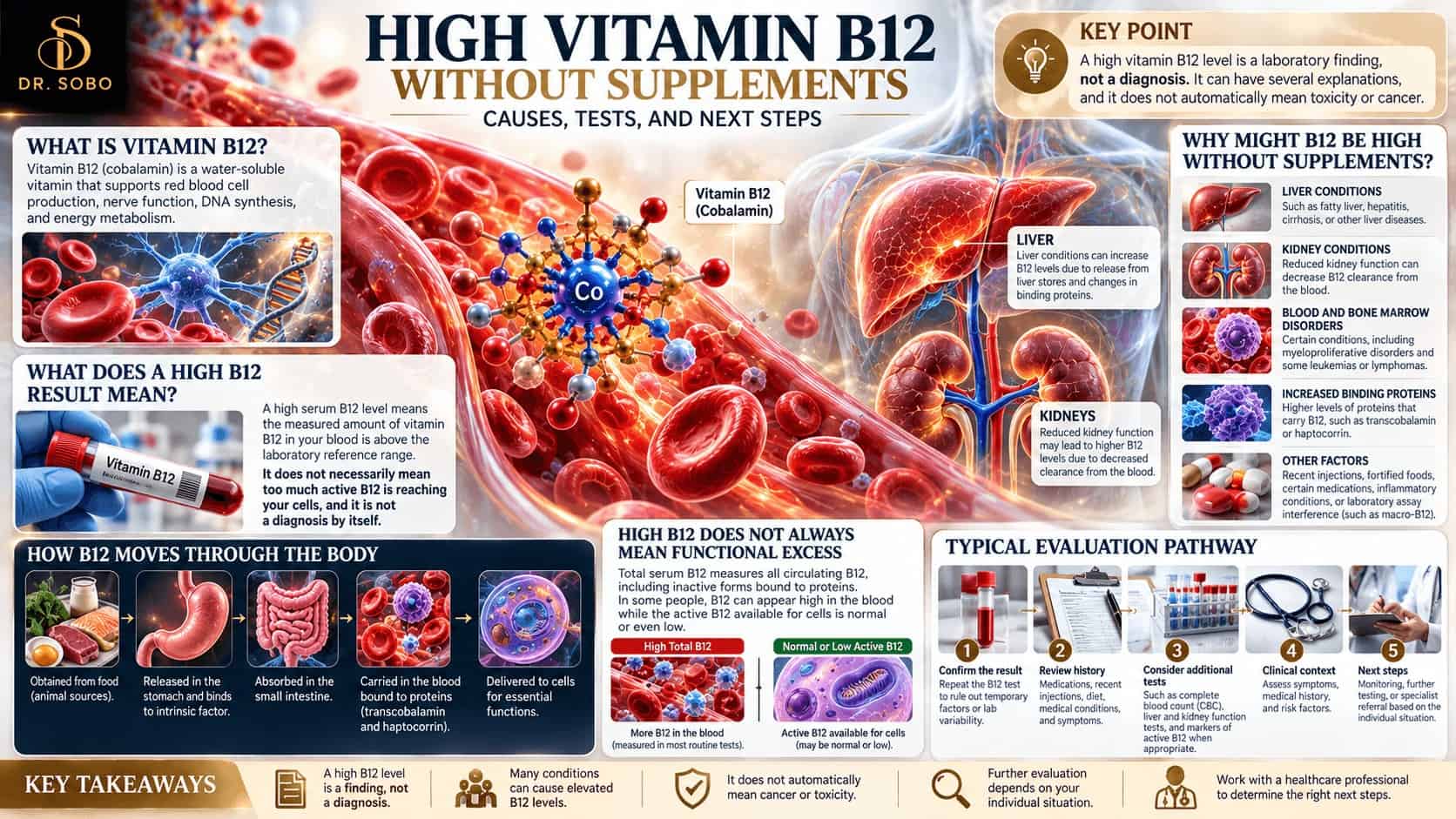
High Vitamin B12 Without Supplements: Visual Guide
The following infographic summarizes what total serum B12 measures, why the result may be elevated without reported supplementation, and the types of follow-up testing a clinician may consider.
What Tests Should Be Done for Unexplained High B12?
There is no single universally accepted testing panel for every person with elevated vitamin B12.
A reasonable starting point is often to confirm what was measured, review the report's reference interval, and identify any B12-containing products or recent treatments.
When the elevation is unexpected, persistent, or accompanied by other concerns, clinicians may choose additional tests according to the clinical findings.
| Test or review | What it may help clarify | When it may be useful |
|---|---|---|
| Review the original B12 report | Units, reference interval, test date, and degree of elevation. | For every unexpected result. |
| Medication and supplement history | Injections, fortified products, vitamins, and recent treatment. | Usually among the first steps. |
| Repeat B12 | Whether the abnormality persists. | When confirmation will change the next decision. |
| Complete blood count | White cells, red cells, platelets, and selected cell indices. | When unexplained elevation or hematologic concerns warrant review. |
| Peripheral blood smear | Blood cell appearance and abnormalities. | When the CBC or clinical findings suggest it. |
| Liver tests | Possible liver-related abnormalities. | Based on history, examination, and other results. |
| Kidney function tests | Creatinine, eGFR, and relevant kidney health. | When renal function may affect interpretation. |
| MMA or selected active B12 testing | Functional B12 status when deficiency remains a concern. | Not routinely necessary for every high B12 value. |
| Specialized binding-protein assessment | Potential causes of unexplained high total B12. | Selected persistent cases, often with laboratory specialist input. |
Should Vitamin B12 Be Repeated?
Repeating the test may help distinguish a temporary elevation from a persistent pattern, particularly when the result is unexpected and other information does not explain it.
However, the timing should be chosen by the clinician. There is no established universal retesting interval that applies to every elevated B12 result.
Repeated testing without a clinical question may add expense or anxiety without clarifying management.
If a recent injection or supplement explains the elevation, the clinician may take that history into account before deciding whether another test is useful.
What Does a Normal CBC Mean When B12 Is High?
A normal complete blood count can be reassuring, especially when there are no concerning symptoms or other laboratory abnormalities.
It does not, however, establish that the B12 result is meaningless or exclude every possible underlying condition.
The clinical importance of the finding depends on its persistence, the actual value, the patient's history, and the results of other relevant investigations.
The same principle applies to abnormal CBC findings. A clinician should identify the specific abnormality rather than using high B12 as a substitute for a diagnosis.
What Should You Do if Your Vitamin B12 Is High?
A sensible response begins with reviewing the full laboratory report and avoiding premature conclusions.
- Check the units and reference interval. Confirm what the laboratory actually measured and whether the value was above its stated upper limit.
- Review possible B12 exposure. Include injections, vitamins, nutritional products, energy drinks, and fortified foods or beverages.
- Compare previous results. Determine whether the elevation is new, longstanding, or associated with changes in health or treatment.
- Discuss symptoms and medical history. Mention unexplained weight loss, persistent fever, bruising, gastrointestinal symptoms, neurological concerns, or other changes.
- Review related blood tests. Your clinician may consider the CBC, liver measurements, kidney function, and other findings when appropriate.
- Agree on a focused next step. This might involve observation, confirmation, additional laboratory studies, or referral when justified.
The purpose is not to normalize B12 through unnecessary restriction, but to understand what the measurement means for that individual.
Should You Stop Eating Foods That Contain Vitamin B12?
Not simply because a blood test shows high serum B12.
Vitamin B12 is an essential nutrient. Foods such as meat, fish, eggs, and dairy products provide important nutrition, and dietary restriction is not an established treatment for unexplained elevated B12 caused by underlying medical conditions.
There is no evidence that cutting out all B12-containing foods diagnoses or treats the reason for an unexpectedly high serum result.
If a supplement or injection is being used, its appropriateness should be reviewed with the prescribing or supervising clinician.
Patients with documented deficiencies, absorption disorders, or other medical reasons for B12 therapy should not stop essential treatment based on a high measurement without medical guidance.
Does a High B12 Result Mean Vitamin B12 Toxicity?
No. A high serum B12 measurement is not equivalent to a diagnosis of vitamin toxicity.
The NIH Office of Dietary Supplements notes that vitamin B12 has a low potential for toxicity and that a tolerable upper intake level has not been established because of its low toxicity potential.
This does not mean every supplement is appropriate for every person or that very large doses should be taken without medical justification.
It means that an unexpectedly elevated B12 blood test should not be interpreted as proof that the vitamin itself is poisoning the patient.
The more useful medical question is whether the result reflects supplementation, changes in B12-binding proteins, an underlying condition, or an assay-related factor.
Is High Vitamin B12 the Same as High MCV?
No. These are different laboratory findings.
Vitamin B12 is a nutrient measured in the blood. Mean corpuscular volume, or MCV, describes the average size of red blood cells on a complete blood count.
Vitamin B12 deficiency can contribute to increased MCV, called macrocytosis. But an elevated serum B12 result does not automatically mean that red blood cells are enlarged.
A patient could have high total B12 with a normal MCV. Another patient could have high MCV due to folate deficiency, medication effects, liver disease, alcohol exposure, or another cause.
Interpreting each measurement according to its purpose helps avoid mistaking one abnormal result for an explanation of another.
For another distinct type of blood test abnormality, read Dr. Sobo's guide to iron deficiency without anemia. That article focuses on iron stores and ferritin rather than high B12.
Can High B12 Occur With Normal Liver and Kidney Tests?
Yes. Normal liver and kidney tests may make certain explanations less likely, but they do not automatically establish why serum B12 is high.
Possible additional considerations include recent B12 exposure, transport-protein variation, inflammation, laboratory effects, and other clinical factors.
How aggressively to investigate depends on the degree and persistence of elevation and the patient's broader circumstances.
It is reasonable to ask the clinician whether the next test will answer a specific question and whether its result would change the management plan.
When initial findings are reassuring, observation or repeat assessment may be appropriate in selected cases. When other abnormalities are present, a more directed workup may be useful.
When Should High B12 Be Evaluated More Promptly?
Unexplained high B12 deserves more attention when accompanied by potentially significant symptoms or abnormal laboratory results.
Examples include persistent unexplained weight loss, recurrent fever, night sweats, unusual bruising, persistent abdominal symptoms, yellowing of the skin or eyes, abnormal blood cell counts, or concerning liver or kidney results.
These findings are not specific to any one disease, but they may justify timely clinical assessment.
Chest pain, severe shortness of breath, new neurological deficits, significant uncontrolled bleeding, severe abdominal pain, or sudden marked illness should be evaluated urgently based on the symptoms themselves. A B12 result does not determine the cause and should not delay emergency care.
Patients without symptoms or accompanying abnormalities may still benefit from a planned discussion of an unexpected or persistent result, but emergency testing is not automatically necessary for a high B12 number alone.
How Is Unexpected High B12 Evaluated in Stamford, Connecticut?
Patients in Stamford and neighboring Fairfield County communities may discover elevated B12 during a nutritional evaluation, workup for fatigue, or routine laboratory testing.
At Optimal Health Medical, Dr. Henry C. Sobo, M.D., provides individualized medical consultations in which symptoms, relevant history, medications, supplements, and laboratory results can be reviewed together.
An appropriate discussion may involve clarifying B12 exposure, reviewing the complete blood count, considering nutritional concerns, and determining whether additional laboratory evaluation or specialist referral is warranted.
The practice also provides information about nutrient testing. Such services should be guided by clinical questions rather than an assumption that every patient with elevated B12 needs broad testing.
A physician-guided approach helps distinguish a laboratory finding from a confirmed clinical condition and supports a proportionate follow-up plan.
Questions About High Vitamin B12 Blood Test Results?
If your B12 result is elevated and you do not know why, bring your original laboratory report, medication and supplement list, previous results, and any relevant symptoms to your medical consultation. An individualized evaluation can help clarify whether confirmation, additional testing, or ongoing monitoring is appropriate.
Contact Optimal Health MedicalFrequently Asked Questions About High Vitamin B12 Without Supplements
1. Why is my vitamin B12 high if I do not take supplements?
High vitamin B12 without supplements may be associated with liver conditions, reduced kidney function, increased B12-binding proteins, certain blood disorders, inflammation, or laboratory-related factors. Some people also have unrecognized exposure through injections, multivitamins, or fortified products. A high B12 test is not a diagnosis. Your clinician may review the result, medication and dietary history, other blood tests, and symptoms to determine whether additional evaluation is useful.
2. Is high vitamin B12 dangerous?
Not automatically. An elevated serum B12 value does not independently prove vitamin toxicity or a serious medical condition. It may reflect increased circulating binding proteins, recent exposure, or another explanation. Persistent unexplained elevation can sometimes be associated with underlying illness, so it deserves interpretation in context. The degree of elevation, laboratory reference range, symptoms, CBC findings, and liver or kidney tests help guide the appropriate response.
3. Does a B12 level over 1,000 mean I have cancer?
No. A B12 concentration above 1,000 pg/mL does not diagnose cancer. Some observational studies have found associations between persistent unexplained elevation and later detection of certain cancers, but these studies cannot determine an individual's diagnosis from one laboratory value. Your clinician should consider medical history, routine screening, symptoms, other test results, and whether the elevation persists before recommending additional investigations. Extensive cancer testing is not automatically indicated for every elevated result.
4. Can liver disease cause elevated vitamin B12?
Yes. Some liver conditions may be associated with increased serum B12 because the liver stores the vitamin and plays a role in handling vitamin-binding proteins. However, high B12 does not identify a specific liver disease or establish that liver function is abnormal. A clinician may review liver-related tests, medications, alcohol exposure, symptoms, and medical history when appropriate. Further testing should follow the pattern of findings rather than the B12 result alone.
5. Can kidney problems raise B12 blood levels?
Yes. Reduced kidney function can affect the clearance and handling of proteins involved in vitamin B12 transport, contributing to elevated serum concentrations in some patients. However, a high B12 value cannot diagnose kidney disease. Creatinine, eGFR, urine testing, and relevant medical history provide more direct information about kidney health. Kidney function is also important when interpreting methylmalonic acid because renal impairment may increase MMA independently of vitamin B12 deficiency.
6. Can you have high serum B12 and still be deficient?
In selected circumstances, elevated total B12 may coexist with impaired functional B12 status or misleading assay results. Total B12 includes vitamin bound to different transport proteins and does not directly measure how every tissue uses B12. This situation is not assumed for most patients with high results. When symptoms or clinical findings suggest deficiency, a clinician may consider additional measurements such as methylmalonic acid, taking kidney function and other factors into account.
7. What is macro-B12?
Macro-B12 refers to certain large complexes involving vitamin B12 and binding proteins, sometimes associated with immunoglobulins, that may contribute to unexpectedly elevated serum measurements. The clinical importance and laboratory identification of these complexes can be complicated. Some proposed tests, including polyethylene glycol precipitation, have important specificity limitations. Specialized evaluation may be appropriate for selected persistently unexplained cases, ideally with input from the clinical laboratory, rather than routinely for everyone with high B12.
8. Should high vitamin B12 be retested?
Repeat testing may be useful when the result is unexpected, unexplained, or needs confirmation before deciding on further evaluation. Whether to repeat it and when depends on the actual value, possible recent B12 exposure, medical history, and accompanying laboratory findings. There is no universal retesting schedule for every patient with elevated B12. Ask your clinician what a repeat result would clarify and how it would affect the next decision.
9. What tests should follow an unexplained high B12 result?
Evaluation commonly begins with the original laboratory report and a careful review of medications, vitamins, injections, and fortified products. Depending on the circumstances, a clinician may consider a complete blood count, liver tests, kidney function, or repeat B12 measurement. Tests such as methylmalonic acid, blood smear, or specialized binding-protein investigations may be appropriate for selected questions. An extensive panel is not necessary for every patient solely because B12 is elevated.
10. Should I stop eating foods rich in vitamin B12?
Not simply because serum B12 is above the laboratory reference range. Vitamin B12 is an essential nutrient involved in blood cell production and nervous system health. Restricting ordinary B12-containing foods is not an established way to diagnose or correct an unexplained elevated result. If you receive B12 injections or take supplements for a medical reason, discuss the findings with the clinician managing that treatment before changing your regimen.
11. Does high B12 mean I have vitamin toxicity?
No. A high serum B12 concentration does not automatically indicate vitamin B12 toxicity. The NIH Office of Dietary Supplements describes B12 as having low toxicity potential, and no tolerable upper intake level has been established. Nevertheless, this does not justify unnecessary high-dose supplementation. When serum B12 is unexpectedly elevated, the more useful question is whether the result relates to exposure, transport proteins, laboratory factors, or an underlying medical condition.
12. When should I see a doctor about elevated B12?
Arrange a clinical review when B12 is persistently high without an obvious explanation or occurs alongside abnormal blood counts, liver or kidney tests, or new concerning symptoms. Unexplained weight loss, prolonged fever, unusual bruising, or other changes may justify more prompt assessment. Patients who feel well may still benefit from a focused interpretation of the report, but an isolated elevated B12 value does not automatically require emergency care or invasive testing.
Sources and Medical References
- NIH Office of Dietary Supplements. Vitamin B12: Fact Sheet for Health Professionals. Discusses B12 physiology, assessment, metabolic markers, and toxicity considerations. Read the NIH fact sheet.
- Fedosov SN, Nexo E. Macro-B12 and Unexpectedly High Levels of Plasma B12: A Critical Review. Nutrients. 2024;16(5):648. Read the peer-reviewed review.
- Review of laboratory biomarkers for vitamin B12 status. The Application and Interpretation of Laboratory Biomarkers for the Evaluation of Vitamin B12 Status. Read the review.
- Australian Prescriber. Vitamin B12 Deficiency: Testing and Treatment. 2026. Discusses total and active B12 testing and limitations of interpretation. Read the clinical review.
- Lacombe V, et al. Persistent Elevation of Plasma Vitamin B12 Is Strongly Associated With Solid Cancer. Scientific Reports. 2021;11:13361. Observational evidence; not a standalone cancer diagnostic test. Read the study.
- Unexplained Elevated Vitamin B12: Consider Macro-B12. Clinical laboratory discussion of persistent unexplained elevation and assay-related factors. Read the article.
- Moore and colleagues. Diagnostic Algorithms for the Investigation of Disorders of Vitamin B12: Clinical Practice Review. Journal of Laboratory and Precision Medicine. 2026. Read the clinical review.
Evidence checked: October 27, 2026. This article is intended for patient education. Elevated B12 should be interpreted using the patient's medical history, clinical findings, laboratory-specific reference intervals, and appropriately selected follow-up testing.

Medically Reviewed by Dr. Sobo
Dr. Henry C. Sobo, M.D.
Dr. Sobo is the physician associated with Optimal Health Medical in Stamford, Connecticut. His medical practice emphasizes individualized evaluation and consideration of laboratory results within the broader clinical picture.