
Iron stores · Laboratory interpretation · Stamford, Connecticut
Iron Deficiency Without Anemia:
A normal hemoglobin result does not answer every question about iron. Understand what your tests measure, which symptoms deserve attention, and why the cause matters as much as replacing iron.

Iron deficiency without anemia means iron deficiency is present even though hemoglobin has not fallen into the range that defines anemia. The distinction can be important when someone has persistent fatigue, a relevant blood-loss history, or an unexpected ferritin result. It also prevents a normal blood count from being mistaken for a complete assessment of iron status.
Low energy does not automatically mean low iron, and a supplement is not a diagnostic test. Sleep problems, thyroid disease, medication effects, infection, and other conditions can overlap with the symptoms people attribute to iron deficiency. The useful next step is to connect your history with appropriately selected laboratory tests and a plan for finding the cause.
At Optimal Health Medical in Stamford, Connecticut, discuss your symptoms and previous results with Dr. Henry C. Sobo, M.D. This guide focuses on conventional iron assessment and individualized next steps. It does not replace a medical evaluation or provide a self-prescribing dose.
Evidence status — October 13, 2026: Iron deficiency before anemia is an established clinical condition. The American Society of Hematology has published 2026 diagnostic guidance; its separate treatment recommendations are currently a draft under public review. Human trials support fatigue improvement in some selected groups, but do not establish that iron treats every case of unexplained tiredness.
Hemoglobin and iron stores answer different questions. Check which tests were actually ordered.
Ferritin needs consideration alongside symptoms, inflammation, risk factors, and other findings.
Replacing iron and addressing why it became deficient are connected but separate decisions.
What Is the Difference Between Iron Deficiency and Anemia?
Iron deficiency concerns the amount of iron available to the body; anemia concerns a hemoglobin concentration below the appropriate diagnostic threshold. They can occur together, but they are not interchangeable diagnoses. A person may have depleted iron stores before developing anemia, and anemia can also have causes other than iron deficiency.
Hemoglobin is the oxygen-carrying protein in red blood cells. Ferritin is an iron-storage protein, while transferrin transports iron. A clinician uses these different measurements to answer different questions rather than expecting one result to summarize the entire process. MedlinePlus explains what a hemoglobin test measures.
For practical purposes, keep both diagnoses clear when discussing your report. “My hemoglobin is normal, but my clinician is evaluating low iron stores” is more precise than saying either “my blood is normal” or “I have anemia” without confirmation. The wording matters when different offices review your history or arrange follow-up.
This article concerns adults discussing possible iron deficiency. Pregnancy, childhood, chronic kidney disease, and other specific conditions can require different assessment and treatment pathways. A general adult explanation should not be substituted for instructions from the clinician managing those circumstances.
Does a Normal CBC Rule Out Low Iron Stores?
No. A complete blood count, or CBC, assesses blood cells and includes hemoglobin, but it does not directly measure ferritin. Iron studies must be ordered when they are appropriate; they should not be assumed to be included in every set of “routine bloodwork.”
Ask for the actual report rather than relying only on the message that everything was normal. Check the test names, collection date, units, reference intervals, and clinician comments. A result from several months ago may not answer a new question after bleeding, a major dietary change, or another illness.
A useful conversation distinguishes “the CBC does not show anemia” from “the available evidence excludes iron deficiency.” Those are different conclusions. Conversely, having a normal CBC and feeling tired does not establish that an omitted iron test would be abnormal. The history should guide what additional information is needed.
Bring previous reports if you have them, especially when collection occurred through more than one practice. Comparing original documents reduces confusion about whether the same measurement was repeated. Ask which result will guide the next decision and whether further testing changes the management plan.
Which Symptoms Can Occur With Iron Deficiency Without Anemia?
Fatigue, reduced exercise tolerance, and difficulty concentrating can occur with iron deficiency, but these symptoms are not specific enough to diagnose it. Some people have few symptoms. The clinical question is whether iron deficiency is documented and whether it plausibly contributes to the person’s experience.
Describe your loss of function: what you previously managed, what is difficult now, and when the change began. Distinguish general tiredness from breathlessness, dizziness during standing, poor sleep, or a delayed worsening after activity. Those details may lead to different questions and evaluations.
An urge to move the legs at rest or unusual cravings, including persistent ice chewing, also deserve discussion. These experiences have several possible explanations. MedlinePlus describes the relationship between iron and restless legs syndrome, and its pica resource explains why unusual nonfood cravings warrant assessment.
Hair shedding should not be attributed to ferritin alone. If shedding began during weight-management treatment, see Dr. Sobo’s guide to hair loss during semaglutide or tirzepatide treatment. A focused iron evaluation can fit within a broader assessment without becoming an explanation for every symptom.
Which Blood Tests Help Assess Iron Status?
Ferritin and selected iron studies can add information to a CBC. Serum iron, transferrin or total iron-binding capacity, and transferrin saturation describe aspects of iron transport and availability. Your clinician decides which combination is useful; more tests are not automatically more informative.
| Measurement | Main question | Interpretation limit |
|---|---|---|
| CBC and hemoglobin | Is anemia present, and what do blood-cell measurements show? | A normal hemoglobin result does not directly assess iron stores. |
| Ferritin | What does the result suggest about stored iron? | Inflammation can raise the level and obscure deficiency. |
| Serum iron and binding capacity | How is circulating iron being carried? | An isolated serum iron result is not a complete diagnosis. |
| Transferrin saturation, or TSAT | How much of the iron-binding capacity is occupied? | Preparation and the broader clinical setting matter. |
| Additional targeted tests | Is another condition or inflammatory process relevant? | Selection should follow the history rather than a universal panel. |
MedlinePlus’s iron-test guide explains why multiple measurements may be used together. Ask the clinician to explain the pattern in plain language, including what is established and what remains uncertain. One highlighted value should not replace that interpretation.
If you have results described only as “low iron,” ask which measurement was low. Ferritin, serum iron, and hemoglobin are not synonyms. Keeping their names and units attached to the result helps avoid treatment decisions based on a remembered number from a different test.
What Ferritin Level Suggests Iron Deficiency?
Ferritin thresholds depend on the population and clinical setting. The ASH 2026 diagnostic summary suggests a threshold of 30 ng/mL or lower for adults outside menstruation or pregnancy. Its accompanying remarks allow higher thresholds in selected symptomatic or at-risk patients.
This is a diagnostic consideration, not a universal treatment target. Do not interpret a value just above 30 as proof that iron status is adequate in every circumstance, or a value below a social-media “optimal range” as proof that supplementation is necessary. Pregnancy, menstrual bleeding, inflammation, and associated illness can change interpretation.
The ferritin blood-test resource explains the measurement’s role and why an abnormal result needs context. Ask whether your clinician is interpreting the laboratory reference interval, a clinical diagnostic threshold, or a condition-specific treatment decision. Those are related but different concepts.
Preserve the units: ng/mL and micrograms per liter are numerically equivalent for ferritin. A value from another measurement cannot be compared as though it were ferritin. If previous reports use different terminology or ranges, bring them to the same review rather than deciding independently that the trend is reassuring or alarming.
Can Ferritin Look Normal When Iron Deficiency Is Still Possible?
Yes. Ferritin can increase with inflammation, so a result within the laboratory interval does not always exclude iron deficiency. ASH’s diagnostic guidance suggests checking both ferritin and transferrin saturation in adults with inflammation rather than relying on ferritin alone.
WHO guidance on ferritin assessment also addresses the effect of infection and inflammation. This does not mean that every normal ferritin result is misleading. It means that interpretation should reflect the patient’s situation and, when needed, additional information.
Tell the clinician whether you were unwell around collection and whether you have an inflammatory or chronic condition. A recent infection, a new diagnosis, or a treatment change is useful context. Do not try to subtract a fixed amount from the ferritin value to “correct” for inflammation.
A high ferritin result also does not automatically mean that more iron is needed or that iron overload is present. Different causes require different evaluation. Clarify the explanation and next step before choosing a supplement, stopping a prescribed product, or comparing your result with a generic online target.
What Can Cause Iron Deficiency Before Anemia Develops?
Potential causes include blood loss, insufficient intake, increased requirements, and impaired absorption. More than one can contribute. Replacing iron may address the deficiency while leaving its cause unresolved, so the evaluation should ask both whether iron is low and why.
| Possible contributor | History worth sharing | Question for your clinician |
|---|---|---|
| Blood loss | Menstrual changes, blood donation, visible bleeding, or prior bleeding problems. | Does the source of iron loss need a separate evaluation? |
| Food intake | Restriction, reduced appetite, difficulty obtaining food, or major dietary changes. | Can the eating plan meet my needs, and is additional treatment necessary? |
| Absorption concerns | Digestive illness, relevant surgery, or poor response to treatment. | Is there a reason oral iron might not work as expected? |
| Increased requirements | Pregnancy or another relevant life-stage change. | Should care follow a condition-specific pathway? |
You do not need to identify the cause before asking for help. Start with what changed and what is already known. A short chronology is often more useful than a list of diagnoses you suspect. Your clinician can decide which possibilities deserve testing, examination, or referral.
Why Is a Blood-Loss History Important Even With Normal Hemoglobin?
Blood loss can deplete iron before anemia appears. Explain menstrual bleeding, donation frequency, and any blood you have noticed. Small or intermittent gastrointestinal losses may not be visible; the absence of obvious bleeding does not settle the cause.
NIDDK’s gastrointestinal bleeding guidance describes both visible and occult bleeding. Tell the clinician about bowel changes, abdominal symptoms, medications associated with bleeding, and any previous evaluation. Do not stop anticoagulants or another prescription without instructions.
Unexplained deficiency in a man or someone past menopause deserves attention rather than automatic attribution to diet. Whether gastrointestinal testing is appropriate depends on age, symptoms, family history, the iron pattern, and other findings. Low ferritin alone does not diagnose cancer, and this article does not prescribe colonoscopy for every patient.
If you menstruate, describe changes in duration, flow, clots, and the effect on daily life. A pattern that has become familiar can still be clinically important. Ask whether the bleeding needs treatment alongside iron replacement; otherwise, the same problem may continue to affect future results.
When Should Absorption Problems or Digestive Conditions Be Considered?
Absorption deserves consideration when the history suggests a digestive condition, relevant gastrointestinal surgery, or an inadequate response to an appropriately managed oral treatment plan. A clinician may need to examine these possibilities instead of repeatedly increasing the dose.
Celiac disease can have digestive and non-digestive symptoms. Mention persistent bowel symptoms and previous diagnoses even if fatigue is your main concern. Do not start a restrictive diet solely to investigate yourself; ask how dietary changes might affect planned testing.
Bring details of any bariatric or other digestive surgery, including when it occurred and what nutritional follow-up was recommended. If you use acid-suppressing medication, include it on the list. Its presence does not prove the cause, but it may affect the discussion.
The next step should answer a specific clinical question. Ask what evidence supports an absorption concern, which tests could clarify it, and whether another specialist should be involved. A symptom checklist cannot establish that your body absorbs no iron or that intravenous treatment is automatically necessary.
Iron Stores, Testing, Symptoms, and Finding the Cause
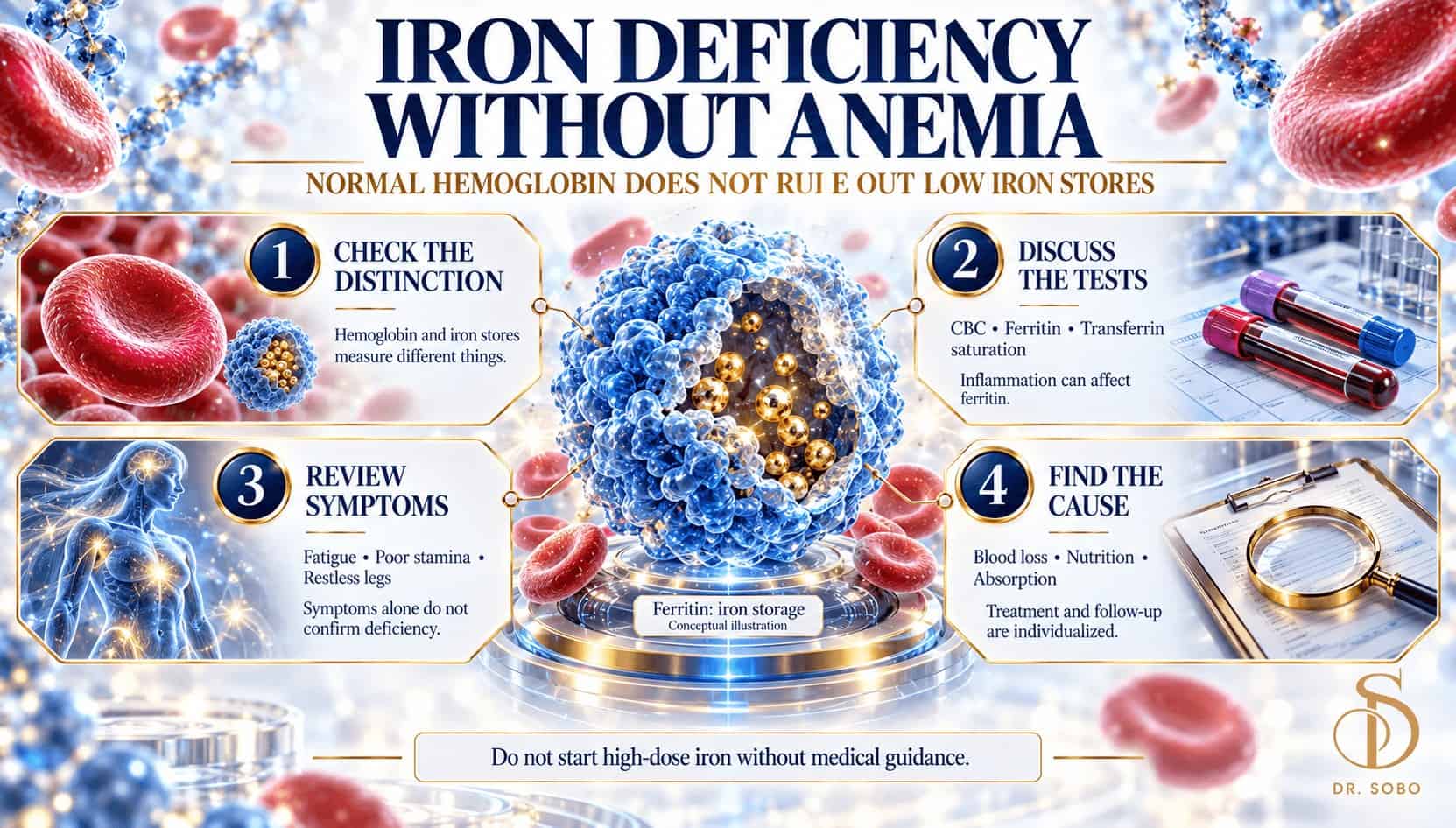
How Should You Prepare for Ferritin and Iron Studies?
Ask the ordering clinician and laboratory for instructions for the actual tests being collected. Preparation can differ between ferritin alone and a combined iron panel. MedlinePlus notes that fasting may be requested; do not assume every patient needs the same schedule.
Tell the office about current iron, multivitamins, and other supplements, including the last dose time. Ask whether anything should be paused and when to resume it. Never extend a pause or stop a prescribed medicine because you found general instructions intended for a different test.
If several tests are ordered together, request one clear plan for the collection appointment. Confirm the time, whether food or supplements affect preparation, and whom to contact if you accidentally depart from the instructions. Written directions reduce confusion when different clinicians are involved.
After collection, keep the report with the preparation details. When a result is unexpected, that information helps the interpreting clinician decide what it means. Repeating a test without clarifying preparation or the reason for the repeat can produce another number without resolving the original question.
How Is Iron Deficiency Without Anemia Treated?
Treatment depends on confirmed deficiency, its cause, symptoms, and the patient’s circumstances. Oral iron is commonly used; intravenous iron may be appropriate in selected situations. A 2025 clinical review in JAMA discusses these options across adult iron deficiency, including intolerance and absorption problems.
Ask for explicit instructions naming the product, elemental iron amount, schedule, and follow-up. The weight of an iron compound on a package is not necessarily the amount of elemental iron delivered. A pharmacy label, bottle photograph, or written plan is safer than remembering a tablet’s color or a brand name.
Do not combine several products because each seems to contain a small amount. A multivitamin and a separate iron preparation may overlap. Discuss the total use and the reason for each product rather than assuming an over-the-counter label makes unsupervised dosing appropriate.
Treatment should also address continuing loss or another contributor. Ask which part of the plan replenishes iron, which part investigates the cause, and who is coordinating them. Those responsibilities may involve more than one clinician, especially when menstrual, gastrointestinal, or specialist care is needed.
What If Oral Iron Causes Side Effects or Interacts With Medication?
Oral iron can cause constipation, nausea, abdominal discomfort, or diarrhea. MedlinePlus’s iron supplement information advises taking it as directed and reporting persistent or severe problems. A tolerability issue is a reason to contact the prescriber, not independently double, abandon, or substitute the treatment.
Explain which symptoms began, when they occur, and whether they prevent you from following the plan. Bring the exact preparation and dose. Ask whether the formulation, schedule, or administration instructions should change and whether further assessment is needed.
Iron can interfere with medicines, including levothyroxine. The NIH iron fact sheet discusses medication interactions. Ask the pharmacist or prescriber to review timing across the whole day rather than adopting a generic schedule that conflicts with other treatment.
Store iron securely away from children. Suspected overdose requires immediate advice from Poison Control at 1-800-222-1222 in the United States. Call 911 for collapse, a seizure, serious breathing difficulty, or inability to wake the person. Do not wait for routine follow-up in those circumstances.
Can Food Alone Correct Low Iron Stores?
Food can support iron intake, but diet alone may not adequately correct a documented deficiency when losses continue or absorption is impaired. Ask whether nutrition changes are sufficient for your situation or whether replacement treatment is also indicated.
Iron sources include meat, seafood, beans, and iron-fortified foods. Plant foods provide nonheme iron, whose absorption depends partly on the meal. A dietary plan can respect vegetarian choices, allergies, appetite, and budget; one prescribed menu does not fit every patient.
Describe a typical day of eating rather than only your best day. Include restrictions, foods you cannot tolerate, and whether nausea or low appetite limits intake. A manageable change that fits your routine is more useful than an ambitious plan you cannot maintain.
Dietary assessment should start from the reason iron is low. It should not imply that someone caused the deficiency by eating badly or that a particular food is a guaranteed treatment. If eating enough is difficult, explain the barrier so the plan can address it.
Does Low Ferritin Mean You Need an Iron Infusion?
No. Low ferritin alone does not determine the treatment route. Intravenous iron may be considered when oral treatment is unsuitable, ineffective in the clinical context, poorly tolerated, or unlikely to be absorbed adequately. The expected benefit and risks need individualized review.
An infusion is a medical treatment requiring an appropriate indication, product selection, administration, and monitoring. It should not be framed as a general energy boost. Ask why it is being considered, what alternatives exist, and how success will be judged.
If an infusion is recommended, clarify which clinician and facility will provide it, what preparation is required, and how follow-up results will be interpreted. Referral, insurance requirements, and treatment availability should be verified directly rather than assumed from an educational webpage.
This article does not establish that Optimal Health Medical provides intravenous iron. Contact the practice about evaluation and coordination of care. A recommendation to discuss iron status should not be interpreted as a promise that a particular product or procedure is available at the office.
What Do Human Trials Show About Iron and Fatigue?
Human randomized trials show that iron can improve fatigue in some selected nonanemic populations, but results are not uniform. Research needs to be read with the participant group, treatment duration, and outcome in view.
| Study | Population and duration | Finding and limit |
|---|---|---|
| Vaucher and colleagues, 2012 | 198 nonanemic menstruating women with fatigue and ferritin below 50 micrograms/L; 12 weeks. | Fatigue improved more with oral iron than placebo. Other measured outcomes did not all improve; findings do not apply automatically to every patient. |
| Waldvogel and colleagues, 2012 | 154 nonanemic iron-deficient female blood donors; four weeks. | Iron markers improved, but fatigue and other clinical outcomes did not show a significant benefit. |
These trials studied different situations. The donor study does not prove that treatment never helps, and the fatigue study does not prove that all tired people should take iron. Neither provides a personal recovery deadline or a universal ferritin target.
Clinical diagnostic guidance and treatment evidence also answer different questions. Identifying iron deficiency does not establish how much of an individual’s symptoms it explains. Ask what benefit is realistically expected and how the clinician will reassess the plan if tests improve but symptoms do not.
How Will You Know Whether the Treatment Plan Is Working?
Follow-up should evaluate symptoms, laboratory findings, tolerability, and whether the cause has been addressed. Hemoglobin alone may be an incomplete response measure when it was normal before treatment. Your clinician should specify which tests and outcomes will guide the review.
Confirm when to arrange repeat collection and whether preparation differs while taking iron. Do not order frequent tests on your own or assume that a short-term change establishes long-term correction. The timing should fit the treatment route and clinical question.
Record practical changes: whether you can complete a usual task more comfortably, whether sleep is still disrupted, and whether side effects interfere with treatment. This is more useful than checking only whether you feel perfect or whether one number reached an online target.
Know what happens after results return. Ask who will interpret them, whether you should continue the same regimen until contacted, and what concerns justify an earlier call. A clear endpoint and maintenance plan help avoid indefinite supplementation without reassessment.
What If Ferritin Improves but You Still Feel Tired?
Persistent fatigue needs reassessment rather than an automatic increase in iron. Improved tests do not prove that iron was the sole cause of symptoms, and a partial response does not rule out another contributor.
Tell the clinician what improved and what stayed the same. Compare function, sleep, symptom timing, and medication changes. If you are still unable to manage daily responsibilities, say so clearly instead of minimizing the problem because a laboratory value looks better.
A broader review may consider thyroid disease, sleep disorders, ongoing loss, another nutritional problem, or a different condition. For related practice information, see thyroid care and chronic fatigue syndrome care. Those links provide separate context; persistent tiredness alone does not establish either diagnosis.
A useful follow-up question is: “What evidence suggests more iron would help, and what else should we evaluate?” The answer should connect symptoms and testing with a specific next step. Repeating treatment without reconsidering the explanation can leave the original problem unresolved.
What Information Should You Record Before Your Appointment?
A concise timeline can make a consultation more productive. Start with the symptom or result that prompted the appointment, then note what changed beforehand. You do not need an elaborate spreadsheet or a self-diagnosis.
- Previous reports: collection dates, complete results, units, and reference intervals.
- Symptoms: onset, frequency, and effect on work, activity, sleep, or self-care.
- Possible losses: menstrual changes, blood donation dates, or observed bleeding.
- Treatment history: exact products, doses, side effects, and any prior response.
- Other context: digestive diagnoses or surgery, pregnancy, food restrictions, and current medicines.
Bring product labels when possible. “I take iron” may describe preparations with different elemental amounts and schedules. If you were advised to stop or restart a product, record who gave the instructions and when.
If tracking is burdensome, prioritize a few clear examples and original reports. Ask the office which documents it needs in advance. The purpose is to help the clinician reconstruct the clinical question, not to prove that you have exhausted every possible explanation.
When Should You Seek Urgent Care Instead of Waiting for Iron Testing?
Seek urgent help for chest pain, severe breathing difficulty, fainting, vomiting blood, or signs of substantial bleeding. A previous normal hemoglobin result does not make a new serious symptom safe to ignore.
Iron can darken stools, but black, tarry stools can also indicate gastrointestinal bleeding. MedlinePlus explains this distinction. Do not assume every dark stool is a harmless supplement effect, especially when accompanied by dizziness, pain, weakness, or visible blood.
Contact a clinician promptly for new bleeding, worsening symptoms, or difficulty maintaining food and fluids. For stable concerns about fatigue or a report, arrange a routine review. The urgency should follow the symptoms and clinical circumstances, not a ferritin number considered in isolation.
Discuss Iron Status With Dr. Sobo in Stamford, Connecticut
Bring your reports, symptom timeline, and medication and supplement list to a consultation with Dr. Sobo. State whether another clinician manages menstrual, digestive, pregnancy-related, or hematology care so evaluation and treatment can be coordinated.
Useful questions include what confirms the deficiency, whether inflammation complicates interpretation, what cause needs attention, and which treatment options fit your situation. Ask who will arrange referrals when appropriate and how follow-up decisions will be communicated.
The practice’s nutrient-testing page discusses broader nutritional assessment. Testing for iron deficiency in this article concerns conventional measures such as ferritin, hemoglobin, and transferrin saturation; a broad wellness panel should not be assumed to replace them.
A consultation should produce a clear next step based on the available evidence. That might mean targeted testing, review of an existing plan, nutritional guidance, treatment consideration, or specialist coordination. No single appointment or supplement can promise to explain every symptom or guarantee recovery.
Get a Clearer Plan for Your Symptoms and Iron Results
Contact Optimal Health Medical to discuss an evaluation with Dr. Sobo. Bring the complete report and your current treatment information so the discussion can address your individual circumstances.
Optimal Health Medical, LLC
111 High Ridge Road, Stamford, CT 06905
Frequently Asked Questions About Iron Deficiency Without Anemia
Can you have iron deficiency without anemia?
Yes. Iron stores can become depleted before hemoglobin falls into the range that defines anemia. A normal CBC therefore does not directly establish that iron stores are adequate. Your clinician may use ferritin and other iron studies when the history supports assessment. Diagnosis should combine the results with relevant symptoms, risk factors, and the possibility of inflammation.
Can low ferritin cause fatigue when hemoglobin is normal?
Iron deficiency may contribute to fatigue even without anemia, and selected human trials have found benefit from treatment. However, fatigue has many possible causes, and low ferritin does not establish that it explains every symptom. Confirm the iron findings, investigate the cause, and discuss realistic treatment goals. Persistent fatigue after improvement in iron status needs reassessment.
Does a normal CBC mean I do not need iron studies?
Not necessarily. A CBC measures blood cells and hemoglobin, while ferritin and iron studies provide different information. Whether additional testing is appropriate depends on symptoms, blood-loss history, nutrition, associated illness, and prior findings. Ask which tests were actually collected and what they establish. A normal CBC alone neither diagnoses iron deficiency nor excludes it in every circumstance.
What ferritin level means iron deficiency?
Thresholds depend on the clinical setting. ASH’s 2026 diagnostic summary suggests 30 ng/mL or lower for adults outside menstruation or pregnancy, with additional considerations for symptoms and risk factors. Other populations and inflammation require contextual interpretation. A diagnostic threshold is not a universal treatment target. Ask your clinician how the guidance applies to your actual report and medical history.
Can ferritin be normal despite iron deficiency?
Yes. Inflammation can raise ferritin and make an apparently normal result harder to interpret. In adults with inflammation, ASH guidance suggests ferritin and transferrin saturation together rather than ferritin alone. Tell your clinician about relevant illness around collection and ongoing conditions. Do not assume every normal result is misleading or attempt to calculate your own correction for inflammation.
What causes low iron without anemia?
Possible contributors include blood loss, insufficient intake, increased requirements, and impaired absorption. Menstrual bleeding, blood donation, digestive conditions, and relevant surgery may be important, and several factors can coexist. A clinician should investigate the history rather than assume diet is the explanation. Replacing iron and addressing the underlying cause are connected parts of care, with follow-up based on the individual situation.
Should I start iron supplements because I feel tired?
Do not use tiredness alone to choose an iron dose. Fatigue does not confirm deficiency, and unnecessary iron can cause harm or interact with medication. Discuss appropriate evaluation first. If treatment is recommended, obtain clear instructions for the exact product, elemental iron amount, schedule, and follow-up. Include multivitamins and other products so overlapping iron intake can be reviewed.
Does low ferritin mean I need intravenous iron?
No. The treatment route depends on the confirmed findings, cause, tolerability, absorption, and clinical needs. Oral iron is commonly used, while intravenous treatment may be considered in selected circumstances. Ask why a particular route is recommended and how benefit and risks will be assessed. This educational article does not establish that intravenous iron is offered at Optimal Health Medical.
Can I take iron with my thyroid medication?
Iron can interfere with levothyroxine absorption, so administration timing needs review. Ask your prescriber or pharmacist to check the exact thyroid preparation, iron product, and the rest of your medication schedule. Do not stop thyroid medicine or create your own dose adjustment. Supplement instructions and thyroid-treatment instructions should be coordinated rather than treated as independent plans.
How soon will iron treatment improve my energy?
There is no guaranteed timeline. Response depends on whether iron deficiency contributes to symptoms, whether treatment is tolerated and effective, and whether loss or absorption problems continue. Clinical trials use specific populations and follow-up periods that do not predict an individual recovery date. Review symptoms and tests at the interval your clinician recommends, and report persistent or worsening problems.
Can food alone restore my iron stores?
Diet can support iron intake, but it may be insufficient to correct documented deficiency when losses continue or absorption is impaired. Discuss the cause, usual eating pattern, restrictions, and practical barriers with your clinician. A tailored plan may include food changes, replacement treatment, or additional evaluation. Do not assume one iron-rich food or a restrictive diet is a guaranteed solution.
When should I seek urgent help for symptoms related to low iron?
Chest pain, severe breathing difficulty, fainting, vomiting blood, or substantial bleeding require urgent or emergency attention. Black, tarry stools may indicate gastrointestinal bleeding, even though iron can also darken stool. Do not assume a supplement explains a new concerning change. Seek advice promptly for worsening symptoms, and do not wait for routine ferritin testing during a possible emergency.
Sources
- American Society of Hematology: Diagnosis of Iron Deficiency and current treatment-guideline status.
- ASH: 2026 diagnostic recommendations, visual summary.
- WHO: Guideline on use of ferritin concentrations to assess iron status, 2020.
- NIH Office of Dietary Supplements: Iron, Health Professional Fact Sheet.
- MedlinePlus: Hemoglobin Test.
- MedlinePlus: Iron Tests.
- MedlinePlus: Ferritin Blood Test.
- MedlinePlus: Iron Supplements.
- MedlinePlus Genetics: Restless Legs Syndrome.
- MedlinePlus: Pica.
- NIDDK: Symptoms and Causes of Gastrointestinal Bleeding.
- NIDDK: Symptoms and Causes of Celiac Disease.
- Auerbach and colleagues: Iron Deficiency in Adults, JAMA review, 2025.
- Vaucher and colleagues: Randomized trial of iron for fatigue in nonanemic menstruating women, 2012.
- Waldvogel and colleagues: Randomized trial in nonanemic iron-deficient female blood donors, 2012.
- MedlinePlus: Black or Tarry Stools.