
Thyroid health · Supplement safety · Stamford, Connecticut
Biotin and Thyroid Blood Tests
A supplement taken for hair or nails can affect some thyroid laboratory measurements. Learn what to disclose, why preparation instructions differ, and how to respond to an unexpected result.

Biotin and thyroid blood tests can be a confusing combination. A supplement taken for hair or nails may affect the way a laboratory measures thyroid markers, creating an abnormal-looking result that does not accurately reflect what is happening in your body. That matters whether you are being screened for thyroid disease, monitoring an existing condition, or deciding whether a thyroid medication dose needs to change.
The useful question is specific: does your supplement contain biotin, and can it interfere with the particular tests your laboratory uses? An alarming result should be evaluated carefully, but it should not automatically be dismissed as a supplement effect. Genuine thyroid disease and laboratory interference can coexist.
This guide explains what to tell your clinician, how to read a supplement label, why recommendations for pausing biotin differ, and what to do if blood has already been drawn. Patients seeking thyroid care in Stamford, Connecticut can learn about Dr. Sobo’s thyroid services and bring their complete medication and supplement list to an appointment.
Evidence checked October 13, 2026: Biotin interference is documented in human studies and laboratory guidance. Its direction and duration depend on the assay, supplement exposure, and patient factors. This is an established testing concern, not evidence that biotin treats thyroid disease.
Bring the current label, your actual dose, and the date and time you last took it.
Biotin does not affect every thyroid assay in the same way. Ask for your laboratory’s instructions.
Unexpected results deserve context. Do not adjust prescribed thyroid medicine yourself.
Does Biotin Change Thyroid Function or the Laboratory Result?
The key concern is interference with the measurement process. Biotin, also called vitamin B7, is a nutrient. It is also used as part of the chemistry in some laboratory tests. Excess biotin circulating in a blood sample can disrupt that chemistry, so the instrument reports a value that is higher or lower than the actual concentration.
An assay is the laboratory method used to measure a substance. Some assays use biotin and a binding protein called streptavidin to help capture or detect the target. The biotin already present in a patient’s sample can interfere with those steps. The effect depends on how the assay is designed, rather than simply whether the blood was drawn at a hospital or a commercial collection center. The AACC/ADLM laboratory guidance explains why test design matters.
This distinction protects patients from a common misunderstanding: a changed test number does not necessarily mean that a supplement has changed thyroid hormone production. It also does not mean that every unexpected result is an error. Your clinician must consider symptoms, medical history, previous values, current treatment, and the laboratory method.
For example, a person taking a hair supplement might receive an unexpected thyroid result at a routine appointment. Another person with known thyroid disease might receive an unexpected result while genuinely experiencing a change in thyroid function. Both need a careful review. The supplement history helps guide that review; it does not supply the diagnosis.
Which Thyroid Blood Test Results Can Biotin Affect?
Biotin can affect TSH, thyroid hormones, thyroglobulin, and some other thyroid-related measurements when the assay is susceptible. The familiar pattern of a low TSH with high thyroid hormones is possible, but it is not universal. Some methods do not use the susceptible chemistry, and even tests on the same instrument can behave differently.
| Measurement | What it helps assess | Possible interference |
|---|---|---|
| TSH | Pituitary signaling to the thyroid | May be falsely low in susceptible methods. |
| Free T4 or T3 measurements | Thyroid hormone concentrations interpreted in clinical context | Some measurements may be falsely high; the exact assay matters. |
| Thyroglobulin | A thyroid protein used in selected thyroid cancer follow-up | May be falsely low in susceptible methods. |
| Other thyroid-related assays | Additional diagnosis-specific questions | Direction and susceptibility must be checked with the laboratory. |
These are potential effects, not a way to correct your own numbers. There is no reliable patient calculation that turns an affected result into an accurate one. Subtracting a percentage, comparing the value with an internet chart, or assuming a familiar-looking pattern is harmless could lead to the wrong decision.
A clinician may ask the laboratory whether interference is plausible, arrange another specimen after an appropriate pause, or request a suitable alternative method. The approach depends on the urgency of the clinical question. A routine monitoring visit and an urgent assessment do not necessarily use the same sequence of steps.
How Can You Tell Whether Your Supplement Contains Biotin?
Read the Supplement Facts panel and ingredient list, including the serving size. Biotin may appear in a single-ingredient product, a B-complex supplement, a multivitamin, or a product marketed for hair, skin, or nails. The front label alone may not tell you the daily amount.
Milligrams and micrograms are different units: 1 milligram equals 1,000 micrograms. A label showing 5,000 mcg describes 5 mg, while 10,000 mcg describes 10 mg. Writing down the unit prevents a thousandfold misunderstanding. Copy the number exactly instead of reporting that you take “a small vitamin.”
Also distinguish the amount per serving from the amount per capsule or gummy. If the label gives the amount for a two-gummy serving and you take one gummy, tell the clinician both the printed serving amount and your actual use. If you use more than one product, bring every label so the amounts can be reviewed together.
Useful details include the product name, biotin amount, serving size, number of servings taken, how regularly you take it, and the date and time of your last dose. A clear photograph of the complete panel can be easier to interpret than a remembered brand name. Product formulations can change, so a current label is more useful than an old online listing.
If you cannot find biotin on the package, do not guess from words such as “beauty,” “energy,” or “wellness.” Ask a pharmacist or the manufacturer about the ingredients. If the amount is unclear, tell the ordering clinician that it is unclear before assuming a particular waiting period is adequate.
How Long Should You Stop Biotin Before a Thyroid Blood Test?
Ask your clinician and laboratory for instructions matched to your supplement dose and the planned tests. Published recommendations differ because they address different assays, exposures, and clinical situations. A minimum interval in one guidance document is not a guarantee that every thyroid test will be unaffected.
The American Thyroid Association’s general thyroid-testing information advises avoiding biotin for two days before testing. A separate ATA summary of a 2021 human study advises at least three to five days. Laboratory guidance from AACC, now the Association for Diagnostics & Laboratory Medicine, discusses a minimum of eight hours after 5–10 mg doses, while recognizing that longer intervals may be required for susceptible assays. These recommendations come from ATA thyroid-testing information, the ATA’s biotin study summary, and laboratory guidance on biotin interference. Higher prescribed doses and impaired kidney function require additional consideration.
| Source | Published guidance | How to use it |
|---|---|---|
| ATA thyroid function information | Two days before thyroid testing. | Discuss with the ordering clinician; this is general patient guidance. |
| ATA study summary, January 2022 | At least three to five days. | A more conservative recommendation discussed alongside a 10 mg study. |
| AACC laboratory guidance | Minimum eight hours after 5–10 mg; longer may be needed. | Laboratory-specific minimums should not replace your test-specific instructions. |
These intervals are alternatives to discuss, not instructions to choose the shortest one. If your laboratory recommends a longer pause, ask why and follow the agreed plan. If a supplement was prescribed for a medical condition, obtain guidance from that prescriber before interrupting it.
When instructions conflict, send the ordering office the actual supplement label and the laboratory’s written preparation requirements. Ask which plan applies to your appointment and whether a repeat draw would be needed if you cannot complete that plan. Resolving the question before collection is usually more useful than trying to explain an uncertain result afterward.
Your Biotin and Thyroid Testing Checklist
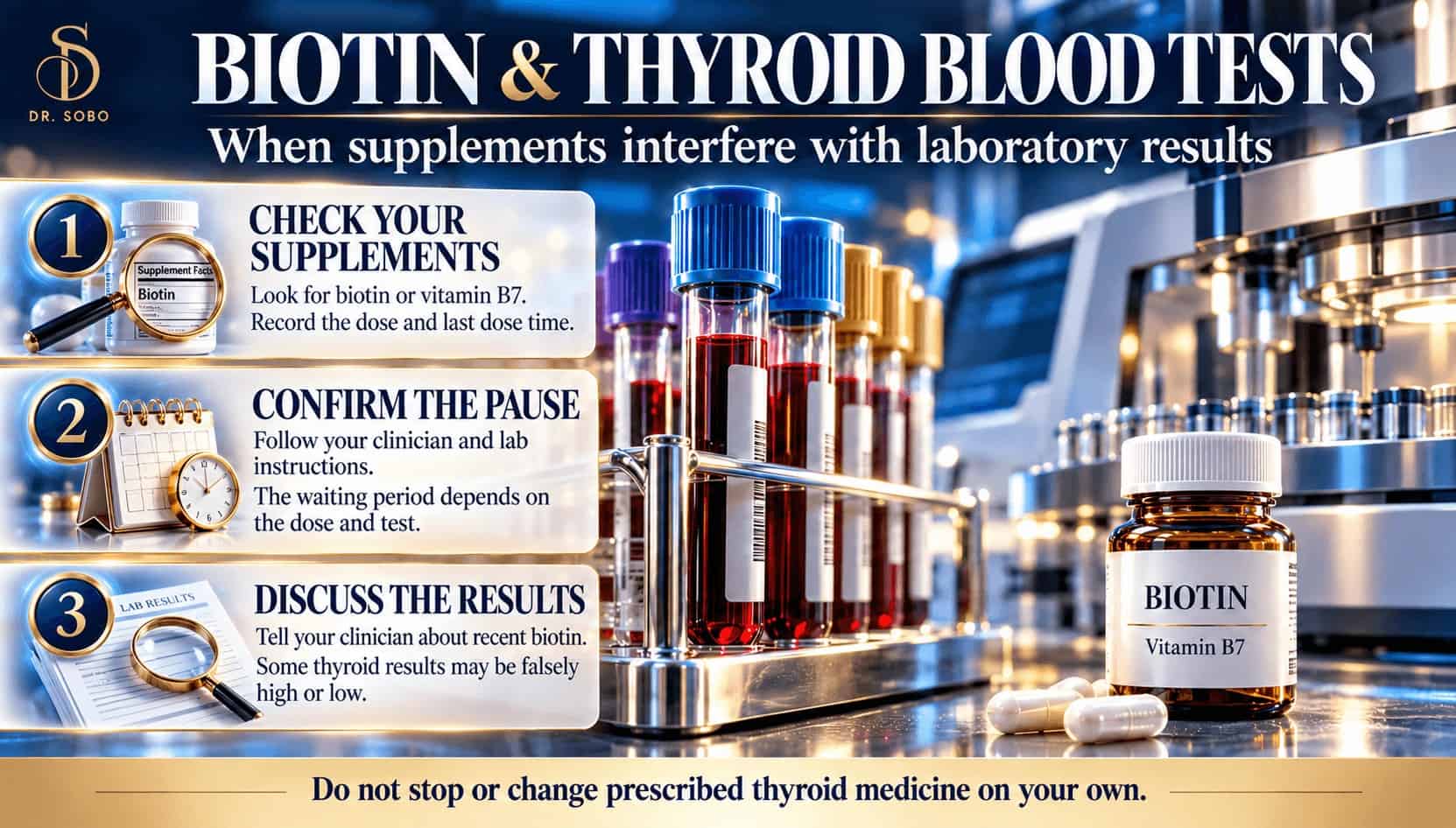
What Should You Do Before Your Blood Draw?
Prepare a complete supplement history, confirm any biotin pause, and keep prescribed medication instructions separate. “Stop biotin” does not mean “stop everything.” Blood tests may have different requirements, especially when thyroid testing is combined with other laboratory work.
- Gather current labels. Include products you take occasionally as well as your daily routine.
- Tell the ordering clinician. Share the dose, frequency, last dose time, and reason for taking biotin.
- Confirm the laboratory instructions. Ask about the actual thyroid tests ordered and any additional tests collected at the same visit.
- Clarify prescription timing. Ask whether your usual thyroid medicine should be taken before or after collection; do not decide from the supplement instructions.
- Record the agreed plan. Save it with the appointment details so you do not have to reconstruct it on the morning of testing.
- Disclose any departure from the plan. If you accidentally took biotin, tell the office and collection staff before blood is drawn.
A useful appointment note is simple: product name, amount and unit, actual servings taken, last dose date and time, and the preparation instructions you received. This is information for your clinical team, not a self-testing protocol. It lets the person interpreting the result see what happened rather than assuming preparation was completed.
If you are arranging laboratory work through more than one clinician, share the supplement history with each ordering team. A list held by one office may not automatically appear in another office’s records. Likewise, telling the collection staff does not replace telling the clinician who will review the result.
What Questions Should You Ask When Scheduling Thyroid Testing?
Ask for one clear plan that identifies the supplement, the tests, the preparation instructions, and the person who will interpret the results. You do not need to select a laboratory assay yourself. You do need to make sure the clinical team knows what you are taking and that you understand its instructions.
- Which product should I pause? Show the current label rather than assuming that every vitamin in your routine is covered by a biotin instruction.
- What date and time should the pause start? Ask the clinician to translate its instructions into your actual appointment schedule.
- What should I do with prescribed medicine? Confirm thyroid medication timing separately and follow the prescribing clinician’s advice.
- Who should I contact if I accidentally take biotin? Save the ordering office’s contact details before the morning of collection.
- How will I receive the results? Clarify who will review them and whether follow-up is needed before making a treatment decision.
If your appointment changes, ask whether the original preparation plan still applies. If another clinician adds tests, share the supplement information with that office as well. The useful outcome is a documented, understandable plan, rather than a collection of conflicting instructions remembered from different websites.
After the draw, keep the report, supplement information, and any follow-up instructions together. If a repeat test is arranged, record what changed between the two collections. That helps the clinician evaluate the sequence without assuming that a new number represents either a true thyroid change or a confirmed laboratory error.
What If You Already Took Biotin or Already Had the Test?
Contact the ordering clinician with the dose and timing. Do not assume the specimen is unusable, and do not assume it is unaffected. The laboratory may be able to identify whether the ordered assays are susceptible and advise the clinician about next steps.
If the blood draw has not happened
Tell the office before the appointment when possible. Staff may advise proceeding with appropriate documentation, changing the testing plan, or moving a routine collection. Do not independently delay an urgent assessment because an elective preparation interval has not been completed.
If a result is already available
Send the supplement information to the clinician interpreting it. Include the collection time and any recent changes in thyroid medicine, symptoms, or supplements. Ask whether interference needs to be investigated before a treatment change. An unexpectedly low TSH deserves context, but it should not be labeled a false result by the patient.
If your medication dose was changed
Contact the prescribing office promptly and explain that biotin was used around the test. Ask whether the interpretation or follow-up plan should be revisited. Do not reverse the change yourself or take extra tablets to compensate. The prescriber needs to weigh the original results, the possibility of interference, and your current clinical situation.
Keep copies of the original result and any repeat result with their dates. Avoid comparing isolated screenshots that omit the assay’s reference interval or units. A clear sequence of supplement use, collection, treatment decisions, and follow-up is more informative than one flagged number.
Can Biotin Make It Look Like Graves’ Disease or Too Much Thyroid Medication?
Yes, susceptible tests can produce a biochemical pattern that resembles hyperthyroidism or excessive replacement therapy. Case reports describe this problem, but a resemblance is not a diagnosis. Graves’ disease, thyroiditis, medication-related changes, and other explanations may still require evaluation.
Symptoms and history matter. A clinician should not treat a laboratory flag as the whole story, yet the absence of obvious symptoms does not prove interference. The correct question is whether the result fits the clinical picture and whether the laboratory can help assess an analytical explanation.
For someone taking replacement thyroid hormone, an inaccurate result could create confusion about the dose. For someone being assessed for possible new thyroid disease, it could confuse the diagnostic pathway. The goal is to obtain interpretable evidence before making decisions that depend on that evidence.
This guide focuses on supplement-related testing errors. It does not determine which thyroid preparation is best for a patient or whether additional testing is indicated. Those are separate clinical questions that should be addressed after the reliability and meaning of the results have been considered.
Why Might Two Laboratories Report Different Results?
Different laboratories may use different instruments, reagent versions, and measurement methods. A biotin effect observed in a published study does not establish that every current test from the same manufacturer has the same susceptibility.
A 2023 study using a Beckman analyzer found interference in some biotin-based thyroid assays while other assays were unaffected. A 2025 publication examined a newly formulated free T4 assay with improved resistance to biotin interference. These findings reinforce the need to ask about the current assay, rather than deciding that an entire laboratory brand is either vulnerable or immune.
Other factors can also complicate comparisons, including different reference intervals, treatment timing, and changes in the patient’s health. A clinician may want follow-up testing performed consistently or may deliberately request a different method to investigate interference. Those are different purposes, so the choice should be intentional.
If you change collection centers, provide prior reports rather than only a verbal summary. Ask whether the new results can be compared directly with the old ones. A laboratory change does not automatically explain an abnormal value, but documenting it can prevent a misleading comparison.
What Does the Research Show, and What Remains Uncertain?
Human studies demonstrate biotin interference, but their small samples and selected assay platforms limit universal predictions. In a 2021 prospective study, 13 adults took 10 mg daily for eight days. Researchers compared thyroid-related measurements using different methods and found assay-dependent changes. This supports the testing concern; it does not establish that every person taking that amount will receive the same error.
A separate 2020 human study evaluated 10 healthy adults taking 5 mg and 10 mg daily for seven days. The duration of interference differed by dose and instrument, with the higher dose producing interference lasting one or two days in affected methods. Its results should not be used as a personalized clearance schedule for patients with different medical circumstances.
Case reports add examples of misleading thyroid results in clinical practice. They illustrate what can go wrong and why a supplement history matters, but they cannot estimate how frequently the problem occurs in all patients. Bench testing can explain assay behavior without proving what will happen in a specific clinical sample.
The evidence therefore supports three practical conclusions: disclose biotin, confirm test-specific preparation, and investigate unexpected results in context. It does not support an exact correction formula, a guaranteed safe dose for every assay, or an automatic diagnosis of interference whenever thyroid values are abnormal.
Does This Mean You Should Avoid Every Supplement?
No. A testing interaction is a reason for better documentation and appropriate preparation. It is not a reason to assume every supplement is harmful or to stop medically necessary treatment. The purpose, dose, evidence, and individual circumstances should be reviewed separately.
Biotin is often marketed for hair and nails, but evidence for broad cosmetic benefits in people without a relevant deficiency is limited. A supplement should have a clear reason for use. If the original concern is hair shedding during medical weight loss, review the separate guide to hair loss during semaglutide or tirzepatide treatment rather than assuming high-dose biotin addresses the cause.
When discussing alternatives, start with the symptom or diagnosis that prompted the supplement. Ask what evaluation is appropriate, whether nutrition needs attention, and whether a particular supplement is necessary. Replacing biotin with another unreviewed “thyroid support” product can introduce a new issue rather than solve the original one.
When Should You Seek Urgent Medical Care?
Seek urgent care for chest pain, severe trouble breathing, fainting, or other severe or rapidly worsening symptoms. Tell the treating team about biotin, including your last dose, but do not postpone emergency care while waiting for it to clear.
The FDA has warned about biotin interference that can cause falsely low results in susceptible troponin assays used when evaluating possible heart injury. This is a separate safety concern from routine thyroid monitoring. Emergency clinicians and laboratories need the supplement history so they can interpret testing appropriately.
For a routine abnormal thyroid result without urgent symptoms, contact the ordering clinician to discuss the next step. The fact that biotin can interfere does not make concerning symptoms safe to observe at home, and it does not remove the need for appropriate medical evaluation.
Discuss Thyroid Testing With Dr. Sobo in Stamford, CT
Bring your previous laboratory reports and current medication and supplement labels to a thyroid appointment. That information helps your clinician interpret results in the context of your treatment and symptoms.
Explore thyroid care at Optimal Health Medical or contact the office to discuss an evaluation.
Optimal Health Medical
111 High Ridge Road, Stamford, CT 06905
Frequently Asked Questions About Biotin and Thyroid Blood Tests
Can biotin cause a falsely low TSH?
Yes. Supplemental biotin can make TSH appear falsely low in susceptible laboratory assays. Other TSH methods may be unaffected. Tell the ordering clinician the product, dose, and last dose time, especially if the result is unexpected. A low TSH can also reflect genuine thyroid disease or medication effects, so biotin use alone does not prove that a result is incorrect.
Can biotin make free T4 or T3 appear high?
Yes. Some thyroid hormone assays can report falsely elevated values when biotin interferes with the measurement process. The effect depends on the exact test, rather than applying to every T4 or T3 result. Your clinician may consult the laboratory or arrange follow-up testing. Do not use an internet correction formula or change thyroid treatment based on a presumed supplement effect.
Is stopping biotin for two days always enough?
No single interval is guaranteed for every patient and assay. ATA general information advises two days, while a separate ATA study summary advises three to five days. Laboratory guidance also depends on dose and assay susceptibility. Ask your clinician and laboratory which interval applies to your actual supplement and planned tests, particularly with high prescribed doses or impaired kidney function.
Does a multivitamin count as a biotin supplement?
It can. Biotin is included in some multivitamins and B-complex products as well as dedicated hair and nail supplements. Check the current Supplement Facts panel, serving size, and amount you actually take. Share all products with your clinician so combined use can be reviewed. The fact that a product is called a multivitamin does not establish its relevance to a particular assay.
Is 5,000 mcg the same as 5 mg?
Yes. One milligram equals 1,000 micrograms, so 5,000 mcg equals 5 mg and 10,000 mcg equals 10 mg. Preserve the units when recording your supplement use. Also check whether the label describes an amount per serving or per individual gummy or capsule. Your clinician needs your actual use, including any additional products containing biotin.
Should I stop my thyroid medication before testing?
Do not stop or change prescribed thyroid medication on your own. Instructions about pausing biotin concern a supplement-related testing interaction and do not automatically apply to thyroid medicine. Ask the ordering clinician about medication timing before collection. This is particularly important when you are monitoring treatment, because consistent preparation and an accurate medication history help with interpretation.
What if I took biotin on the morning of my test?
Tell the ordering office and laboratory the dose and time before collection, if possible. They can decide whether to proceed, change the testing plan, or reschedule routine testing. If blood has already been drawn, provide the information to the clinician reviewing the results. Do not assume the sample is either unusable or unaffected, and do not delay urgent care.
Can biotin interfere with thyroid cancer monitoring?
Yes. Biotin can affect thyroglobulin measurements in susceptible assays, and thyroglobulin is used in selected thyroid cancer follow-up. Notify the specialist directing your monitoring about supplements before testing. The meaning of a result depends on the cancer history, treatment, other tests, and laboratory method. Biotin use does not by itself establish that a change in a tumor marker is false.
Can another laboratory avoid biotin interference?
A suitable alternative method may help investigate suspected interference, but changing collection centers does not guarantee a different assay. Laboratories can use different instruments and reagent versions, and susceptibility is test-specific. The ordering clinician should coordinate with the laboratory about the appropriate method. Bring earlier reports when comparing results so units, reference intervals, and testing circumstances can be reviewed.
Should I wait to seek emergency care if I recently took biotin?
No. Seek emergency care for chest pain, severe breathing difficulty, fainting, or other serious symptoms without waiting for a supplement pause. Tell the emergency team about biotin and your last dose. Biotin can affect some troponin assays, so disclosure helps the team interpret laboratory testing. It is a reason to share information promptly, not a reason to postpone evaluation.
Sources
- American Thyroid Association: Thyroid Function Tests.
- American Thyroid Association: Biotin use and thyroid disease management, January 2022.
- NIH Office of Dietary Supplements: Biotin—Health Professional Fact Sheet.
- Li and colleagues: AACC Guidance Document on Biotin Interference in Laboratory Tests, 2020.
- Ylli and colleagues: Biotin Interference in Assays for Thyroid Hormones, Thyrotropin and Thyroglobulin, 2021.
- Zhang and colleagues: Assessment of biotin interference in thyroid function tests, 2020.
- Dasgupta and colleagues: Significant Interference of Biotin in Thyroid Function Tests Using Beckman Analyzer, 2023.
- Comparison of newly formulated and earlier Beckman free T4 assays for biotin interference, 2025.
- FDA: Biotin Interference with Troponin Lab Tests.
- MedlinePlus: TSH Test.
- MedlinePlus: How to Prepare for a Lab Test.
- MedlinePlus: How to Understand Your Lab Results.