
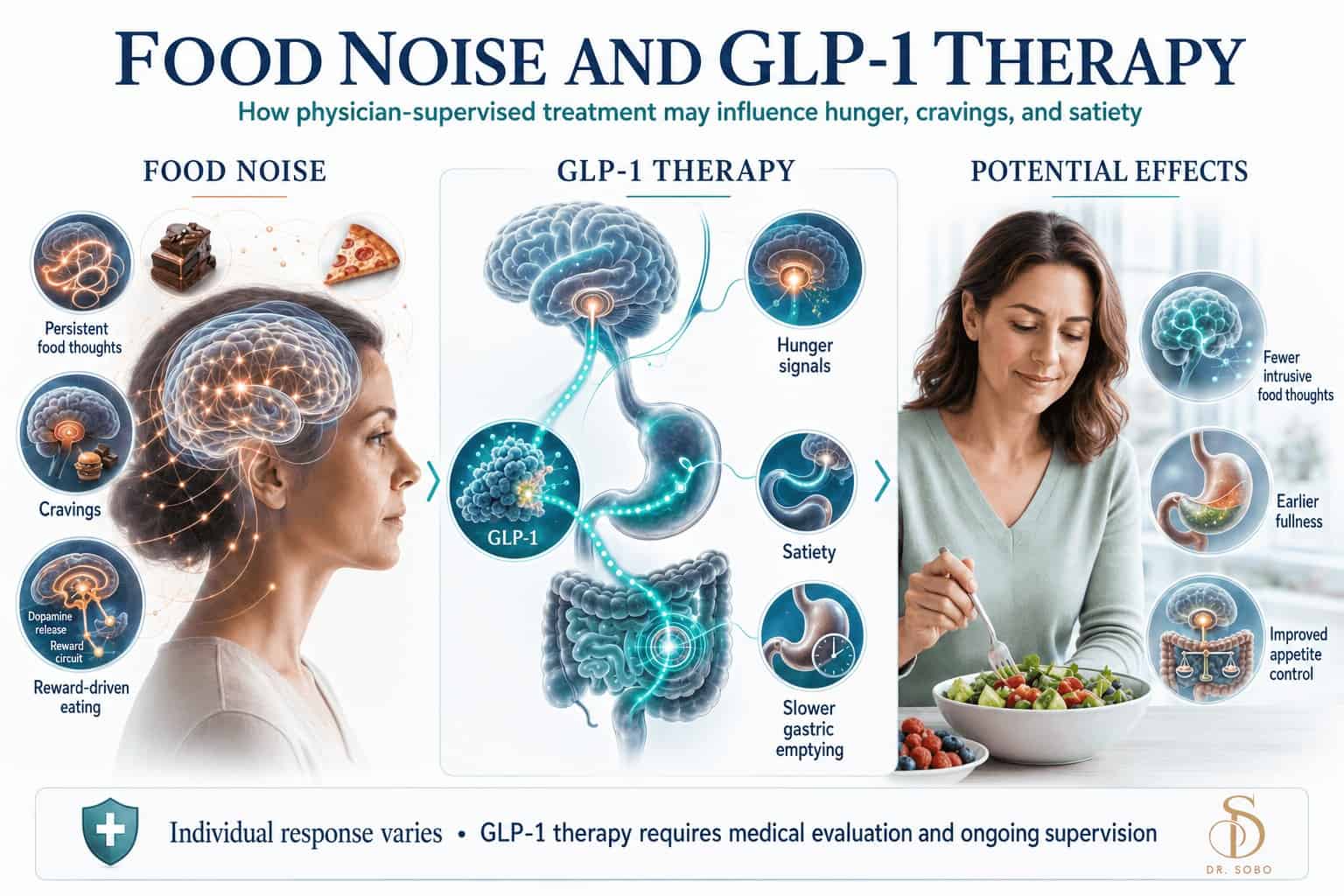
Food noise and GLP-1 therapy are closely connected topics in medical weight-loss care. GLP-1 medications may help appropriate patients experience fewer persistent food thoughts, reduced cravings, earlier fullness, and improved appetite control.
For many patients, weight loss is not only about portion size, meal plans, or motivation. It is also about the constant mental pressure of food thoughts, cravings, hunger cues, emotional eating patterns, and the feeling that the brain is always negotiating with food. This is often described as food noise.
Food noise is not a formal diagnosis, but it is a useful patient-friendly term. It describes frequent, intrusive, or persistent thoughts about food that can make weight management feel exhausting. A patient may think about the next meal while still eating the current one. Another may feel pulled toward snacks even when physically full. Some patients describe cravings that feel louder during stress, poor sleep, hormonal changes, or after years of dieting.
GLP-1 therapy has changed this conversation because many patients taking semaglutide, tirzepatide, or related medications report that food noise becomes quieter. They may feel full sooner, think about food less often, experience fewer cravings, or gain enough space between impulse and action to make healthier choices. That shift can feel dramatic, especially for patients who have been told for years that appetite control is simply a willpower problem.
For patients considering GLP-1 weight loss, medical weight loss, semaglutide, or tirzepatide, the more useful question is not, “Why can’t I just control myself?” A better question is: “What is driving my appetite, cravings, food noise, metabolism, and long-term weight pattern?”
At Optimal Health Medical, Dr. Sobo approaches appetite control as part of a broader metabolic picture. GLP-1 medications may help appropriate patients, but they work best when paired with physician supervision, nutrition planning, muscle preservation, side-effect management, and long-term maintenance strategy.
Patients in Stamford, Greenwich, Fairfield County, and throughout Connecticut can call 203-348-8805 to discuss medically supervised GLP-1 weight loss options with Dr. Sobo.
Food Noise and GLP-1 Therapy: What Is the Connection?
GLP-1 therapy may help some appropriate patients experience less food noise, fewer cravings, earlier fullness, and improved appetite control. These medications influence hunger and satiety signals and may also affect reward-related pathways that shape food motivation. Patients often describe this as having more mental space around food rather than constantly battling cravings.
However, GLP-1 therapy is not a personality change, a cure for emotional eating, or a replacement for nutrition, sleep, protein, resistance training, and medical follow-up. Appetite control is biological, behavioral, and environmental. A doctor-supervised plan helps determine whether GLP-1 therapy is appropriate, how dosing should be managed, how side effects should be monitored, and how long-term habits should be built while appetite is better controlled.
Who Should Read This Guide?
This guide is for patients who struggle with food noise, cravings, late-night snacking, emotional eating, persistent hunger, large appetite swings, or weight regain after dieting. It is also for patients who are already using GLP-1 therapy and want to understand why appetite may feel different during treatment.
It may be especially helpful for patients who have tried repeated diets, lost weight temporarily, and then regained it when hunger returned. It is also relevant for patients approaching GLP-1 maintenance and wondering whether appetite control will stay stable over time.
This article is not meant to diagnose binge eating disorder, bulimia, anorexia, or another eating disorder. Patients with a current or past eating disorder should discuss GLP-1 therapy carefully with a qualified clinician because appetite-suppressing treatment requires individualized screening and monitoring.
What Is Food Noise?
Food noise is the ongoing mental chatter about food. It can include cravings, constant meal planning, thoughts about snacks, fear of hunger, guilt after eating, difficulty stopping once started, or feeling distracted by food even when the body does not need more energy.
Some patients describe food noise as a background radio that never turns off. Others describe it as a tug-of-war between what they want long term and what their appetite is demanding in the moment. Food noise can become louder during stress, sleep loss, dieting, boredom, social events, hormonal changes, alcohol use, and exposure to highly palatable foods.
Food noise is not simply liking food. It becomes a problem when it interferes with health goals, concentration, confidence, or the ability to maintain a stable eating pattern.
| Food Noise Pattern | How It May Show Up | Why It Matters |
|---|---|---|
| Persistent food thoughts | Thinking about food often, even after eating. | Can make weight loss feel mentally exhausting. |
| Cravings | Strong pull toward sweets, salty snacks, fast food, or large portions. | Can override planned meals and trigger overeating. |
| Hunger anxiety | Worrying about getting hungry or not having food available. | May lead to grazing, overbuying, or eating preemptively. |
| Reward-driven eating | Eating for relief, stimulation, comfort, or stress reduction. | Requires more than simple calorie advice. |
| Regain after dieting | Hunger increases after weight loss and old patterns return. | Shows why maintenance planning matters. |
Why Appetite Control Is More Than Willpower
Willpower is real, but it is not the whole story. Appetite is regulated by signals from the brain, gut, pancreas, liver, fat tissue, hormones, sleep patterns, stress response, medications, and the food environment. The body also has strong mechanisms designed to defend stored energy.
When a person loses weight, the body may respond by increasing hunger, lowering energy expenditure, and making food cues more noticeable. That is one reason long-term maintenance can feel harder than active weight loss. It is not because the patient suddenly became less disciplined. It is because biology is pushing back.
Modern obesity medicine recognizes that weight is influenced by more than personal effort. The 2025 American Association of Clinical Endocrinology obesity algorithm emphasizes obesity as a complex chronic disease and encourages treatment focused on health, complications, and individualized care rather than body mass index alone.
This matters for patients who have carried years of shame about appetite. If hunger, cravings, and food noise have biological drivers, then medical evaluation is reasonable. A patient may still need habit change, but the plan should be built around physiology rather than blame.
How GLP-1 Therapy May Affect Appetite and Cravings
GLP-1 medications work through pathways involved in appetite, fullness, digestion, glucose regulation, and metabolic signaling. Patients often notice that they feel full sooner, eat smaller portions, lose interest in some high-calorie foods, or feel less urgency around snacks.
Research has also explored how GLP-1 receptor agonists may affect reward-related eating. Studies suggest that GLP-1 signaling can influence brain pathways involved in food reward and motivation. This may help explain why some patients describe less “pull” toward highly palatable foods rather than only feeling physically full.
That said, every patient is different. One patient may feel a dramatic reduction in food noise within weeks. Another may experience only modest appetite changes. A third may have nausea or constipation that reduces food intake but does not feel like healthy appetite regulation. This is why physician monitoring matters.
| Possible GLP-1 Effect | Patient May Notice | Clinical Consideration |
|---|---|---|
| Earlier fullness | Smaller meals feel satisfying. | Protein and nutrient intake still need planning. |
| Less food noise | Fewer intrusive thoughts about eating. | Patients should use this window to build sustainable habits. |
| Reduced cravings | Less urgency around sweets, snacks, or large portions. | Emotional eating triggers may still need support. |
| Slower gastric emptying | Food stays in the stomach longer. | May contribute to nausea, reflux, constipation, or fullness. |
| Improved appetite structure | Easier meal timing and less grazing. | A plan is needed before dose changes or maintenance. |
Food Noise vs. Physical Hunger
Food noise and physical hunger are related, but they are not identical. Physical hunger usually builds gradually and is often satisfied by a balanced meal. Food noise can feel more urgent, specific, repetitive, or emotionally charged.
A patient with physical hunger might think, “I need lunch.” A patient with food noise may think, “I cannot stop thinking about chips, sweets, or takeout even though I just ate.” Distinguishing the two helps the patient and clinician build a better plan.
GLP-1 therapy may reduce both physical hunger and reward-driven cravings for some patients. But if food noise is strongly tied to stress, trauma, emotional restriction, sleep deprivation, or binge-pattern eating, medication alone may not be enough. Behavioral support, nutrition structure, and mental health care may be appropriate.
Why Food Noise Can Become Louder After Dieting
Many patients with obesity have a long history of dieting. Repeated dieting can teach the brain to expect restriction, scarcity, and regain. During weight loss, hunger hormones, energy expenditure, and reward pathways may shift in ways that make food more compelling.
This is one reason patients often feel successful during the first phase of a diet but struggle later. The early phase may be powered by motivation and novelty. The later phase requires a plan that can survive hunger return, plateaus, travel, holidays, stress, and fatigue.
Dr. Sobo’s article on what happens after GLP-1 weight loss explains why maintenance planning matters after significant weight loss. Food noise belongs in that same conversation because appetite can change when medication is reduced, paused, or stopped.
Why Cravings Are Not Always a Character Problem
Cravings can be shaped by blood sugar swings, sleep loss, stress hormones, menstrual or menopausal changes, alcohol, medications, insulin resistance, highly processed foods, and learned reward patterns. A craving is not always a command, but it is information.
For example, a patient who craves sweets every evening may be under-eating protein earlier in the day, sleeping poorly, or using food as the only reliable stress relief. Another patient may crave salty foods when dehydrated or eating too little. Another may experience strong cravings when the body is trying to regain weight after weight loss.
A physician-supervised weight-loss plan can help separate these drivers. The solution may include medication, but it may also include protein timing, hydration, fiber, sleep support, strength training, side-effect management, and lab review.
What Patients Often Report When Food Noise Improves
Patients who respond well to GLP-1 therapy often describe more than appetite suppression. They may describe relief. Food feels less urgent. Grocery decisions become easier. Restaurant portions feel manageable. Dessert may still be enjoyable, but it may no longer feel impossible to stop.
This can be emotionally powerful because many patients have spent years believing they simply lacked discipline. When food noise improves, they may realize how much mental energy was being spent on appetite management.
That experience can be useful, but it should not lead to under-eating. A patient who suddenly feels little appetite still needs enough protein, fluids, fiber, micronutrients, and overall nutrition. Appetite control is helpful only when it supports health.
When Less Food Noise Can Become a Problem
For some patients, appetite reduction can become too strong. They may skip meals, avoid protein, drink too little water, become constipated, feel weak, or lose muscle. A patient may be pleased that food noise is quiet but still be under-fueling the body.
Warning signs include fatigue, dizziness, hair shedding, weakness, inability to eat enough protein, persistent nausea, worsening reflux, severe constipation, dehydration, or rapid weight loss that feels poorly supported.
This connects directly to Dr. Sobo’s article on GLP-1 weight loss and muscle loss. The goal is not only to make appetite quieter. The goal is to lose weight in a way that protects strength, function, and long-term metabolic health.
Food Noise and Emotional Eating
GLP-1 therapy may reduce appetite pressure, but it does not erase every reason people eat. Some patients eat for stress relief, loneliness, celebration, comfort, boredom, fatigue, or habit. If food has been the main coping strategy for years, a quieter appetite may reveal emotional patterns that still need attention.
This is not a reason to avoid treatment. It is a reason to treat the whole patient. A strong plan may include stress management, sleep improvement, meal structure, counseling, mindfulness, family support, and practical strategies for high-risk situations.
Patients with a history of binge eating disorder, bulimia, anorexia, compulsive restriction, or purging should be especially open with their clinician. GLP-1 medications are not FDA approved for eating disorders, and appetite suppression can be risky for certain patients if not carefully monitored.
Food Noise, Blood Sugar, and Insulin Resistance
Some cravings are connected to metabolic instability. Patients with insulin resistance, prediabetes, or type 2 diabetes may experience appetite swings, energy crashes, or cravings that are influenced by blood sugar patterns. GLP-1 therapy may help appropriate patients by improving satiety and glucose-related signaling, but labs and symptoms still need monitoring.
A patient who feels shaky, lightheaded, excessively hungry, or fatigued should not assume every symptom is “normal appetite.” Medication interactions, diabetes medications, meal timing, hydration, and total intake may all matter.
This is why Dr. Sobo’s medical weight loss approach includes more than the scale. Blood sugar, blood pressure, cholesterol, liver markers, kidney function, inflammation, sleep, digestion, and body composition can all be part of long-term metabolic care.
A Doctor-Supervised Food Noise Checklist
| Question to Review | Why It Matters |
|---|---|
| When do food thoughts become loudest? | Timing may reveal skipped meals, stress, sleep loss, or medication patterns. |
| Are cravings specific or general hunger? | Specific cravings may point toward reward-driven eating or habit loops. |
| Is the patient eating enough protein? | Low protein can worsen hunger, fatigue, and muscle loss risk. |
| Is constipation or nausea limiting intake? | Side effects can reduce nutrition and undermine the plan. |
| Has hunger changed with dose timing? | Dose strategy should be individualized and supervised. |
| Are sleep and stress affecting appetite? | Poor sleep and high stress can make food noise louder. |
| Is weight loss too rapid? | Rapid loss may increase weakness, dehydration, or lean mass concerns. |
| Is there a history of disordered eating? | Screening helps reduce risk and guide support. |
What a Doctor May Adjust When Food Noise Persists
If food noise remains strong during GLP-1 therapy, it does not automatically mean the medication is failing. A physician may review dose timing, dose escalation, side effects, nutrition, hydration, constipation, sleep, stress, alcohol, medication interactions, and whether the patient is eating enough earlier in the day.
The doctor may also evaluate whether another medical issue is contributing to appetite patterns. Sleep apnea, thyroid changes, depression, anxiety, pain, menopause, testosterone changes, insulin resistance, and certain medications can all influence hunger and cravings.
The safest approach is not to self-increase a dose or copy someone else’s dosing schedule. GLP-1 therapy should be adjusted through medical supervision, especially when side effects, fatigue, nausea, low intake, or rapid weight loss are present.
How to Use the “Quiet Appetite Window” Wisely
When GLP-1 therapy reduces food noise, patients often have a valuable window of opportunity. The brain is less preoccupied with food, and it may be easier to practice new habits. This is the time to build the maintenance plan, not just celebrate lower hunger.
Useful habits may include regular protein intake, resistance training, hydration routines, fiber-rich meals, consistent sleep, meal planning, slower eating, reduced alcohol, walking after meals, and realistic strategies for restaurants or travel.
The goal is to make healthy choices easier before appetite changes again. If medication is reduced or stopped later, patients should already have routines that support satiety, muscle, and metabolic health.
What Patients Should Not Do
Patients should not assume that less appetite means they can ignore nutrition. GLP-1 therapy can reduce the drive to eat, but the body still needs protein, minerals, fiber, fluids, and enough energy to preserve muscle and function.
Common mistakes include:
- Skipping meals because appetite is low.
- Eating very little protein and losing strength.
- Ignoring constipation, nausea, reflux, or dehydration.
- Increasing the dose without medical guidance.
- Using GLP-1 therapy to support restrictive or disordered eating patterns.
- Assuming food noise will stay quiet forever without a maintenance plan.
- Treating medication as a substitute for sleep, strength training, and follow-up.
When to Contact a Doctor
Patients should contact a doctor if food noise remains intense, cravings are leading to repeated overeating, hunger returns suddenly, side effects prevent adequate nutrition, or weight regain begins. Patients should also call if they experience persistent vomiting, severe constipation, dehydration, dizziness, fainting, weakness, low blood sugar symptoms, or inability to eat enough protein.
A patient should also seek professional help if eating feels compulsive, secretive, shame-driven, or connected to purging, restriction, or loss of control. Those patterns deserve support, not judgment.
How This Topic Fits With Long-Term GLP-1 Care
Food noise is one of the most patient-relevant ways to understand GLP-1 therapy, but it is not the whole plan. Long-term success depends on maintaining muscle, preventing regain, managing side effects, monitoring metabolic markers, and building habits that survive appetite changes.
Patients who want a broader view can read Dr. Sobo’s related articles on GLP-1 weight loss plateaus, GLP-1 weight loss and muscle loss, what happens after GLP-1 weight loss, and GLP-1 anti-inflammation benefits.
Together, these topics make the same point: GLP-1 therapy is most powerful when it is part of physician-guided metabolic care, not a short-term appetite shortcut.
Final Thoughts
Food noise and cravings are not simply evidence of weak willpower. They can reflect appetite biology, reward pathways, metabolic adaptation, stress, sleep, hormonal changes, diet history, and the body’s effort to defend stored weight.
GLP-1 therapy may help appropriate patients by making appetite feel quieter and cravings more manageable. For many people, that can create the first real opening to build healthier habits without constant mental struggle.
But appetite control still needs structure. Patients need protein, hydration, resistance training, side-effect management, lab monitoring, and a maintenance plan. The goal is not only to quiet food noise. The goal is to build long-term metabolic health.
Patients in Stamford, Greenwich, Fairfield County, and throughout Connecticut can call 203-348-8805 to discuss whether GLP-1 therapy, semaglutide, tirzepatide, or another physician-supervised weight-loss option may be appropriate.
FAQs About Food Noise, Cravings, and GLP-1 Therapy
What is food noise?
Food noise is a patient-friendly term for frequent or intrusive thoughts about food, cravings, snacks, meals, or eating decisions. It may feel like constant mental chatter, even when the body is not physically hungry. Food noise is not a formal diagnosis, but it can describe a real experience that makes weight management difficult and emotionally draining.
Can GLP-1 medications reduce food noise?
Some patients report that GLP-1 medications reduce food noise by helping them feel full sooner, think about food less often, and experience fewer cravings. Research suggests GLP-1 signaling affects appetite and may influence reward-related eating pathways. Results vary, and patients still need medical supervision, nutrition planning, and long-term maintenance support.
Why do cravings happen even when I am not hungry?
Cravings can be driven by stress, sleep loss, habit loops, blood sugar swings, hormonal changes, alcohol, emotional eating patterns, highly palatable foods, or the brain’s reward system. They are not always the same as physical hunger. A doctor-supervised plan can help identify whether cravings are related to nutrition, metabolism, medication, stress, or another factor.
Is appetite control just willpower?
No. Willpower can play a role in daily choices, but appetite is also regulated by biology. Hunger, satiety, reward, stress, sleep, hormones, insulin resistance, medications, and weight-regain biology can all influence appetite control. Treating obesity or weight regain as only a willpower issue misses the medical and metabolic factors that often need attention.
How do GLP-1 medications affect appetite?
GLP-1 medications can affect appetite by increasing fullness, slowing stomach emptying, supporting glucose-related signaling, and influencing pathways involved in hunger and food motivation. Many patients feel satisfied with smaller meals. However, appetite reduction should not lead to chronic under-eating, dehydration, low protein intake, or muscle loss.
Can food noise come back after stopping GLP-1 therapy?
Food noise may return for some patients when medication is reduced, paused, or stopped, especially if there is no maintenance plan. Hunger can also increase with stress, poor sleep, weight regain biology, or changes in routine. Patients should discuss dose strategy, nutrition, protein, resistance training, and relapse-prevention planning before making medication changes.
What should I eat if my appetite is low on GLP-1 therapy?
Patients with low appetite should focus on enough protein, fluids, fiber, and nutrient-dense meals rather than simply eating as little as possible. The exact plan should be individualized based on body size, kidney function, activity level, side effects, and medical history. If nausea, reflux, or constipation limits intake, the prescribing clinician should be contacted.
Can GLP-1 therapy help emotional eating?
GLP-1 therapy may reduce appetite pressure and cravings for some patients, which can make emotional eating easier to manage. However, it does not erase stress, trauma, boredom, loneliness, or learned coping patterns. Patients who eat for emotional relief may benefit from behavioral support, stress management, counseling, sleep improvement, and structured nutrition alongside medical care.
Who should be careful with GLP-1 therapy and food noise?
Patients with a current or past eating disorder, severe restriction, binge-purge patterns, frequent vomiting, poor nutritional intake, or intense fear of eating should be carefully evaluated before and during GLP-1 therapy. Appetite suppression can be risky in some situations. Honest medical screening helps protect safety and supports the right treatment plan.
Where can I discuss GLP-1 therapy for food noise in Connecticut?
Patients in Stamford, Greenwich, Fairfield County, and throughout Connecticut can schedule a medical weight loss consultation with Dr. Sobo to discuss GLP-1 therapy, food noise, cravings, appetite control, semaglutide, tirzepatide, and long-term metabolic health. Call 203-348-8805 to discuss whether a physician-supervised plan may be appropriate.
Sources
- FDA – Wegovy Prescribing Information
- Endocrine Society – Obesity and Appetite Regulation
- American Association of Clinical Endocrinology – 2025 Obesity Algorithm
- Nature – How Obesity Drugs Quiet Food Noise in the Brain
- PubMed – Hedonic Eating and GLP-1 Receptor Signaling
- ScienceDirect – Semaglutide, Appetite, and Food Reward Signaling
- Dr. Sobo – Medical Weight Loss
- Dr. Sobo – GLP-1 Weight Loss
- Dr. Sobo – Semaglutide
- Dr. Sobo – Tirzepatide
- Dr. Sobo – GLP-1 Weight Loss and Muscle Loss
- Dr. Sobo – What Happens After GLP-1 Weight Loss?

Medically reviewed by
Founder of Optimal Health Medical and physician specializing in holistic, integrative, and medical weight loss care.