
How to Evaluate Peptide Information Online: Red Flags, Medical Questions, and Safety Basics
Peptide therapy has become one of the most searched wellness and medical weight loss topics online. Patients are seeing peptides discussed in podcasts, social media videos, anti-aging forums, fitness groups, medical weight loss advertisements, and direct-to-consumer websites. Some of this information is helpful. Some of it is incomplete. Some of it is promotional. Some of it can be risky.
The problem is not patient curiosity. Patients should ask questions, learn about treatment options, and understand what may be possible. The problem is that peptide information online often mixes real science, early-stage research, personal testimonials, marketing claims, and unregulated product sales in a way that makes everything sound equally reliable.
For patients, the safest starting point is simple: do not evaluate a peptide claim only by how exciting it sounds. Evaluate the source, the evidence, the medical oversight, the pharmacy process, the label, the dosing instructions, the side-effect plan, and whether the therapy fits your health history.
At Optimal Health Medical, Dr. Sobo helps patients move away from online guesswork and toward medically guided decision-making. This article explains how to evaluate peptide information online, what red flags to watch for, what questions to ask, and why legitimate medical care is different from internet-seller peptide marketing.
Peptide Information Online at a Glance
Patients should be cautious when peptide information online promises dramatic results, skips medical screening, encourages self-dosing, sells products labeled “for research only,” or does not involve a licensed clinician and a legitimate pharmacy process.
The most trustworthy peptide guidance connects the therapy to a patient’s health history, symptoms, goals, medications, labs when appropriate, dosing clarity, side-effect monitoring, and follow-up.
Why Peptide Content Online Is So Confusing
Peptides are short chains of amino acids that act as signaling molecules in the body. Some peptide-related medications are FDA-approved and widely used in conventional medicine. Insulin and GLP-1 medications are examples of peptide-related therapies with established clinical roles. Other peptides are still being studied, used in specific medical contexts, compounded in certain circumstances, or discussed mostly in wellness and performance communities.
That wide range creates confusion. A patient may read about GLP-1 medications for weight loss, BPC-157 for injury recovery, KPV for inflammation, MOTS-c for metabolic health, or GHK-Cu for skin and hair support, then assume all peptides have the same level of evidence, approval status, safety data, and availability. They do not.
Online content also tends to flatten important distinctions. A social media video may present early animal research as if it proves a human outcome. A vendor page may describe a peptide’s theoretical mechanism while avoiding discussion of real-world risks, dose uncertainty, contamination, side effects, or lack of human clinical trials. A forum may recommend a protocol based on one person’s experience, even though that person may have a completely different medical history, medication list, and risk profile.
The patient’s job is not to become a peptide researcher. The patient’s job is to know when a claim deserves medical review before action.
Not All Peptide Claims Are the Same
When evaluating peptide information, patients should separate four different categories:
- FDA-approved peptide or peptide-related medications used under approved indications.
- Medically supervised compounded prescriptions from legitimate, licensed pharmacies when appropriate.
- Emerging research peptides with promising but incomplete human evidence.
- Unregulated internet-seller products marketed without proper prescribing, labeling, or oversight.
These categories should not be treated as interchangeable. A regulated prescription medication and a “research only” vial sold online are not the same thing. A properly labeled prescription from a legitimate compounding pharmacy is also different from a website selling unlabeled or non-patient-specific products without medical supervision.
This distinction matters for Dr. Sobo’s patients because legitimate compounding pharmacies are pharmacies. They are regulated by state boards and must follow pharmacy standards. The safety concern is not legitimate compounding as a category. The major concern is internet sellers, gray-market vendors, no-prescription peptide sites, research-chemical sellers, and products that are not dispensed as patient-specific prescriptions under medical care.
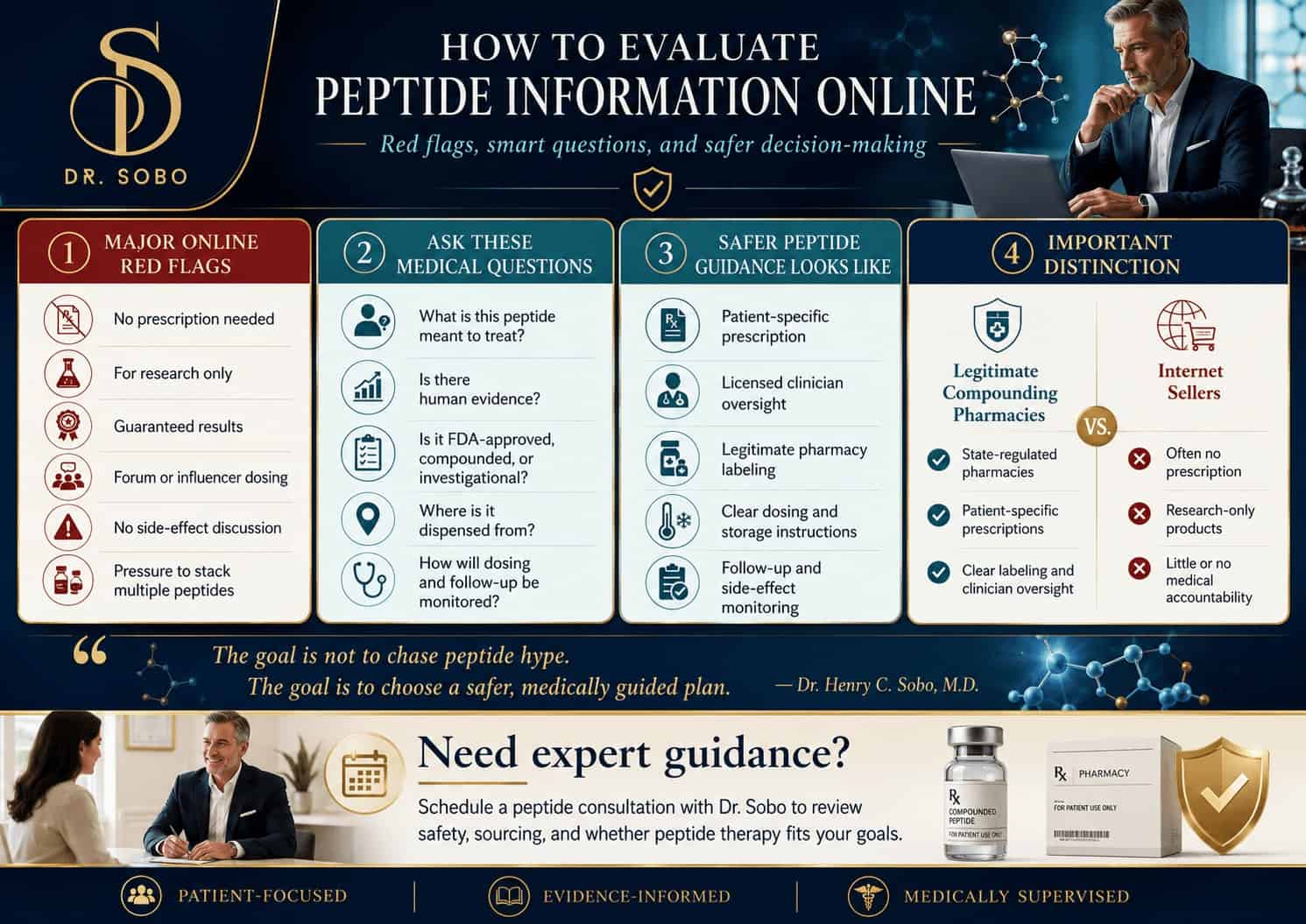
The Biggest Red Flags in Online Peptide Information
The following red flags do not automatically prove that every claim is false, but they should prompt caution and medical review before a patient takes action.
| Online Red Flag | Why It Matters | Better Patient Response |
|---|---|---|
| “No prescription needed” peptide sales | Prescription decisions should be based on medical history, medications, risks, and monitoring needs. | Do not buy. Ask a qualified clinician whether the therapy is appropriate. |
| “For research only” labeling | This usually means the product is not intended or labeled for personal medical use. | Treat it as a major warning sign for patient use. |
| Guaranteed results | Real medical care cannot guarantee weight loss, healing, anti-aging, or symptom resolution. | Look for realistic, individualized guidance instead. |
| Dosing advice from forums or influencers | Dose depends on patient-specific factors and the actual product being prescribed. | Ask how dosing is determined and monitored medically. |
| No discussion of side effects | Every meaningful therapy can have risks, interactions, or tolerability concerns. | Ask what side effects to watch for and when to call. |
| No pharmacy information | Patients should know where medication is dispensed and whether labeling is patient-specific. | Look for a legitimate pharmacy process and clear prescription labeling. |
| Claims based only on animal studies | Animal or cell research may not translate directly to human outcomes. | Ask whether human evidence exists and how strong it is. |
| Pressure to stack multiple peptides | More therapies can mean more variables, costs, and safety questions. | Start with a clear medical goal and a monitored plan. |
What “For Research Only” Really Means
Patients often see peptide products online labeled with phrases such as “for research only,” “not for human use,” or “laboratory use only.” Those words should not be ignored. They generally mean the product is not being sold as a patient-specific prescription medication for personal medical use.
A product marketed this way may not include the patient’s name, the prescribing clinician’s name, clear dosing instructions, appropriate pharmacy labeling, storage guidance, sterile-use safeguards, or follow-up instructions. The label may protect the seller, but it does not protect the patient.
A legitimate prescription process is different. A patient-specific prescription should have the patient’s name, prescribing clinician information, medication details, clear directions, and pharmacy labeling. This is the kind of basic medication accountability patients are used to seeing with prescriptions from pharmacies such as CVS or Walgreens.
How to Evaluate the Source of a Peptide Claim
Before trusting a peptide article, video, product page, or social media post, patients should ask who is behind it and what the source is trying to accomplish.
- Is the source a licensed medical professional, medical organization, pharmacy, research journal, manufacturer, or vendor?
- Is the content educational, or is it mainly trying to sell a product?
- Does the source explain limitations, side effects, and uncertainty?
- Does it distinguish human evidence from animal or cell research?
- Does it explain whether the peptide is FDA-approved, compounded, investigational, or not approved?
- Does it recommend medical supervision, or does it encourage self-treatment?
- Does it provide clear references from credible medical or scientific sources?
Trustworthy medical education usually acknowledges uncertainty. Risky marketing often removes uncertainty and replaces it with certainty, urgency, and dramatic promises.
How to Evaluate the Evidence Behind a Peptide
A peptide may sound promising because it has a clear mechanism. Mechanism matters, but mechanism is not the same as proven patient benefit. A strong evidence review should consider the level of research behind the claim.
| Evidence Type | How Patients Should Interpret It |
|---|---|
| Cell or laboratory research | Useful for understanding mechanisms, but it does not prove clinical benefit in people. |
| Animal research | Can be promising but may not translate directly to human dosing, safety, or outcomes. |
| Small human studies | Helpful but often limited by size, design, duration, and patient selection. |
| Randomized controlled trials | Stronger evidence, especially when replicated and clinically relevant. |
| FDA-approved labeling | Important for approved indications, dosing, warnings, contraindications, and safety information. |
| Anecdotes and testimonials | Can describe experiences but should not be treated as proof of safety or effectiveness. |
Questions to Ask Before Considering Peptide Therapy
A patient who is interested in peptide therapy should not begin with “Which peptide should I take?” A better starting point is a structured medical conversation. Useful questions include:
- What health goal or symptom am I trying to address?
- What medical conditions should be ruled out first?
- Do my medications or supplements create any concerns?
- Are labs needed before treatment?
- What is the evidence for this peptide in humans?
- Is this peptide FDA-approved, compounded, investigational, or not approved?
- What side effects or interactions should I understand?
- How is dosing determined?
- Where would the medication be dispensed from?
- Will the prescription label include my name, the prescribing clinician, and clear dosing instructions?
- How will progress be measured?
- What is the follow-up schedule?
- When should I stop or call the office?
Why Medical Supervision Changes the Risk Profile
Medical supervision does not make every peptide appropriate. It does, however, create a safer decision-making process. A clinician can review whether the patient’s goals match the available evidence, whether symptoms need evaluation first, whether there are contraindications or medication concerns, and whether the patient can follow the plan safely.
Medical supervision also creates accountability. The plan can include dosing instructions, side-effect guidance, lab review when appropriate, follow-up, and a clear process for changing or stopping therapy. Without that structure, patients may end up guessing about dose, frequency, storage, injection technique, side effects, and whether the therapy is working.
This matters especially for patients who are taking multiple medications, managing metabolic conditions, dealing with autoimmune or gastrointestinal issues, using GLP-1 therapy, trying to preserve muscle during weight loss, or exploring peptides for recovery, inflammation, gut health, or healthy aging.
Compounding Pharmacies vs. Internet Sellers
Patients often hear mixed messages about compounding pharmacies. The important distinction is this: legitimate compounding pharmacies are pharmacies, while internet sellers and research-chemical vendors are not the same thing.
A legitimate compounding pharmacy operates under pharmacy regulation and dispenses medications through a prescription process. The prescription should be patient-specific, properly labeled, and tied to clinician oversight. Patients should still ask questions, but that process is fundamentally different from buying peptide vials from an online seller that does not know the patient, does not require a prescription, and does not provide a medical monitoring plan.
The FDA advises patients to research online pharmacies before using them and warns that buying medicines from unregulated or unlicensed sources can expose patients to potentially poor-quality products. That warning applies strongly to peptide websites that appear to function as consumer product stores rather than legitimate pharmacies.
Signs a Peptide Plan Is More Medically Responsible
A responsible peptide plan should feel organized and patient-specific. Patients should expect clear answers about what is being used, why it is being considered, and how safety will be monitored.
- The therapy is connected to a specific health goal or symptom pattern.
- The clinician reviews medical history, medications, and relevant risks.
- Labs are considered when appropriate.
- The patient understands whether evidence is strong, limited, emerging, or investigational.
- The medication source and labeling are clear.
- The dose and schedule are written down.
- Side effects and warning signs are discussed.
- Storage and handling instructions are provided.
- Follow-up is scheduled.
- The plan includes nutrition, exercise, sleep, or lifestyle support when relevant.
Peptide Stacking Claims Need Extra Caution
Online peptide content often promotes stacking, which means combining multiple peptides or peptide-related therapies at the same time. Stacking may sound more advanced, but it also creates more variables. If a patient improves, worsens, or develops side effects, it can become difficult to know which therapy contributed to the change.
Stacking can also increase cost, complexity, and the risk of inconsistent use. Patients should be cautious when a website or influencer recommends multiple peptides without explaining why each one is necessary, what evidence supports the combination, how dosing is managed, and how side effects will be monitored.
If a peptide stack is being considered, it should be built around a specific goal and a clear monitoring plan, not around the idea that more is automatically better.
When Peptide Content Should Prompt a Medical Appointment
Patients should consider scheduling a consultation when they are interested in peptide therapy but are unsure how to separate credible information from marketing claims. A medical appointment is especially important if the patient has:
- A history of diabetes, insulin resistance, thyroid disease, cardiovascular disease, kidney or liver disease, autoimmune conditions, cancer, or complex gastrointestinal symptoms.
- Current prescription medications, hormone therapy, GLP-1 therapy, or multiple supplements.
- Unexplained fatigue, weight gain, pain, brain fog, digestive symptoms, sleep problems, or inflammatory symptoms.
- Previous side effects from peptides, GLP-1s, hormone therapy, or injectable medications.
- Interest in peptides that are investigational or not FDA-approved.
- Questions about dosing, stacking, storage, injection technique, or product sourcing.
What Patients Should Bring to a Peptide Consultation
A well-prepared consultation helps the clinician evaluate the patient, not just the peptide. Bring or write down:
- Current medications and supplements.
- Recent lab work, if available.
- Medical diagnoses and surgical history.
- Allergies or prior medication reactions.
- Main symptoms and when they started.
- Primary health goals.
- Prior GLP-1, peptide, hormone, or wellness-treatment experience.
- Questions about evidence, risks, dosing, pharmacy source, and follow-up.
How Dr. Sobo Helps Patients Evaluate Peptide Information
Dr. Sobo provides medically guided peptide therapy and wellness consultations designed to help patients understand whether a therapy makes sense for their goals, health history, and risk profile. The purpose is not to chase every trend. The purpose is to decide what is appropriate, what should be evaluated first, and what plan can be followed safely.
At Optimal Health Medical, peptide-related conversations may include symptom review, medication review, lab-informed decisions when appropriate, discussion of evidence quality, dosing education, side-effect guidance, storage instructions, and follow-up planning. For weight loss patients, the conversation may also include GLP-1 options, medical weight loss, nutrition support, muscle preservation, and long-term maintenance.
This approach is especially important because peptide information online changes quickly. New research, regulatory discussions, FDA guidance, and social media trends can all influence what patients see. A medical consultation helps turn scattered online information into a patient-specific plan.
The Bottom Line: Do Not Let Online Peptide Hype Replace Medical Judgment
Peptide therapy can be an important topic for patients interested in weight loss, metabolic health, recovery, gut health, inflammation, and healthy aging. But the online peptide marketplace is filled with a wide range of content quality. Some information is useful. Some is oversimplified. Some is designed mainly to sell products. Some may expose patients to unnecessary risk.
The safest path is to evaluate the source, evidence, medical oversight, pharmacy process, labeling, dosing plan, side-effect guidance, and follow-up. Patients should be especially cautious with no-prescription sales, “research only” products, guaranteed claims, forum-based dosing, and stacks promoted without medical review.
If you are interested in peptide therapy, Dr. Sobo can help you ask better questions, understand what is known and unknown, and decide whether a medically supervised plan is appropriate for your goals.
Schedule a Peptide Therapy Consultation
If you are trying to evaluate peptide information online, a consultation can help you move from uncertainty to a more medically grounded plan. Learn more about peptide therapy, GLP-1 weight loss, medical weight loss, and functional medicine support at Optimal Health Medical.
FAQs About Evaluating Peptide Information Online
How can I tell if peptide information online is trustworthy?
Look for content that explains evidence quality, risks, limitations, medical screening, dosing supervision, pharmacy source, and follow-up. Trustworthy medical information usually explains what is known, what is not known, and why patient-specific factors matter.
Be cautious with content that promises guaranteed results, skips side effects, encourages self-dosing, or is mainly designed to sell a product. Reliable peptide education should help you ask better medical questions, not pressure you into buying something immediately.
What is the biggest red flag when researching peptides online?
One of the biggest red flags is a website selling peptides without requiring a prescription or medical evaluation, especially if the product is labeled “for research only,” “not for human use,” or “laboratory use only.”
Patients should also be cautious when a website avoids naming a pharmacy, does not provide patient-specific labeling, does not discuss side effects, or promotes a universal protocol for everyone. Medical decisions should be based on the patient’s health history, symptoms, medications, goals, and follow-up needs.
Are compounding pharmacies the same as internet peptide sellers?
No. Legitimate compounding pharmacies are pharmacies and operate under pharmacy regulation. Internet sellers, research-chemical vendors, and no-prescription peptide websites are not the same as patient-specific prescriptions dispensed through a legitimate pharmacy process.
Dr. Sobo supports properly licensed compounding pharmacies when they are used appropriately through physician oversight. The concern is not legitimate compounding. The concern is internet sellers that are not pharmacies, do not require prescriptions, and do not provide patient-specific medical accountability.
What does “for research only” mean on a peptide product?
It generally means the product is not labeled or intended for personal medical use. Patients should not treat “research only” peptide products as equivalent to prescription medication.
A legitimate prescription should include patient-specific labeling, prescribing clinician information, clear dosing instructions, and appropriate pharmacy packaging. “For research only” labeling is a major warning sign for personal use unless the product is part of a legitimate research study through a legitimate research institute.
Should I trust peptide dosing advice from forums or influencers?
No. Dosing should not be copied from forums, influencers, or product pages. Dose decisions depend on the patient’s health history, medication list, goals, product, side effects, and monitoring plan.
Online protocols can be especially risky because they may not account for other medications, medical conditions, lab findings, injection technique, storage requirements, or adverse reactions. A safe plan should include clear dosing instructions from a qualified clinician and a process for follow-up.
What questions should I ask before starting peptide therapy?
Ask what the peptide is for, what evidence supports it, whether labs are needed, what side effects may occur, where it will be dispensed, how dosing is determined, and how follow-up will work.
Patients should also ask whether the peptide is FDA-approved, compounded, investigational, or not approved for the intended use. A responsible consultation should also review what symptoms require medical attention, when to stop therapy, and whether non-peptide steps such as nutrition, sleep, exercise, or medication adjustments should be addressed first.
Are testimonials useful when evaluating peptides?
Testimonials may describe one person’s experience, but they do not prove safety or effectiveness. A positive testimonial does not show whether the person had the same diagnosis, dose, product quality, medication list, lab results, or health risks as another patient.
Medical decisions should be based on evidence, patient-specific evaluation, and professional guidance. Testimonials may raise questions worth discussing, but they should not replace a medical consultation.
Is peptide stacking safe?
Peptide stacking can increase complexity and make side effects harder to interpret. Combining multiple peptides may also increase cost, confusion, and the number of variables involved in a treatment plan.
Stacking should only be considered with a clear medical rationale, dosing plan, and follow-up. More peptides do not automatically mean better results. A medically responsible plan should start with the patient’s goal, diagnosis, risk factors, evidence, and monitoring needs.
When should I schedule a peptide consultation?
Schedule a consultation if you are interested in peptide therapy but are unsure about safety, dosing, evidence, product sourcing, lab needs, side effects, or whether a peptide fits your health goals.
A consultation is especially important if you take prescription medications, use GLP-1 therapy, have a history of chronic illness, have unexplained symptoms, or are considering an investigational peptide. Medical guidance can help separate realistic options from online hype.
How does Dr. Sobo help patients evaluate peptide options?
Dr. Sobo helps patients review their goals, health history, medications, labs when appropriate, available evidence, safety considerations, dosing questions, and follow-up needs before deciding whether peptide therapy may be appropriate.
The goal is not to chase every peptide trend. The goal is to understand the patient’s full health picture and determine whether peptide therapy, medical weight loss, GLP-1 support, functional medicine, lifestyle changes, or another approach makes the most sense.
Sources
- FDA: BeSafeRx — Your Source for Online Pharmacy Information — https://www.fda.gov/drugs/buying-using-medicine-safely/besaferx-your-source-online-pharmacy-information
- FDA: About BeSafeRx — https://www.fda.gov/drugs/besaferx-your-source-online-pharmacy-information/about-besaferx
- FDA: Compounding and the FDA — Questions and Answers — https://www.fda.gov/drugs/human-drug-compounding/compounding-and-fda-questions-and-answers
- MedlinePlus: Drug Safety — https://medlineplus.gov/drugsafety.html
- CDC: Medication Safety and Your Health — https://www.cdc.gov/medication-safety/about/index.html
- FDA: MedWatch Safety Information and Adverse Event Reporting Program — https://www.fda.gov/safety/medwatch-fda-safety-information-and-adverse-event-reporting-program
- FDA: DOs and DON’Ts of Proper Sharps Disposal — https://www.fda.gov/medical-devices/safely-using-sharps-needles-and-syringes-home-work-and-travel/dos-and-donts-proper-sharps-disposal

Medically reviewed by
Dr. Henry C. Sobo is a physician focused on holistic, integrative, and patient-centered medical care at Optimal Health Medical.