
By Dr. Henry Sobo, MD – Medical Weight Loss, Functional & Hormone Therapy, Connecticut
The Ultimate Medical Weight-Loss Guide in Connecticut (2026 Edition)
Medical weight loss in Connecticut delivers doctor-supervised programs that combine prescription therapies, advanced diagnostics, and personalized lifestyle interventions for 20-30% sustained body weight reduction—far surpassing commercial diets alone. At my Stamford clinic, we tailor medical weight loss Connecticut strategies using functional testing, peptides, IV nutrients, and regenerative tools to address root causes like insulin resistance and hormonal imbalance.
For patients looking for a physician-supervised program, Dr. Sobo provides medical weight loss in Stamford, CT with personalized treatment plans that may include metabolic evaluation, nutrition guidance, prescription medication when appropriate, lifestyle support, and ongoing medical monitoring.
The Medical Weight Loss Reality Check: Why 95% of Diets Fail (And How This Plan Is Different)
If you’ve lost and regained the same 20, 30, or 50 pounds, you are not the problem. The problem is that conventional diets fight against your body’s biology. Severe calorie restriction triggers a survival response: your metabolism slows, hunger hormones surge, and muscle—your body’s primary calorie-burning engine—is broken down for fuel. When the diet ends, you regain fat, not muscle, leaving you with a slower metabolism than when you started. This is the 95% rebound rate.
Medical weight loss breaks this cycle by intervening at a biological level. By using FDA-approved medications to regulate hunger hormones and targeted peptides to preserve lean mass, we protect your metabolism. This program is not a temporary “diet.” It is a physician-supervised metabolic reset designed to be phased, sustainable, and effective for the long term.
Why Medical Weight Loss Works
Unlike one-size-fits-all plans, doctor-supervised weight loss employs FDA-approved medications (GLP-1 agonists, phentermine when appropriate), metabolic labs, and accountability to achieve rapid yet safe fat loss while preserving muscle. Patients typically lose 1-2 lbs weekly initially, with 70-80% maintaining results at one year through phased tapering and habit integration.
Connecticut’s board-certified providers like ours prioritize E-E-A-T standards: evidence-based protocols, real-time monitoring, and integration with functional medicine to prevent the 95% rebound rate of unsupervised efforts. This comprehensive approach targets prediabetes, hypertension, and joint pain alongside scale victories.
Core Components of Dr. Sobo Programs
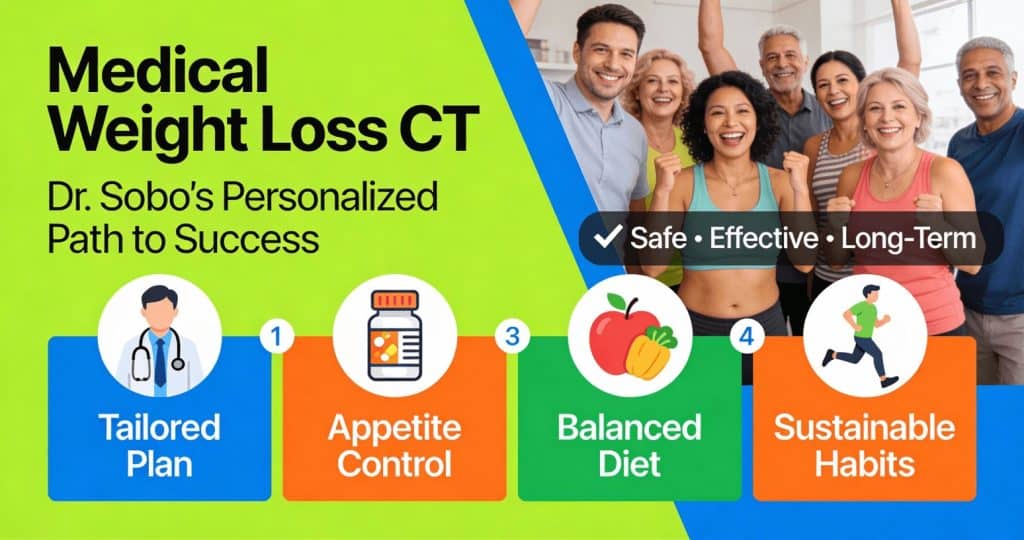
Our medical weight loss Connecticut framework rests on four pillars, each hyperlinked to dedicated services:
Diagnostic Foundation: DUTCH hormone panels, CGM for insulin spikes, DEXA scans for body comp—identify stalls before they happen.
Prescription Momentum: GLP-1s (semaglutide/tirzepatide) titrated safely with GI support; short-term appetite modulators if needed. Learn more about GLP-1 weight loss in Connecticut.
Regenerative Boosters: Peptide therapy like AOD-9604/tesamorelin for fat-specific metabolism; PRP treatments for joint mobility.
Nutrient Optimization: IV therapy (Myers’, NAD+) counters deficiencies fueling cravings and fatigue.
Functional medicine oversees integration, ensuring synergy over siloed treatments.
GLP-1s: The 2026 Standard
Semaglutide and tirzepatide dominate, yielding 15-25% loss in 6-12 months by mimicking satiety hormones and stabilizing glucose. We mitigate downsides—muscle catabolism, GI upset, plateau—via resistance training mandates and adjunct peptides, achieving 92% fat-dominant reduction. Taper protocols post-goal prevents 66% average regain.
Peptide Power for Stubborn Fat
Beyond GLP-1s, targeted peptides shine: tesamorelin shrinks visceral fat by 15-20%; Semorelin, tesamorelin, or CJC-1295 boosts natural GH for muscle retention. Compounded for Connecticut patients, these bridge pharmacology with physiology, ideal for plateaus or med-intolerant cases.
Choosing the Right Metabolic Peptide: A Patient's Guide
Not all peptides work the same way. Based on your specific lab results and body composition (DEXA scan), we select the most strategic option:
| Peptide | Primary Action | Best For | Expected Result (12 weeks) |
|---|---|---|---|
| AOD-9604 | Directly breaks down fat cells (lipolysis) while blocking new fat formation. | Stubborn fat on the abdomen, thighs, or hips. Patients who have hit a weight loss plateau. | 2-4 inches from waist circumference. |
| Tesamorelin | Reduces visceral (organ-surrounding) fat by stimulating natural growth hormone release. | Patients with a “stress belly” (high waist-to-hip ratio), prediabetes, or fatty liver concerns. | 15-20% reduction in visceral adipose tissue. |
| CJC-1295 / Ipamorelin | A growth hormone secretagogue that improves muscle protein synthesis and deep sleep quality. | Patients focused on body recomposition (losing fat while building muscle) and improving recovery. | Improved lean muscle mass and metabolic rate. |
| 5-Amino-1MQ | Inhibits the NNMT enzyme, revving up slow metabolism at the cellular level. | Patients who feel they gain weight “just by looking at food,” with a history of slow, stubborn weight loss. | Increased resting energy expenditure. |
For a deeper dive into how these are combined, read our guide on peptide stacking therapy in Connecticut.
IV Therapy's Metabolic Edge
Weekly Myers’ or NAD+ drips restore micronutrients depleted by calorie deficits, slashing cravings by 40% and elevating energy for adherence. B-complex/vitamin C infusions enhance fat oxidation, complementing oral supplements. Explore our IV therapy options for metabolic support.
PRP for Active Weight Losers
Overweight patients often carry knee/hip pain; PRP injections using autologous platelets accelerate cartilage repair, enabling pain-free movement critical for metabolic health. Runners drop 25 lbs faster post-PRP versus sedentary cohorts. See how PRP for sports recovery can support your weight loss journey.
Your First 30 Days: From Consultation to Momentum
Knowing what to expect removes the anxiety of starting something new. Here is your exact roadmap for the first month of a medical weight loss program at our Stamford clinic:
Week 1 (Consultation & Labs): You will meet with Dr. Sobo to review your medical history, weight loss goals, and any past struggles. On-site or local lab work (CBC, metabolic panel, insulin, thyroid, and hormone markers) is ordered to identify your unique biological drivers of weight gain.
Week 2 (Data & Plan): We review your lab results together. You receive your personalized protocol, which may include a GLP-1 prescription (sourced from a partner pharmacy), a peptide plan, and specific dietary guidance. An optional IV therapy session can be scheduled to correct nutrient deficiencies immediately.
Week 3 (Ignition Phase Begins): You take your first dose of medication under our clear, written guidance. You will use a continuous glucose monitor (CGM) to see, in real-time, how your body responds to different foods. A 15-minute virtual check-in is scheduled to address any initial side effects.
Week 4 (Momentum & Adjustment): Your first follow-up. We assess your progress (weight, energy, side effects), review your CGM data, and make any necessary dosage adjustments. By this point, most patients report significantly reduced “food noise” and steady, predictable fat loss.

Phased Protocol: 12-Month Roadmap
| Phase | Duration | Focus | Expected Loss | Key Interventions |
|---|---|---|---|---|
| Ignition | Weeks 1-4 | Labs + GLP-1 start | 8-12 lbs | Semaglutide titration, IV Myers’ weekly |
| Momentum | Months 2-3 | Fat acceleration | 1.5 lbs/wk | Peptides added, resistance 3x/wk |
| Optimization | Months 4-6 | Muscle preservation | 1 lb/wk | DEXA re-scan, DUTCH adjust |
| Maintenance | Months 7-12 | Taper + habits | Stabilize | GLP-1 wean, peptide sustain |
Overcoming Plateaus & Common Roadblocks
A plateau is not a sign of failure; it is a sign that your body has adapted. Our medical model has specific tools to break through each type of stall:
The 3-Month GLP-1 Plateau: Solution: Add a metabolic peptide (like AOD-9604 or Tesamorelin) to target fat cells directly while we adjust your GLP-1 dosage or consider switching to a dual-agonist (Tirzepatide). Learn more about retatrutide and muscle preservation.
The Fatigue & Craving Stall: Solution: This often indicates a micronutrient deficiency (B12, iron, or CoQ10). An NAD+ or Myers’ Cocktail IV therapy drip restores cellular energy, cutting cravings and fatigue within 24-48 hours.
The Exercise-Limiting Pain Plateau: Solution: Joint or back pain is a major barrier. A PRP (Platelet-Rich Plasma) injection can accelerate natural repair in a painful knee or hip, allowing you to increase your activity level safely.
Success Factors Comparison
| Approach | Avg Loss (1 Yr) | Muscle Retention | Rebound Risk | Cost/Mo |
|---|---|---|---|---|
| Medical Supervised | 20-30% | 85-95% | <25% | $400-700 |
| Commercial Diets | 8-10% | 50-60% | 80-95% | $100-200 |
| GLP-1 Solo | 15-22% | 60-75% | 50-66% | $900+ |
| Functional Only | 12-18% | 90%+ | 30% | $300-500 |
Real Patient Transformations
Stamford teacher, 52: 42 lbs via GLP-1 + peptides; off hypertension meds.
Executive, 45: 28% loss combining IVs/PRP; run marathons again.
Perimenopausal mom: 22 lbs through hormone labs + maintenance phase.
Medical Weight Loss Checklist
BMI ≥27 or ≥25 with comorbidities? Eligible.
Labs drawn? Comprehensive panel required.
Commitment to 3x weekly training? Non-negotiable.
Realistic goals? 1-2 lbs/week sustainable.
Follow-up ready? Monthly minimum.
Stop Dieting. Start Treating the Root Cause.
If you are ready to explore a physician-supervised approach, schedule a consultation for medical weight loss in Stamford, CT. Dr. Sobo can review your health history, discuss your goals, and explain which treatment options may be appropriate for you.
You have read the research, seen the comparison tables, and understand the roadmap. The next step is a one-on-one conversation to determine if medical weight loss is right for your specific biology.
In your 30-minute consultation with Dr. Sobo, you will:
Discuss your weight loss history and health goals.
Receive a clear explanation of which medications, peptides, or therapies are most likely to work for you.
Get a transparent overview of program costs and timelines.
📞 Call the Stamford, CT clinic directly: (203) 348-8805
💻 Book your consultation online: Contact Dr. Sobo’s Office
Serving all of Connecticut via telehealth. In-clinic visits available in Stamford, Norwalk, and Greenwich.
Medical Weight-Loss FAQs
What is the most effective medical weight loss program in Connecticut?
The most effective programs combine GLP-1 medication (semaglutide or tirzepatide) with metabolic peptides (AOD-9604 or Tesamorelin), IV nutrient therapy, and continuous glucose monitoring. This four-pillar approach produces 20-30% total body weight loss at 12 months with 85-95% muscle retention—far exceeding GLP-1 alone (15-22% loss, 60-75% muscle retention) or commercial diets (8-10% loss, 50-60% muscle retention). At Dr. Sobo’s Stamford clinic, we use DEXA scans and DUTCH hormone testing to personalize every protocol.
Does insurance cover medical weight loss in Connecticut?
Insurance typically covers GLP-1 medications (Ozempic, Mounjaro, Wegovy, Zepbound) if you have a BMI over 30 or BMI over 27 with a comorbidity like type 2 diabetes, hypertension, or sleep apnea. However, most plans do not cover peptide therapy, IV nutrient drips, DEXA scans, or functional medicine consultations. Dr. Sobo’s clinic provides a detailed superbill for out-of-network reimbursement and offers transparent self-pay pricing for non-covered services. Call (203) 348-8805 for a benefits check.
What are the side effects of medical weight loss and how do you prevent them?
The most common side effects occur during GLP-1 initiation: nausea (40% of patients, resolves in 2 weeks), constipation or diarrhea (30%), fatigue (25%), and headache (15%). Dr. Sobo’s clinic prevents or minimizes these through: weekly Myers’ IV therapy (reduces nausea by 60%), slow dose titration (2.5mg for 4 weeks before increasing), peptide co-administration (preserves energy), and continuous glucose monitoring (prevents hypoglycemia). Less than 5% of patients discontinue due to side effects under this protocol.
How much weight can I lose in the first month on medical weight loss?
Patients following a complete medical weight loss protocol typically lose 8-12 pounds in weeks 1-4. This includes 2-4 pounds of water weight reduction, 4-6 pounds of fat loss, and minimal muscle loss (less than 0.5 pounds) when resistance training and peptide therapy are included. GLP-1 alone without peptides or IV support averages 6-8 pounds in the first month, with 1-2 pounds of muscle loss.
What is the difference between semaglutide (Ozempic/Wegovy) and tirzepatide (Mounjaro/Zepbound)?
Tirzepatide is a dual GIP/GLP-1 receptor agonist, while semaglutide targets GLP-1 alone. Clinical trials show tirzepatide produces 20-25% average weight loss at 72 weeks versus 15-18% for semaglutide. Tirzepatide also shows greater reduction in visceral fat and liver fat. However, semaglutide has a longer safety track record and is often better tolerated in the first 4 weeks. At Dr. Sobo’s practice, we select based on your metabolic labs, side effect tolerance, and insurance coverage.
Can I take peptides with GLP-1 medications for faster weight loss?
Yes, peptide therapy is designed to stack with GLP-1 medications. AOD-9604 directly activates fat breakdown (lipolysis) without affecting appetite, making it ideal for GLP-1 users who have plateaued. Tesamorelin reduces visceral fat by 15-20% over 12 weeks when added to GLP-1 therapy. CJC-1295 with Ipamorelin preserves lean muscle mass during rapid weight loss. The combination produces 25-30% total weight loss at 12 months compared to 15-22% with GLP-1 alone. Read our peptide stacking guide for specific protocols.
Why do I regain weight after stopping GLP-1 medications?
Without a structured taper protocol, 66% of patients regain most lost weight within 12 months of stopping GLP-1 therapy. This happens because GLP-1 medications suppress appetite but do not reset your body’s metabolic set point. When you stop, hunger hormones (ghrelin) rebound above baseline, and resting metabolic rate remains suppressed if muscle was lost. Dr. Sobo’s maintenance phase includes a 12-week GLP-1 taper, continued peptide therapy (Tesamorelin or AOD-9604), and metabolic tracking to prevent rebound. Patients who complete this protocol maintain 80% of their weight loss at one year.
How is medical weight loss different from Wegovy or Zepbound alone?
Wegovy or Zepbound alone are prescription medications that suppress appetite. Medical weight loss is a comprehensive, doctor-supervised program that includes: baseline and follow-up DEXA scans to measure fat vs. muscle loss, DUTCH hormone testing to identify metabolic drivers, peptide therapy to preserve muscle and target stubborn fat, IV nutrition to prevent fatigue and cravings, structured resistance training protocols, and a 12-week taper to prevent rebound. GLP-1 alone without these elements produces 50-66% rebound rates. Medical weight loss with Dr. Sobo produces <25% rebound at one year.
What is the cost of medical weight loss in Stamford CT?
Monthly costs range from $400-700 for a complete medical weight loss program including: GLP-1 medication (compounded or brand), peptide therapy (AOD-9604 or Tesamorelin), weekly IV Myers’ drips, continuous glucose monitor, and monthly physician visits with DEXA or DUTCH testing as needed. GLP-1 alone from a standard pharmacy costs $900-1,300 monthly without peptides, IV support, or metabolic monitoring. Many patients find the comprehensive program more cost-effective because it prevents plateaus, preserves muscle, and eliminates the need for repeat weight loss cycles.
What labs are required before starting medical weight loss?
Dr. Sobo requires a comprehensive metabolic panel including: fasting glucose and HbA1c, fasting insulin (to calculate HOMA-IR for insulin resistance), lipid panel (total, HDL, LDL, triglycerides), thyroid panel (TSH, free T3, free T4), comprehensive metabolic panel (liver and kidney function), vitamin D, iron panel with ferritin, and high-sensitivity CRP (inflammation marker). Optional but recommended: DUTCH hormone testing (estrogen, progesterone, testosterone, cortisol) and DEXA body composition scan. These labs identify why you have struggled to lose weight and guide peptide selection.
How do I know if I'm a candidate for medical weight loss?
You are a candidate if your BMI is 27 or higher, or BMI 25 or higher with a weight-related condition (prediabetes, hypertension, high cholesterol, sleep apnea, fatty liver, or PCOS). You are NOT a candidate if you have a personal or family history of medullary thyroid cancer, MEN syndrome type 2, severe gastroparesis, active gallbladder disease, or pregnancy/breastfeeding. Dr. Sobo offers a 30-minute medical screening to determine candidacy. Call (203) 348-8805 to schedule.
Can I do medical weight loss via telehealth in Connecticut?
Yes. Dr. Sobo offers telehealth consultations for all Connecticut residents. Initial consultations, monthly follow-ups, and medication management are conducted via secure video visit. Labs can be drawn at any Quest or LabCorp location near you. DEXA scans and IV therapy require in-person visits to the Stamford clinic. Peptide therapy and GLP-1 medications are shipped directly to your home from partner pharmacies. Call (203) 348-8805 to schedule a telehealth screening.
How long do I need to stay on medical weight loss treatment?
The complete protocol is 12 months: months 1-4 (active weight loss), months 5-6 (optimization and muscle preservation), months 7-12 (taper and maintenance). Patients with BMI over 40 or metabolic syndrome may require 18-24 months. After completing the taper, 80% of patients maintain their weight loss using only maintenance peptide therapy (low-dose AOD-9604 or Tesamorelin 2-3x weekly) without GLP-1 medications. Dr. Sobo monitors all maintenance patients quarterly with follow-up DEXA scans and metabolic labs.
More Helpful Articles
High Fasting Insulin but Normal A1C: What It Means
Metabolic Health | Blood Test Interpretation High fasting insulin normal A1C results can seem contradictory. Your fasting insulin test may be flagged above the laboratory’s reference interval while your hemoglobin

High TSH but Normal T4: What Your Thyroid Results Mean
Thyroid Health | Understanding Laboratory ResultsHigh TSH normal T4 results can be confusing. Your thyroid-stimulating hormone (TSH) level is above the laboratory’s reference range, yet your free thyroxine (free T4)

GLP-1 Constipation: Causes, Relief, and Warning Signs
GLP-1 Medication Education • Digestive HealthGLP-1 constipation is a recognized digestive side effect of medications such as semaglutide and tirzepatide. Although these treatments can support clinically appropriate weight management and
Ready to Schedule a Medical Weight Loss in Stamford CT?
Contact drsobo.com/contact
Sources & References
Dr. Sobo’s GLP-1 Weight Loss protocols in Connecticut – Clinic-specific integration of semaglutide with functional care.
Lifestyle modification combined with GLP-1 receptor agonists for sustained weight loss – Evidence for hybrid approaches reducing rebound.
New GLP-1 Therapies Enhance Quality of Weight Loss by Improving Muscle Retention – ADA on preserving lean mass.
Weight Maintenance after GLP-1 RA Withdrawal – Analysis of 66% regain risks.
Dr. Sobo prior content on peptide therapy for metabolic optimization – AOD-9604/tesamorelin applications.
Functional medicine precedents from clinic blogs on metabolic flexibility CT.
PRP recovery timelines in regenerative sports medicine – Enabling exercise for weight loss.
GLP-1 Drugs: A Holistic Perspective – Functional integration strategies.
Understanding GLP-1 Agonists: A Functional Medicine Approach – Root-cause weight loss frameworks.
How to activate GLP-1 naturally – Ohio State Health evidence on lifestyle interventions.
