
By Dr. Henry Sobo, MD – Medical Weight Loss, Functional & Hormone Therapy, Connecticut
Metabolic Flexibility: A Functional Medicine Guide to Fat Loss
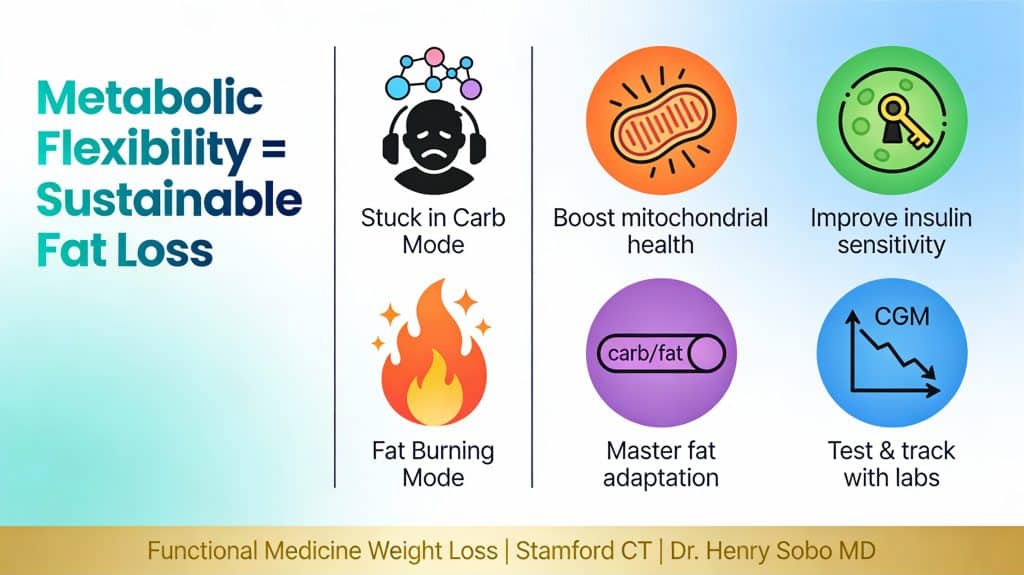
Patients often ask why weight loss feels so hard despite cutting calories or exercising more. The answer frequently lies in metabolic flexibility—the body’s ability to efficiently switch between burning carbohydrates and fats for fuel depending on what’s available. In functional medicine, metabolic flexibility CT approaches focus on restoring this capacity through insulin sensitivity, mitochondrial health, and fat adaptation, offering sustainable fat loss that goes beyond simple calorie restriction.
This guide explains metabolic flexibility CT in practical terms, why it matters for fat loss, and how functional metabolism CT strategies—backed by lab testing and personalized protocols—can help patients in Connecticut achieve lasting results compared to standard dieting or GLP‑1 medications alone.
What Is Metabolic Flexibility?
Metabolic flexibility is the capacity to adapt fuel oxidation to changing nutrient availability: burning glucose when carbohydrates are plentiful (after meals) and switching to fat oxidation when they’re scarce (fasting or low‑carb states). When functioning well, the body seamlessly toggles between these “modes,” maintaining steady energy, stable blood sugar, and efficient fat burning without extreme hunger or fatigue.
In contrast, metabolic inflexibility—common in obesity, insulin resistance, and type 2 diabetes—means the body gets “stuck” burning glucose even when fat is available, leading to fat storage, cravings, and stalled weight loss. Functional medicine views this as a core driver of weight gain, treatable through targeted metabolic repair rather than willpower alone.
Why Metabolic Flexibility Matters for Fat Loss
People with good metabolic flexibility burn fat more readily, experience fewer cravings, and adapt easily to different eating patterns like intermittent fasting or lower‑carb meals. Studies show that improved metabolic flexibility correlates with better insulin sensitivity, lower body fat, and sustained weight loss, as the body can access stored fat without relying constantly on dietary carbs.
For patients struggling with functional metabolism CT issues, poor flexibility often stems from mitochondrial dysfunction, chronic inflammation, or hormonal imbalances, making traditional “eat less, move more” advice ineffective. Restoring it through functional medicine for weight loss creates a foundation where fat loss becomes the natural outcome of optimized biology.

Ready to Start a Plan That Works?
If you have questions about CJC-1295 for men in Connecticut, Greenwich, or Norwalk area, contact us today. We focus on combining safe, effective medication with a realistic lifestyle plan.
For broader options, see our Medical Weight Loss Services.
Insulin Sensitivity: The Gatekeeper of Metabolic Flexibility
Insulin sensitivity determines how effectively cells take up glucose after meals, allowing the body to store it properly and shift back to fat burning between feedings. When insulin resistance develops, glucose lingers in the blood, forcing constant glucose oxidation and blocking fat access—classic metabolic inflexibility.
Functional medicine testing (fasting insulin, HOMA‑IR, continuous glucose monitoring) reveals this early, often before fasting blood sugar rises. Protocols targeting insulin sensitivity through nutrition, exercise, and supplements can restore flexibility, as seen in studies where weight loss improved mitochondrial function and fuel switching.
Mitochondrial Health: The Powerhouses of Fat Burning
Mitochondria are cellular engines that oxidize both glucose and fats; their number, function, and efficiency directly dictate metabolic flexibility. In obesity and insulin resistance, mitochondrial capacity often declines, impairing fat oxidation and promoting energy inefficiency.
Research links higher mitochondrial oxidative capacity to better flexibility and weight loss success; exercise training and certain diets boost it by increasing mitochondrial biogenesis and uncoupling proteins. In functional metabolism CT practice, supporting mitochondria with CoQ10, PQQ, omega‑3s, and time‑restricted eating helps patients “unlock” fat burning.
Fat Adaptation: Training the Body to Burn Fat Efficiently
Fat adaptation is the process where muscles and liver become proficient at using fatty acids for energy, reducing reliance on carbs. This is enhanced by low‑carb/ketogenic phases, fasting, and aerobic exercise, which upregulate fat‑transport proteins and enzymes.
Adapted individuals maintain energy on fewer carbs, experience blunted hunger, and lose fat more readily—a key goal of metabolic flexibility CT programs. Functional medicine guides this safely with monitoring to avoid pitfalls like adrenal stress or nutrient gaps.
Metabolic Flexibility vs. Calorie Restriction
Traditional calorie restriction often fails long‑term because it doesn’t address inflexibility; the body adapts by slowing metabolism and hoarding fat. Metabolic flexibility CT instead optimizes fuel use, preserving muscle and metabolic rate during fat loss.
Studies show lifestyle interventions improving flexibility (e.g., exercise + diet) outperform restriction alone for sustained weight loss. This aligns with functional medicine for weight loss, where diagnostic testing identifies barriers like poor mitochondrial health or insulin issues.
GLP‑1 Medications vs. Functional Medicine for Metabolic Repair
GLP‑1 drugs like semaglutide excel at appetite suppression and short‑term weight loss (10–15% body weight), but they don’t inherently restore metabolic flexibility. Patients may regain weight post‑medication if underlying inflexibility persists, as muscles remain carb‑dependent.
Functional metabolism CT offers complementary repair: GLP‑1 can jumpstart loss while labs guide mitochondrial support, insulin optimization, and fat adaptation for durability. Compare in the table below:
| Approach | Weight Loss Speed | Metabolic Flexibility | Long‑Term Sustainability |
|---|---|---|---|
| GLP‑1 Only | Fast (10–15%) | Limited improvement | Risk of regain |
| Functional Medicine | Gradual but steady | High (insulin/mito repair) | Strong (root‑cause fix) |
| Combined | Optimal | Excellent | Best outcomes |
Diagnostic Testing in Functional Metabolism CT
Functional medicine for weight loss starts with biomarkers:
Continuous glucose monitoring (CGM): Reveals real‑time flexibility (post‑meal spikes, overnight lows).
Labs: Fasting insulin, HbA1c, lipid panel, hs‑CRP, cortisol, thyroid panel, organic acids (mito markers).
VO2 max testing: Quantifies fat/glucose oxidation capacity.
These pinpoint issues like mitochondrial dysfunction or insulin resistance, guiding precise interventions.
Strategies to Build Metabolic Flexibility
Nutrition: Time‑restricted eating (12–16 hrs), prioritize protein/fiber, cycle carbs (high training days, low rest days).
Exercise: HIIT + strength training (mito biogenesis), zone 2 cardio (fat oxidation).
Supplements: Berberine, alpha‑lipoic acid (insulin), CoQ10/PQQ (mito), omega‑3s.
Lifestyle: Sleep 7–9 hrs, stress management (cortisol control).
Connecticut patients benefit from personalized functional metabolism CT plans integrating these.
Who Benefits from Metabolic Flexibility Optimization?
Ideal candidates: stalled dieters, prediabetics, those with belly fat despite “healthy” habits, or post‑GLP‑1 patients seeking durability. Contraindications include active eating disorders or severe adrenal fatigue—screening ensures safety.
Frequently Asked Questions
What exactly is metabolic flexibility?
The body’s ability to switch between burning carbs (glucose) and fats efficiently based on availability, crucial for fat loss and energy stability.
How does poor metabolic flexibility cause weight gain?
When metabolic flexibility is impaired, the body gets “stuck” burning glucose instead of fat, even when dietary carbs are low or during fasting—this creates a cascade driving weight gain:
Blocked fat access: Muscles/liver can’t efficiently oxidize stored fat for energy, so fatty acids recirculate and get re‑stored instead.
Insulin resistance worsens: Constant glucose reliance spikes insulin chronically, promoting fat storage (especially visceral) and blocking lipolysis. HOMA‑IR >2.5 signals this inflexibility.
Mitochondrial inefficiency: Fewer/dysfunctional mitochondria mean poor fuel switching, lower energy expenditure, and easier fat accumulation.
Cravings & overeating: Carb‑dependence causes blood sugar rollercoasters, hunger, and preference for high‑carb foods to “refuel.”
Result: Calories get partitioned toward fat storage rather than energy use, explaining why “healthy eaters” with belly fat often have underlying inflexibility. Functional medicine testing (CGM, HOMA‑IR, mito markers) reveals this; restoration flips the switch to fat burning.
Can exercise improve metabolic flexibility?
Yes—strength training and aerobic work boost mitochondrial function and fat oxidation capacity.
Is metabolic flexibility better than GLP‑1 for long‑term weight loss?
GLP‑1 accelerates loss; flexibility ensures sustainability by fixing root causes like insulin and mito issues. Combined is ideal.
How do I test my metabolic flexibility?
Functional medicine uses several precise tests to measure metabolic flexibility and identify barriers to fat burning:
Continuous Glucose Monitoring (CGM): Worn for 7–14 days to track real‑time blood sugar responses to meals, fasting, and exercise. Poor flexibility shows prolonged high glucose (>140 mg/dL post‑meal) or overnight spikes. Most accessible starting point.
Indirect Calorimetry / VO2 Max Testing: Gold standard—measures respiratory exchange ratio (RER) during rest and exercise. RER near 0.7 indicates fat burning; >0.85 shows carb dominance. Available at sports labs or functional clinics.
Lab Markers (blood/urine):
Fasting insulin + glucose → HOMA‑IR score (insulin resistance blocks flexibility).
Organic acids test (urine) → mitochondrial markers like citrate, malate.
Beta‑hydroxybutyrate (blood/breath) → ketone levels during fasting confirm fat adaptation.
Functional Panels: Comprehensive metabolic panel + hs‑CRP (inflammation), free fatty acids, and adiponectin for full picture.
Connecticut patients can access CGM through functional practitioners and VO2/indirect calorimetry at sports medicine centers. Start with CGM + fasting insulin for baseline, then retest after 8–12 weeks of targeted interventions.
Sources
Smith RL et al. Metabolic Flexibility in Health and Disease.
https://www.sciencedirect.com/science/article/pii/S1550413117302206Goedecke JH et al. Metabolic flexibility in health and disease.
https://pmc.ncbi.nlm.nih.gov/articles/PMC5513193/Turnpaugh Health & Wellness. What is Metabolic Flexibility?
https://turnpaughhwc.com/what-is-metabolic-flexibility/Dr. Will Cole. Exactly How To Achieve Metabolic Flexibility.
https://drwillcole.com/understanding-metabolic-flexibility-exactly-how-to-achieve-it/Nutrisense. Metabolic Flexibility: Everything You Need to Know.
https://www.nutrisense.io/blog/metabolic-flexibilityStorlien L et al. Metabolic flexibility and insulin resistance.
https://pmc.ncbi.nlm.nih.gov/articles/PMC2584808/Holloway GP. Targeting skeletal muscle mitochondrial health in obesity.
https://portlandpress.com/clinsci/article/136/14/1081/231605/Targeting-skeletal-muscle-mitochondrial-health-inLevels Health. What is metabolic flexibility, and why is it important?
https://www.levels.com/blog/what-is-metabolic-flexibility-and-why-is-it-importantMeex RCR et al. Weight loss increases skeletal muscle mitochondrial energy metabolism.
https://academic.oup.com/lifemeta/article/2/2/load014/7103241Terrain Health CT. Top Metabolic Health Center & Clinic in CT.
https://terrainhealth.org/metabolic-health/Aether Medicine. Metabolic Flexibility: A Valid Concept or Just a Catchy Term?
https://www.aethermedicine.com/how-we-treat/lifestyle-medicine/metabolic-flexibility-a-valid-concept-or-just-a-catchy-term/Boon H et al. Metabolic flexibility in the development of insulin resistance and type 2 diabetes.
https://pubmed.ncbi.nlm.nih.gov/19207879/

Read more our posts...

High Fasting Insulin but Normal A1C: What It Means
Metabolic Health | Blood Test Interpretation High fasting insulin normal A1C results can seem contradictory. Your fasting insulin test may be flagged above the laboratory’s reference interval while your hemoglobin

High TSH but Normal T4: What Your Thyroid Results Mean
Thyroid Health | Understanding Laboratory ResultsHigh TSH normal T4 results can be confusing. Your thyroid-stimulating hormone (TSH) level is above the laboratory’s reference range, yet your free thyroxine (free T4)

GLP-1 Constipation: Causes, Relief, and Warning Signs
GLP-1 Medication Education • Digestive HealthGLP-1 constipation is a recognized digestive side effect of medications such as semaglutide and tirzepatide. Although these treatments can support clinically appropriate weight management and