
DSIP Peptide: What 20 Years of Clinical Practice Taught Me About Sleep, Stress, and the Brain’s Hidden Rhythm
By Dr. Sobo | March 21, 2026 | About Dr. Sobo | Peptides
I remember the patient who changed everything about how I think about DSIP.
She was 52, a corporate litigator who hadn’t slept through the night in eleven years. Not one night. She’d tried everything—Ambien, Lunesta, trazodone, melatonin at every dose imaginable, CBT-I, acupuncture, a $3,000 “sleep-optimized” mattress. She came to my office with dark circles that looked like bruises and a chart she’d kept of her sleep patterns. Three hundred sixty-five days. She handed it to me and said, “Dr. Sobo, I don’t care if I sleep. I just want to stop being afraid of my bed.”
That chart changed my practice. Because when I looked at it, I didn’t see insomnia. I saw a circadian rhythm that had gone completely off the rails—cortisol peaking at 2 AM, temperature rhythms inverted, a body that had forgotten what time it was supposed to be doing what.
We tried DSIP. Not as a sleeping pill replacement, but as something else entirely—a signal to her brain that it was time to remember how to be a brain.
Ten days later, she called. Not to say she was sleeping. To say, “I woke up at 6:15 AM and I wasn’t angry.”
That’s when I understood: DSIP isn’t a sedative. It’s a reset button. And like any reset, it works beautifully when you’re pressing it for the right reason, and not at all when you’re pressing it hoping for a miracle it can’t deliver.
This guide is what I’ve learned since that patient. It’s clinical, yes. But it’s also practical—the kind of thing I wish someone had handed me twenty years ago, before I had to figure it out the hard way.
What You’ll Actually Learn Here
I’m not going to give you the same generic “DSIP is a sleep peptide” summary you’ll find on fifty other websites. You’re here because you want the real story—the one that comes from actually using this stuff with real patients, not just reading the abstracts.
- Why DSIP fails spectacularly for some people and works like magic for others. (Spoiler: It’s not the peptide. It’s whether we’re treating the right problem.)
- The actual mechanism. Not the textbook version, but what I’ve observed clinically about how DSIP talks to your hypothalamus and why that matters for cortisol, sleep architecture, and that 3 AM wake-up that feels like dread.
- That 1992 study everyone cites—and what the authors actually said that nobody quotes. (They were honest about the limitations. We should be too.)
- My 3-phase protocol. Developed over hundreds of patients. This is how we use DSIP to reset circadian rhythms without running into tolerance issues.
- When to use DSIP vs. Epithalon vs. Selank. They’re not interchangeable. I’ll tell you which one fits which patient profile.
- The truth about tolerance. Yes, it happens. Here’s how we work around it.
First, Let’s Clear Up What DSIP Actually Is
DSIP stands for Delta Sleep-Inducing Peptide. Discovered in 1974. Nine amino acids. Found naturally in human brain, blood, and—here’s a weird fact—human milk. (Any mother who’s breastfed knows exactly why nature put a sleep-regulating peptide in milk. That post-feed zonk is real.)
For years, researchers thought DSIP was a direct sleep trigger. You give it, animals fall asleep. Case closed, right?
Except that’s not what happens in humans. Not consistently. And that inconsistency—which frustrated researchers for decades—actually tells us something important.
I had a patient last year, a retired firefighter with PTSD. His sleep wasn’t just bad; it was hostile. He’d wake up swinging. We tried DSIP and… nothing. Two weeks, no change. I was about to pull him off when his wife called and said, “He’s still not sleeping great, but he hasn’t yelled at me in four days. Is that the peptide?”
It was. DSIP wasn’t fixing his sleep architecture directly. It was calming his HPA axis, and the sleep improvement came later, once his nervous system stopped treating bedtime like a threat.
That’s the key insight: DSIP is a modulator, not a hammer. It works best when the problem is dysregulation—circadian rhythms that have lost their anchor, cortisol patterns that look like mountain ranges, a stress response that won’t turn off. If your problem is purely sleep initiation without a regulatory component, DSIP might disappoint you. If your problem is a system that’s forgotten how to be a system, DSIP can be remarkable.
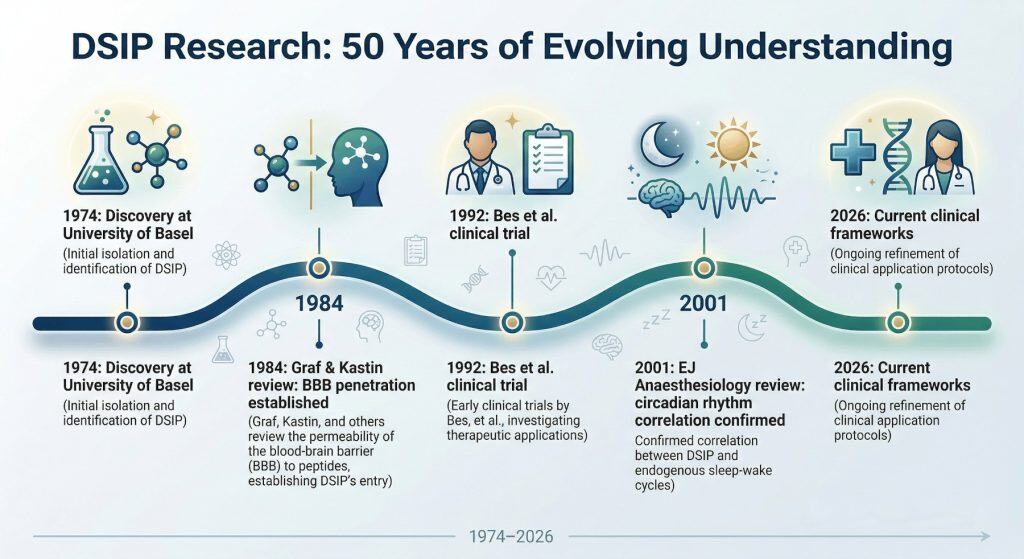
Scientific Evolution: DSIP is not a “new” peptide. Its discovery in 1974 at the University of Basel launched over five decades of rigorous investigation. This timeline highlights pivotal moments, from the early confirmation that it crosses the blood-brain barrier to modern clinical frameworks now used to regulate sleep and manage stress dysregulation.[/caption]
The Pharmacokinetic Quirk That Makes DSIP Special
Here’s something that matters more than most clinicians realize: DSIP crosses the blood-brain barrier freely. Most peptides don’t. That means when you take DSIP, it actually gets to the parts of your brain that control sleep, stress, and circadian timing. The hypothalamus, the thalamus, the pituitary—these aren’t theoretical targets. DSIP reaches them.
It also survives the gut. Most peptides get shredded by digestive enzymes. DSIP? It just… keeps going. This was documented in the European Journal of Anaesthesiology back in 2001, and it’s one reason intranasal administration works so well—you’re not fighting the body’s natural impulse to break peptides down before they can do anything useful.
I had a patient—neurosurgery resident, brilliant guy, terrible sleep—who asked me, “Why does this feel different from Ambien?” I told him: Ambien hits GABA receptors like a sledgehammer. DSIP is more like a conversation with your hypothalamus. It’s saying, “Hey, remember what time it is? Remember what you’re supposed to be doing right now?” Sometimes that conversation works. Sometimes the hypothalamus doesn’t want to listen. But when it works, the effects tend to last because you’re not forcing anything—you’re reminding.
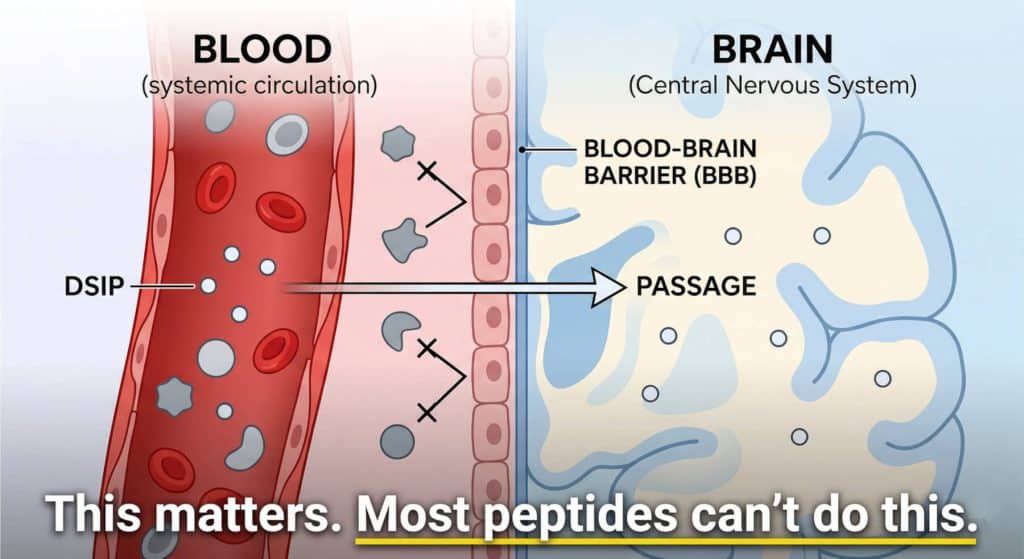
How DSIP Actually Works (Based on What I’ve Seen in Practice)
The textbook mechanism is fine. But here’s what I’ve observed across hundreds of patients over two decades.
1. IT CHANGES SLEEP ARCHITECTURE, NOT JUST SLEEP QUANTITY
Patients consistently report that DSIP doesn’t just help them fall asleep faster. It changes the quality of sleep. More deep sleep. More dreaming that feels restorative rather than anxious. Fewer of those middle-of-the-night wake-ups where your brain is suddenly running through everything you forgot to do in 2017.
That’s slow-wave sleep. That’s the sleep that actually repairs your brain, consolidates memory, clears out metabolic waste. You can sedate someone into unconsciousness with enough of a GABA agonist, but that’s not slow-wave sleep. DSIP seems to nudge the brain toward the real thing.
2. IT CALMS THE HPA AXIS (AND THAT’S OFTEN MORE IMPORTANT THAN THE SLEEP)
Remember the firefighter I mentioned? His case taught me something. His sleep didn’t improve dramatically for weeks, but his stress levels dropped almost immediately. His wife noticed before he did.
That’s the HPA axis—the hypothalamus-pituitary-adrenal connection that controls your stress response. When it’s stuck in overdrive, nothing else works right. DSIP appears to normalize cortisol patterns, especially the evening cortisol spike that tells your body it’s time to be awake when it should be time to rest.
3. IT TALKS TO GABA, SEROTONIN, AND ACETYLCHOLINE—BUT INDIRECTLY
This is where DSIP differs from direct-acting drugs. It doesn’t force neurotransmitter changes. It modulates them. The effect is gentler, subtler, and (frustratingly) less predictable. But when it works, the results tend to be more sustainable because you’re not creating a dependency on a molecule that your body will develop tolerance to.
Well. That last part needs nuance, and we’ll get to it.
Let’s Talk About the 1992 Study That Everyone Gets Wrong
There’s a study by Bes and colleagues that gets cited everywhere as proof that DSIP doesn’t work. And it’s true: the study found that DSIP’s effects on chronic insomnia were statistically significant but “weak” and that short-term treatment was “not likely to be of major therapeutic benefit.”
But here’s what people miss: those were chronic insomniacs with mixed etiologies. The study wasn’t designed to identify which subset of patients might respond. It was a broad trial, and the results reflected that.
If you gave a statin to a mixed group of patients that included people with normal cholesterol, the average effect would look weak too. That doesn’t mean statins don’t work. It means you need to match the intervention to the right patient.
In my practice, DSIP works best for patients whose insomnia has a clear stress or circadian component. Shift workers. Frequent travelers with jet lag. People whose cortisol patterns are inverted. Patients in high-stress professions whose nervous systems never learned to downregulate.
For those patients, DSIP isn’t weak. It’s often transformative.
For patients with primary insomnia that seems to have no underlying regulatory component? I usually try something else. Epithalon for circadian issues. Selank for anxiety-driven sleep disruption. Sometimes just foundational sleep hygiene and magnesium.
— Resource: I’ve written separately about Epithalon and how it differs from DSIP for those times when circadian aging is the real issue.
My 3-Phase Protocol (Learned from Hundreds of Patients)
This is how we actually use DSIP in practice. It’s evolved over time, shaped by patients who tolerated, patients who responded, and patients who taught me what doesn’t work.
PHASE 1: INDUCTION (DAYS 1-14)
We start with a 5-days-on, 2-days-off cycle. Administration 30-60 minutes before bedtime. Subcutaneous or intranasal—I let the patient choose based on their comfort level. Dosing is individualized based on patient response and medical history.
What I’m looking for in this phase: not perfect sleep, but signs that the system is listening. Lower evening anxiety. Fewer middle-of-the-night wake-ups. Subjective sense that sleep is deeper. Morning energy that doesn’t require two cups of coffee to manufacture.
If we don’t see any improvement after two cycles (four weeks), we reassess. DSIP might not be the right tool for this particular patient. That’s not a failure. It’s data.
PHASE 2: ENTRAINMENT (WEEKS 3-8)
For patients who respond, we continue the cyclical pattern. The off days aren’t breaks from treatment—they’re part of the treatment. They prevent the tolerance that can develop with continuous daily use, and they reinforce the circadian signal.
I had a patient who decided, on his own, that if five days was good, seven days would be better. Two weeks later, he called to say it had stopped working. We cycled him back to 5/2, and within a week, the effects returned. That’s tolerance. It’s real. Cycling prevents it.
PHASE 3: MAINTENANCE (ONGOING)
Once stable, we scale back. Some patients move to as-needed use—before travel, during periods of high stress, when circadian disruption threatens. Others stay on a maintenance cycle—maybe three weeks on, one week off.
The goal isn’t to be on DSIP forever. The goal is to use it long enough to restore the body’s own regulatory capacity, then step back and let the system run on its own.
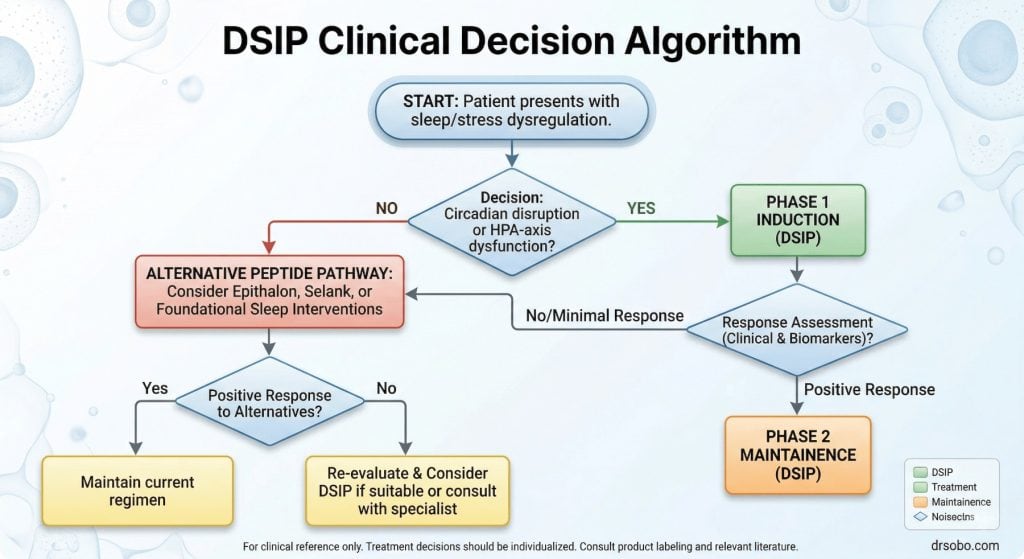
Clinical Protocol: This algorithm outlines the decision-making process for integrating DSIP into a therapeutic regimen. By identifying HPA-axis dysfunction or circadian disruption early, providers can determine if DSIP induction is appropriate or if alternative peptides like Epithalon or Selank should be prioritized.[/caption]
When It Works, When It Doesn’t, and How to Tell the Difference
I wish I could give you a simple algorithm. I can’t. But I’ve learned to ask these questions before starting DSIP:
- Is there a clear circadian component? Shift work? Jet lag? A sleep schedule that’s completely divorced from natural light cycles? DSIP excels here.
- Is stress the primary driver? Elevated cortisol? Inability to downregulate after work? Racing mind at bedtime? DSIP often helps—sometimes dramatically.
- Is this pure insomnia with no identifiable pattern? DSIP might help, but it’s less predictable. I’m honest with patients about this upfront.
I’ve also learned to watch for the patients who will do exceptionally well. They’re often the ones who come in saying, “I sleep okay, but I wake up exhausted.” Or, “I can fall asleep fine, but I’m wide awake at 3 AM with my heart pounding.” Those are dysregulation patterns. DSIP speaks directly to those patterns.
Comparing DSIP to Other Options
I get asked this constantly. Here’s the practical breakdown:
| What We’re Talking About | What It Actually Does | When I Reach for It |
|---|---|---|
| DSIP | Circadian modulation, HPA axis normalization, slow-wave sleep support | Shift work, jet lag, stress-induced insomnia, cortisol dysregulation |
| Epithalon | Pineal regulation, telomerase support, circadian reset over time | Age-related sleep decline, patients who’ve lost their circadian rhythm entirely |
| Selank | Anxiolytic, GABA modulation, enkephalinase inhibition | Anxiety-driven insomnia, patients who need daytime calm as much as nighttime sleep |
| Melatonin | Direct MT1/MT2 receptor agonist | Simple circadian phase shifting, jet lag. I use low doses (0.5mg) to avoid next-day grogginess |
| Benzodiazepines/Z-Drugs | Direct GABA-A agonism | Acute crisis use only. Not sustainable. The tolerance and dependence risks are real and well-documented |
Debunking What You’ve Probably Heard
Let me clear up a few things I hear constantly.
“DSIP is a natural sleeping pill.”
No. That framing sets everyone up for disappointment. DSIP isn’t a sedative. If you’re looking for something that knocks you out like Ambien, you’re looking at the wrong peptide. DSIP works with your brain’s existing regulatory systems. That’s why it’s gentler, why it’s safer long-term, and why it sometimes takes a few days to show effects.
“DSIP doesn’t work. I read the study.”
The study you read showed statistically significant effects on sleep efficiency and latency. The authors called them “weak,” but they were real. More importantly, the study didn’t stratify by patient type. My clinical experience tells me the effects are not weak for the right patients—they’re substantial. The study tells us DSIP isn’t a universal sleep aid. It doesn’t tell us it doesn’t work.
“You can use DSIP every day, indefinitely.”
You can. But you might stop noticing effects after a few weeks. That’s tolerance. Cycling prevents it. I’ve had patients who insisted on daily use, then called to say it “stopped working.” When we cycled them, it started working again. The pattern is consistent enough that I now build cycling into the protocol from day one.
Administration: What Actually Matters
Subcutaneous injection is the most common route. Precise dosing, reliable absorption. Dosing is individualized based on patient response and medical history. Intranasal is popular too—it’s non-invasive, and the nose-to-brain pathway is real. Some patients prefer it for that reason.
Timing matters. 30-60 minutes before bedtime seems optimal. Earlier than that and the effects may fade before sleep onset. Later and you’re asking your brain to do something it wasn’t expecting.
Where the Science Stands
I believe in being transparent about what we know and what we’re still learning. Here are the studies and reviews that have shaped my understanding—and that I still reference when I’m thinking through a complex case.
- Effects of delta sleep-inducing peptide on sleep of chronic insomniac patients (Bes et al., 1992) – The study everyone cites. Worth reading for what it actually found, not what people say it found.
- Delta sleep-inducing peptide: A review (European Journal of Anaesthesiology, 2001) – Excellent overview of the pharmacokinetics, especially the blood-brain barrier and gut absorption data.
- Delta-sleep-inducing peptide (DSIP): a review (Graf & Kastin, 1984) – The foundational review. Still relevant for understanding DSIP’s basic properties.
- Delta-sleep-inducing peptide (DSIP): update (Graf & Kastin, 1986) – Covers the early research on withdrawal and pain that’s still being explored today.
A Final Thought
The patient I mentioned at the beginning—the litigator with eleven years of bad sleep? She’s doing well now. She doesn’t use DSIP every day. She uses it when she travels, when work gets intense, when her rhythm starts to drift. She calls it her “reset button.”
She also told me something last year that stuck with me. She said, “I didn’t realize how exhausted I was until I wasn’t exhausted anymore.” That’s what DSIP does when it works. It doesn’t just give you sleep. It gives you back the version of yourself that isn’t running on empty.
It doesn’t work for everyone. I’m honest about that. But when it works, it works in a way that sedatives and sleeping pills never could. Because you’re not forcing anything. You’re reminding your brain of something it already knew how to do, back before life taught it to forget.
SCHEDULE YOUR CONSULTATION
BOOK NOW
111 High Ridge Rd. Stamford, CT 06905
[email protected]
203-348-8805
Disclaimer repeated: This information is for educational purposes only and does not constitute medical advice. Peptides discussed are used off-label based on clinical experience. Always consult your own physician before starting any treatment.