
Dihexa
Dihexa in Stamford, CT: Physician-Guided Peptide Consultation for Cognitive Support
Dihexa is an investigational peptide that has drawn attention in neuroscience and regenerative medicine because of its potential role in synaptic repair, neuroplasticity, and cognitive support. Derived from angiotensin IV and developed through research connected to Washington State University, Dihexa has been studied for its ability to cross the blood-brain barrier and influence pathways involved in learning and memory. Preclinical research suggests it may promote synaptogenesis and support signaling through the HGF/c-Met system, which is relevant to neuronal growth, repair, and connectivity. At the same time, the evidence base remains largely preclinical, and Dihexa should be discussed with careful attention to safety, appropriateness, and regulatory status.
At Dr. Sobo’s peptide therapy practice, patients in Stamford and throughout Connecticut often seek guidance when they are concerned about memory decline, mental clarity, focus, or cognitive resilience. Rather than treating a peptide as a shortcut, Dr. Henry C. Sobo’s integrative approach centers on a full medical evaluation, history review, lifestyle assessment, and an individualized discussion of whether a given therapy belongs in a broader cognitive-support plan. This people-first model matters, especially for emerging therapies where the science is promising but still developing. Dr. Sobo’s practice already emphasizes holistic and integrative support for cognitive health, including patient education and broader Alzheimer’s-related care.
What Is Dihexa?
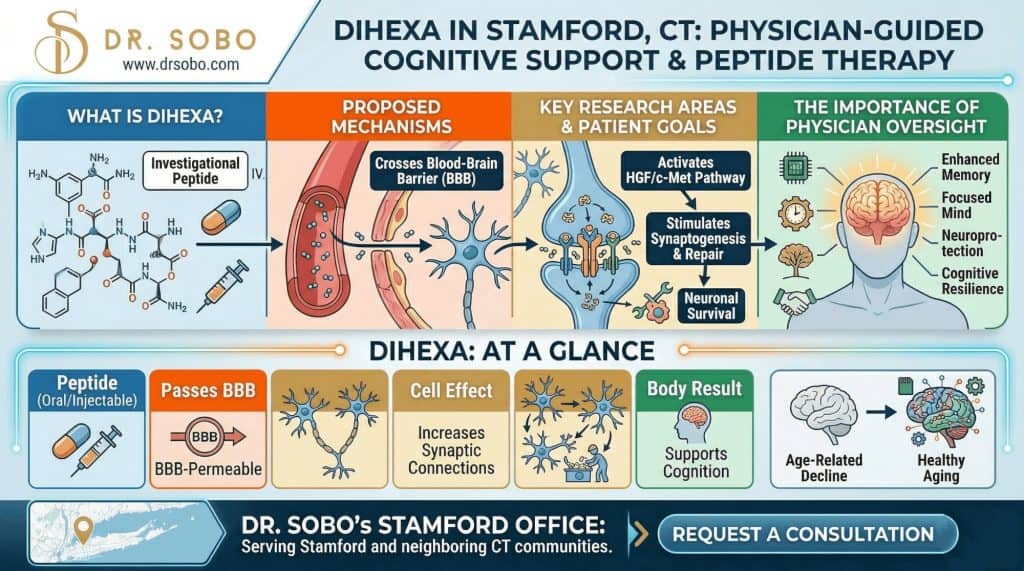
Dihexa is a synthetic peptide derivative of angiotensin IV, a molecule linked to the renin-angiotensin system. Researchers became interested in this class of compounds because angiotensin IV analogs appeared to have procognitive effects, but earlier compounds were limited by stability and poor permeability. Dihexa was engineered to improve those characteristics, including brain penetration, which is a major challenge in neurotherapeutics. Washington State University research and subsequent publications describe Dihexa as a brain-penetrant analog with potential relevance to neurodegenerative disease and memory-related dysfunction.
What makes Dihexa different from many other investigational compounds is the proposed mechanism behind its activity. Instead of acting like a simple stimulant, it has been studied for its ability to facilitate the hepatocyte growth factor (HGF)/c-Met pathway, a signaling system associated with neuronal survival, dendritic arborization, synaptogenesis, and other repair-oriented functions in the nervous system. In plain language, that means Dihexa is being studied not merely for temporary alertness, but for its potential to support the brain’s structural communication network.
Dihexa at a Glance
| Topic | What Patients Should Know |
|---|---|
| What it is | Dihexa is an investigational peptide derived from angiotensin IV. |
| Main area of interest | Cognitive support, neuroplasticity, synaptic connectivity, and memory-related research. |
| Proposed mechanism | Studied for effects on the HGF/c-Met pathway, which may support neuronal growth and synapse formation. |
| Why it stands out | It has been described as capable of crossing the blood-brain barrier in preclinical research. |
| Current evidence level | Primarily preclinical and animal research, not established large-scale human outcomes. |
| Common patient goals | Memory support, mental clarity, focus, executive function, and cognitive resilience. |
| Important caution | It should be approached with physician oversight and realistic expectations. |
| Best next step | Consultation with Dr. Sobo for individualized cognitive-support evaluation. |
How Does Dihexa Work?
Current research suggests that Dihexa binds with high affinity to hepatocyte growth factor (HGF) and may enhance HGF-dependent activation of the c-Met receptor. That signaling cascade is important because HGF/c-Met activity has been associated with neuronal growth, synapse formation, cell survival, and resilience against certain types of neurotoxicity. A key preclinical paper reported that Dihexa and related compounds stimulated spinogenesis and synaptogenesis in hippocampal neurons and that these effects were tied to the HGF/c-Met system.
This mechanism matters for two reasons. First, memory and higher executive function depend on synaptic strength and connectivity, not just on the presence of neurons alone. Second, many neurodegenerative and neuroinflammatory processes are associated with lost or impaired synaptic communication long before severe structural decline becomes obvious. Dihexa’s appeal in the research world is the idea that strengthening or rebuilding synaptic connections could potentially improve cognitive performance in settings of dysfunction. That is why the peptide is often discussed in relation to neuroplasticity, long-term potentiation, and memory formation.
Dihexa and Neuroplasticity
Neuroplasticity is the brain’s capacity to reorganize itself by forming and refining neural connections. This process is essential for learning new information, adapting after injury, maintaining cognitive flexibility, and preserving functional independence with age. The reason Dihexa has attracted attention is that it is being studied for its potential to support the very processes that underlie neuroplasticity, especially new synaptic formation and functional neural communication.
For patients and families, the practical translation is straightforward: if synaptic repair and connectivity can be supported, there may be implications for memory performance, mental clarity, attention, processing speed, and resilience after neurological stressors. That does not mean Dihexa has been proven to reverse dementia in humans. It does mean there is legitimate scientific interest in whether compounds that enhance HGF/c-Met signaling could support neural function in carefully selected settings
Why the Blood-Brain Barrier Matters
A major reason many promising neurological treatments fail is the blood-brain barrier, which prevents numerous compounds from reaching meaningful concentrations in brain tissue. One of the reasons Dihexa stands out in the literature is that it was specifically designed to be more practical in this regard. Preclinical work has described it as orally active and blood-brain barrier permeable, traits that are highly relevant when researchers assess whether a neuroactive compound is even viable as a therapy candidate.
This does not mean oral use has been clinically validated for broad patient populations. It means that, from a drug-development standpoint, Dihexa was designed to overcome some of the pharmacologic limitations that made earlier angiotensin IV compounds less useful. For a cognitive-support page, that distinction is important because it explains why Dihexa continues to appear in scientific discussions despite not being an established mainstream therapy.
What the Research Suggests About Dihexa
The strongest support for Dihexa today comes from animal and laboratory studies, not large human clinical trials. In preclinical research, Dihexa has been associated with improved performance in dementia-like or chemically impaired animal models, increased synaptic markers, and activation of pathways tied to neuronal survival and plasticity. A 2021 study in APP/PS1 mice reported that Dihexa improved cognitive performance, reduced neuronal loss, attenuated neuroinflammation, and activated the PI3K/AKT signaling pathway. The authors concluded that Dihexa rescued cognitive impairment and recovered memory in that mouse model.
A broader review on growth factors and peptide mimetics for traumatic brain injury also noted Dihexa’s high-affinity interaction with HGF, its ability to stimulate spinogenesis and synaptogenesis in rat hippocampal neurons, and its procognitive effects in rat dementia models. The same review highlighted its blood-brain-barrier permeability and oral activity as factors that increase therapeutic interest, while also emphasizing that more preclinical investigation is needed.
Research on the brain renin-angiotensin system has also supported broader interest in angiotensin IV-related compounds as potentially relevant to memory, neuroprotection, cerebral blood flow, and neurodegenerative disorders such as Alzheimer’s and Parkinson’s disease. These findings help explain why Dihexa has remained a topic of scientific and clinical curiosity.
Potential Benefits Patients Commonly Ask About
Patients searching for Dihexa in Connecticut are usually not looking for a chemistry lesson. They want to know whether this peptide is being explored for issues that affect daily life. Common areas of interest include:
Memory Formation and Recall
Preclinical models have linked Dihexa with improved memory performance, including better outcomes in animal studies designed to measure learning and recall. Because the proposed mechanism involves synaptic connectivity and long-term potentiation-related processes, Dihexa is often discussed in the context of short-term and long-term memory support.
Focus, Clarity, and Executive Function
Patients with cognitive complaints often describe their struggles as “brain fog,” reduced concentration, slower thinking, or trouble organizing tasks. While strong human outcome data are not yet established, the scientific rationale behind Dihexa has made it a point of interest for attention, executive function, and mental clarity discussions within cognitive-support medicine. These remain investigational use areas and should be presented responsibly.
Age-Related Cognitive Decline
Age-related memory changes are among the most common reasons patients seek integrative cognitive care. Dihexa has been studied in preclinical settings relevant to dementia and neurodegeneration, which is why it is frequently mentioned in conversations about mild cognitive decline, early memory change, or broader brain-aging strategies. However, the current evidence does not justify claiming proven human benefit for these conditions.
Neuroinflammation and Neuroprotection
Some published research suggests Dihexa may influence inflammatory signaling and pathways associated with neuronal preservation. The APP/PS1 study reported reduced inflammatory markers and less glial activation in the brains of treated mice. That is an important research signal, but it should still be framed as preclinical evidence rather than established clinical fact.
Who May Seek a Dihexa Consultation?
At an integrative practice like Optimal Health Medical, the right candidates are not chosen based on marketing hype. They are identified through careful clinical judgment. A patient may ask about Dihexa when they are experiencing:
- persistent brain fog
- concerns about memory or word-finding
- reduced concentration or mental stamina
- cognitive changes after illness, stress, or aging
- interest in a broader physician-guided integrative medicine plan for cognitive support
- a desire to explore peptide options alongside nutrition, testing, and lifestyle intervention
In practice, however, the real question is not “Who wants Dihexa?” but “Who needs a proper workup for cognitive symptoms?” Memory and focus complaints can be tied to sleep disturbance, thyroid imbalance, nutrient deficiencies, medications, stress, mood disorders, metabolic dysfunction, inflammation, hormonal shifts, or neurodegenerative disease. That is why a physician-led evaluation matters.
Add Your Heading Text Here
Why Physician Oversight Matters
This topic should not be handled like a generic supplement purchase. FDA materials explain that compounded drugs are not FDA-approved, and agency documents identify Dihexa acetate among bulk substances that raise significant safety concerns in the 503A compounding context. That does not settle every clinical or legal question by itself, but it clearly means this is an area where patients need medical guidance, source scrutiny, and risk awareness.
At Dr. Sobo’s practice, the more responsible positioning is an educational and consultation-based approach. Rather than promising outcomes, the page should communicate that treatment decisions must be individualized, that peptide quality and oversight matter, and that cognitive symptoms deserve a broader diagnostic lens. This aligns with the practice’s existing emphasis on physician-led, integrative, root-cause-oriented care.
Dihexa as Part of a Broader Cognitive Support Strategy
For many patients, the most effective path is not a single therapy but a layered plan. Depending on the individual, a cognitive-support program may include:
- comprehensive medical history and symptom review
- nutritional and metabolic evaluation
- lifestyle assessment including sleep, stress, and physical activity
- review of medications and contributing conditions
- integrative strategies that may include physician-guided peptide discussions
- coordination with broader memory-support resources such as Alzheimer’s-related care when appropriate
- follow-up monitoring over time
This type of framing improves both conversion quality and AI-citation quality because it gives a complete answer to user intent. Patients are not just asking what Dihexa is. They are asking whether there is a thoughtful, medically credible pathway for addressing cognitive concerns in Connecticut.
Dihexa in Stamford, CT
For local search, the page should clearly communicate that Dr. Sobo provides care in Stamford, Connecticut, serving patients from nearby communities as well. The practice is located at 111 High Ridge Rd., Stamford, CT 06905, with consultation access through the main contact page and directions page. This geographic specificity supports local SEO, GEO optimization, and practical conversion intent for users searching terms like “Dihexa Stamford CT,” “cognitive peptide therapy Connecticut,” or “integrative medicine for memory support near me.”
Why Patients Choose Dr. Sobo for Integrative Cognitive Support
Patients looking for cognitive-support care are often frustrated by fragmented answers. They may have been told their labs are “normal” while still feeling mentally slower, less focused, or less sharp. Dr. Henry C. Sobo’s background in internal medicine and integrative care makes his practice especially relevant for patients who want a more complete evaluation rather than a one-dimensional solution. The existing Dr. Sobo site already highlights his professional background, holistic philosophy, peptide experience, and Connecticut-based patient care model.
That positioning is important on a Dihexa page because the strongest differentiator is not the peptide alone. It is the quality of clinical judgment around it.
The Bottom Line on Dihexa
Dihexa is one of the more scientifically interesting peptides in the cognitive-support conversation because preclinical research suggests it may enhance synaptic connectivity, neuroplasticity, and memory-related signaling pathways. It has also drawn attention because of its blood-brain-barrier permeability and HGF/c-Met-related mechanism. But responsible content must say the quiet part out loud: human clinical evidence remains limited, regulatory status is unsettled for routine therapeutic use, and this is not a peptide that should be approached casually.
For that reason, the most credible service-page approach is not hype. It is physician-guided evaluation, transparent evidence framing, and individualized cognitive-support planning. Patients in Stamford and throughout Connecticut who want to explore whether Dihexa belongs in a broader cognitive health strategy can begin with a consultation at Optimal Health Medical. From there, Dr. Sobo can determine whether further evaluation, testing, integrative treatment, or referral is appropriate based on the individual’s symptoms, goals, and medical history.
FAQs
What is Dihexa?
Dihexa is an investigational peptide derived from angiotensin IV that has been studied for its potential effects on memory, neuroplasticity, and synaptic repair. Researchers have been interested in Dihexa because it appears to cross the blood-brain barrier and may enhance signaling through the HGF/c-Met pathway, which is involved in neuronal growth and connectivity. Most of the evidence supporting Dihexa comes from preclinical and animal research, not large human clinical trials, so claims about benefits in people should be presented cautiously.
How does Dihexa work?
Current research suggests Dihexa may bind with high affinity to hepatocyte growth factor (HGF) and facilitate activation of the c-Met receptor system. This signaling pathway is associated with synaptogenesis, neuronal survival, dendritic growth, and functional brain connectivity. In preclinical models, these effects have been linked to improved learning and memory performance. In practical terms, Dihexa is being studied for whether it can support the brain’s ability to form and maintain the synaptic connections needed for cognition.
Is Dihexa FDA-approved?
No. Dihexa is not FDA-approved as an established prescription treatment for cognitive impairment, Alzheimer’s disease, or general memory support. FDA materials also note that compounded drugs are not FDA-approved, and FDA category documents list Dihexa acetate among bulk substances that raise significant safety concerns in compounding review contexts. This is one reason physician oversight and compliance review are essential before publishing or offering any content related to this peptide.
Who may ask about Dihexa in a medical consultation?
Patients who may raise questions about Dihexa are often those dealing with memory concerns, brain fog, reduced concentration, slower processing, or interest in integrative cognitive support. However, those symptoms can have many underlying causes, including sleep disturbance, hormone imbalance, thyroid issues, nutrient deficiencies, chronic inflammation, mood disorders, metabolic problems, or neurodegenerative disease. A responsible consultation should focus first on identifying the likely drivers of symptoms before deciding whether any peptide discussion is appropriate.
Why does physician supervision matter with Dihexa?
Physician supervision matters because Dihexa sits at the intersection of emerging science, incomplete human data, and regulatory complexity. Patients deserve a clinician who can interpret the evidence accurately, assess risk factors, review interactions or contraindications, evaluate whether symptoms require more standard medical workup, and place any peptide discussion inside a broader care plan. Physician oversight is also critical because the quality, sourcing, and legal status of peptide products can vary significantly outside of reputable medical settings.
How is a Dihexa discussion different in an integrative medicine practice?
In an integrative medicine setting, the conversation is broader than “Does this peptide exist?” It includes questions such as: What is driving the patient’s symptoms? Are there modifiable contributors like sleep, nutrition, inflammation, stress, metabolic dysfunction, thyroid imbalance, or hormone changes? Would other interventions make more sense first? This type of structured clinical reasoning is especially important for cognitive complaints because a single therapy rarely explains the whole picture.
Does Dihexa cross the blood-brain barrier?
Preclinical research has described Dihexa as blood-brain-barrier permeable, which is one of the features that made it a notable candidate in early drug-development research. This characteristic is important because many neurological compounds fail specifically because they cannot reach brain tissue in meaningful amounts. That said, pharmacologic promise does not automatically establish safe, effective, routine clinical use in humans.
Where can patients in Connecticut speak with Dr. Sobo about cognitive-support options?
Patients can contact Dr. Sobo’s office in Stamford, Connecticut through the practice’s contact page to request a consultation. The office is located at 111 High Ridge Rd., Stamford, CT 06905, and the practice serves patients looking for physician-guided integrative care, including broader discussions around memory support, peptide therapy, and individualized cognitive health strategies.
Sources
- DIHEXA – Dr. Sobo current page
- Peptides | Dr. Sobo | Connecticut
- Integrative Medicine | Dr. Sobo | Connecticut
- Holistic Alzheimer’s Treatment | Dr. Sobo | Connecticut
- Contact | Holistic Medicine | Dr. Sobo | Stamford CT
- Directions to Dr. Sobo | Stamford CT
- Peptide Therapy in Connecticut: A Complete Guide to Anti-Aging & Regeneration
- The procognitive and synaptogenic effects of angiotensin IV-derived peptides are dependent on activation of the hepatocyte growth factor/c-met system
- AngIV-Analog Dihexa Rescues Cognitive Impairment and Recovers Memory in the APP/PS1 Mouse via the PI3K/AKT Signaling Pathway
- Growth factors and their peptide mimetics for treatment of traumatic brain injury
- Prospective Alzheimer’s drug builds new brain cell connections | Washington State University
- FDA: Understanding the Risks of Compounded Drugs
- FDA 503A Categories Update listing Dihexa Acetate in Category 2